




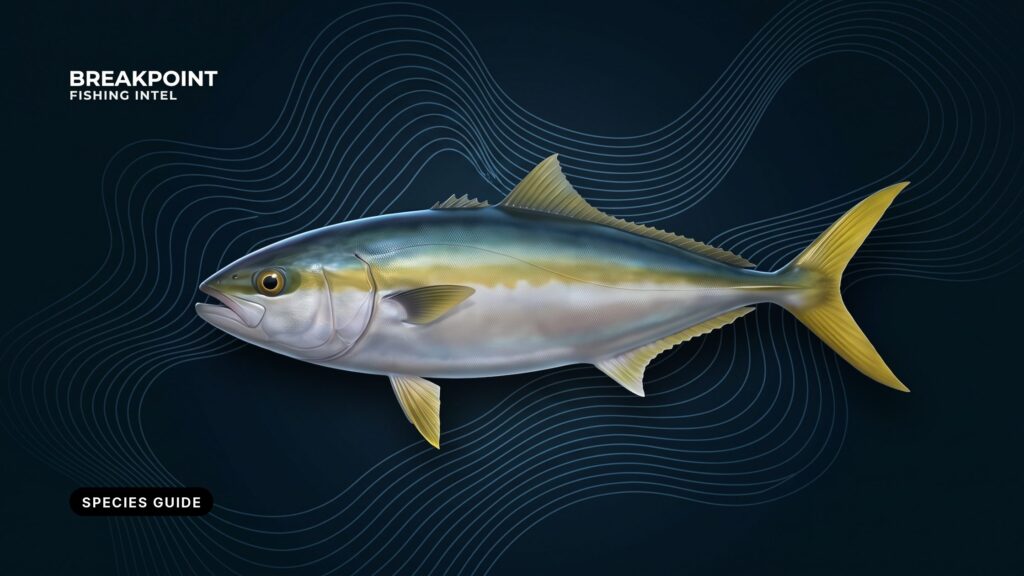
California yellowtail (Seriola dorsalis) are a schooling jack found in the Southern California Bight and Baja. This guide covers how to identify them, where and when they show up, how they feed, how they’re caught, and what the rules require. The California Department of Fish and Wildlife (CDFW) sets the rules for yellowtail in California ocean waters. Regional detail is linked where it applies.
Identify It
California yellowtail belong to the jack family, Carangidae, genus Seriola. The species is Seriola dorsalis, formerly treated as S. lalandi, according to NOAA Fisheries yellowtail research. Older material uses "yellowtail amberjack" and S. lalandi for this fish.
NOAA Fisheries lists a maximum length of up to 130 cm fork length and a maximum weight of about 36 kg. A separate scientific reference gives a maximum of at least 152 cm. Because the two sources differ, treat both as upper bounds.
Two look-alikes cause confusion at the rail:
- Yellowfin tuna: a crescent-shaped tail and yellow finlets. Yellowtail have a forked tail and yellow fins.
- White seabass: often found in the same kelp. CDFW measures it by total length, not fork length, so the size rule differs.
For the rest of the jacks, tunas and seabass, see other coastal and offshore gamefish.
Size slang
Dock talk sorts yellowtail by size. "Rats" and "firecrackers" are the small fish, and "mossbacks" are the big ones. These are slang terms with no fixed weights.
For reference, yellowtail mature at about 55 to 70 cm fork length (Ben-Aderet et al.). Some fish mature at 50 cm, and all are mature by 63 cm.
How to measure fork length
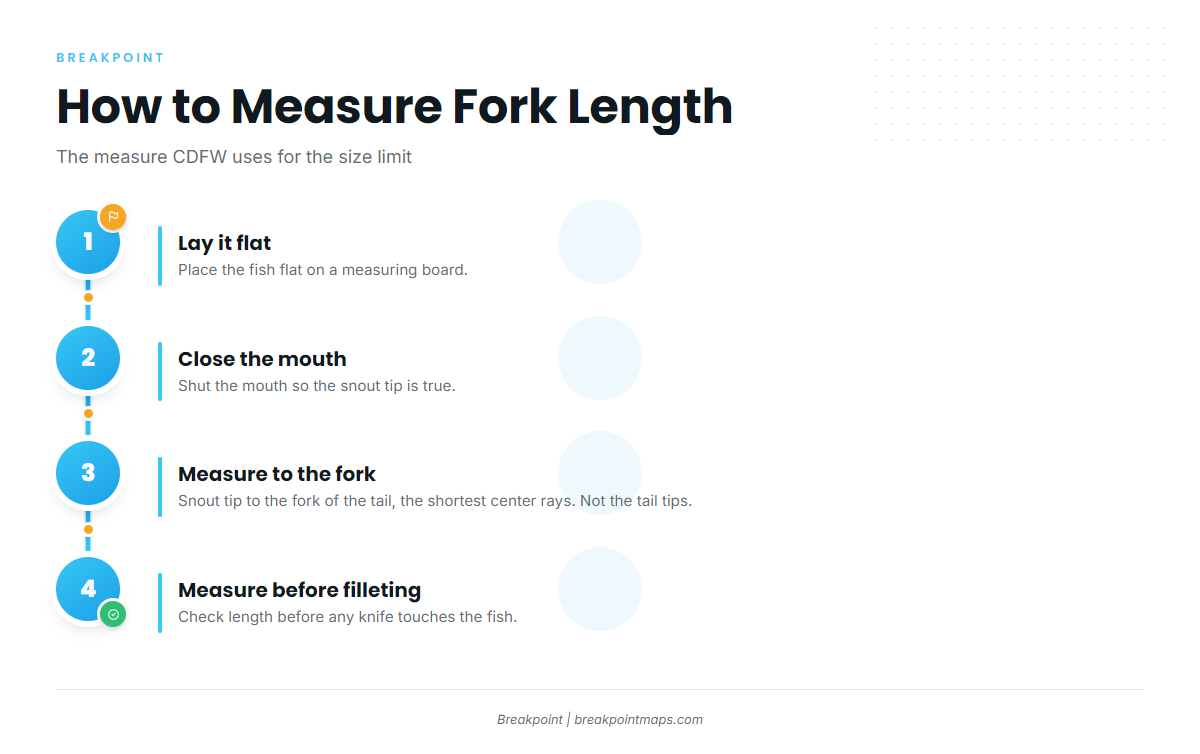
CDFW uses fork length for the yellowtail size limit.
- Lay the fish flat on a measuring board.
- Close its mouth.
- Measure in a straight line from the tip of the snout to the fork of the tail, the shortest center rays. Do not measure to the tail tips.
- Measure before any fillet knife touches the fish.
Where and When
Yellowtail move with the water. According to Ben-Aderet et al., they push north into the Southern California Bight in summer and retreat south along Baja California in winter and spring. NOAA Fisheries describes the same pattern as a northward move in early spring as water warms, and a return south in late summer and fall. Sportboat timing follows that rhythm.
Habitat splits by size. Madigan et al. found inshore fish tied to anchored kelp beds and offshore fish tied to floating kelp mats, called paddies. Smaller fish move offshore, and larger fish settle as inshore residents. Their depth range runs from 0 to 300 m, according to Shorefishes of the Eastern Pacific.
Size varies by place. Inshore-caught fish in the Madigan et al. sample ran 83 to 121 cm, and offshore-caught fish ran 51 to 102 cm. The Southern California Bight sample in Ben-Aderet et al. averaged 74.5 cm fork length at 5.75 years. The Baja sample averaged 92.4 cm at 9.04 years.
Where yellowtail spawn is only partly known. Larvae show up mainly off Mexico. Spawning off Southern California is inferred in some years, and warmer-than-average summer conditions in the outer Bight are thought to support it.
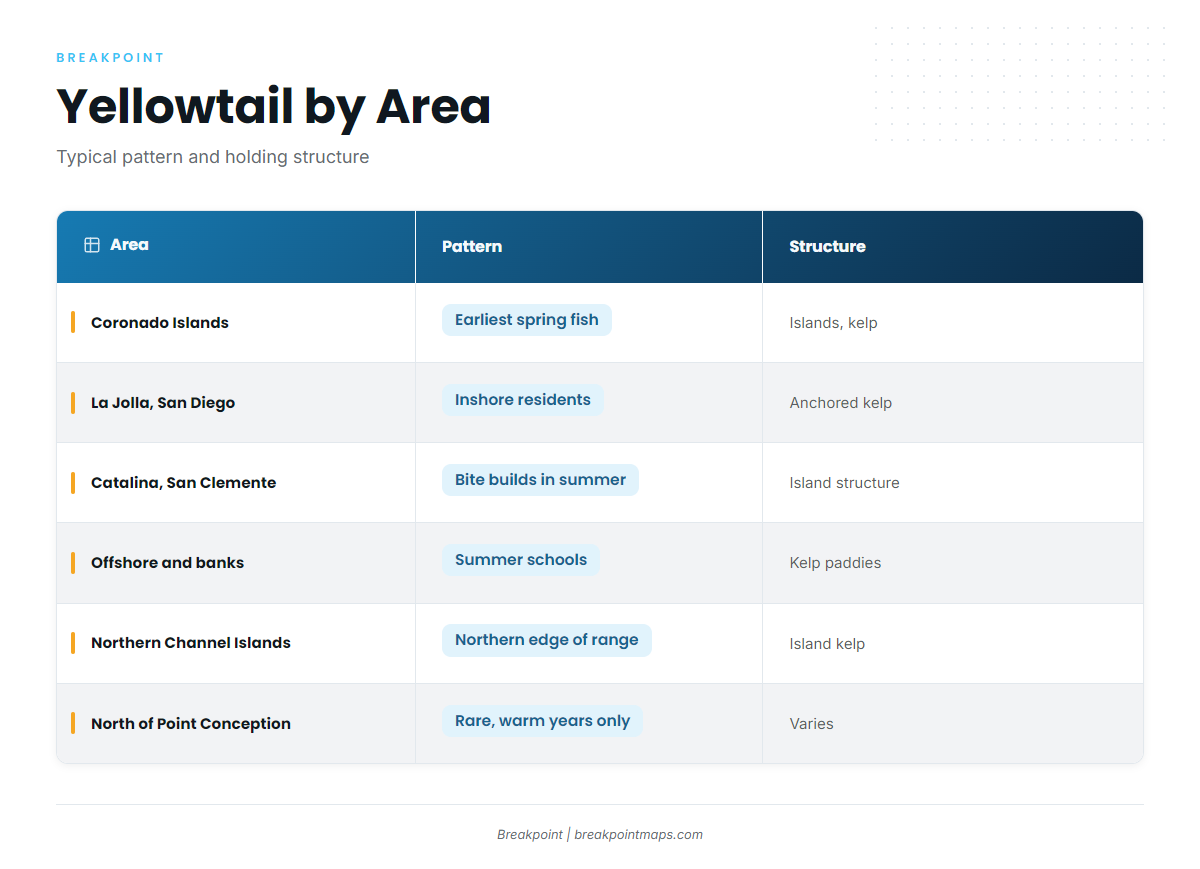
Regional timing summary
| Area | Typical pattern | Holding structure |
|---|---|---|
| Coronado Islands (Mexican waters) | Typically the earliest spring fish | Kelp and island structure |
| La Jolla and San Diego kelp | Inshore residents | Anchored kelp beds |
| Catalina and San Clemente | The bite builds through summer | Island kelp and structure |
| Offshore and banks | Summer schools | Floating kelp paddies |
| Northern Channel Islands (Anacapa, Santa Cruz) | Reported northern edge of the regular range | Island kelp and structure |
| North of Point Conception | Rare, except in highly anomalous warm years | Varies |
Island, bank and kelp-level detail is in California yellowtail in the Pacific Southwest.
The northern limit
The range sources disagree on how far north yellowtail go. Ben-Aderet et al. report they are rare north of Point Conception except in highly anomalous warm years. NOAA Fisheries reports the range to southern Washington. Shorefishes gives California to central Mexico and the Revillagigedos.
Anglers north of the point can follow warm-year fish through our regional fishing guides.
How It Feeds and Moves
Yellowtail eat what the water holds. Madigan et al. list sardine, anchovy, Pacific and jack mackerel, rockfish, topsmelt and herring, plus market squid and pelagic red crab. Ben-Aderet et al. found coastal pelagic fish in 62% of stomachs and pelagic red crab in 23%.
The bait tells you when to fish. When squid are spawning, yellowtail can key on squid and ignore other baits.
Current matters too. Fish feed when moving water pushes bait through structure, so if the bite is dead on slack water, wait for the water to move.
Movement varies by fish. Tag recaptures in Madigan et al. show net displacement from 2.5 to 198.2 km, with a mean of 43.3 ± 54.4 km. Some fish stay home and some travel far.
Temperature edges, paddies and what the data cannot see
A temperature break concentrates bait, and a kelp paddy holds bait and shade. Both draw yellowtail, but neither is easy to read from a screen.
- Cloud blocks the view. A satellite SST pass misses water under cloud.
- Color is not fish. Chlorophyll shows bait-friendly water color, not the fish themselves.
- Paddies are not charted. No chart shows a floating kelp paddy.
In Breakpoint, OBS SST shows where the edges sit, Chlorophyll shows where the green water meets the blue, and Chart Contours shows the bottom under both. Laid together, they help you decide where to start looking. Chart layers are not for navigation.
How It’s Caught
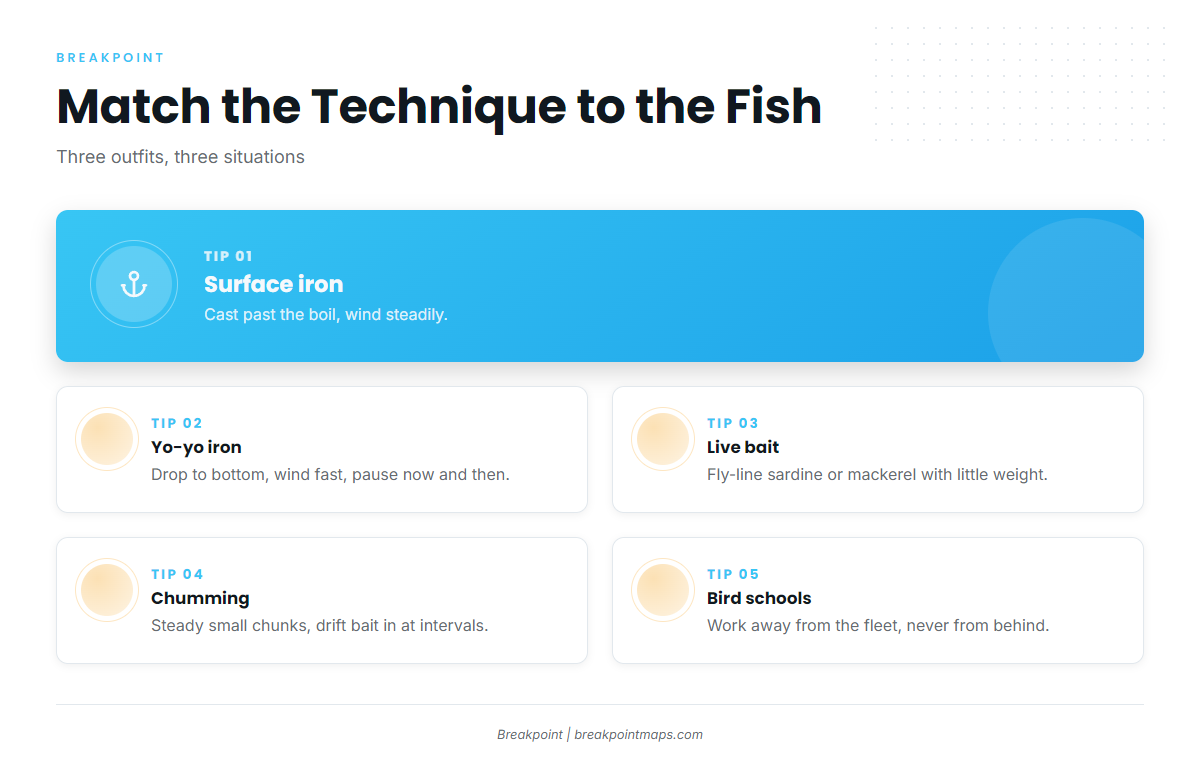
Three techniques cover most yellowtail fishing: surface iron, yo-yo iron and live bait. Each wants its own outfit.
Surface iron
Use surface iron when fish crash bait on top. Pick a long rod built for casting light iron. Common jigs include the Tady 45 and the Salas 7X light, often in blue-and-white or mint-and-white. Cast past the boil and wind steadily.
Yo-yo iron
Use yo-yo iron on deep schools over structure. Drop a heavy jig, such as a Tady 4/0 or Salas 6X Jr, to the bottom. Wind as fast as you can, pausing occasionally. A short, stout rod with heavy braid and a fluorocarbon topshot suits this style.
Live bait and fly-lined squid
Live sardine and mackerel are the top baits. Squid works when fish key on it. Fly-line with little or no weight, and add a small split shot, rubber-core sinker or sliding egg sinker as needed. If you’re new to conventional casting, use a smaller bait rather than a big sardine for casting weight.
Chumming and bird schools
Chumming works best with a steady rhythm:
- Keep a steady stream of small chunks going behind the boat.
- Drift a live bait back at intervals.
On bird schools, work away from the fleet when you can. Never drive up on a school from behind.
Fighting fish in the kelp and landing it legally
Turn the fish’s head early. Keep it out of the kelp and away from the anchor line.
Two CDFW rules apply when you land a fish. A boat must carry a landing net with an opening of at least 18 inches in diameter to land undersize fish. A gaff may not be used on any finfish shorter than its minimum size. If a fish is borderline, measure it in the net, not on the gaff.
FAQ
What is the yellowtail size limit in California?
The minimum is 24 inches fork length. Up to 5 fish under 24 inches may be kept within the daily limit. Check CDFW before you fish, since rules can change.
What is the bag limit, and how does the 20-fish limit work?
The limit is 10 yellowtail per person per day. Yellowtail count inside CDFW’s 20-finfish aggregate, with no more than 10 of any one species.
Do different rules apply in federal waters?
Federal plans cover groundfish, highly migratory species and halibut. Yellowtail are not among them, so the CDFW rule is the yellowtail rule off California. Confirm with CDFW and NOAA Fisheries if you fish beyond 3 nautical miles.
How do I measure fork length?
Lay the fish flat on a board with its mouth closed. Measure in a straight line from the snout tip to the fork of the tail. Measure before you fillet.
Is California yellowtail the same as amberjack?
California yellowtail is Seriola dorsalis, a jack formerly treated as S. lalandi, the yellowtail amberjack. Other amberjacks are separate Seriola species. For more on how it compares with the rest of the offshore fleet, see our coastal and offshore gamefish guides.
When do yellowtail show up?
They move north into the Southern California Bight in summer and south along Baja in winter and spring. The Coronado Islands typically give the earliest spring fish. Yellowtail are rare north of Point Conception except in highly anomalous warm years.
Do I need the Ocean Enhancement Validation?
Yes, south of Point Arguello, in addition to your sport fishing license. You don’t need it on a one-day or two-day license. CDFW lists current fees.
Can I fillet yellowtail at sea?
Yes. Each fillet must be at least 17 inches long with a 1-inch-square patch of skin attached. No more than 10 fillets may be shorter than 17 inches.
Quick answers from this California Yellowtail Fishing Guide.