




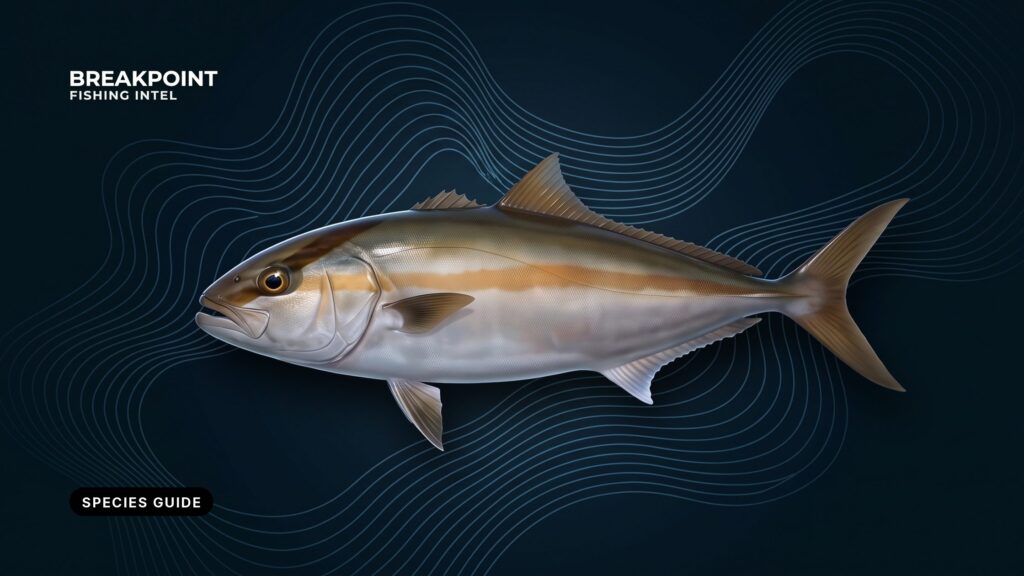
Greater amberjack (Seriola dumerili) is the largest of the jacks, and anglers at the dock call it the reef donkey for the way it digs in and refuses to come up. Adults hold on wrecks, oil rigs, artificial reefs and ledges, typically in 60 to 240 feet of water, according to FWC. The Gulf of America (Gulf of Mexico) stock is under a rebuilding plan, so Gulf seasons are short and can close early on quota. This guide covers how to identify, find, catch and legally keep the fish in US waters: how to tell it from its lookalikes, where to find it on structure, how to rig for it, and which agency’s rule applies where you fish. Rules decide whether a fish can be kept, so the Regulations section is written to be exact.
Identification
Greater amberjack has a dark stripe from the snout through the eye to the front of the dorsal fin, an olive or brownish back with silver sides, an amber band along the flank, 7 spines in the first dorsal fin, and 11 to 19 gill rakers.
The Gulf Council lookalike ID guide adds two checks: the upper jaw bone curves up toward the eye, and the first dorsal fin has 7 spines.
FWC lists three more marks:
- The anal fin is about 2/3 the length of the second dorsal fin.
- There are no scutes on the body.
- The eye stripe "lights up" when the fish is feeding.
Identification matters at the rail. Greater amberjack, lesser amberjack and banded rudderfish fall under different size rules, so a wrong ID can mean an illegal fish.
Greater amberjack is managed as a Gulf reef fish alongside snappers, groupers and triggerfish. See our reef fish guides.
Lookalikes: lesser amberjack, almaco jack, banded rudderfish and yellowtail
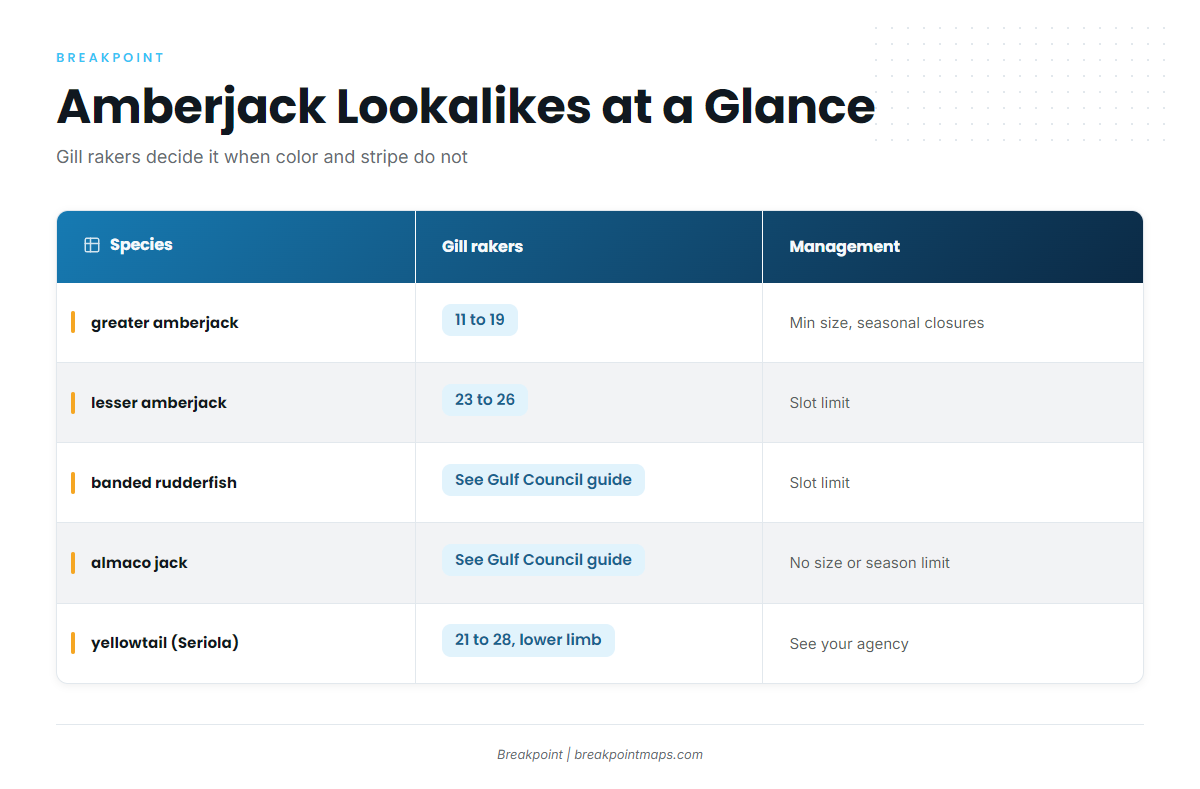
Where a cell in the table points to the Gulf Council, the ID guide carries the detail.
| Species | Eye stripe | Dorsal spines | Gill rakers | Management status |
|---|---|---|---|---|
| greater amberjack | Dark stripe, snout through eye to dorsal fin | 7 | 11 to 19 | Minimum size and seasonal closures |
| lesser amberjack | See Gulf Council ID guide | See Gulf Council ID guide | 23 to 26 | Slot limit |
| almaco jack | See Gulf Council ID guide | See Gulf Council ID guide | See Gulf Council ID guide | No size or season limit (Gulf Council). In Louisiana and federal Gulf waters it counts in the 20-fish reef fish aggregate |
| banded rudderfish | See Gulf Council ID guide | See Gulf Council ID guide | See Gulf Council ID guide | Slot limit |
| yellowtail (Seriola, not yellowtail snapper) | See Gulf Council ID guide | See Gulf Council ID guide | 21 to 28 on the lower limb | See your agency |
Swipe the table sideways to see every column.
The gill raker counts by species are the deciding numbers when color and stripe are unclear on a fish at the boat.
How to measure fork length
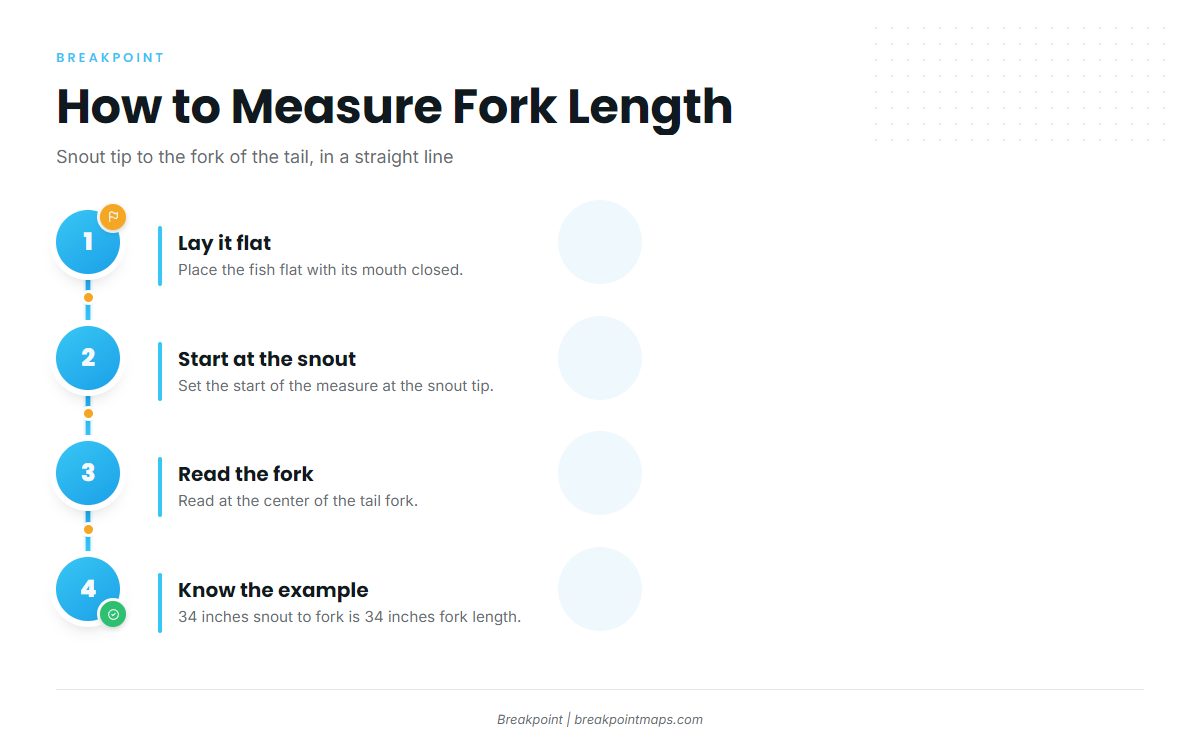
Fork length runs from the tip of the snout to the fork of the tail, measured in a straight line. A fish that measures 34 inches from snout tip to the fork is 34 inches fork length, even if the tail tips run longer.
- Lay the fish flat with its mouth closed.
- Start the measure at the snout tip.
- Read at the center of the fork.
Total length is a different measure, and some reef fish rules use it. All amberjack rules in this guide use fork length.
Where and When: Range and Habitat by Region
Adults hold over rocky reefs, debris and wrecks, typically in 60 to 240 feet. Juveniles associate with floating objects and may be found in water under 30 feet.
Fish favor structure with vertical relief:
- Wrecks
- Oil rigs and petroleum platforms
- Artificial reefs
- Ledges and natural reef
Spawning and peak timing vary by region, and managers protect the spring spawning period. The closures are in Regulations.
Gulf of America
Rigs, platforms, large wrecks and artificial reef zones off Texas, Louisiana, Mississippi, Alabama and the Florida Panhandle and west coast hold fish in the 60 to 240 foot band.
South Atlantic
Wrecks, ledges and live bottom from the Carolinas to the Florida Keys hold fish. They move south in spring, covered below.
Mid-Atlantic
This is the northern edge of the regularly fished range. Local guides carry the detail.
Spot-level detail, structure names and local timing are in our regional and local fishing guides.
Feeding and Movement
Greater amberjack school over vertical relief and feed on bait passing in the current. They hold in the water column above the structure rather than on the bottom. The forage list matches the live bait list: blue runners, cigar minnows, pinfish, pigfish, grunts and sand perch.
Fish also move. The NCDMF greater amberjack profile reports that greater amberjack move in spring from the Carolinas to southeast Florida.
They gather to spawn and are vulnerable while they do, which is why managers protect the spring spawning period.
Sharks taking hooked fish is a known problem on popular structure. Three responses help:
- Pull the fish off the structure fast.
- Keep the fight short.
- Move to another spot when sharks show up.
How to Catch Greater Amberjack
Finding fish: structure and sonar
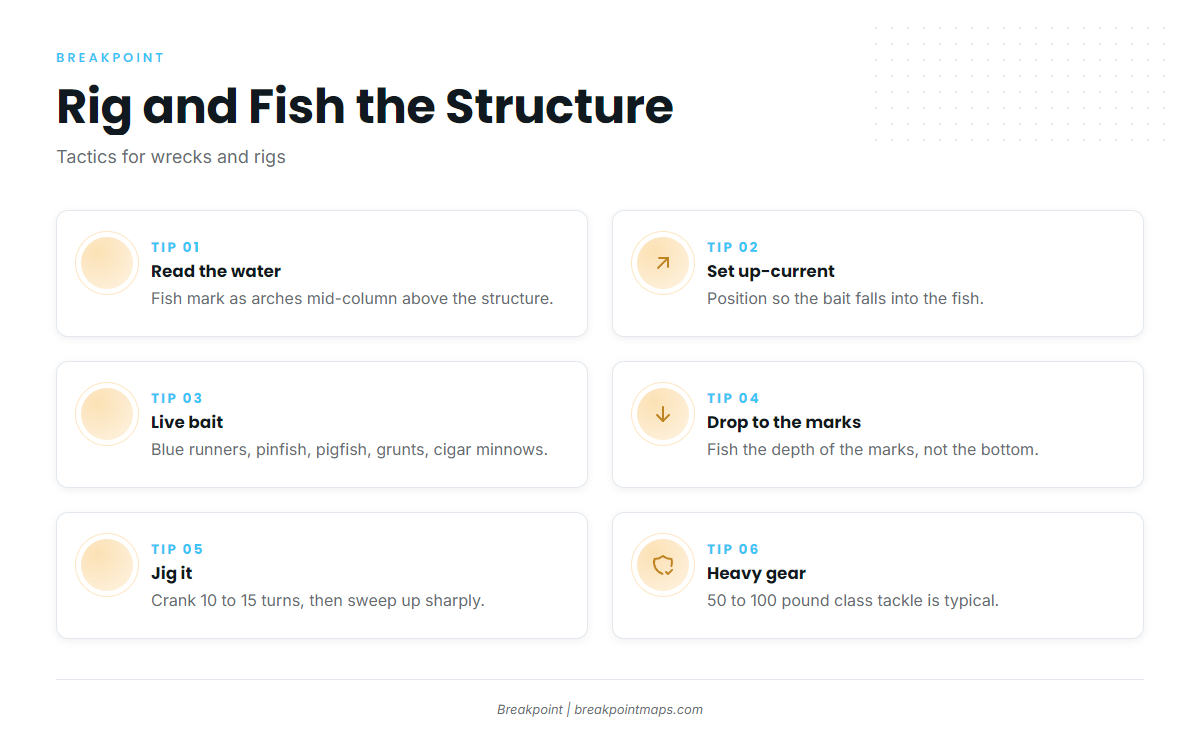
Mark the structure, then idle over it and read the water column. Fish show as arches in the middle of the water column above the structure, not as tight marks on the bottom. Set your drift or position up-current so the bait falls into the fish.
Chart Contours shows where the bottom breaks around a wreck or rig field. OBS SST shows where the warm edge sits. Chart layers are not for navigation.
Live bait
FWC lists the common baits: blue runners, pinfish, pigfish, grunts, cigar minnows and sand perch. Larger baits draw larger fish.
Rig it with:
- A circle hook (required with natural bait in Gulf reef fish waters; see Regulations)
- A fluorocarbon leader
- Enough weight to hold near the depth where the fish mark
Drop the bait to the depth of the marks, not to the bottom.
Vertical jigging
Rig for it with:
- Jigs of 150 to 300 grams, matched to depth and current
- Braid main line with a fluorocarbon leader
Drop to the bottom, crank 10 to 15 turns, then work the jig with sharp upward sweeps through the zone where the fish mark.
Tackle
FWC describes 50 to 100 pound class tackle as typical. Lighter tackle works in some situations. Use a heavy drag and expect a fast first run off the structure.
Circle hooks and release
Fish that are released should go back down quickly with a descending device. Use a dehooker on deep hooks, and keep a fish you plan to release in the water or out of it only briefly. The gear rules are in Regulations.
Plan the Run
Short open seasons reward choosing the right structure before you leave the dock. The regional and local fishing guides are the next step toward deciding where to look.
Region guides for greater amberjack: greater amberjack fishing in the Atlantic Southeast and greater amberjack fishing in the Gulf of Mexico.
FAQ
Why is it called a reef donkey?
The name comes from its stubborn, heavy fight close to structure. A hooked greater amberjack digs for the wreck or rig and holds there, so the angler has to turn it before it cuts the line.
Are greater amberjack good to eat?
Yes. The meat is firm and white, and it takes well to grilling and smoking. Whether you can keep one depends on the season, the size limit and where you caught it, so check the agency rule for your zone first.
What are the worms in amberjack?
They are a known parasite, usually found in the tail section, and they are cut out when you clean the fish. Seeing them does not mean the fish was mishandled. Trim the affected meat and keep the rest as you would any other fillet.
Can I keep one on a charter?
Passengers can keep one only during an open season and only if the fish meets the size limit. Captain and crew limits are zero in the Gulf. Check the season with NOAA, FWC or LDWF before the trip, because early closures on quota can change the answer.
How do I measure fork length?
Measure in a straight line from the snout tip to the center of the tail fork, with the fish flat and its mouth closed. A fish that reads 34 inches from snout tip to the fork is 34 inches fork length, even if the tail tips run longer.
Do state or federal rules apply?
It depends on where you fish. The Florida Gulf and Louisiana lines sit at 9 nautical miles. In Louisiana the limit follows you, so Louisiana size and bag limits apply to fish caught in federal waters off Louisiana as well.
Do I need a descending device?
In the Gulf, a descending device or venting tool must be rigged and ready. In the South Atlantic, a descending device is required, attached to at least 16 ounces of weight and 60 feet of line. Florida Gulf state waters carry the same weight and line specification.
What is the difference between greater and lesser amberjack?
Count gill rakers. Greater amberjack has 11 to 19 and lesser amberjack has 23 to 26. The rules differ too: greater amberjack has a minimum size and seasonal closures, while lesser amberjack falls under a slot limit.
Can I spearfish amberjack?
Spearing is allowed in Florida Gulf state waters. In the South Atlantic, spearfishing gear without rebreathers is allowed. The same size, bag and season limits apply to a speared fish as to one taken on hook and line.
Where are closure announcements posted?
Closure announcements are posted on the NOAA Gulf seasonal closures page, the FWC amberjack page and the LDWF recreational saltwater finfish page, all linked in the Regulations section above. Check them before each trip, since seasons can end early on quota.
Find Your Structure Before You Leave the Dock
The rules set the window and the structure sets the odds. If you want the next level of local detail, find your port in the state and port guides on breakpointmaps.com, or download Breakpoint from the App Store or Google Play and read the ocean data layers for the structure you plan to fish.