




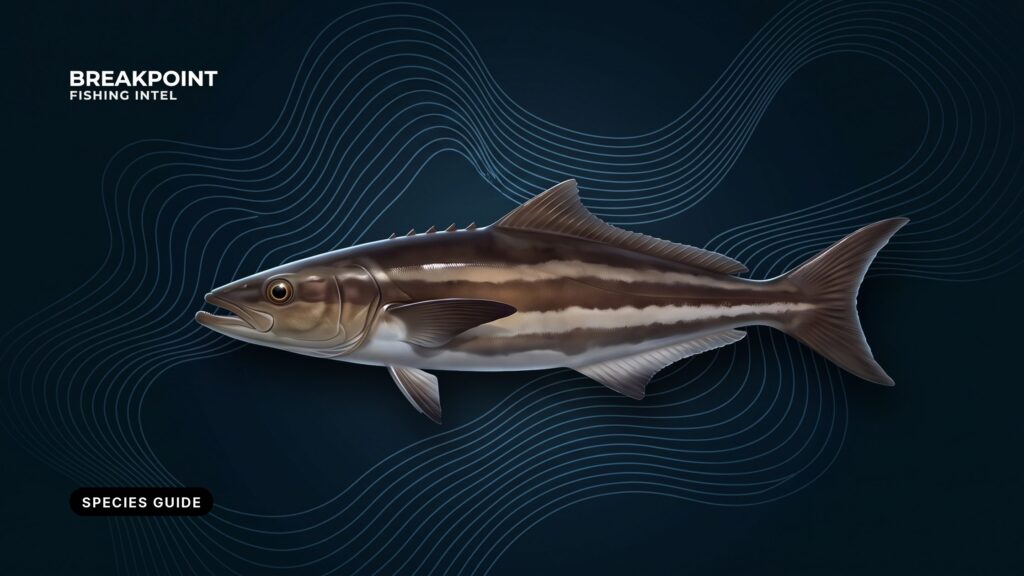
A field guide to finding, catching and legally keeping cobia in US waters.
Cobia follow warming water, big animals and structure, and the rules change with the water you fish and the dock you land at. This guide covers how to identify cobia, when they show up by region, how they feed, how they are caught, and how state and federal rules divide. Place-level detail, including Mid-Atlantic and Chesapeake water, is in our fishing guides by region.
How to identify cobia
Cobia have a dark stripe from gill to tail and no suction disc on the head. Rachycentron canadum is the only member of the family Rachycentridae. The body is long and torpedo-shaped, the head broad and flat with a protruding lower jaw, and a row of short, stout spines sits ahead of the soft dorsal fin. Cobia pass 100 lb. Regional names include ling, lemonfish and crab-eater, all the same fish.
At a distance, a cruising cobia looks like a brown, shark-shaped shadow. Up close, the flat head and the stripe settle it.
Cobia vs remora vs shark
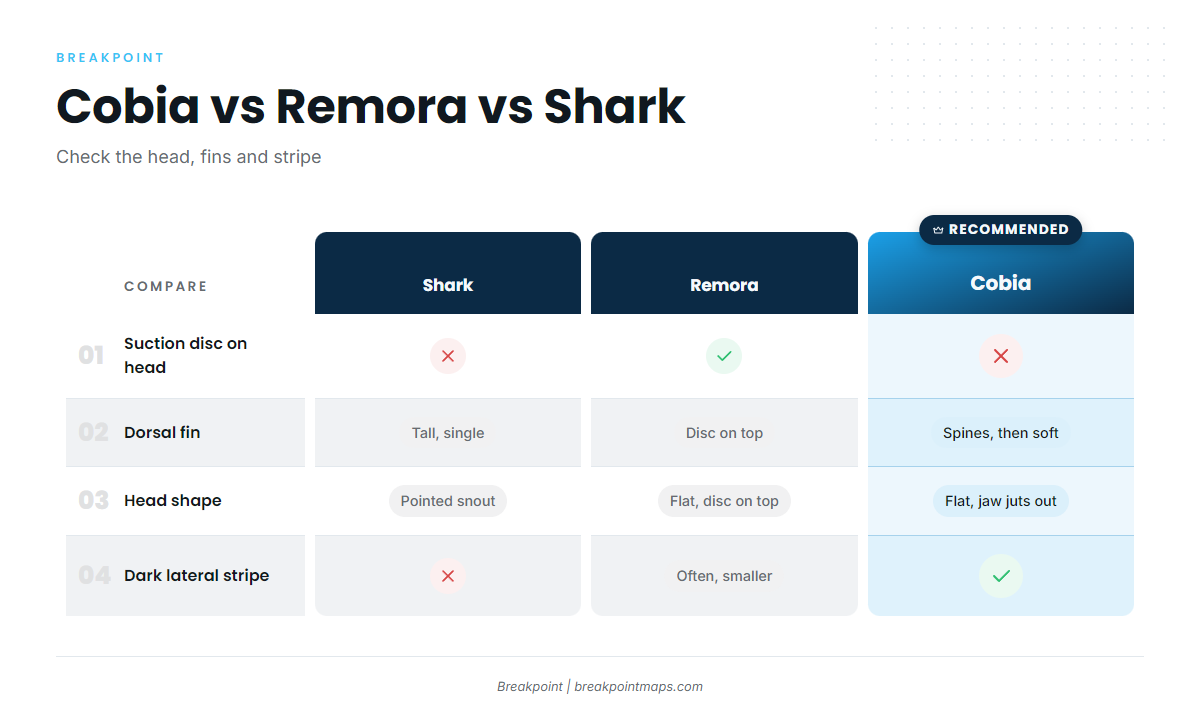
| Feature | Cobia | Remora | Shark |
|---|---|---|---|
| Suction disc on the head | None | Yes, on top of the head | None |
| Dorsal fin | Short separate spines, then a long soft dorsal | The first dorsal fin is modified into the suction disc | Tall single first dorsal, no spines |
| Head shape | Broad and flat, lower jaw protrudes | Flat, with the disc on top | Pointed or rounded snout, mouth underneath |
| Stripe | Dark lateral stripe, gill to tail | Often striped, smaller fish | No lateral stripe, gill slits visible |
Remoras ride rays, sharks and turtles too, so a stripe alone does not confirm a cobia. Check for the disc.
Where and when cobia show up
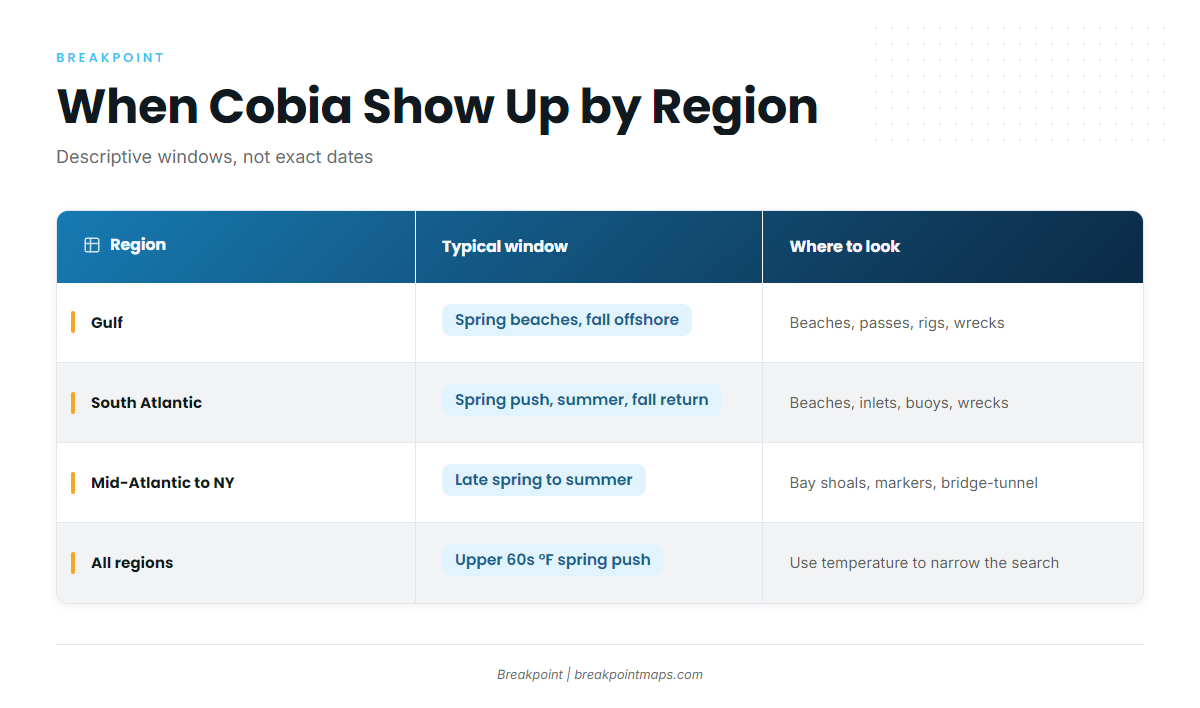
Cobia move north and inshore as water warms in spring, hold through summer, and push south and offshore in fall. Anglers widely report the spring push in the upper 60s °F. Temperature tells you where to look, but it doesn’t tell you where the fish are.
| Region | Typical window | Where to look |
|---|---|---|
| Gulf (Florida Panhandle, Alabama, Mississippi) | Spring run along the beaches, fall on offshore structure | Nearshore sand beaches, passes, then rigs, wrecks and reefs |
| South Atlantic (Florida east coast, Georgia, Carolinas) | Spring push north along the beaches, summer in sounds and inlets, fall return | Beaches, inlets, buoys and markers, nearshore wrecks |
| Mid-Atlantic and Chesapeake to New York | Late spring through summer, latest arrival on the coast | Bay mouth shoals, channel markers, bridge-tunnel structure, nearshore ocean |
Gulf
The spring run hugs the Florida Panhandle and the Alabama and Mississippi beaches. Fish run close to shore, and you can see them from a tower. The spring run off Destin is the signature example.
In fall the fish shift to rigs, wrecks and reefs, suspending at mid-depth or holding near bottom. For the full regional picture, read cobia fishing in the Gulf of Mexico.
South Atlantic
Cobia follow ray schools north along the Florida east coast and the Georgia and Carolina beaches. In late spring and summer they settle into sounds and inlets, and they also use buoys, markers and nearshore wrecks. The regional detail is in cobia in the Atlantic Southeast. For South Carolina fish, see cobia off Charleston.
Mid-Atlantic, Chesapeake and north to New York
Chesapeake Bay cobia work the bay-mouth shoals, channel markers and bridge-tunnel structure, and summer bay aggregations are associated with spawning. Fish reach New Jersey and New York water later in summer, the last to arrive on the coast.
Fall structure is shared with other gamefish. Our coastal and offshore gamefish guides cover king mackerel and amberjack on the same rigs and wrecks.
How cobia feed and move
Cobia shadow anything large that moves or floats. Look for these:
- Cownose ray schools in spring. Several cobia often trail or circle beneath them.
- Sea turtles. Cobia follow them the same way.
- Buoys, channel markers and pilings. Fish often sit head-on to the structure.
- Floating debris. A drifting log or pallet can hold a fish.
- Wrecks, reefs and oil and gas platforms. These stack bait and hold cobia, especially in the Gulf.
The diet explains the bait choices below: crabs (blue crabs above all), eels, squid and small baitfish. Cobia migrate with temperature and bait, and wind and current can push fish up or down in the water column, so surface visibility varies day to day.
Reading the edge and the structure
The OBS SST layer shows where the warm surface edge sits along the coast and how it moves day to day. The Chart Contours layer shows the shoals, slopes and depth changes, in feet, where structure and bait concentrate. Use them to choose where to look first.
SST shows the surface rather than the fish, and cloud can block a satellite pass. Chart layers are not for navigation.
How cobia are caught
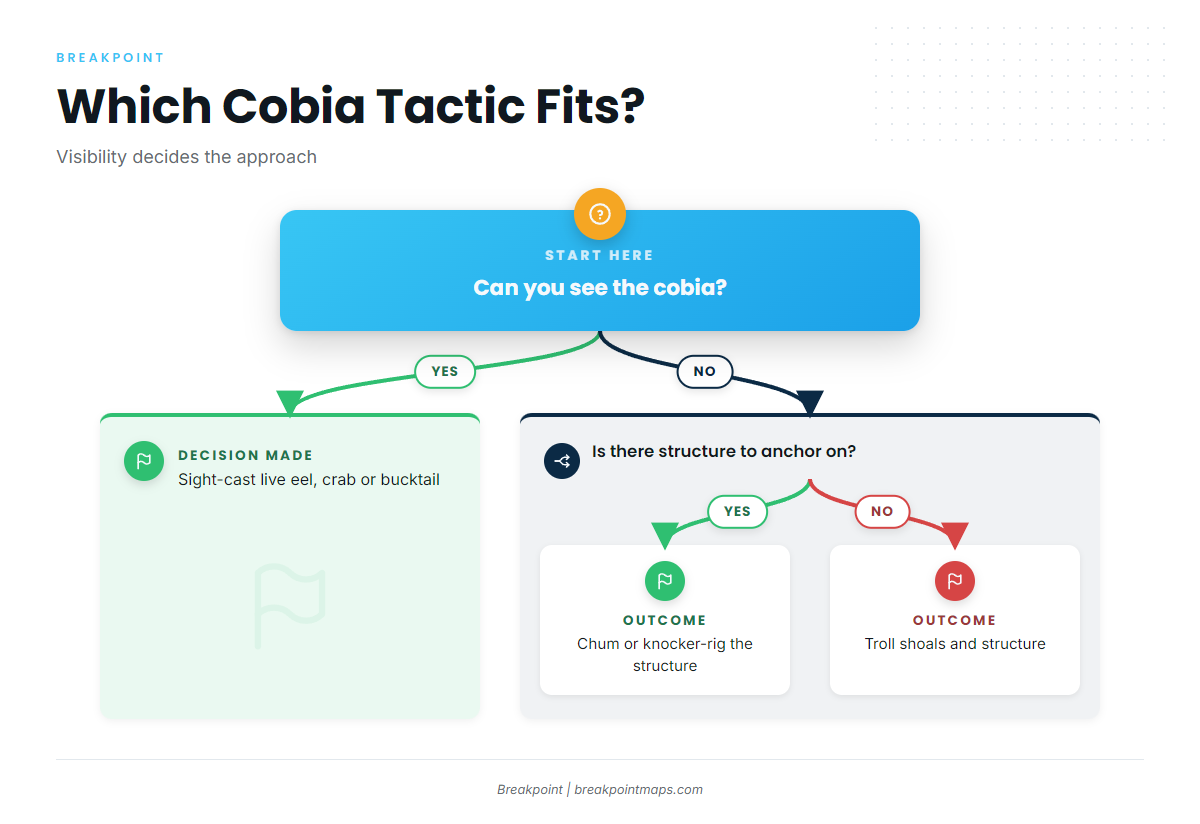
When you can see cobia, sight-cast. When you cannot, chum, bottom fish or troll structure.
Sight-casting
Fish from a tower or a raised deck in polarized glasses, with copper or amber lenses common nearshore. Wait for the sun to get high enough to see into the water.
Approach a ray school from the front rather than over the top, which scatters both rays and cobia. Kill noise and vibration early. Land the bait a few feet ahead of the fish’s path, never on its head, and match its speed and direction. Fish sitting on markers face the structure, which allows repeated presentations.
Live bait
Live eels and crabs are the standard sight-casting baits. Menhaden, mullet, pinfish, croaker, spot and blue runners work on drifts and at anchor. Live bait goes on circle hooks.
Bucktails and plastic eels
A bucktail jig is the common artificial, with 1 to 3 oz weights in white, chartreuse or pink widely used. Pump the jig up the water column, or use a quick, erratic retrieve in front of a visible fish. Soft plastic eels and diving plugs are the alternatives.
Chumming and bottom fishing
Anchor up-current of buoys, pilings, markers, wrecks or reefs and build a slick. Expect sharks, skates and rays in the slick too.
For bottom-holding fish on rigs and wrecks, use a knocker rig, with an egg sinker sliding down to the hook eye. Bait it with cut menhaden or blue crab on a circle hook.
Trolling
Trolling is a secondary method over shoals and structure, useful for covering water when fish are not showing.
Tackle
Common practice looks like this:
- Heavy spinning reel in the 5000 to 6000 class.
- Rod of 7 to 8 feet, medium-heavy to heavy.
- Braided main line, roughly 30 to 80 lb depending on method and structure.
- Fluorocarbon or mono leader, heavier around rough structure, since cobia mouths are bony and abrade leader.
- Circle hooks in roughly 6/0 to 8/0 for bait.
- A large gaff or net, and polarized glasses.
Fighting, gaffing and release
A cobia often comes to the boat looking calm with energy left. Anglers call this fish green. A green fish gaffed early can thrash hard in the cockpit, and the dorsal spines and tail do damage. Expect runs toward nearby structure, and gaff or net only when the fish is spent.
Handle undersized or over-limit fish in the water where you can. Keep the fish horizontal, revive it, and keep hands clear of the spines.
FAQ
Are cobia good to eat?
Yes. Cobia have firm, white, mild flesh with large flakes, and the fish is widely considered top table fare. It grills, sears and smokes well.
How do you tell a cobia from a remora?
A remora has a suction disc on top of its head and a cobia has none. Both can show a dark stripe, so check the head.
How do you tell a cobia from a shark in the water?
Look for the flat head, the dark side stripe and the short spines ahead of the dorsal. A shark has a tall single dorsal fin and visible gill slits, with no stripe.
How do you handle the spines?
The short dorsal spines are stout and sharp. Control the fish only when it is spent, keep hands clear of the back, and do not gaff a green fish.
When is the cobia run?
Spring on the Gulf beaches and along the Florida and South Atlantic coast. Late spring and summer in the Chesapeake and north. Fall on Gulf and offshore structure.
What is the cobia size limit?
It depends on jurisdiction and measurement method. The limit is 36 inches fork length in Florida and in federal waters off North Carolina, and 43 inches total length in New Jersey. Everywhere else, check the state agency in the table above.
Why are cobia called ling or lemonfish?
These are regional common names, along with crab-eater. They all refer to the same single species, Rachycentron canadum.
Pick your water
Temperature moves the fish, structure and rays reveal them, and the agency decides what you keep. Find your port in the regional and local guides, and read the OBS SST and Chart Contours layers before you run. We would be glad to have you download Breakpoint from the App Store or Google Play and put those layers to work on your next cobia trip.