




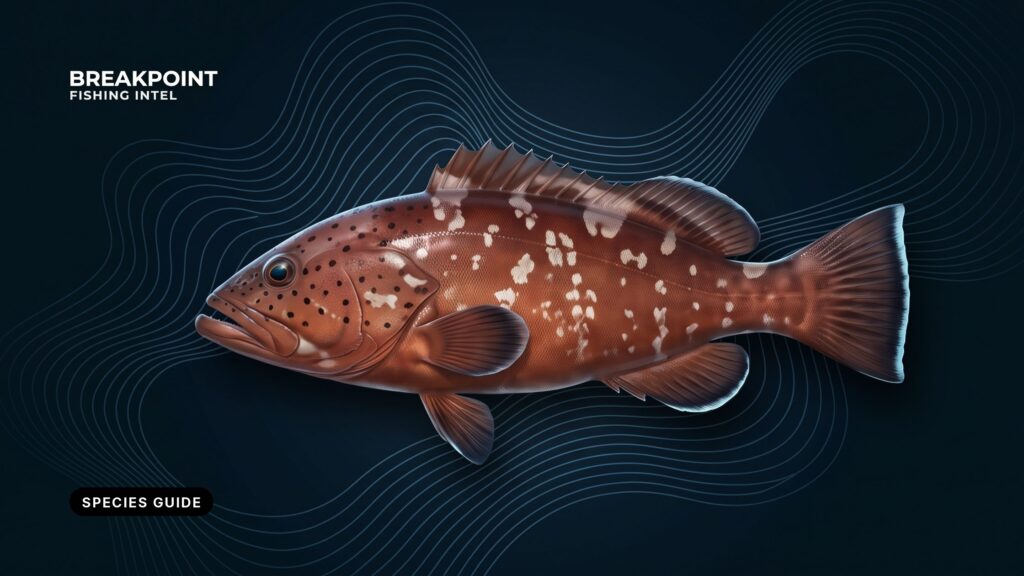
Red grouper (Epinephelus morio) is a bottom-dwelling grouper, most abundant in the eastern Gulf, where most are caught on the West Florida Shelf. This guide covers how to tell it from gag and other groupers, where it lives, how it feeds and spawns, how to catch and release it, and which rulebook applies where you fish.
Red grouper vs gag grouper: how to identify a red
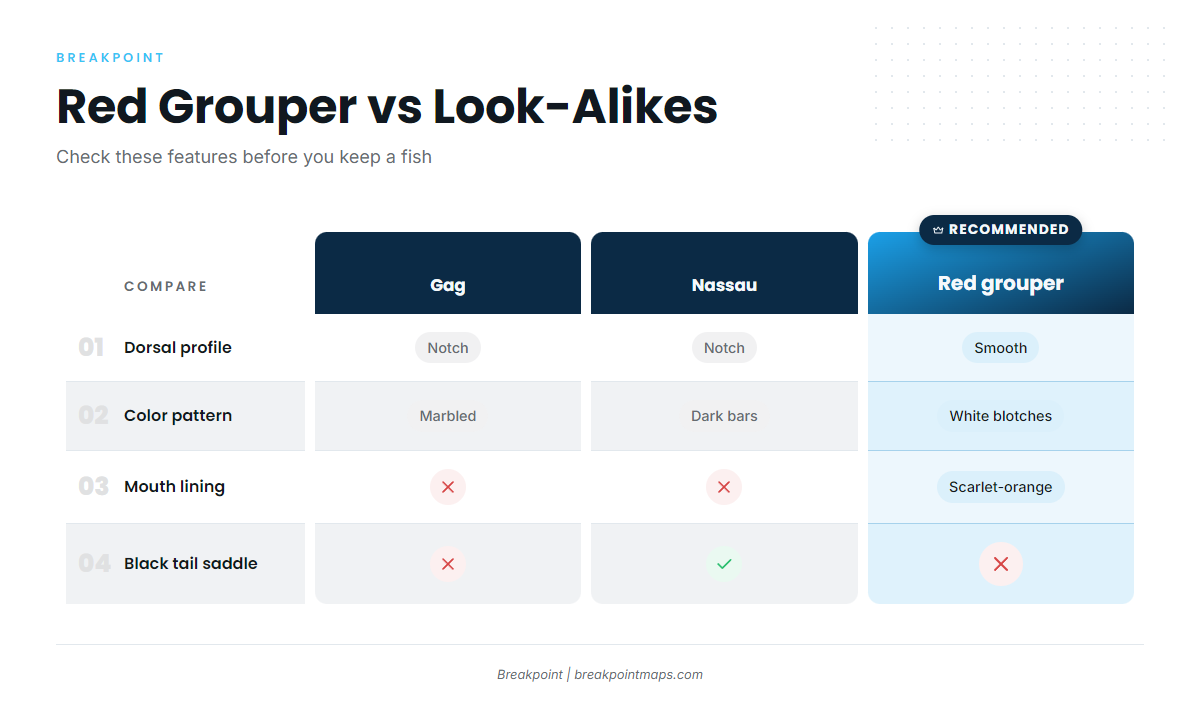
A red grouper has a smooth dorsal profile with no deep notch, and its second dorsal spine is noticeably longer than the rest. The body is reddish-brown with irregular white blotches, and the mouth lining is scarlet-orange. A gag looks marbled or blocky. The two species carry different size limits and seasons.
| Feature | Red grouper vs look-alikes |
|---|---|
| Tail | Red has a square tail with no black saddle. |
| Dorsal profile | Red is smooth and straight. Black grouper and scamp show a clear notch. |
| Color | Red is dark reddish-brown, fading to pale pink below, with white blotches. Gag is marbled. |
| Mouth lining | Red is scarlet to orange. |
| Black saddle on tail base | Nassau has a bold black saddle and dark bars. Red has neither. |
Nassau grouper is no-harvest in Florida Gulf state waters and federal Gulf waters, and no-retention in South Atlantic federal waters. Gag has a 24 inch minimum and its own season, so check the agency page for dates. If you can’t identify a fish with confidence, measure it, photograph it and release it.
Where and when red grouper live
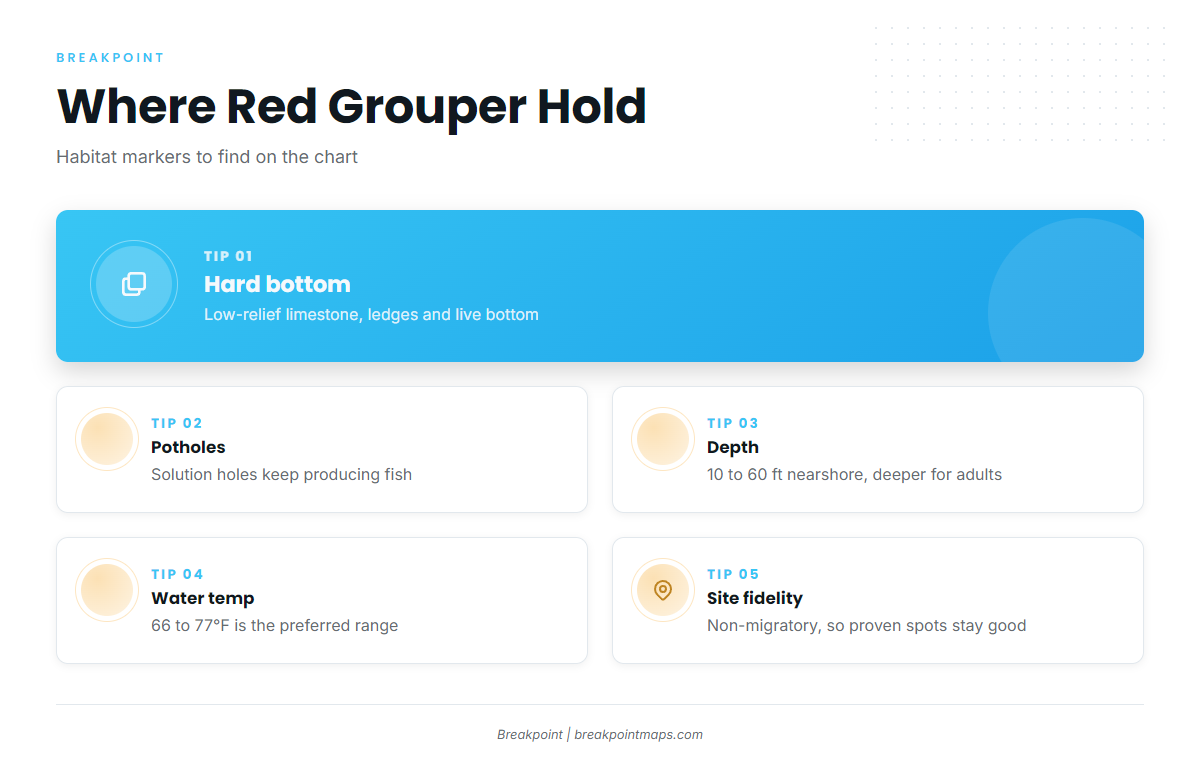
Adults hold on low-relief limestone hard bottom, potholes, ledges and live bottom. They rest on the bottom and rarely live on coral reefs.
- Depth:
- NOAA Fisheries lists the species as commonly found in 10 to 60 feet, a range that reflects nearshore and younger fish.
- Adults are usually found at 70 to 330 m (about 230 to 1,083 feet), per the FishBase adult depth range.
- SAFMC gives 10 to 40 feet for the Atlantic Southeast.
- Bottom: Ledges, crevices and caverns of rocky limestone reefs, low-profile live bottom with sponges, corals and sea squirts, and hard and muddy bottoms (FWC).
- Temperature: FWC gives 66 to 77°F as the preferred range.
- Juveniles: Seagrass beds first, then nearshore reefs. They move offshore as they mature.
So how deep for red grouper? Published ranges run from 10 to 60 feet for nearshore and younger fish to 70 to 330 m (about 230 to 1,083 feet) for adults. Start with bottom type rather than a single depth. Low-relief hard bottom, ledges and potholes hold fish at nearly any depth in that span.
Red grouper are non-migratory with high site fidelity, and they work solution holes. A known pothole keeps producing, so bottom data matters more than chasing a temperature break.
Finding the bottom on the chart
Low-relief limestone hard bottom, potholes and ledges are the target. Chart Contours helps you find depth breaks, and OBS SST shows water inside the 66 to 77°F range FWC gives as preferred. Chart layers are not for navigation.
West Florida Shelf
This is the center of the US fishery and where red grouper are most abundant. In the Gulf, recreational landings rise in May and June and peak in July and August, according to GCOOS.
Florida Keys
Red grouper range through the Keys, with distinct habitat and a different rulebook. Our guide to red grouper in the Florida Keys carries the place-level detail. Monroe County follows different grouper rules, covered in Regulations below.
Atlantic coast, Carolinas to Florida
Fish hold on ledges and limestone reefs plus lower-profile live bottom. For place-level detail, see our regional fishing guides.
How red grouper feed and move
Red grouper are opportunistic ambush feeders and swallow prey whole. Adults eat crabs, shrimp, lobsters, mantis shrimp, octopus, snappers and parrotfish. Juveniles feed mainly on crustaceans in seagrass.
- Movement: The Florida Museum species profile lists the fish as non-migratory, with site fidelity year-round. Red grouper do not migrate to form spawning aggregations, and adults may travel in groups over short distances only.
- Habitat engineering: Fish excavate flat bottom and clear solution holes, creating habitat for other species.
In practice, bait that matches a crustacean and small-fish diet makes sense, and proven holes are worth revisiting.
Spawning and sex change
Red grouper are protogynous hermaphrodites. They mature as females at 4 to 6 years, and some become males at roughly 7 to 15 years. The Florida Museum gives 7 to 14. Large fish are disproportionately male, so removing big fish and fishing spawners skews the sex ratio, which is why size limits and spawning closures exist.
Spawning windows by region:
| Region | Spawning window | Detail |
|---|---|---|
| Gulf | February to June, peak March to May | Average depth 70 m (about 230 feet) on low-relief hard bottom and limestone solution holes. See the GCOOS red grouper profile. |
| South Atlantic | March to July | Per SAFMC. |
| FWC | April and May | Agencies publish different windows. |
Red tide on Florida’s Gulf coast is one factor in stock and catch-limit changes.
How red grouper are caught
Red grouper fishing is bottom fishing. It takes the right rig, a crustacean-style bait, tackle matched to depth, and a plan for releasing fish that come up from deep water.
Rigs
The default is a fish-finder or Carolina-style egg sinker rig with a fluorocarbon leader. A knocker rig, with the sinker sliding to the hook, is a common variant for working tight to structure.
Hooks must be non-stainless, non-offset circle hooks with natural bait. See Regulations for details.
Bait
Live or cut bait fished on the bottom. Pinfish, grunts and squid are standard, matched to the crustacean and small-fish diet described above.
Tackle
Over flat low-relief bottom, lighter gear works. Deeper water, or holes near ledges, call for stiff rods and heavy reels.
Fighting the fish
A hooked red runs for the rocks. Turn its head away from structure immediately and keep steady pressure. Our reef fish guides cover where these tactics overlap with gag, scamp and snapper bottom fishing.
Release with a descending device
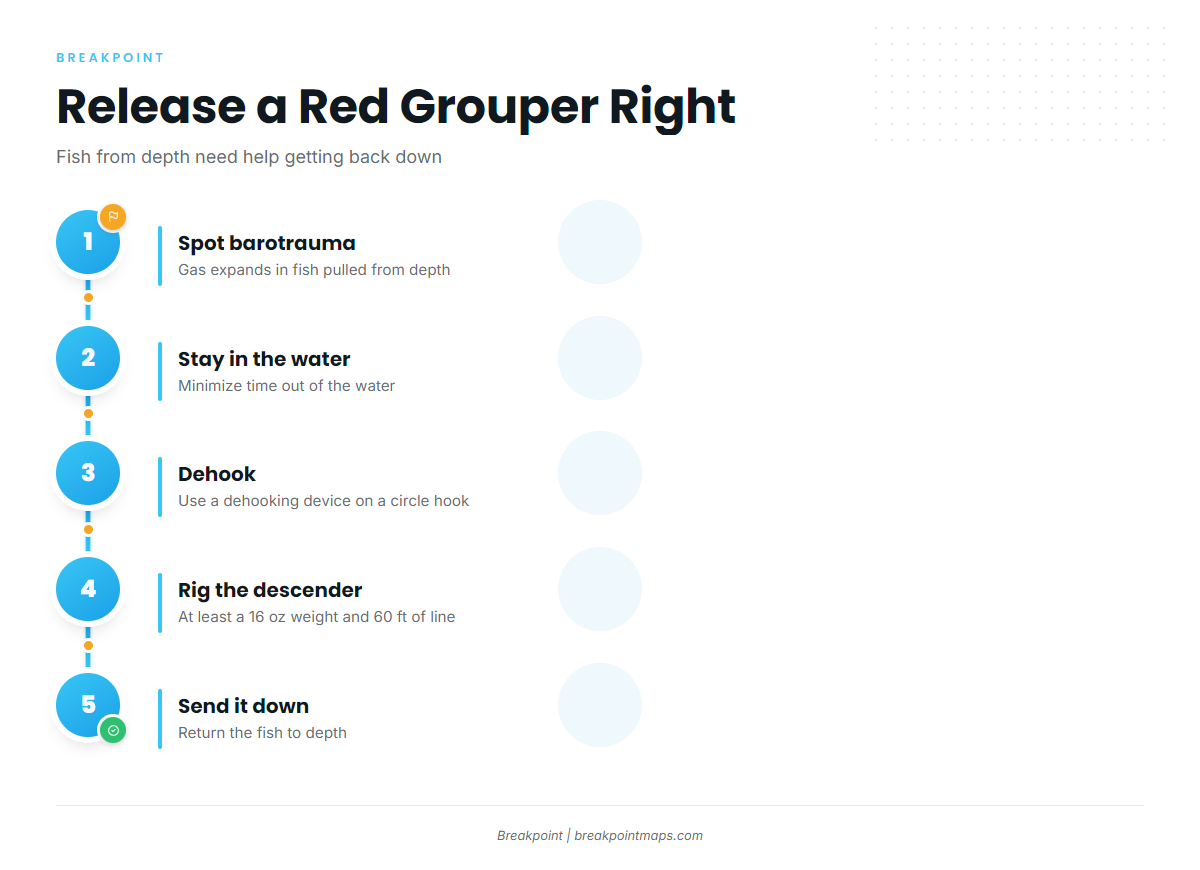
Fish pulled from depth suffer from expanding gas, called barotrauma. NOAA Fisheries encourages venting tools or descenders for fish showing barotrauma. A descending device needs at least a 16 oz weight and 60 ft of line.
- Minimize time out of the water.
- Dehook with a dehooking device.
- Send the fish back to depth with the descending device.
Plan the drop
Find the hard bottom before you run. Breakpoint maps are built for that. For the run itself, check wind, wave height and period on the official marine forecast.
Region guides for red grouper: red grouper fishing in the Atlantic Southeast and red grouper fishing in the Gulf of Mexico.
Frequently Asked Questions
How do you tell a red grouper from a gag?
Look for a smooth dorsal profile, a long second dorsal spine, white blotches on a reddish-brown body and a scarlet-orange mouth lining. A gag looks marbled or blocky. The two carry different size limits and seasons, so identify the fish before you keep it.
What is the red grouper size limit in Florida?
It is 20 inches total length in Gulf state and federal waters, excluding Monroe County. Keys and Atlantic anglers follow different rules, so check FWC before you fish those waters.
How deep do red grouper live?
NOAA Fisheries lists 10 to 60 feet for nearshore and younger fish. FishBase puts adults usually at 70 to 330 m (about 230 to 1,083 feet). Hard bottom matters more than any single depth.
When is red grouper season in the South Atlantic?
Shallow-water grouper are closed January 1 to April 30. Red grouper in federal waters off North Carolina and South Carolina stay closed until June 1. Check SAFMC and NOAA for the current rules.
Can I keep red grouper in the Florida Keys?
Monroe County follows Florida’s Atlantic grouper rules rather than the Gulf limits. Check FWC before you fish for red grouper there.
Do I need a descending device for red grouper?
One must be rigged and ready in Gulf state and federal waters, and on board in South Atlantic federal waters. The device needs at least a 16 oz weight and 60 ft of line.
Why are there spawning closures for grouper?
Red grouper are protogynous hermaphrodites. The large fish are disproportionately male, so removing them and fishing spawners skews the sex ratio. Spawning runs February to June in the Gulf and March to July in the South Atlantic.
Is red grouper good to eat?
Yes. It is a prized, mild white-fleshed table fish.