




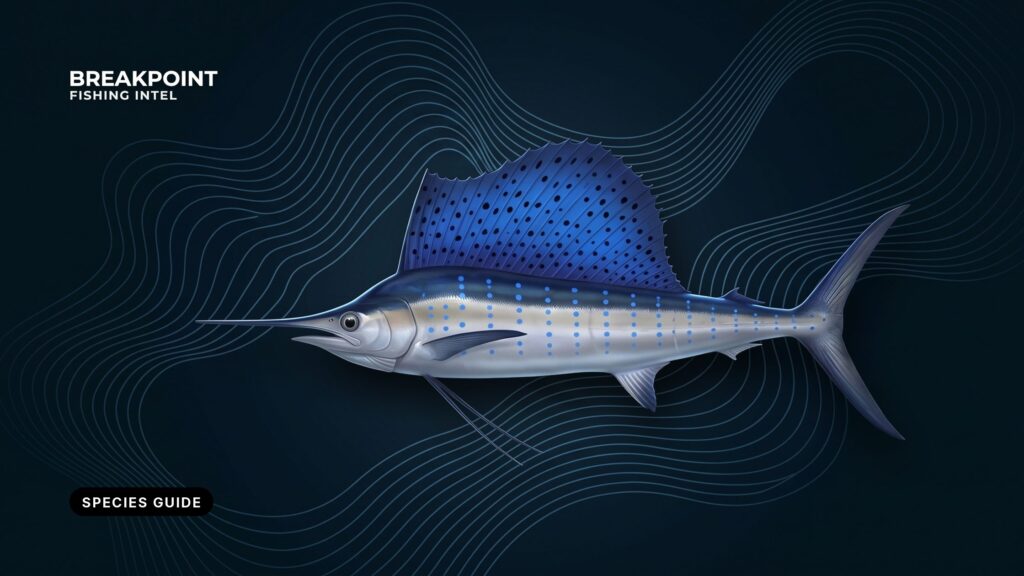
This guide covers the sailfish, the water it holds on and the rules that govern it. The sailfish is a billfish managed as an Atlantic highly migratory species. US anglers fish for it off Southeast Florida and the Keys, up the South Atlantic coast, across the Gulf, along the Mid-Atlantic edge in summer, and in Hawaii. It is overwhelmingly a release fishery.
The guide reads the water first: temperature edges, color changes, current and bottom contours. It then covers the law: how to tell a sailfish from the other billfish, which coast and season to fish, why baits are fished the way they are, and which agency’s rules apply where you are. NOAA Fisheries’ Atlantic HMS Management Division is the federal manager.
Identifying a Sailfish
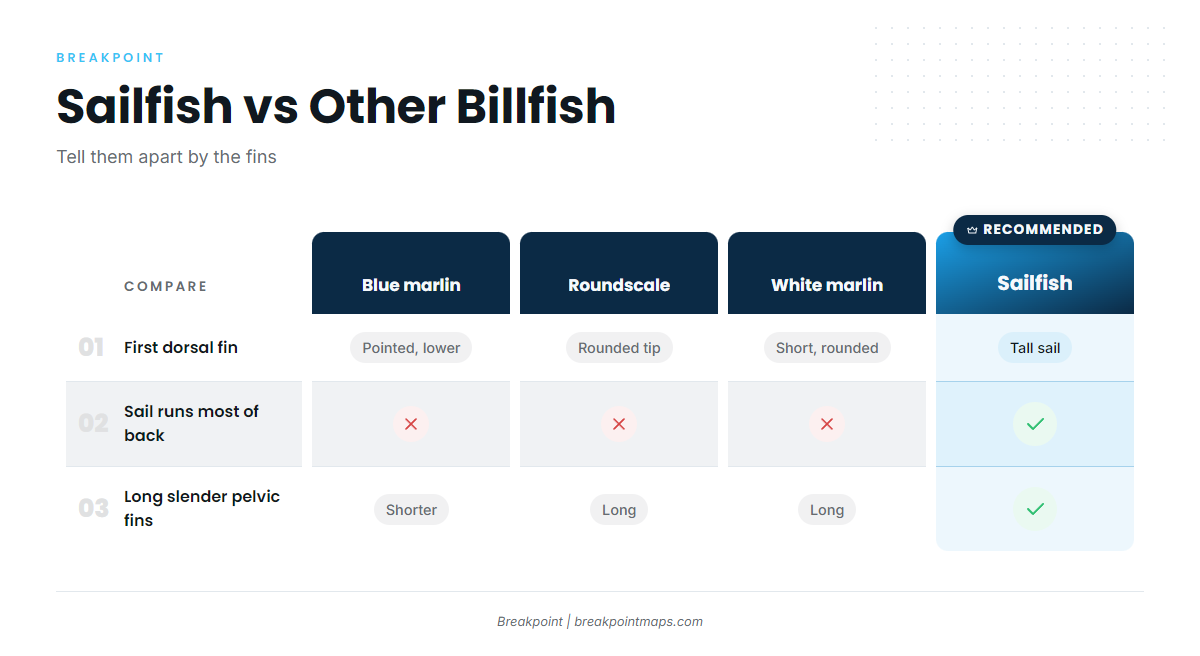
The sailfish, Istiophorus platypterus, is the easiest billfish to name once you know the sail. Identification matters beyond bragging rights, because size minimums and reporting are species-specific and a wrong call can put you out of compliance.
Look at three features:
- The first dorsal fin. It runs much of the length of the back and is taller than the body is deep. This is the sail.
- The pelvic fins. They are long and slender, trailing back along the belly.
- The bill. It is long and rounded rather than flattened.
Color runs from a dark blue back to lighter flanks, with vertical bars or spots along the sides. Color shifts with excitement and light, so rely on the fins.
| Species | First dorsal fin | Pelvic fins | Other cues |
|---|---|---|---|
| Sailfish | Tall sail running most of the back, taller than the body is deep | Long and slender | Long, rounded bill; vertical bars or spots on the flanks |
| White marlin | Shorter, with a rounded tip that drops off behind | Long | Rounded dorsal and anal fin tips |
| Roundscale spearfish | Shorter, with a more pointed front lobe | Shorter than a white marlin’s | Looks very close to a white marlin; do not separate the two on the water |
| Blue marlin | Pointed dorsal, much lower than a sail | Short | Heavier, deeper body with a pointed bill |
Profiles of the other billfish cover their range and rules, and each has its own federal rules. If you are unsure of the species, release the fish.
Where and When to Find Sailfish
Sailfish follow warm water and bait, so their range shifts with season, fronts and the position of the Gulf Stream. Each region below has its own offshore guide, and the fishing guides by home port will take you to the one for your coast.
| Region | Why fish are there | Timing | Signature method |
|---|---|---|---|
| Southeast Florida and the Keys | Gulf Stream runs closest to shore | Builds with fall fronts, peaks through winter | Kite fishing with live bait |
| South Atlantic and the Carolinas | Gulf Stream’s western wall as water warms | Warmer months | Trolling with teasers and ballyhoo |
| Gulf | Blue-water intrusions, eddies and current edges over the outer shelf | Warm months | Trolling and live bait on color changes |
| Mid-Atlantic and northern edge | Summer northern limit of the range | Peak summer warmth | Trolling canyons and eddies |
| Hawaii and the Pacific | Pacific population, outside Atlantic rules | See local sources | See local guides |
Southeast Florida and the Keys
The Gulf Stream runs closer to shore here than anywhere else on the US coast, bringing blue water and bait within easy reach of Palm Beach, Stuart and the Treasure Coast. Sailfish Alley runs off Stuart and the Treasure Coast, and Stuart calls itself the "Sailfish Capital of the World."
The run builds as fall fronts push bait south and peaks through winter. Islamorada and the Keys fish well through winter along the reef edge. Kite fishing with live bait is the signature method. The Southeast Florida sailfish guide has the place-level detail.
South Atlantic and the Carolinas
Sailfish range up the coast along the Gulf Stream’s western wall as water warms. Carolina boats see them while trolling for mixed offshore species in the warmer months, and trolling with teasers and ballyhoo is the standard approach. The Southeast guide above covers the Carolinas run too.
Gulf
During the warm months, sailfish follow blue-water intrusions, eddies and current edges over the outer shelf. Trolling and live bait on color changes are the usual approaches. The Gulf sailfish guide covers ports and timing.
Mid-Atlantic and the Northern Edge
This is the summer northern edge of the range. Sailfish turn up as an incidental catch while you troll the canyons and Gulf Stream eddies for white marlin and tuna, and peak summer warmth is the window. The Mid-Atlantic and Northeast sailfish guide covers where the edge sits.
Hawaii and the Pacific
Sailfish are present in Pacific waters, and Hawaii is the US example. Atlantic HMS rules do not govern there. Look to NOAA Fisheries Pacific Islands and the Western Pacific Regional Fishery Management Council, plus the Hawaii Division of Aquatic Resources for state waters.
How Sailfish Feed and Move
Sailfish hunt in pairs and packs. They use the sail to corral schooling bait into a tight ball and the bill to slash and stun. Typical prey includes goggle-eyes, pilchards, threadfin herring, ballyhoo and blue runners. This shapes presentation: a lively bait kicking at the surface looks like a stunned fish leaving the ball.
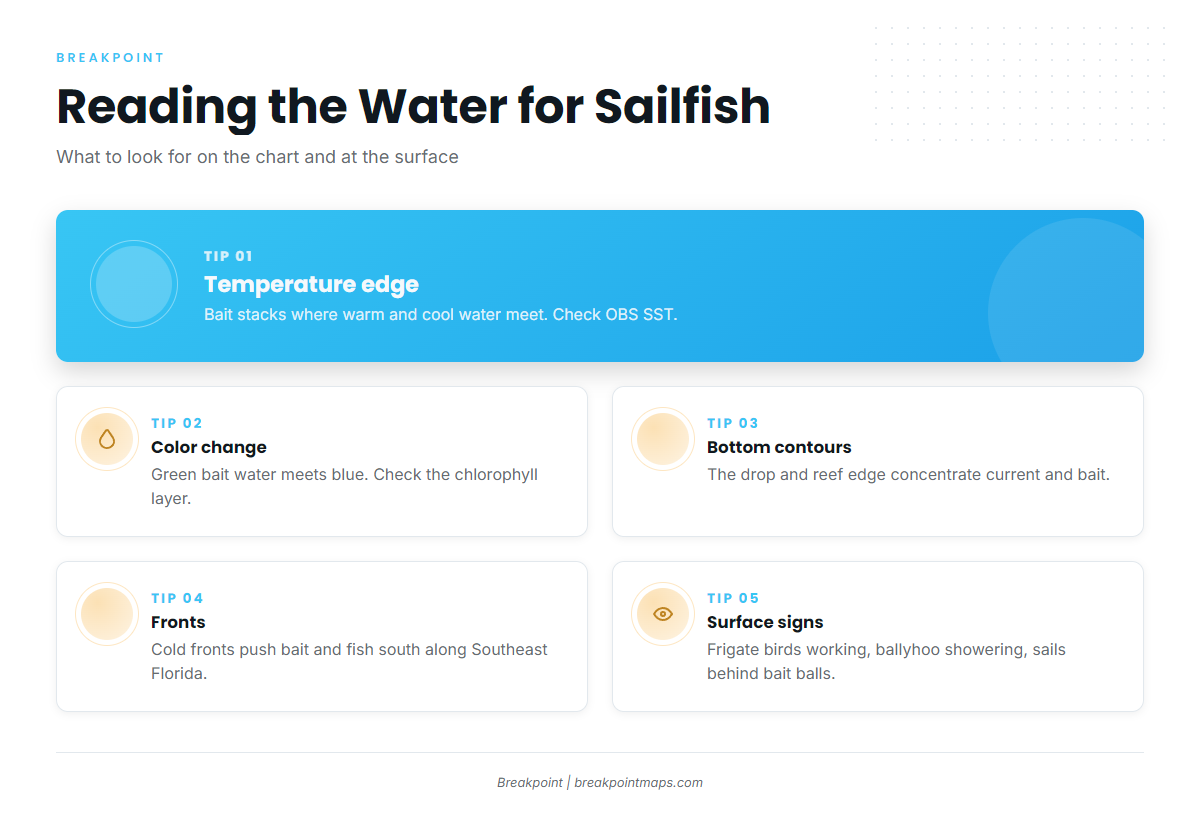
Three conditions put bait and sailfish in the same place:
- Temperature edges. Bait stacks where warm Gulf Stream water meets cooler shelf water. In the data, this shows as a tight gradient on sea surface temperature.
- Color changes. Green, bait-rich water meets blue water. In the data, this shows as a chlorophyll boundary.
- Bottom contours. The reef edge and the drop concentrate current and bait.
Cold fronts push bait and fish south along Southeast Florida. The wind that follows a front pushes against the Gulf Stream current, shifting where bait sits and where fish hold relative to the edge. Check the NWS marine forecast for wind, wave height and period before you go.
On the water, watch for frigate birds working, ballyhoo showering and bait balls with sails behind them.
We read these conditions in Breakpoint. OBS SST shows the temperature edge, Chlorophyll shows the color change, and Chart Contours show the drop and the reef edge. Cloud cover blocks the satellite pass, so an edge can go missing for days. Chart layers are not for navigation.
How Sailfish Are Caught
Every method has the same goal: keeping a lively bait where a sailfish expects stunned prey.
Kite Fishing
Kites hold live baits at the surface on release clips, keeping the leader in the air and out of the fish’s sight. Boats commonly fly two kites to spread baits off each side.
Hold the boat as still as possible into the current. Adjust the line as the kite rises and falls so the bait stays splashing on the surface, and swap tired baits for fresh ones. For the home waters of this method, see kite fishing off Southeast Florida.
Live-Bait Slow Trolling
Lively baits are bumped or slow-trolled along an edge or color change. This works when there is not enough wind for a kite.
Trolling with Teasers, Dredges and Pitch Baits
Teasers and dredges imitate a bait school and raise fish. When a sail rises, pull the teaser away and drop a pitch bait back to the fish. A rigged ballyhoo on a circle hook is the usual pitch bait, and it pays to keep one rigged and ready.
Circle Hooks and the Drop-Back
A circle hook sets in the corner of the jaw when the line comes tight steadily, so do not jerk the rod. When the clip pops, let the fish turn and eat the bait before you come tight. That is the drop-back. Clean jaw hooks mean faster releases and better survival.
HMS rules include circle-hook requirements for certain natural-bait situations. The compliance guide in the Regulations section covers them.
Fly and Artificials
Sailfish are teased to the boat for a fly cast, and they also take artificials while trolling.
Releasing a Sailfish
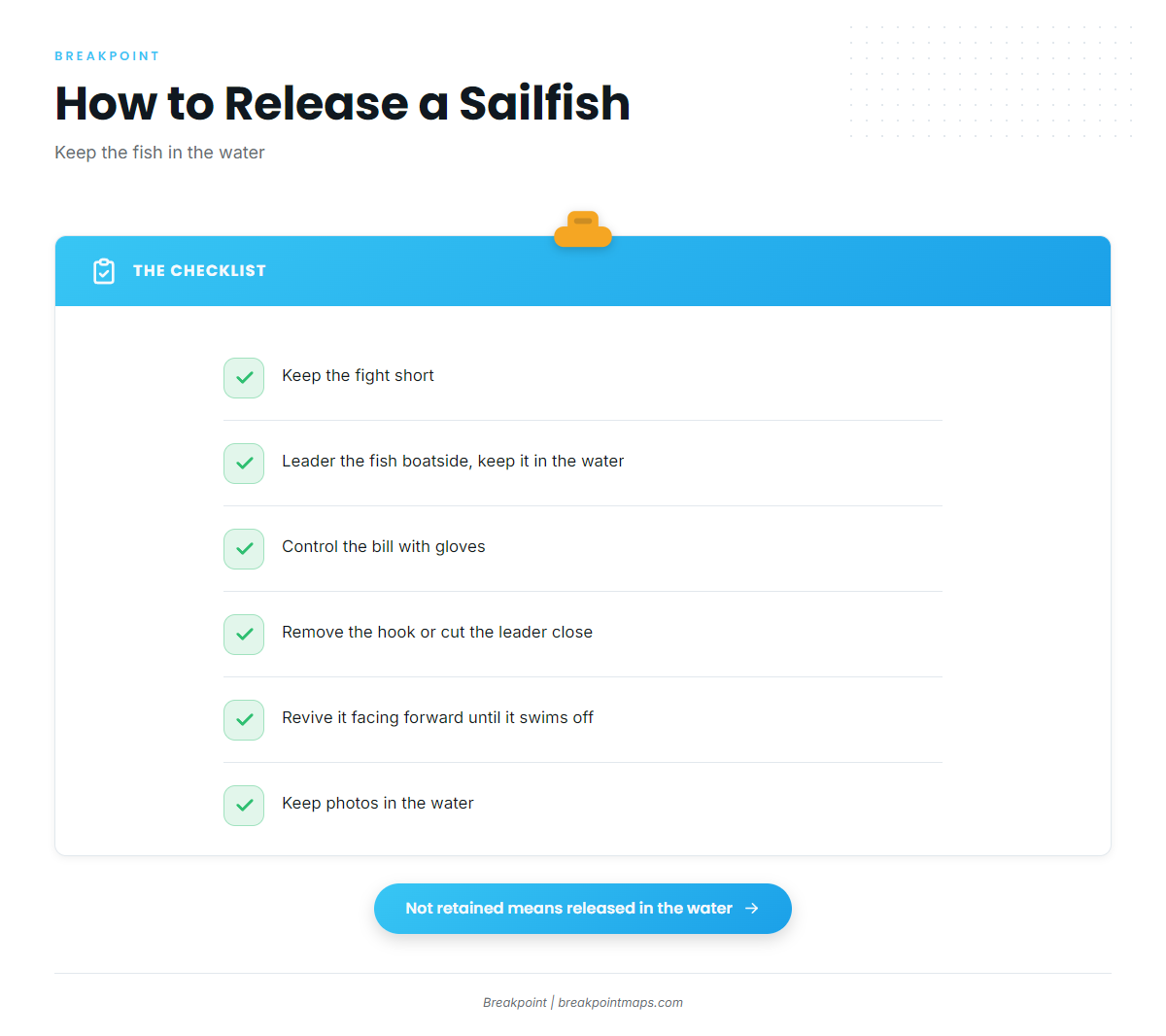
Under 50 CFR part 635, a billfish that is not retained must be released without being removed from the water. Release it by cutting the line near the hook or with a dehooking device.
Good handling keeps fish alive and keeps sharks off them:
- Keep the fight short. Long fights exhaust the fish and invite sharks.
- Leader the fish boatside and keep it in the water.
- Control the bill with gloves.
- Remove the hook or cut the leader close.
- Revive the fish by holding it pointed into the water with the boat moving slowly ahead until it swims off under its own power.
- Keep photos in the water.
Volunteer tagging programs exist, including The Billfish Foundation. On a charter, follow the mate’s lead.
Sailfish FAQ
Quick answers from this guide.
What is the minimum size for a sailfish?
The minimum is 63 inches lower jaw fork length under federal Atlantic HMS rules (50 CFR part 635) and in Florida state waters (FWC). Lower jaw fork length runs from the tip of the lower jaw to the fork of the tail. Check NOAA Fisheries and FWC before you fish.
Do I need a permit to fish for sailfish?
Private boats in federal waters need the HMS Angling permit. For-hire boats need the Charter/Headboat permit. Federal permit holders follow federal rules in state waters unless the state rule is stricter. NOAA Fisheries issues the permits.
Can you keep a sailfish?
Retention is legal only if you meet the size limit, hold the right permit, stay within any bag limit that applies and report the landing to NOAA Fisheries. Most anglers and charters release their sailfish, and a fish you release stays in the water.
How do you tell a sailfish from a white marlin?
A sailfish has a tall, sail-shaped first dorsal running most of the back. A white marlin’s first dorsal is shorter, with a rounded tip that drops off behind. Both have long pelvic fins. If you are unsure, release the fish.
When is sailfish season in Florida?
The run builds with fall fronts and peaks through winter off Southeast Florida and the Keys. Timing shifts with fronts and the position of the Gulf Stream, so the regional guide is the better place to plan a trip.
Do I have to report a sailfish?
Yes, if you land one. Landed billfish must be reported to NOAA Fisheries. The HMS permits site explains how and when to report.
Do Atlantic sailfish rules apply in Hawaii?
No. Atlantic HMS rules do not govern Pacific waters. Check NOAA Fisheries Pacific Islands, the Western Pacific Regional Fishery Management Council and the Hawaii Division of Aquatic Resources.