




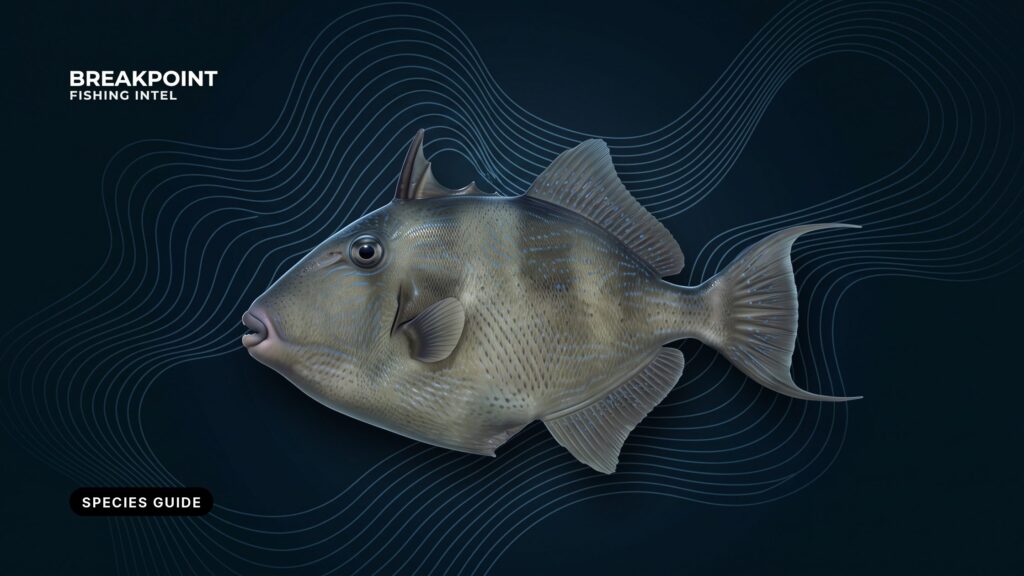
Gray triggerfish, Balistes capriscus, is a hard-mouthed reef fish of the family Balistidae. NOAA lists US wild catch from North Carolina to Texas. It is among the most tightly managed reef fish, and the rules depend on which side of the state or federal line you fish. This guide covers how to identify the fish, where it lives, how it feeds, and how to hook it.
The page runs through identification, habitat, feeding, rigs and handling, then a single rules table with links to every agency. For specific reefs and runs, the fishing guides by region carry the place-level detail. The aim is to help you decide where to look and what you can keep. It does not promise fish.
How to Identify a Gray Triggerfish
The first dorsal spine locks upright, and pressing the smaller second spine, the "trigger," releases it. When threatened, the fish wedges into a crevice and locks the spine. Taxonomically it sits in order Tetraodontiformes, family Balistidae, per the FishBase taxonomy entry.
Quick ID checklist
- Deep, laterally compressed body with tough, sandpaper-like skin.
- Olive-gray to brown color, with blue spots and lines on the upper body and fins and a blue upper rim to the eye.
- Small mouth with heavy, incisor-like teeth.
- Locking first dorsal spine with a trigger release.
- Average weight 2 to 4 pounds. NOAA lists a maximum of 28 inches fork length and 13 pounds.
Gray, queen or ocean triggerfish
Color and pattern separate the three.
| Species | What to look for |
|---|---|
| Gray triggerfish | Uniform olive-gray body with fine blue markings |
| Queen triggerfish | Brighter, bolder color pattern |
| Ocean triggerfish | Plainer fish without the gray’s blue spotting |
If a fish looks doubtful, confirm it against the agency ID page before you keep it.
How to measure fork length
Fork length runs from the tip of the snout, with the mouth closed, to the center of the fork in the tail. Total length runs to the tip of the tail, so it is longer. Federal Gulf triggerfish rules use fork length, while many other reef fish rules use total length. A fish that passes on total length can still be short on fork length.
Where and When: Gulf, South Atlantic and Mid-Atlantic
Adults live 80 to 300 feet down on hard bottom, reefs, ledges and artificial reefs, per the NOAA gray triggerfish species profile. FWC puts them on hard bottom, reefs and ledges deeper than 80 feet. NOAA gives the western Atlantic range as Nova Scotia to Argentina, including Bermuda and the Gulf of America (Gulf of Mexico).
Habitat summary
- Depth: adults 80 to 300 feet (NOAA). FWC lists water deeper than 80 feet.
- Bottom: hard bottom, reefs and ledges.
- Man-made structure: artificial reefs (NOAA).
- Company: FWC notes they are almost always found with red snapper, since the two share habitat.
By region
- Gulf: managed by the Gulf Council and NOAA Fisheries. Artificial reefs and natural hard bottom hold fish.
- South Atlantic: Florida’s Atlantic coast to the Carolinas. FWC notes hard bottom deeper than 80 feet. Managed under the South Atlantic Fishery Management Council.
- Mid-Atlantic: the fish reaches into these waters within the NOAA range.
The yearly cycle
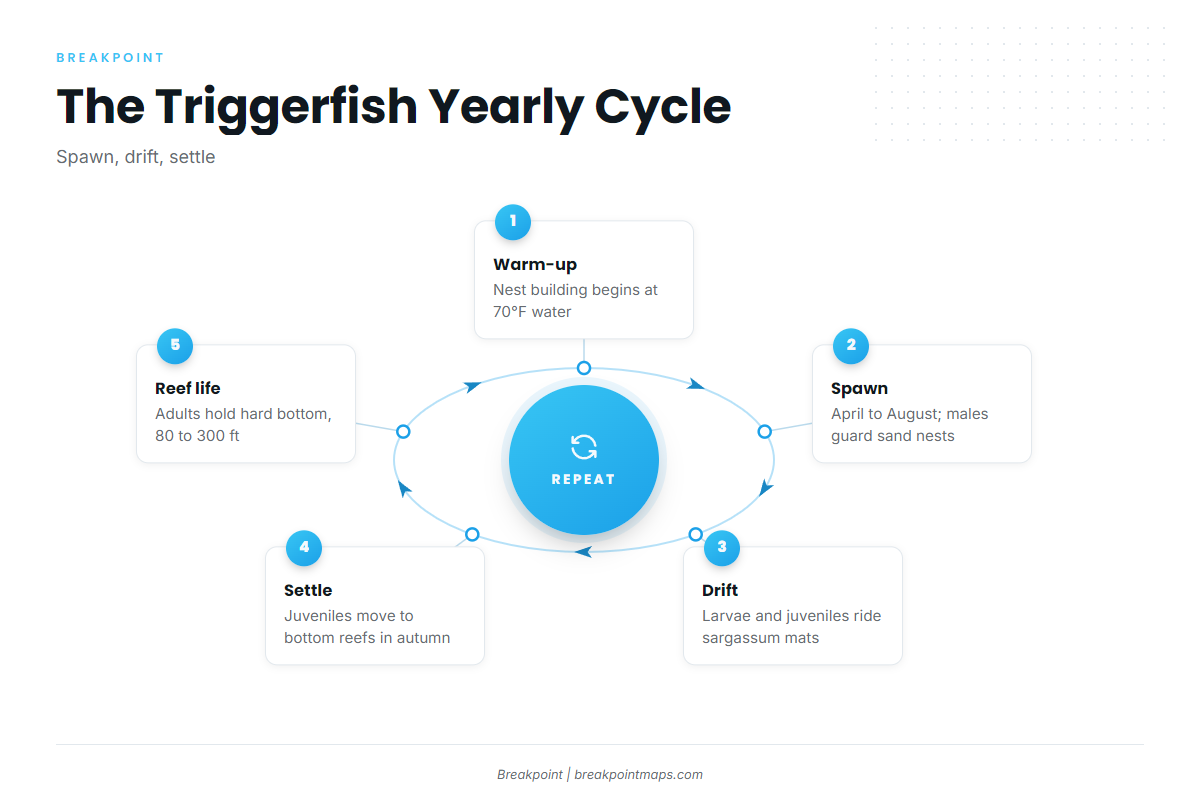
Spawning runs April to August (NOAA). Nest building begins once water reaches 70°F. Males hold territories and build nests in sand. Larvae and juveniles drift among sargassum mats offshore, then move to bottom reefs in autumn. The federal Gulf June to July closure falls inside the peak spawning window.
On the chart, the Chart Contours layer shows ledges and relief in the 80 to 300 foot band. Chart layers are not for navigation.
The fishing guides by region carry the reefs, depths and runs for each stretch of coast.
How Gray Triggerfish Feed and Move
Adults crush shrimp, crabs, sea urchins, sand dollars, sea stars, sea cucumbers and bivalve mollusks, per the Florida Museum species profile. Juveniles eat algae, hydroids, barnacles and polychaetes.
A gray triggerfish picks and crushes hard-shelled prey with a small mouth and heavy teeth. It nibbles bait rather than swallowing it, so it can strip a hook clean before you feel a solid take.
Adults live alone or in small groups and move often among nearby reefs. In summer, adults guard nests on the bottom and will confront divers who come close.
How to Catch Gray Triggerfish
FWC describes light to medium bottom gear with 20 to 50 pound test line as enough. Because the mouth is hard and bony, use a small, very sharp hook. Squid or cut bait works, and tough baits stay on the hook longer against nibbling. The fish is also speared, so check spearfishing rules with the agency.
In Gulf federal waters, non-stainless circle hooks are required with natural bait. See Regulations below.
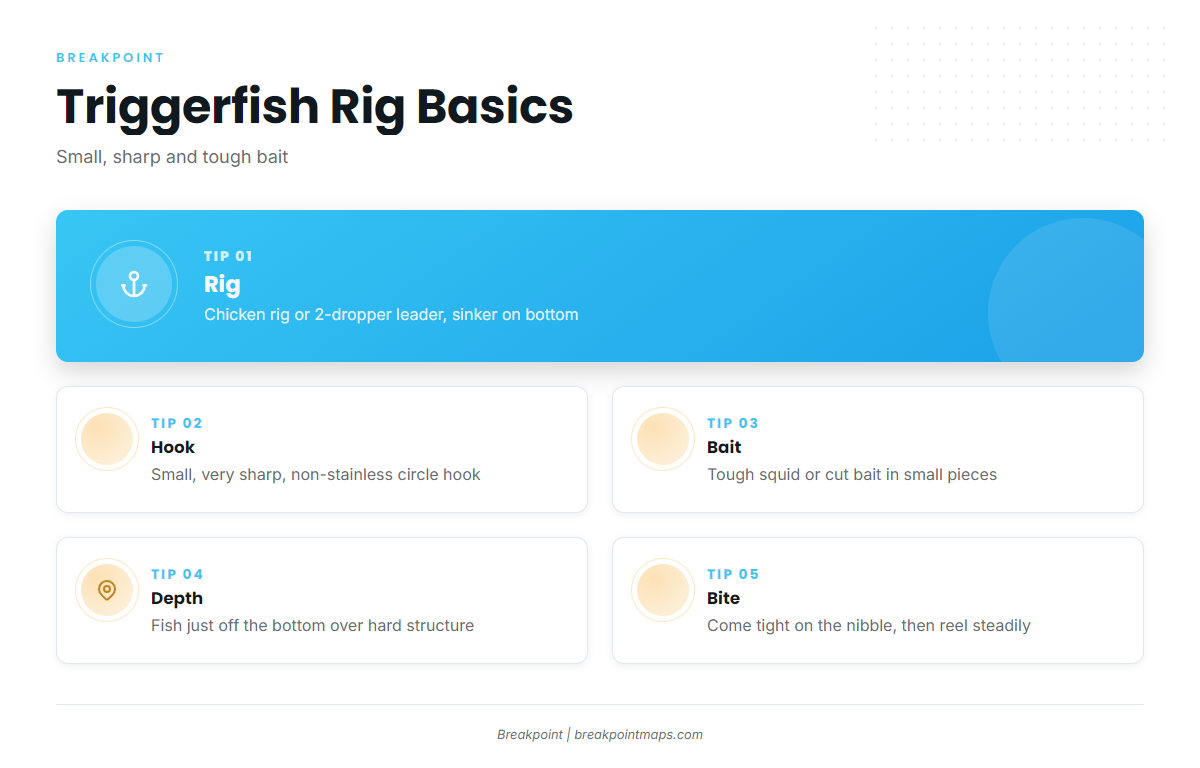
A basic triggerfish rig
- Tie a chicken rig, or a leader with 2 dropper loops, with the sinker at the bottom.
- Use small, very sharp, non-stainless circle hooks where natural bait rules apply.
- Bait with small, tough pieces of squid or cut bait, leaving little to tear off.
- Fish just off the bottom over hard structure.
- Come tight on the nibble. With circle hooks, reel steadily rather than jerking.
Fishing the reef complex
Gray triggerfish share structure with red snapper, vermilion snapper and amberjack. The reef fish guides cover the rest of the complex on the same bottom. Each species carries its own size, bag and season rules, and the 20-fish aggregate counts across them.
Handling, Release and Cleaning
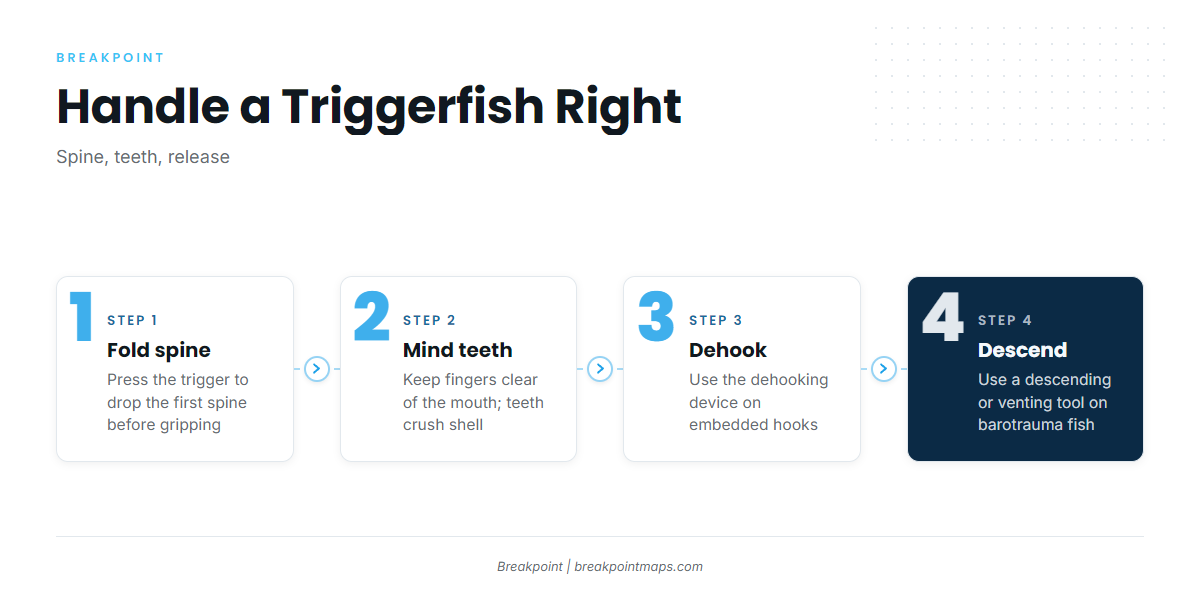
Press the trigger, the second spine, to fold the first spine before gripping. Keep fingers away from the mouth, since the teeth crush shell.
Remove embedded hooks with the dehooking device. Keep a descending device or venting tool rigged and ready, which is required in Gulf federal waters, and use it on fish showing barotrauma.
Fish from Gulf federal waters must be kept with head and fins intact until landed, so do not fillet at sea. The skin is thick and hard to cut. Expect to dull a knife, and trim any dark flesh.
Region guides for gray triggerfish: gray triggerfish fishing in the Atlantic Southeast and gray triggerfish fishing in the Gulf of Mexico.
Frequently Asked Questions
Is the Gulf gray triggerfish season open year-round?
No. The fixed closures run January 1 through the end of February and June 1 through July 31. The season can also close early on quota, and NOAA Fisheries posts closures on its Gulf seasonal closures page.
What is the difference between fork length and total length?
Fork length runs from the snout tip to the center of the tail fork. Total length runs to the tip of the tail, so it is longer. Federal triggerfish rules use fork length, while many other reef fish use total length.
Are gray triggerfish good to eat?
Yes. They are widely kept for their firm white fillets. The skin is tough, so plan on a sharp knife and some patience at the cleaning table.
How do I clean a gray triggerfish?
Use a sharp, sturdy knife, because the skin is thick and dulls a blade. Trim away any dark flesh. If the fish came from federal waters, keep the head and fins intact until you land it.
How do I tell a gray triggerfish from a queen or ocean triggerfish?
Gray triggerfish are uniform olive-gray with fine blue markings. Queen triggerfish carry a brighter, bolder pattern. Ocean triggerfish are plainer, without the gray’s blue spotting. If you are unsure, check the agency ID page before keeping the fish.
What gear must be on board for Gulf reef fish?
In Gulf federal waters you need non-stainless circle hooks when fishing natural bait and a dehooking device. You also need a descending device or venting tool rigged and ready.
Do I need a Florida State Reef Fish Survey sign-up?
Private-boat anglers who intend to land gray triggerfish in Florida sign up as a State Reef Fish Angler, with annual renewal. Check the FWC page for the current process.
Can I catch triggerfish on the same trip as red snapper?
Yes. FWC notes they share habitat. Each species follows its own season, and both count toward the 20-fish aggregate. The reef fish guides cover the rest of the complex.