




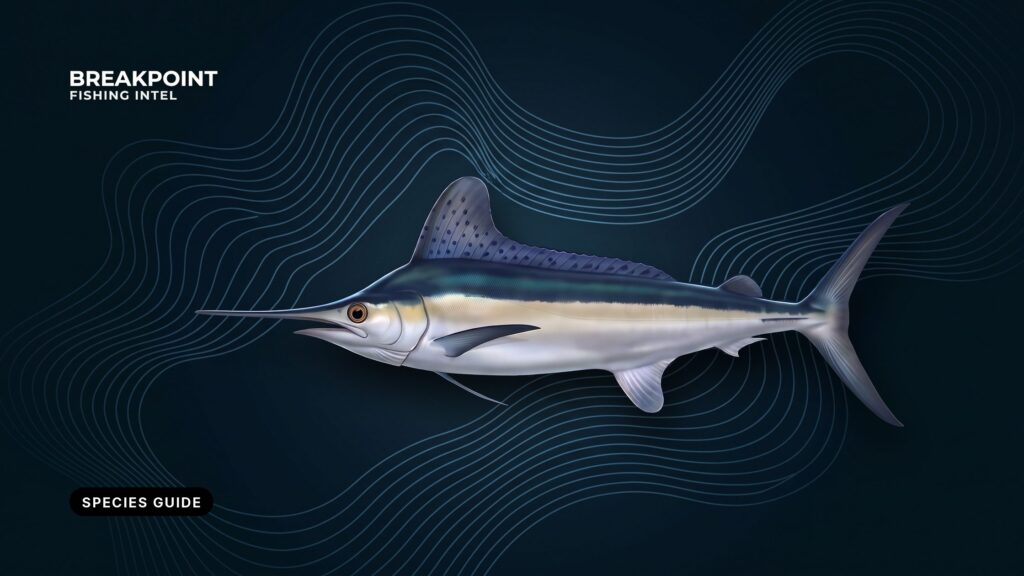
White marlin (Kajikia albida) is the smallest Atlantic marlin. It is fished in US waters along the Atlantic coast and in the Gulf of America (Gulf of Mexico), and the main fishery is a summer fishery between Cape Cod and Cape Hatteras.
This guide is for anglers who already run offshore for tuna and mahi and want to move up to billfish. It covers how to tell a white marlin from its look-alikes, where and when it shows up by region, how crews raise and hook it, and how federal and state rules divide.
NOAA Fisheries manages white marlin as an Atlantic highly migratory species. Most recreational fish are released.
Quick facts
| Item | Detail |
|---|---|
| Species | white marlin, Kajikia albida |
| Group | billfish (marlins, sailfish, spearfish) |
| Federal manager | NOAA Fisheries, Atlantic Highly Migratory Species (HMS) Management Division, 50 CFR part 635 |
| Where the rules apply | Atlantic, Gulf and Caribbean federal waters. They also reach state waters for HMS permit holders. |
| Permit | Atlantic HMS Angling (private boat) or HMS Charter/Headboat (for-hire) |
| Size and limits | Measured in lower jaw fork length (LJFL). See Regulations. |
| Release norm | Most fish are released. Release-first handling is the standard. |
| International status | Assessed by ICCAT as an overfished Atlantic stock |
Identification
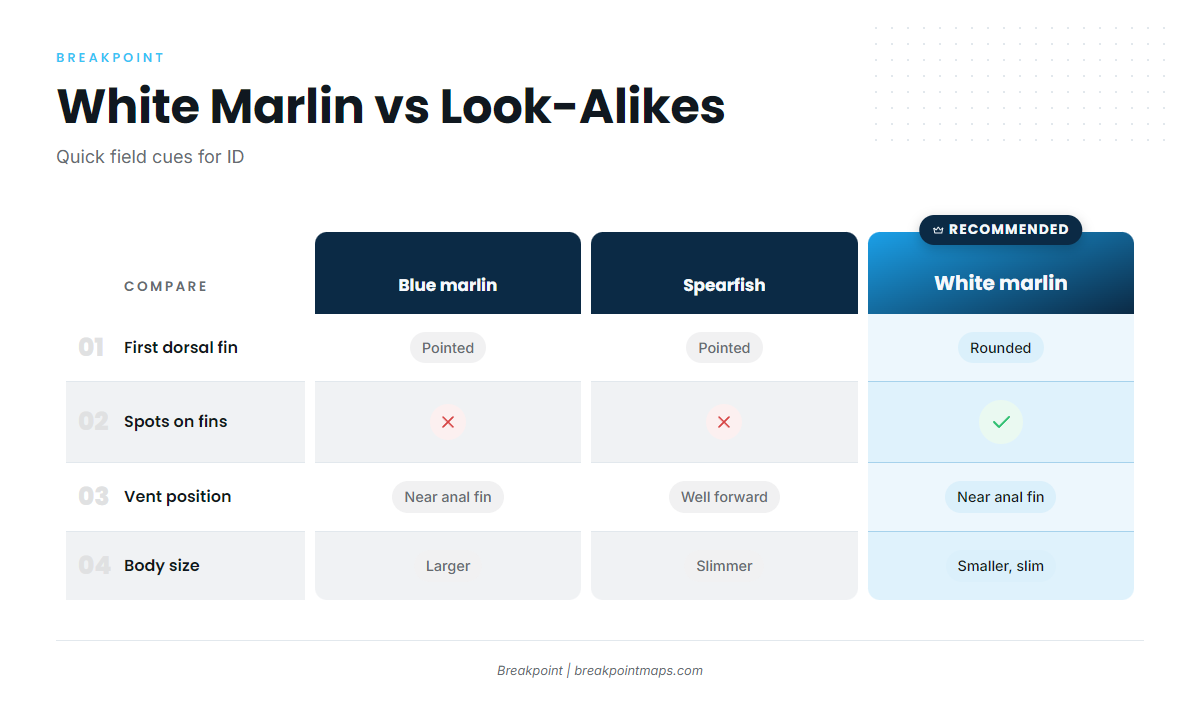
White marlin are smaller and slimmer than blue marlin, with a rounded first dorsal fin and spots on the dorsal and anal fins. Blue marlin have a pointed dorsal and no spots.
Identification affects more than bragging rights. White marlin and roundscale spearfish fall under the same retention limit, so a misidentified fish changes the legal count and the tournament scoring.
The best way to separate a white marlin from a roundscale spearfish is the position of the vent relative to the anal fin:
- On a white marlin, the vent sits close to the anal fin.
- On a roundscale spearfish, the vent sits well forward of the anal fin.
- On a close call, photograph the vent area before you release the fish.
Other cues help at the rail. The white marlin’s rounded dorsal fin often runs taller than its body is deep, and its coloring is lighter than a blue marlin’s and can show green. For the other species you may raise, see our other billfish guides.
White marlin and look-alikes
| Species | First dorsal fin | Spotting | Anal fin and vent | Body shape |
|---|---|---|---|---|
| white marlin | Rounded, often taller than body depth | Spots on dorsal and anal fins | Vent close to the anal fin | Slim, smallest of the Atlantic marlins |
| blue marlin | Pointed | No spots | Vent close to the anal fin | Heavier and deeper |
| roundscale spearfish | Rounded, similar to white marlin | Spots possible | Vent well forward of the anal fin | Slim, close to white marlin |
| sailfish | Very tall, sail-like, runs most of the back | Spots on the sail | Anal fins set apart from the vent | Slender, with a long sail |
| striped marlin | Tall, pointed to rounded | Vertical stripes | Vent close to the anal fin | Pacific species, rarely relevant in US Atlantic waters |
Swipe the table sideways to see every column.
Range and seasons
Fish follow warm water and bait along the shelf edge and its canyons. The regional guides carry the place-level detail, and the summaries below point to them.
Northeast and Mid-Atlantic
The Mid-Atlantic canyons are the center of the fishery: the Baltimore, Washington and Norfolk canyons, and the Jack Spot off Ocean City, Maryland. Ocean City calls itself the White Marlin Capital of the World and hosts the White Marlin Open each August. For grounds, timing and the run, read the guide to white marlin in the Northeast and Mid-Atlantic canyons.
Carolinas, Hatteras and Florida
Hatteras and the Outer Banks sit where the Gulf Stream runs close to shore, which shortens the run to blue water. The window is longer at the southern end of the summer pattern. The Southeast white marlin guide covers Hatteras, the Carolinas and Florida.
Gulf of America (Gulf of Mexico)
Federal HMS rules in the Gulf match those on the Atlantic coast, because "Atlantic" in 50 CFR 635 includes the Gulf. Texas adds its own size rule, covered under Regulations. For grounds and seasons, see white marlin in the Gulf.
Region and season table
| Region | Key grounds | Season (qualitative) | Regional guide |
|---|---|---|---|
| Northeast and Mid-Atlantic | Baltimore, Washington and Norfolk canyons, Jack Spot | Summer peak | Atlantic Northeast white marlin guide |
| Carolinas | Hatteras, Outer Banks, Gulf Stream edge | Summer pattern with a longer window to the south | Atlantic Southeast white marlin guide |
| Southeast and Florida | Florida Straits and the shelf edge | Southern end of the summer pattern | Atlantic Southeast white marlin guide |
| Gulf | Offshore Gulf structure | Regional guide carries the timing | Gulf of Mexico white marlin guide |
For other species and waters, see our fishing guides by region.
How white marlin feed and move
White marlin eat small fish such as tinker mackerel and sardines, plus squid. They often feed in loose groups and work bait schools. Unlike other marlin, they tend to overtake prey rather than club it with the bill. That is why small baits work, and why a quick switch to a hooked bait matters.
They migrate with the seasons. Tagging studies show long seasonal migrations, north with warm water and bait in summer and south as the water cools.
For the angler, this comes down to bait. Bait stacked at an edge draws fish, edges over structure hold bait longer, and the place to look is wherever the bait is.
Where to look on the water
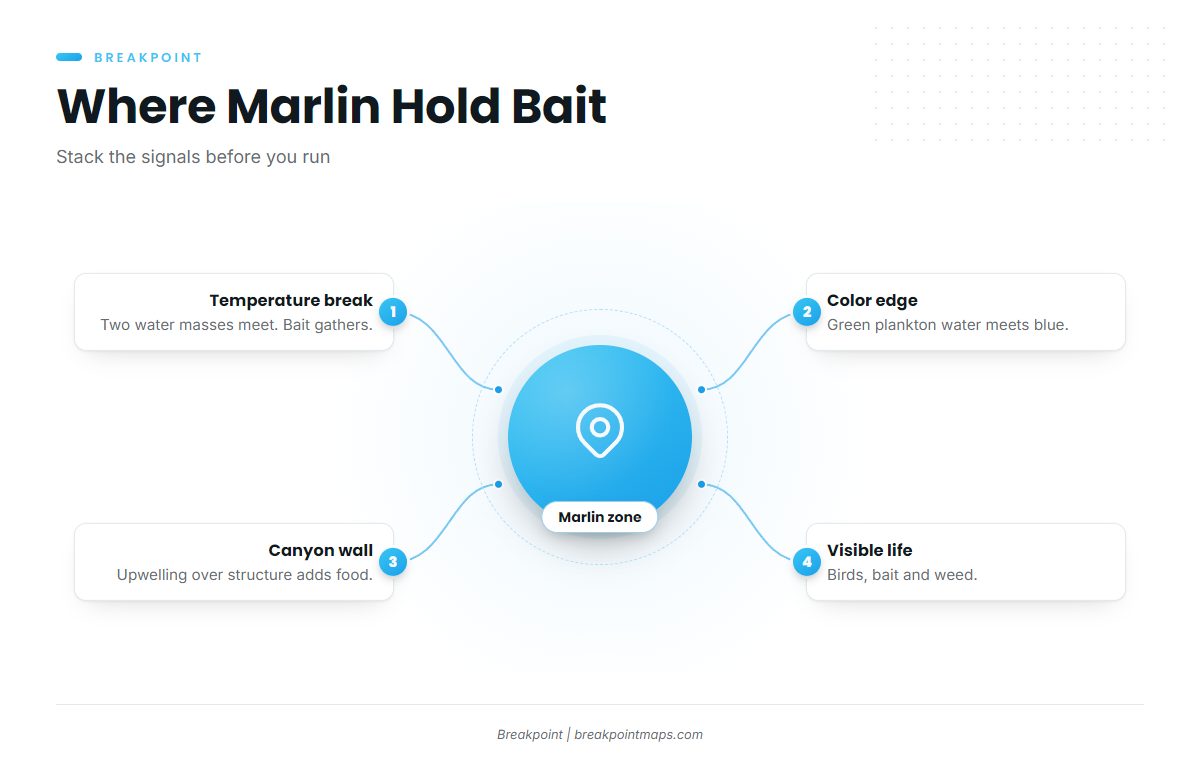
Edges hold bait, and bait holds white marlin. Four features do most of the work:
- Temperature break. It marks where two water masses meet.
- Color or chlorophyll edge. It marks where plankton-rich green water meets clean blue water.
- Structure. A canyon wall or the shelf edge lifts water over the bottom and adds food.
- Visible life. Birds, bait and weed show where it is working.
The more of these that stack up in one place, the better the odds. A seam that lines up with a canyon wall, near the Gulf Stream edge, with birds working, is a stronger bet than any one feature alone.
Reading the map before the run
In Breakpoint, three layers carry this work:
- OBS SST shows temperature breaks.
- Chlorophyll shows color edges.
- Chart Contours shows canyon walls and the drop-off.
Overlay them and look for where an edge crosses structure. That is the spot to plan the run around.
The data has limits. A satellite pass blocked by cloud leaves gaps, so an edge may not show that day. Some shelf surveys behind the contour data are old. Chart layers are not for navigation, and for the canyon run you should check the official marine forecast for wind, wave height and period.
How white marlin are caught
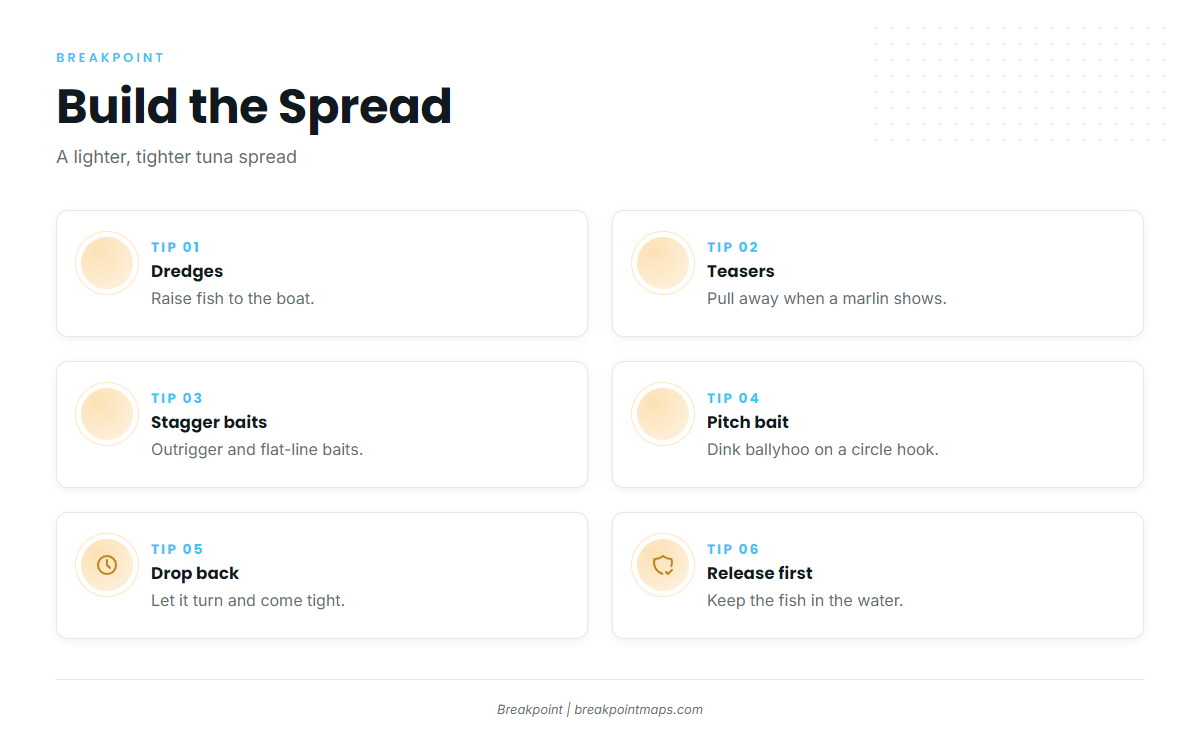
A white marlin spread is a lighter, tighter version of the tuna spread you already run, built around small natural baits and teasers.
The spread
A typical spread uses these pieces:
- Dredges, run from a dredge boom, the outriggers or a handline.
- Teasers, including daisy chains.
- Outrigger baits and flat-line baits, staggered behind the boat.
- Small dink ballyhoo, naked or under a small skirt.
Dredges and teasers
Dredges and teasers raise fish to the boat. When a marlin shows on a teaser, pull the teaser away so the fish turns to a hooked bait.
Pitch baits and bait-and-switch
A pitch bait is a dink ballyhoo on a circle hook, with or without a small chugger head. The bait-and-switch is crew work: the angler and whoever works the teaser coordinate so the fish leaves the teaser and finds a bait.
Circle hooks
Circle hooks seat in the corner of the jaw. That holds better in a bony mouth than a J-hook and improves release survival. Let the fish turn and come tight on the drop-back, and do not jerk. NOAA sets circle hook requirements for billfish, covered in Regulations.
Tackle class
Many crews fish 20 to 30 lb class tackle for white marlin.
Release
Keep the fish in the water. Leader it, cut the leader close or remove the hook with a dehooker, and revive the fish by keeping it moving forward. Wear gloves, because the bill is rough, and photograph the fish in the water. Release comes first for this stock because it is assessed as overfished.
Plan the run on the map before you leave the dock: find the edge, find the structure, then set the spread.
Frequently Asked Questions
Can you keep a white marlin?
Yes, with an HMS permit, at or above the federal minimum LJFL and within NOAA’s quota-based limits. Most anglers release them. Report any landing within 24 hours, and check NOAA before fishing.
What is the difference between white marlin and blue marlin?
White marlin are smaller and slimmer, with a rounded first dorsal fin and spots on the dorsal and anal fins. Blue marlin have a pointed dorsal fin, no spots and a heavier, deeper body.
How do you tell a white marlin from a roundscale spearfish?
Check the vent against the anal fin. On a white marlin the vent sits close to the anal fin. On a roundscale spearfish it sits well forward. The two share one retention limit, so correct identification matters for reporting and tournament scoring.
What permit do I need to fish for white marlin?
A private boat needs an Atlantic HMS Angling permit. A for-hire boat needs HMS Charter/Headboat. Both come from the HMS Permit Shop. Some states also require a state license, as Texas does for landing fish.
How is white marlin length measured?
Measure lower jaw fork length (LJFL) from the tip of the lower jaw to the fork of the tail. The bill is not part of the measurement, because it varies and breaks.
Where and when is the best white marlin fishing in the US?
The summer peak runs from Cape Cod to Cape Hatteras, centered on the Mid-Atlantic canyons. The Carolinas and the Gulf carry their own patterns. The regional guides above hold the grounds and timing for each.
Conclusion
Learn the fish and its look-alikes, then find the edge where temperature, color and structure line up. Run a light spread with circle hooks and work the teasers and pitch baits as a crew. Release fish when you can, report any landing within 24 hours, and check the agency before fishing.
Breakpoint reads the temperature breaks, color edges and canyon walls the night before so you can decide where to look. Download Breakpoint from the App Store or Google Play and see where the edges sit before you run.