




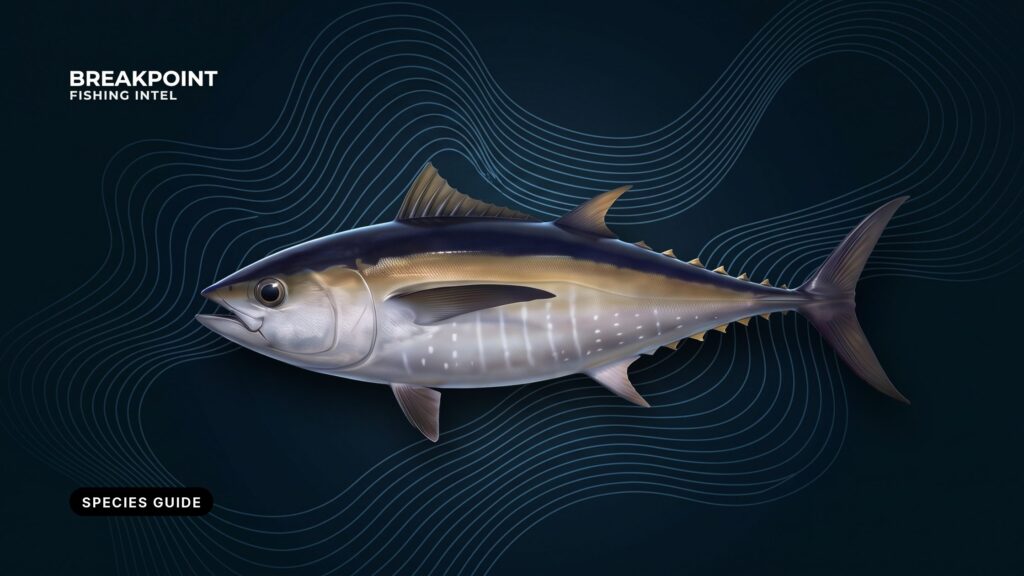
Blackfin tuna (Thunnus atlanticus) is the smallest Thunnus tuna and is found only in the western Atlantic, from Martha’s Vineyard to Rio de Janeiro. It holds in oceanic water near the coast, usually just seaward of the shelf, according to the Florida Museum species profile. That puts it within day-trip range for a center console rather than at the end of a canyon run.
This guide covers how to identify the fish, where it holds, how it is caught, and which rules apply. It should help you decide where to look and what you can keep. It does not promise fish.
| Fact | Value |
|---|---|
| Scientific name | Thunnus atlanticus |
| Family | Scombridae (mackerels and tunas) |
| Range | Western Atlantic, about 40°N to 22°S, including the Caribbean and the Gulf of America |
| Common size | To 28 inches (FWC); average catch 72 cm fork length, 6 to 7 kg (ICCAT) |
| Temperature floor | About 20°C (68°F) |
| Depth | 90% of time at 0 to 187 ft (0 to 57 m) in northern Gulf tagging |
Identification
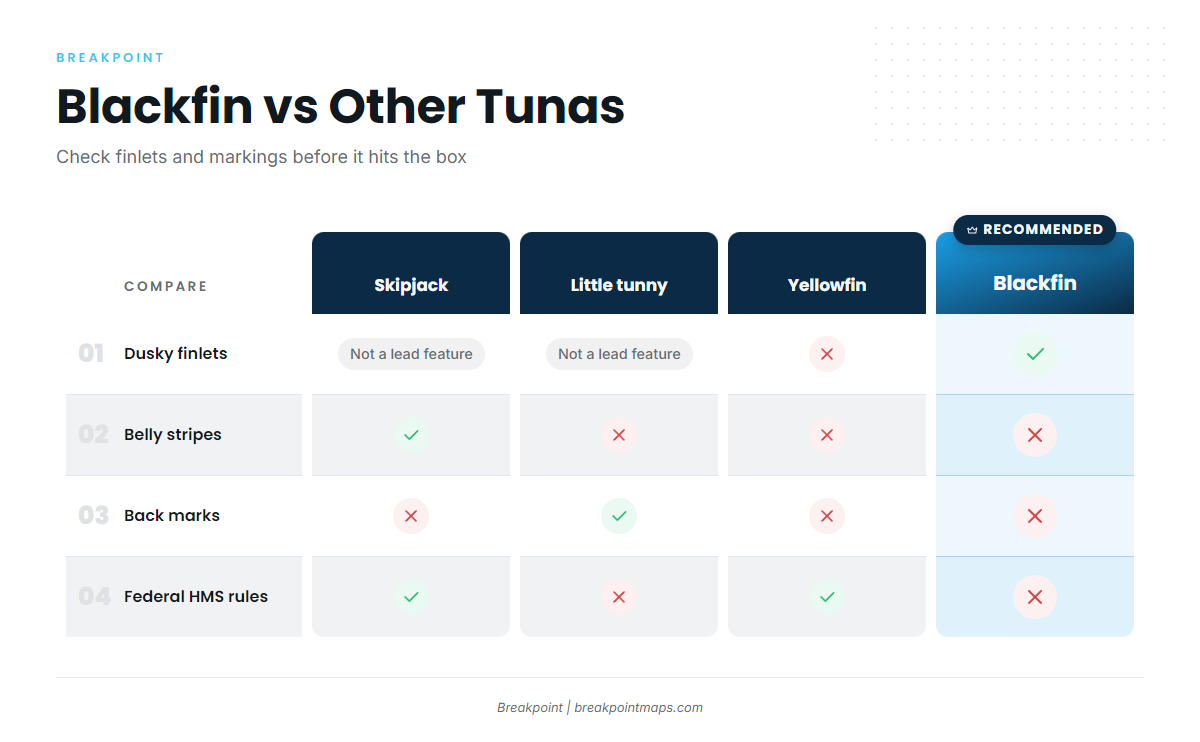
Check the finlets first. Blackfin finlets are dusky, with no bright yellow, and on a thrashing fish at the gaff they are the one feature you can read in two seconds.
Blackfin frequently school with skipjack, yellowfin and little tunny (ICCAT), so the fish on the deck is not always the fish you saw boiling. Check every fish before it goes in the box. This matters legally as well as practically: yellowfin and skipjack follow federal Highly Migratory Species (HMS) rules, so a misread fish is a compliance problem. The Regulations section below explains the split.
Length for any size rule is fork length, measured from the tip of the snout to the fork of the tail.
| Species | Finlets | Body markings | Rules (summary) |
|---|---|---|---|
| blackfin tuna | Dusky, no bright yellow | No belly stripes, no back marks | FWC (Florida); not HMS-managed |
| yellowfin tuna | Yellow | No back marks | Federal HMS; HMS Angling Permit |
| skipjack tuna | (not a lead feature) | Dark stripes along the belly | Federal HMS; HMS Angling Permit |
| little tunny | (not a lead feature) | Wavy marks on the back, spots on the lower side | FWC: 2 fish or 100 lb per day, whichever is more |
| bigeye tuna | Check closely; do not keep on a guess | (no features stated) | Federal HMS; HMS Angling Permit |
Yellowfin, skipjack and bigeye each have their own profile in our other tuna guides.
If a doubtful fish shows yellow in the finlets, treat it as HMS-managed until proven otherwise.
Habitat and range
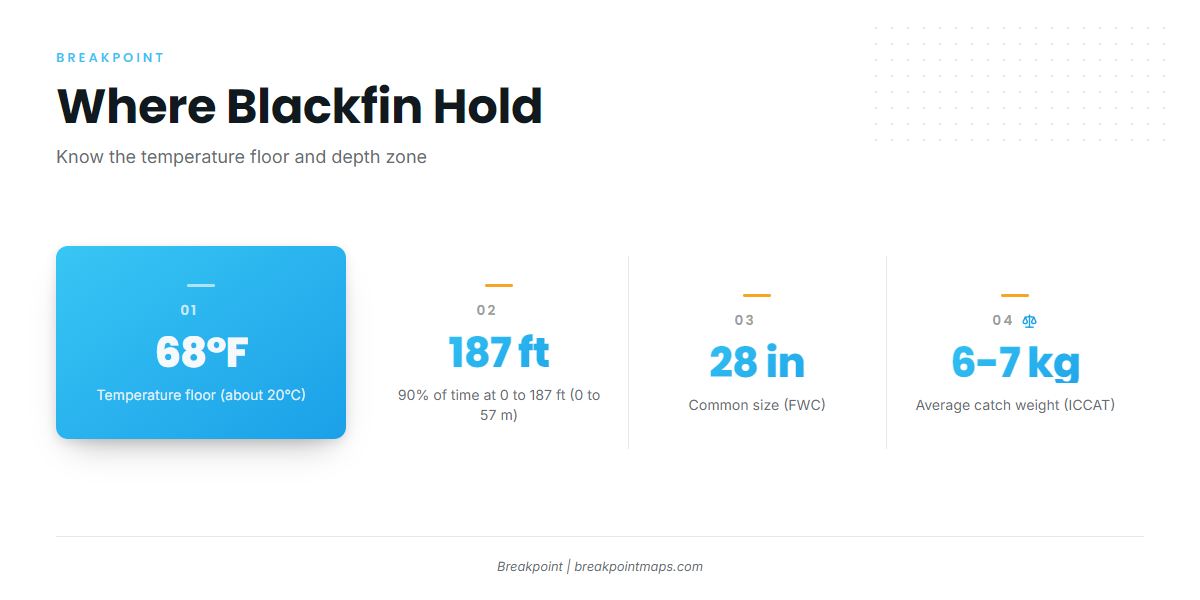
Temperature and depth explain most of where blackfin sit, so learn both before you pick a method.
- Range. Martha’s Vineyard, Massachusetts, south to Rio de Janeiro, including the wider Caribbean and the Gulf of America. The species lives in the western Atlantic only.
- Water type. Oceanic water near the coast, usually seaward of the continental shelf. Blackfin are epipelagic, meaning they live in the upper water column.
- Temperature. The minimal isotherm is about 20°C (68°F), per the ICCAT blackfin species manual. Northern Gulf tagged fish spent 89% of their time at 21.9 to 26.6°C (about 71 to 80°F). In summer, blackfin move into water above 70°F (21°C). Water below about 68°F is the edge of the map for this fish.
- Depth. Tagged fish spent 90% of their time at 0 to 187 ft (0 to 57 m), with dives to 712 ft (217 m). That tagging comes from the northern Gulf only.
- Size. Common to 28 inches. Average catch is 72 cm fork length and 6 to 7 kg. The largest recorded is 108 cm fork length and 20.6 kg.
- Age. Blackfin are short-lived, though longevity can exceed 5 years. They mature at 16 to 20 inches (40 to 50 cm).
- Movement. Some populations may be migratory and others resident. Some tagged fish were recaptured at their release sites after almost 4 years.
Where and when: regions
Timing shifts by region, and the regional guides carry the place-level detail. Start with our regional guides. This section gives the spawning windows and the structure that defines each coast.
| Region | Defining structure | Spawning window |
|---|---|---|
| Atlantic Southeast | Keys humps, Gulf Stream edge off Southeast Florida | April through November along the Florida coast |
| Gulf of America | Oil rigs, shrimp boats, Florida’s west coast | June to September, peak June to July |
| Northern range | Northern limit off Martha’s Vineyard | Not covered here |
Atlantic Southeast: Keys and Southeast Florida to the Carolinas
The Keys humps define this coast: the Islamorada Hump, Marathon Hump and 409 Hump. Farther north, the Gulf Stream edge off Southeast Florida concentrates fish, and the range reaches toward the Carolinas. Spawning along the Florida coast runs April through November, according to the Florida Museum. Details are in our guide to blackfin tuna in the Atlantic Southeast.
Gulf of America: rigs, shrimp boats and Florida’s Gulf coast
In the Gulf, oil rigs and shrimp boats act as structure and chum sources, and Florida’s west coast holds fish along wrecks and live bottom. Spawning runs June to September, with a peak in June to July. For a local example, see blackfin off Sarasota. For the wider basin, see blackfin tuna in the Gulf.
Northern range
The northern limit is off Martha’s Vineyard. It ties back to the 20°C floor: fish push north only as warm water allows.
How blackfin feed and move
Fish lead the diet, followed by cephalopods and crustaceans. FishBase lists squids, shrimps, crabs, stomatopods and decapod larvae. A fish that eats small shrimp larvae and baitfish reacts to small offerings, which is why you scale down.
Blackfin school strongly, and surface schools are easy to spot when birds are present. These cues help:
- Birds. Working birds over a school mark fish at the surface.
- Bait schools. Tight bait on the sonar or breaking at the surface holds tuna underneath.
- Fish-holding structure. Humps, ledges, rigs and wrecks stack bait and hold fish.
- Edges. Temperature breaks, the Gulf Stream edge and color breaks concentrate bait inside the 20°C floor and the 0 to 187 ft comfort zone.
Check OBS SST for temperature edges above about 70°F, Chlorophyll for color breaks, and Chart Contours for humps and ledges. SST does not see through cloud, so a cloudy pass tells you nothing about that day’s edge. Chart layers are not for navigation.
How to catch blackfin tuna
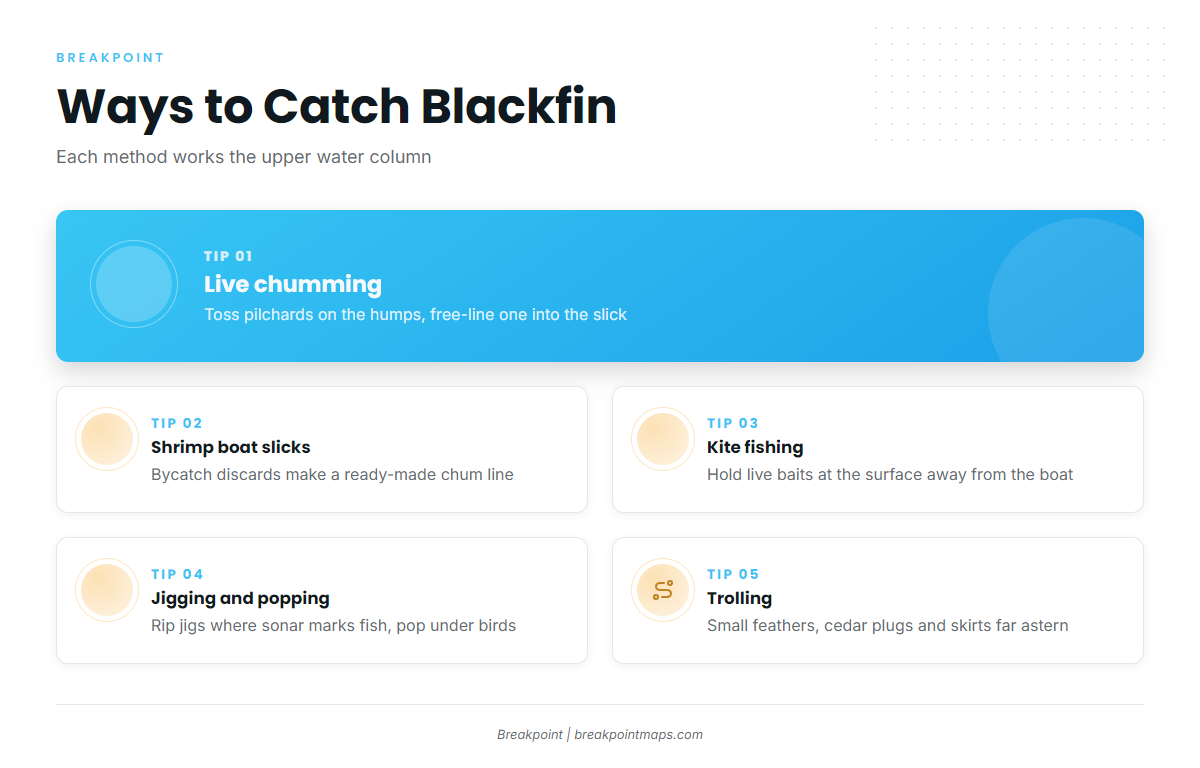
Because blackfin spend most of their time in the upper water column, they can be chummed up or reached with jigs. Each method below follows from that.
Live chumming on the humps
Live chumming with pilchards is the core Keys method. Work the Islamorada Hump, Marathon Hump or 409 Hump. Toss handfuls of live bait to pull fish up, then free-line a bait into the slick on minimal terminal tackle. Use Chart Contours to find the hump edge.
Shrimp boat slicks
Shrimp boats discard bycatch, creating a ready-made chum line. This works off Key West and across the Gulf of America. Fish near oil rigs in the Gulf as well.
Kite fishing
Kite fishing is a Southeast Florida method. It suspends live baits at the surface away from the boat. Boats often fly a kite off each side.
Vertical jigging and popping
Drop a butterfly or speed jig to where the sonar marks fish, then work it up with sharp rips. Use poppers when fish break the surface under birds.
Trolling small lures and feathers
Troll small feathers, cedar plugs and small skirts set far astern, with bird-style teasers ahead of them. Trolling and drift fishing are the documented methods outside Cuba.
Tackle principles
- Light conventional and spinning gear.
- Fluorocarbon leader.
- Scale down leader and hooks for sharp-eyed fish.
- Circle hooks for live bait.
Handling
Confirm the ID, bleed the fish promptly, then ice it promptly. Blackfin meat is firm and red, and quality depends on cooling the fish quickly. It eats well raw or cooked.
To pick your spot, start with the regional guides and the map layers.
FAQ
What is the blackfin tuna bag limit in Florida?
The limit is 2 per person or 10 per vessel per day, whichever is greater, in state and federal waters off Florida (FWC). Six anglers aboard may keep 12 fish. Check the FWC page before fishing.
Do I need an HMS Angling Permit for blackfin tuna?
No, according to the FWC. Yellowfin, skipjack, bigeye, albacore and bluefin on the same boat do require the permit and follow federal rules, so sort the catch by species before deciding what goes in the box.
How do you tell blackfin from yellowfin tuna?
Check the finlets. Blackfin finlets are dusky, with no bright yellow; yellowfin finlets are yellow. Blackfin often school with yellowfin and skipjack, so check every fish individually. Profiles of the other species are in our other tuna guides.
Is there a size limit or closed season for blackfin tuna?
In Florida there is no minimum size and the season is open year-round (FWC). Rules can change, so confirm on the agency page before you fish.
How big do blackfin tuna get?
Blackfin are common to 28 inches (FWC). The average catch is 72 cm fork length and 6 to 7 kg. The largest recorded is 108 cm fork length and 20.6 kg (ICCAT).
What water temperature do blackfin tuna need?
The floor is about 20°C (68°F). Northern Gulf tagged fish spent 89% of their time at 21.9 to 26.6°C (ICCAT). OBS SST shows temperature edges, but it does not see through cloud.
Download Breakpoint from the App Store or Google Play to see where the edges, humps and color breaks line up for your port.