




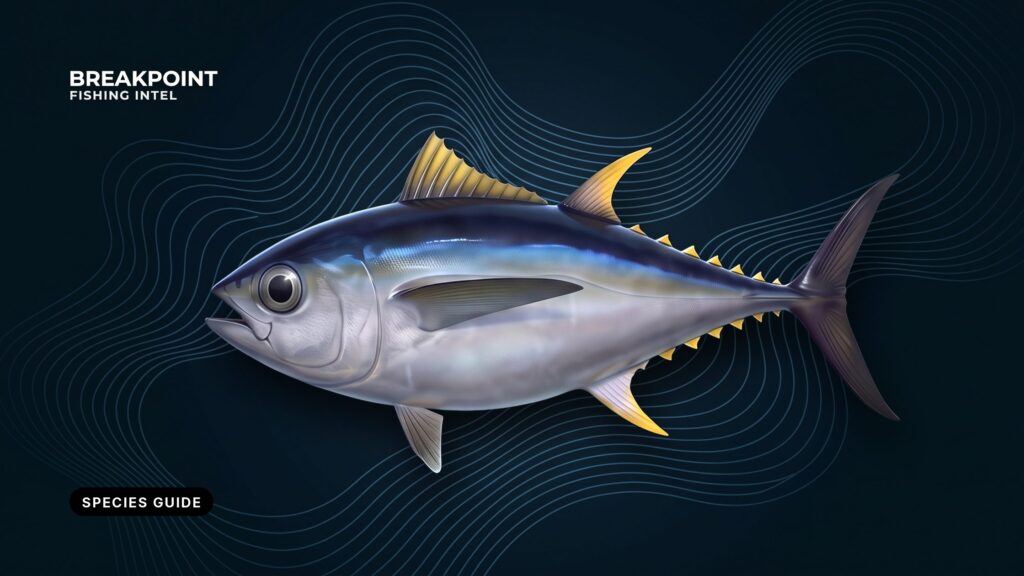
Bigeye look enough like yellowfin to fool good crews, and the difference decides what goes in the box and what goes on the report. Thunnus obesus is a federally managed species, and NOAA Fisheries manages it as a highly migratory species. This guide covers how to identify bigeye, where they live, how they feed and move, how they are caught, how to find them on the map, and how federal and state rules divide. A temperature break over steep structure is where to start looking.
Identification
Bigeye and yellowfin look similar and are hard to separate without experience. The reliable checks are eye size, second dorsal and anal fin length, body depth, finlet edges and the liver.
Misidentification has legal consequences. In Atlantic HMS rules, bigeye and yellowfin share a 27-inch curved fork length minimum, but retention and reporting rules differ by species, so the species you record has to be right. The Regulations section below covers the rules.
Check the liver as soon as the fish is landed, before the striations fade. In bigeye the margin is striated and the right and left lobes are about equal. In yellowfin the liver is smooth and the right lobe is clearly longer. This liver check for tuna ID shows the difference side by side.
Bigeye vs yellowfin vs albacore vs blackfin
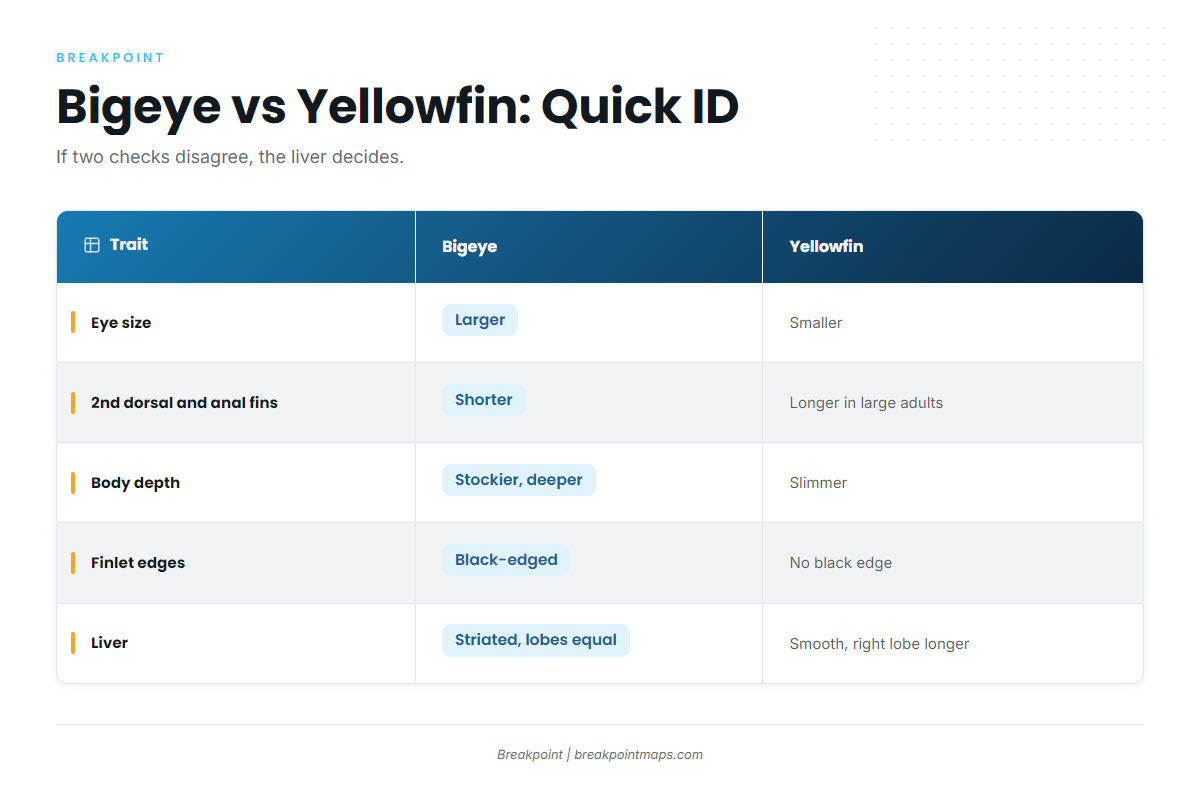
| Trait | Bigeye | Yellowfin | Albacore | Blackfin |
|---|---|---|---|---|
| Eye size | Larger | Smaller | See tuna fishing guides | Smaller tuna, see tuna fishing guides |
| Second dorsal and anal fins | Shorter | Longer, and long in large adults | Very long pectoral fin | See tuna fishing guides |
| Body depth | Slightly stockier and deeper | Slimmer | See tuna fishing guides | Smaller tuna |
| Finlets | Black-edged | Not black-edged | See tuna fishing guides | Dark finlets |
| Liver | Striated margin, right and left lobes about equal | Smooth, right lobe clearly longer | See tuna fishing guides | See tuna fishing guides |
Swipe the table sideways to see every column.
Detail on yellowfin, albacore and blackfin is in our tuna fishing guides. If two checks disagree, the liver decides.
Range and seasons
NOAA Fisheries places bigeye in tropical and warm temperate waters of the Atlantic, Pacific and Indian Oceans. The western Atlantic range runs from southern Nova Scotia to Brazil, and in US Atlantic waters bigeye are caught from Massachusetts to Florida. NOAA’s Pacific page gives a favored temperature range of 55 to 84°F.
Seasonal timing follows warm water rather than the calendar. Place-level detail is in our regional fishing guides.
Regional patterns at a glance:
- Northeast and Mid-Atlantic: canyons from Hudson to Norfolk are the core grounds.
- Southeast and Gulf: steep shelf-edge structure and the edges of the Gulf Stream.
- Southern California: occasional fish when warm water from the south arrives.
- Hawaii: seamounts, submarine ridges, buoys and fish aggregating devices.
Northeast and Mid-Atlantic canyons
Bigeye arrive in the canyons with warm blue water, and Gulf Stream eddies push that water onto the shelf. The trigger to watch is a temperature break over the 100-fathom curve.
Canyon corners and notches, where the walls meet the shelf, trap bait. In years when blue water does not reach the canyons, fishing is slow. Canyon-by-canyon detail is in our Atlantic Northeast bigeye guide.
Southeast and Gulf
Bigeye follow steep shelf-edge structure and the edges of the Gulf Stream, and the US Atlantic catch extends to Florida. Gulf rules route tunas to Atlantic HMS, covered under Regulations. Southeast detail is in our Atlantic Southeast bigeye guide.
Southern California
Per NOAA Fisheries, bigeye come within range off California when warm water from the south brings them in. Treat them as occasional.
Hawaii
"Ahi" covers both bigeye and yellowfin, so identification matters at the dock. According to NOAA Pacific, bigeye group near seamounts and submarine ridges. They also associate with buoys and fish aggregating devices, and when they do they stay in shallower water than their usual daytime depth.
NOAA lists hook-and-line and troll gear for the islands. Pacific and Hawaii detail is in our regional fishing guides.
Feeding and movement
Bigeye eat fish, squid and crustaceans, according to NOAA, and FishBase adds that they feed day and night. The FishBase species profile for bigeye gives a depth range of 0 to 1,500 m, usually 0 to 500 m, and a temperature optimum of 17 to 22°C (about 63 to 72°F).
NOAA Atlantic says bigeye dive to about 800 feet by day, and that daytime depth drives how they are caught.
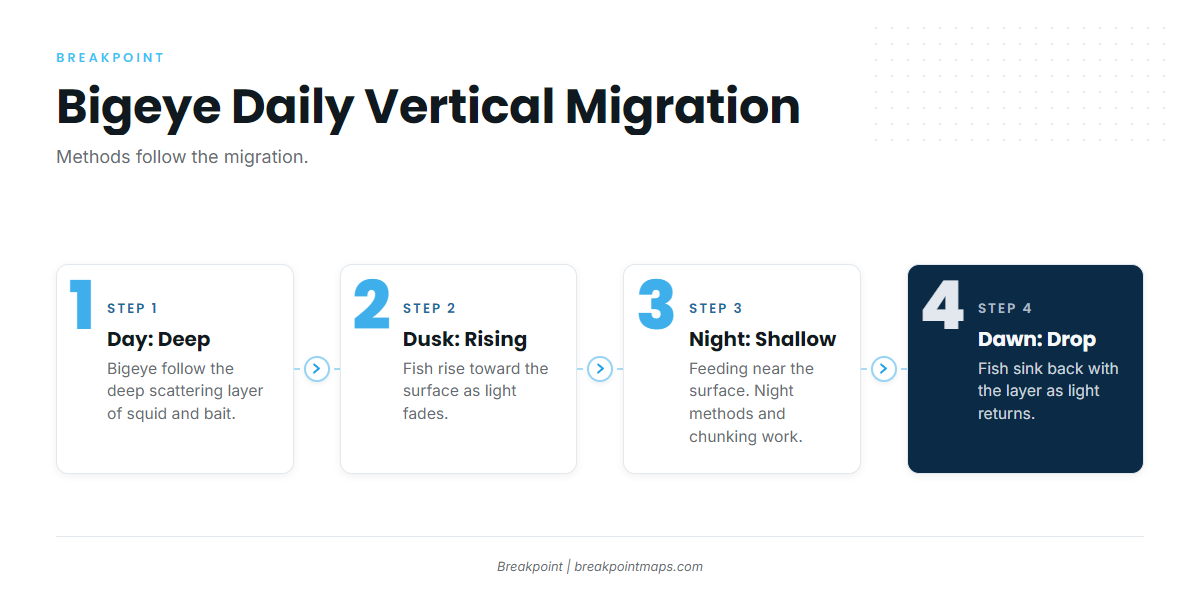
Vertical migration works like this:
- Large eyes suit low light.
- By day, bigeye follow the deep scattering layer of squid and bait down.
- They rise toward the surface at dusk and through the night.
In practice, that means watching dawn and dusk windows, night methods, and squid showing on the sounder.
Daytime fish sit near or below the thermocline, deeper than anything a surface chart shows. That is a limit of satellite data, not a flaw in the method.
Per NOAA Pacific, schools may associate with floating objects and with large, slow animals such as whale sharks. Juveniles school with skipjack and yellowfin.
How bigeye are caught
Methods follow the vertical migration. Fish are deep by day and shallow at night, so the approach changes with the light.
Night trolling. Work canyon edges, following the contours.
Night chunking. Drift across the canyon chunking butterfish or squid. Jigging near deep drop-offs is a companion method.
Daytime and low-light trolling. Run spreader bars and large teasers in a tight spread, with deep-diving plugs behind them. Bigeye respond to surface disturbance near the transom.
Tackle. Heavy stand-up conventional tackle is the standard.
Some captains read whales in the area as a good sign, though it is a signal rather than a guarantee.
NOAA notes that commercial Atlantic fishermen mainly use pelagic longlines, and that this gear rarely contacts the seafloor, which fits bigeye’s life in the water column.
Finding bigeye on the map
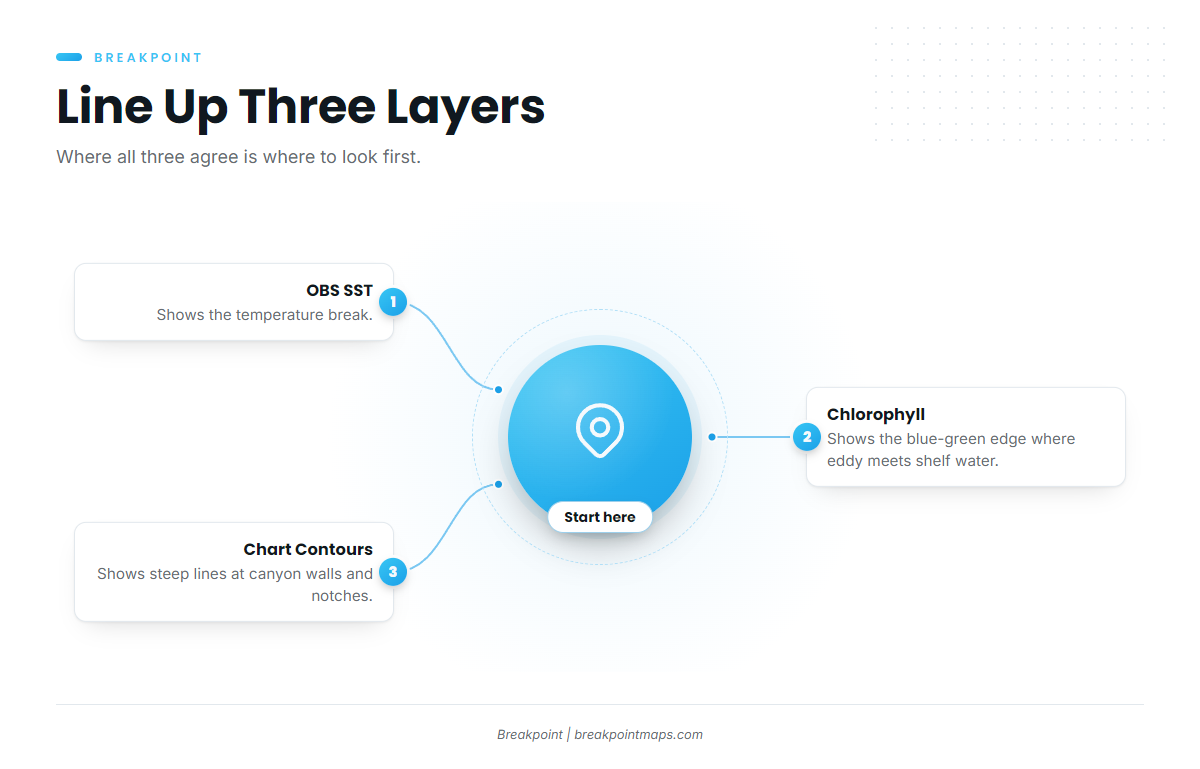
A temperature break over steep structure is the starting point. Three layers in Breakpoint show it:
- OBS SST shows the break.
- Chlorophyll shows the blue-green edge where eddy water meets shelf water.
- Chart Contours show the steep lines at canyon walls and notches.
Where all three line up is where to look first.
There are limits. SST shows the surface, not the thermocline where bigeye spend the day. Cloud blocks satellite passes, so check the pass time. Chart layers are not for navigation.
Care of the catch
Order of work:
- Check the liver first, before the striations fade.
- Bleed the fish.
- Bring the core temperature down fast in an ice and saltwater slurry.
The flesh discolors when exposed to air, so keep cut surfaces covered. Tunas must be landed with at least the tail and one pectoral fin attached. See Regulations.
FAQ
How do you tell a bigeye from a yellowfin?
Look for the larger eye, shorter second dorsal and anal fins, black-edged finlets and a stockier body. The liver decides it: a striated margin with equal lobes means bigeye. Check it right after landing, before the striations fade.
What is the size limit for bigeye tuna?
In Atlantic and Gulf federal waters, the minimum size for bigeye tuna is 27 inches curved fork length. Pacific rules come from the Pacific agencies, so check them before fishing.
Do I need a permit to fish for bigeye?
In the Atlantic and Gulf, yes. The vessel needs an HMS Angling or HMS Charter/Headboat permit. It covers everyone aboard and does not travel to another boat.
Who regulates tuna in state waters?
Federal HMS rules apply, and so do state rules. The fish must meet both. Check NOAA HMS and the state agency before fishing.
When do bigeye feed?
They feed day and night. By day they feed deep with the scattering layer, and at dusk and through the night they feed shallower. That is why dawn, dusk and night windows produce.
Where are bigeye caught in the US?
In the Atlantic, they are caught from Massachusetts to Florida, with the canyons from Hudson to Norfolk at the core. In Hawaii, they are caught near seamounts, buoys and fish aggregating devices. Off California, they show up when warm water from the south arrives.
Are bigeye retention limits fixed?
No, they can change. The NOAA HMS page sets retention and reporting rules, so check it before fishing.
Before the next run, line up OBS SST, Chlorophyll and Chart Contours in the app to decide where to look.