




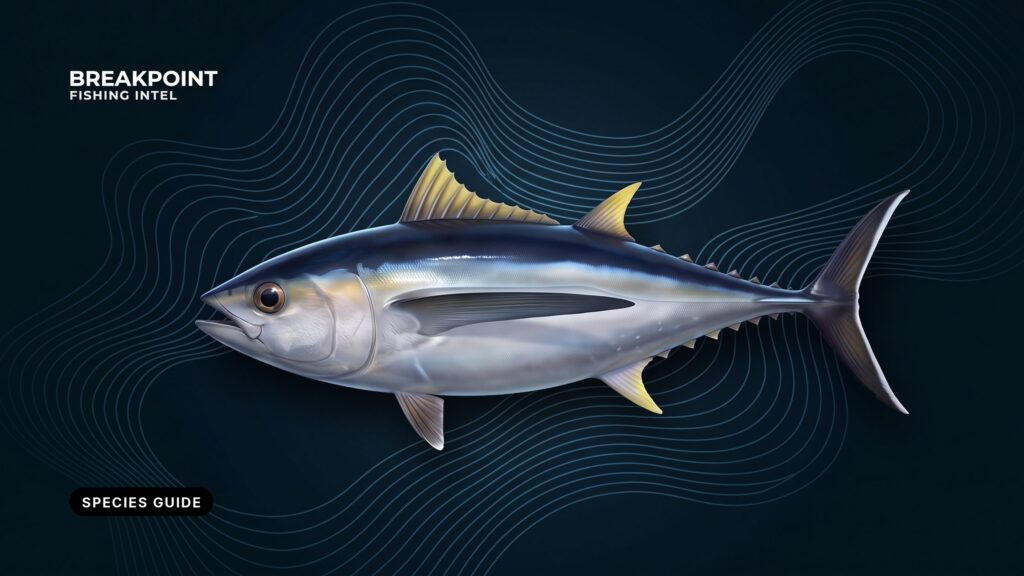
Albacore (Thunnus alalunga) are migratory, open-ocean, temperate tuna. US anglers catch them in the West Coast EEZ from Southern California to Washington, off Hawaii (where the fish is called tombo) and in the Atlantic. Three things decide a trip: water, distance and rules.
This albacore tuna fishing guide covers how to identify the fish, where and when it shows, how to find and work a school, and how federal and state rules divide. It also covers what spread to run, which permit or endorsement applies, and how to care for the fish on the ride home. Read it the night before a run.
We read the water first. A good chart will not promise fish, but it makes the decision about where to look a better one. Two terms come up throughout. HMS means highly migratory species. EEZ is the federal zone from 3 to 200 nautical miles. State waters end at 3 nm.
Identification
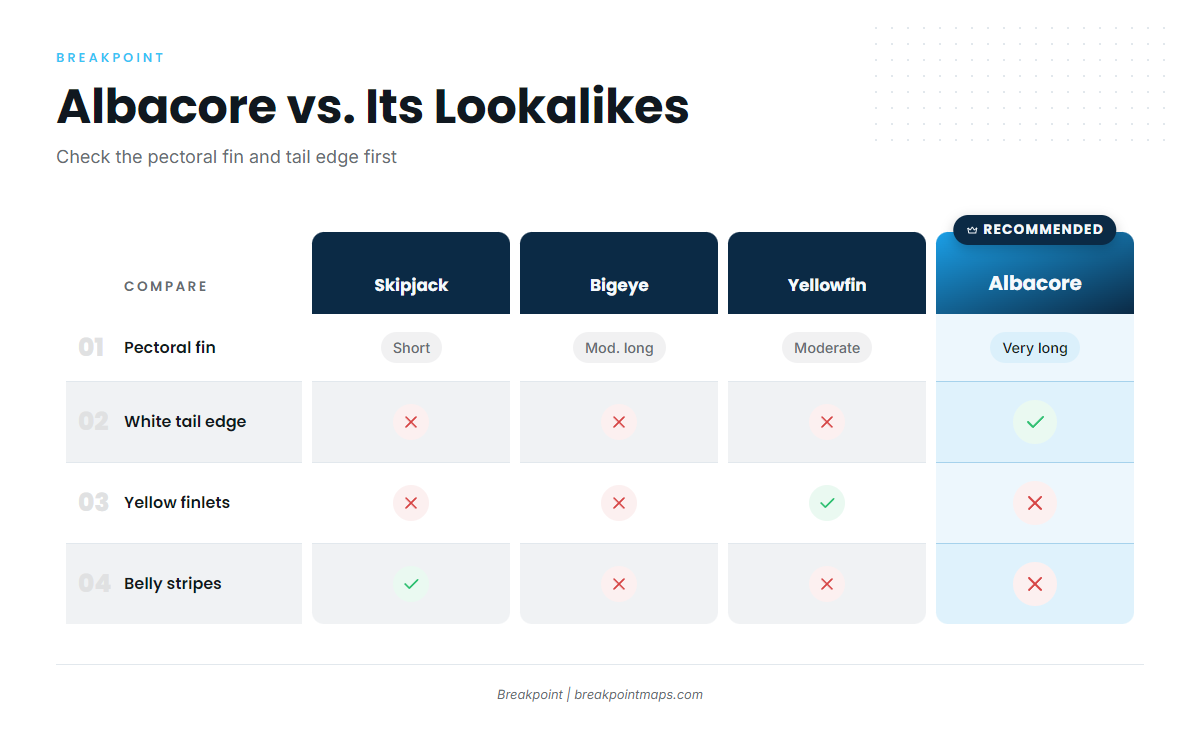
The long pectoral fin is the standard field mark for albacore. Look for these features:
- A very long, sickle-like pectoral fin.
- A thin white trailing edge on the tail.
- A deep, spindle-shaped body with a dark blue back and a silvery belly.
Use this table to separate albacore from the tunas most often mistaken for it:
| Species | Pectoral fin | Other field marks | Common mix-up |
|---|---|---|---|
| Albacore | Very long | White trailing edge on tail | None |
| Yellowfin | Moderate | Yellow finlets and a yellow side stripe; second dorsal and anal fins long on larger fish | Most common confusion |
| Bigeye | Moderately long on adults | Large eye, deep body | Can be confused with albacore on fin length |
| Skipjack | Short | Dark stripes running along the belly | Small schoolies |
| Pacific bluefin | Short | Heavy body, short fins | Same waters, separate limits |
The ID changes the count. In Washington, yellowfin, skipjack and northern bluefin are limited to 2 each per day, while albacore has no state daily limit. In California, yellowfin counts within the 20-finfish general limit, while albacore is counted in addition to it. A misidentified fish can put you over a limit you did not know applied.
For the other tunas you may find in the same water, see the other tunas in our tuna fishing guides.
False albacore, also called little tunny, is a different fish. The FAQ covers it.
Where and When: Albacore by Region
On the West Coast, albacore are a summer and early-fall fishery, and the run is long. Use the table as a starting point, then go to the agency for specifics.
| Region | Timing | Typical run | Source agency |
|---|---|---|---|
| Washington / Oregon | Summer and early fall; August and September most popular (WDFW) | Typically 40 to 100 miles off Washington (WDFW) | WDFW, ODFW |
| California north of Point Conception | Fish reach the US coast by late summer (NOAA) | Offshore EEZ water; 25-fish federal limit zone | CDFW, NOAA Fisheries |
| California south of Point Conception | Timing shaped by ocean temperature and clarity (NOAA) | Offshore EEZ water; 10-fish federal limit zone | CDFW, NOAA Fisheries |
| Hawaii (tombo) | See agency | See agency | Hawaii DAR |
| Atlantic | See agency | See agency | NOAA Fisheries Atlantic HMS |
In the Pacific Northwest, WDFW describes albacore as a summer and early-fall fishery. August and September are the most popular months, and anglers typically fish 40 to 100 miles off the Washington coast. Westport, Ilwaco and Newport are the ports most anglers run from. For port-level detail, see albacore fishing in the Pacific Northwest.
In California, Point Conception (34°27′ N) splits the federal limits. It sets your bag limit for the whole trip, so it matters more than the calendar.
Hawaii anglers know the fish as tombo, and Hawaii DAR is the agency to check. In the Atlantic, NOAA Fisheries manages albacore through its Atlantic HMS Division, and a permit is required to harvest.
For port-level detail in California, Hawaii and the Atlantic, see our regional fishing guides.
Feeding and Movement
Albacore on the West Coast are on a long migration. According to NOAA Fisheries, North Pacific albacore migration starts with juveniles of 2 to 4 years in spring and early summer off Japan. They reach inshore waters off the US Pacific coast by late summer, then spend late fall and winter in the western Pacific. Ocean temperature and water clarity shape the timing and extent of the movement, which is why the arrival date shifts from year to year.
Albacore feed on anchovy, sardine, saury and squid. Where those baitfish gather, the tuna follow.
Edges explain where bait gathers. Cooler, nutrient-rich upwelled water meets warmer, clearer offshore water. Plankton grows on the green side, bait stacks along the seam, and tuna work the edge. That seam is what you are looking for on the chart.
Finding Albacore: Reading the Water
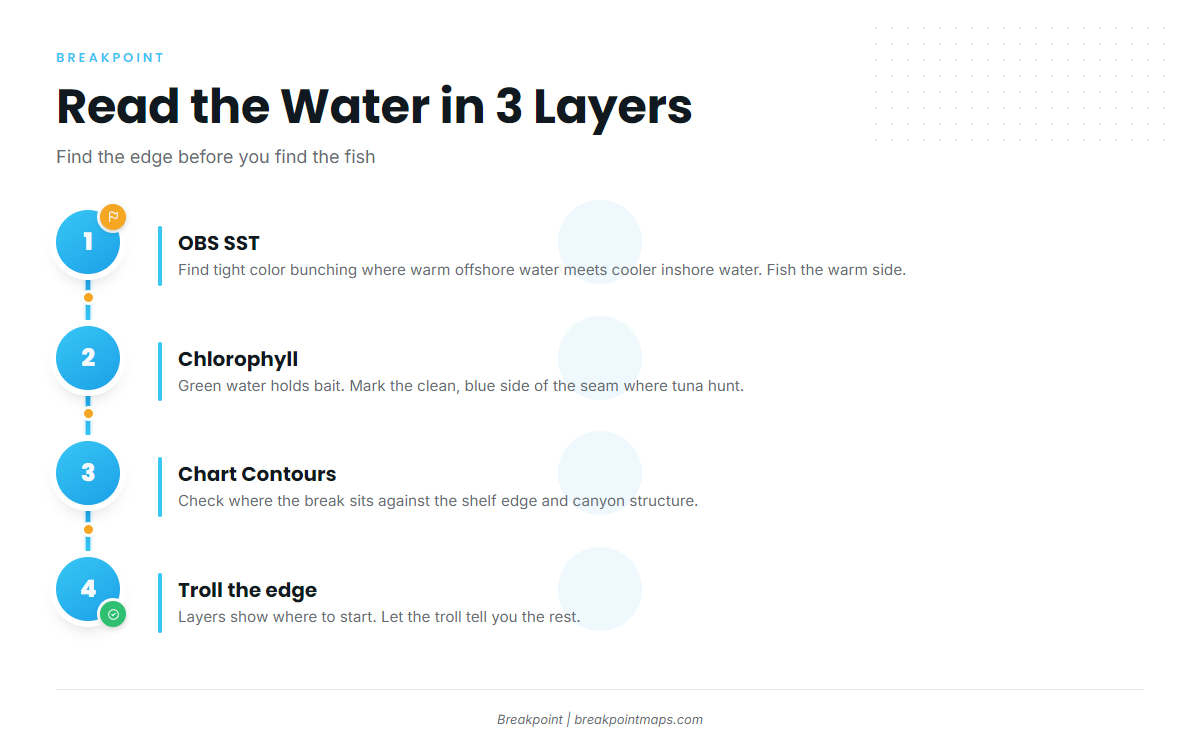
Find the edge before you find the fish. Albacore work the warm, clean side of a temperature break and a color break. Work through the layers in this order:
- OBS SST for the temperature break. Look for tight color bunching where warm offshore water meets cooler inshore water, and plan to fish the warmer side. Satellite SST passes are blocked by cloud, so gaps in the layer are gaps in the data, not cold water. We read the edge on OBS SST before we read the forecast.
- Chlorophyll for the clean side of the color edge. Green water holds plankton and bait. Blue water is where the tuna hunt. Mark the clean side of the seam. Chlorophyll is also blocked by cloud and lags behind the water itself.
- Chart Contours for the shelf break. Check where the break sits relative to the shelf edge and canyon structure, with depths in feet. Chart layers are not for navigation.
A chart layer shows yesterday’s water, not today’s fish. Use it to choose where to start, then let the troll tell you the rest.
How They’re Caught
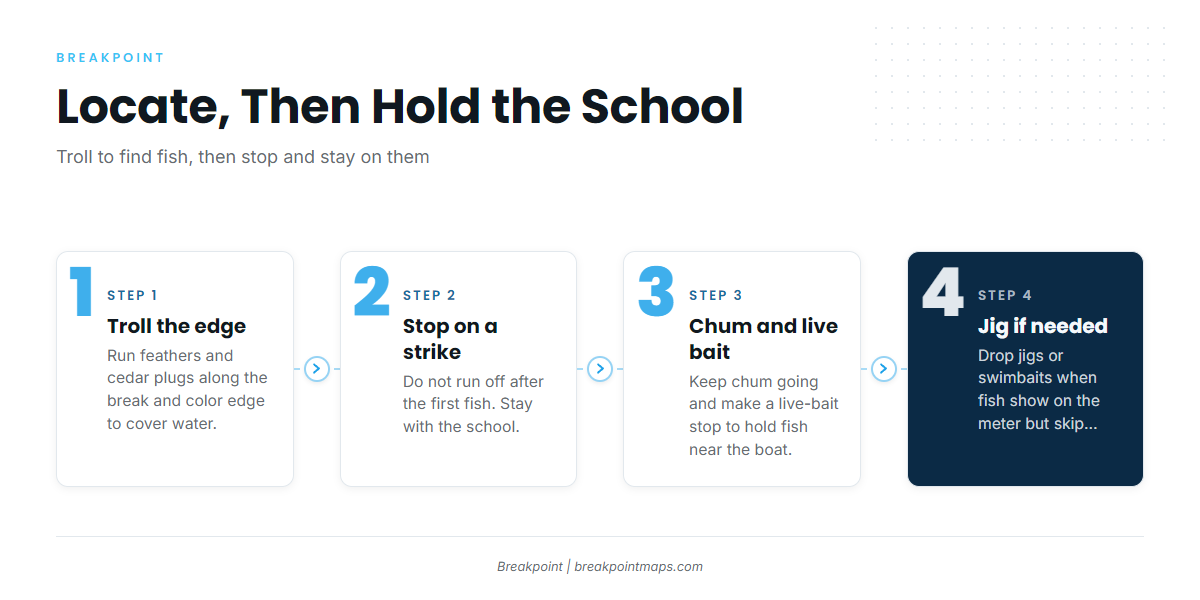
Troll to locate the school, then stop and hold it.
Trolling. Run a spread of tuna feathers and cedar plugs along the break and color edge. Trolling covers water and finds the school.
Holding the school: live bait and chum. When a strike comes, don’t run off after it. Pulling away from a school after the first fish is a common mistake. Make a live-bait stop and keep chum going to hold the fish near the boat. WDFW notes that live bait is productive when a tuna school is near the surface. In Oregon, beyond 3 miles with only offshore pelagics kept, chumming is allowed. See Regulations below.
Jigging. Use jigs and swimbaits when fish show on the meter but will not take trolled gear.
Gear. Use conventional or spinning tackle with a smooth drag and enough line capacity for long, fast runs. Salmon gear may not suit this work, so check drag and capacity before you reuse it.
Check the layers the night before, then check the NOAA/NWS marine forecast for wind, wave height and period.
Handling the Catch
Bleed albacore promptly. They are a high-activity fish with high blood volume, and an unbled fish keeps blood and lactic acid in the meat. Ice the fish quickly for the long ride home.
South of Point Conception, a federal filleting rule applies (50 CFR 660.721):
- Filleted tuna must be bagged individually, and each bag marked with the species’ common name.
- Each fish is cut into 6 pieces with the skin on.
- The 6 pieces are 4 loins, the collar as one piece with both pectoral fins attached, and the belly cut to include the vent with both pelvic fins attached.
The FAQ covers the mercury question.
Frequently Asked Questions
Do I need an HMS permit to fish for albacore?
Not on a private recreational vessel on the Pacific. The federal Pacific HMS permit applies to commercial and charter vessels. State licenses still apply, along with the Oregon Ocean Endorsement. In the Atlantic, NOAA Fisheries requires a permit to harvest albacore.
What is the albacore limit in California, Oregon and Washington?
California is 10 south and 25 north of Point Conception. Oregon is 25 per day in aggregate of offshore pelagics. Washington has no state limit. The federal EEZ limits are 10 and 25, and the agency pages carry the full rules.
Does Washington’s no-limit rule apply 50 miles out?
No. That water is in the EEZ, where the federal limit of 25 applies. WDFW sets no state limit, but the federal rule governs fish caught in federal waters.
How do I tell albacore from yellowfin?
Albacore have a very long pectoral fin and a white trailing edge on the tail. Yellowfin have yellow finlets and a yellow side stripe. The difference matters for your count in both California and Washington.
When is the Pacific Northwest albacore run?
Summer and early fall, with August and September the most popular months, per WDFW. Ocean temperature and water clarity shape the timing, so the window shifts from year to year.
Can I fillet albacore at sea in Southern California?
Yes, under the federal six-piece rule south of Point Conception. Each fish is cut into 6 pieces with the skin on, bagged individually, and each bag marked with the species’ common name.
Is albacore the same as false albacore?
No. False albacore, or little tunny, is a different fish, and it is what many Atlantic anglers mean by the name. It has its own rules, so check with NOAA Fisheries and your state agency.
Is mercury a concern in albacore?
Check the FDA and EPA fish consumption advice for current guidance on tuna. Those agencies publish recommendations by species and by who is eating the fish.
Closing
The decision chain is short: read the water, judge the distance, and know the rules before you leave the dock. This albacore tuna fishing guide gives you the standing facts for each step, and the agency pages carry anything that changes.
If you want the water read for you the night before, download Breakpoint from the App Store or Google Play. OBS SST, Chlorophyll and Chart Contours sit on one map, so you can pick where to start with better information.