




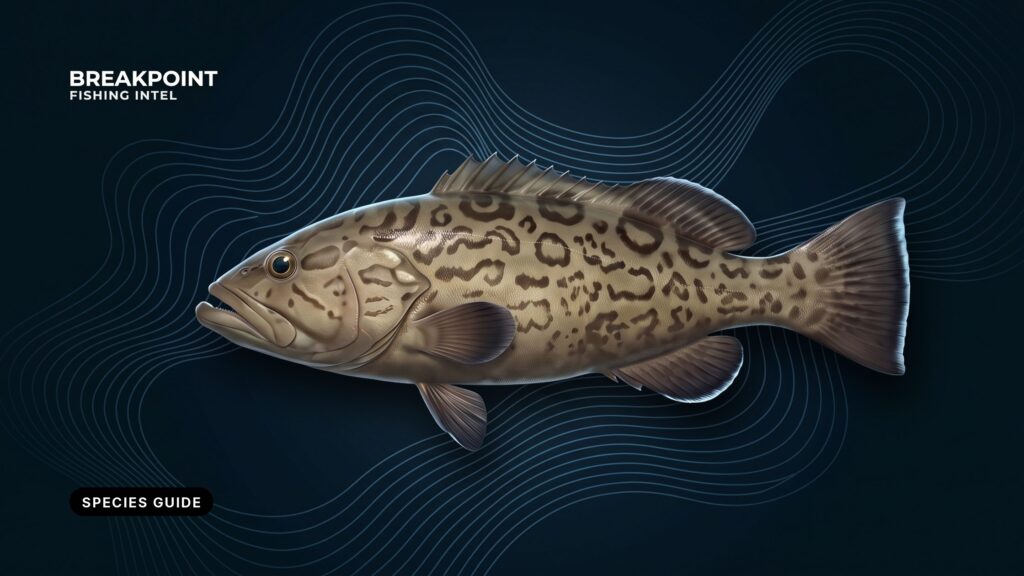
Gag grouper (Mycteroperca microlepis) are the most common grouper on rocky ledges in the eastern Gulf of America (Gulf of Mexico). Adults sit on hard bottom in 60 to 250 feet. Seasons are short and set against a catch limit, so this guide covers identification, where gag hold, how to get them out of the rock, and which agency’s rules apply at your waypoint. Gag is one of several bottom species in our reef fish guides.
Identify Gag Grouper
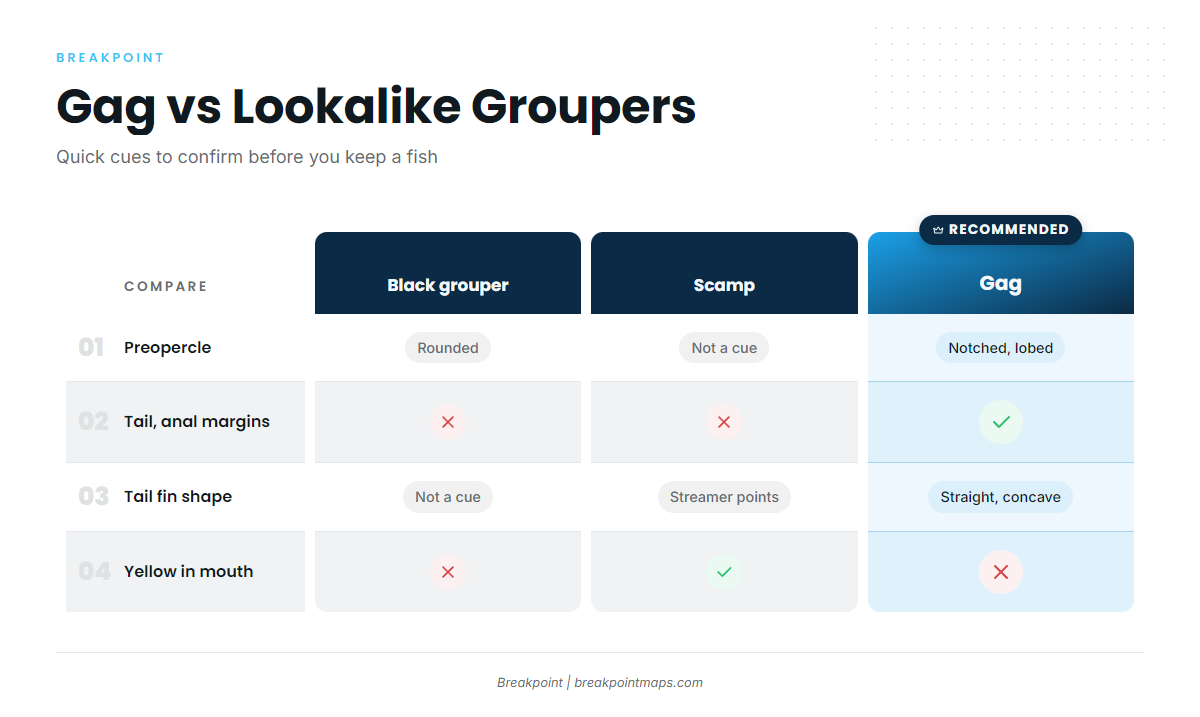
Gag grouper are brownish gray with dark, kiss-shaped marks along the sides. Large fish run darker on top and paler below. The tail is straight to slightly concave, the lower jaw projects past the upper, and the preopercle is notched. The tail and anal fins carry white margins.
Color and size cues come from the North Carolina Department of Environmental Quality. The preopercle and fin-margin cues are laid out in this gag vs black grouper cues reference.
Check these cues before you measure anything:
- Color and marks: brownish gray overall, with dark worm-like or kiss-shaped marks along the sides. Small fish are much lighter. Large fish are dark brownish gray on top and paler below.
- Tail shape: straight to slightly concave, not rounded.
- Jaw: the lower jaw projects past the upper.
- Body: long and compressed, with 11 to 14 rays in the anal fin.
Large males show a darker belly phase, sometimes called "copper-belly." NOAA and the Florida Museum place gag in the family Serranidae. FishBase places the species in Epinephelidae.
Gag vs Black Grouper and Other Lookalikes
| Species | How it differs from gag |
|---|---|
| Black grouper | Its preopercle is evenly rounded with no lobe. Gag has a notched, lobed preopercle. Gag has white margins on the tail and anal fins, and black grouper does not. |
| Scamp / yellowmouth | Has streamer-like points on the tail fin and yellow in and near the mouth. Gag has neither. |
| Red grouper | Check the straight to slightly concave tail, the projecting lower jaw and the preopercle notch on your fish before you decide. |
Size limits differ among these species. Gag and black grouper share a 24-inch limit. Red, scamp and yellowmouth are 20 inches in North Carolina state waters and South Atlantic federal waters. Our reef fish guides cover the sibling species.
Where Gag Grouper Live Across US Waters
According to NOAA, gag range mainly from North Carolina to the Yucatan Peninsula, including the Gulf. Juveniles turn up as far north as Massachusetts.
Where a gag lives depends on its life stage:
- Juveniles: estuaries, seagrass beds and oyster reefs.
- Adults: offshore on rock, reefs, wrecks, live bottom, ledges, and oil and gas platforms, at 60 to 250 feet. They are occasionally found deeper than 500 feet, per the LSU Sea Grant gag profile. Average size increases with depth.
Gulf of America
Spawning runs late January to mid-April, per NOAA. The west Florida Shelf is a major spawning ground, according to the Florida Museum. FWC has recorded active spawning at 70 to 100 m at Florida Panhandle sites. For place-level detail, see our guide to gag grouper off Tampa Bay.
South Atlantic
Spawning runs mid-January to early May, per NOAA, on grounds in the South Atlantic Bight.
| Region | Spawning window | Spawning grounds |
|---|---|---|
| Gulf | Late January to mid-April | West Florida Shelf; Florida Panhandle sites at 70 to 100 m |
| South Atlantic | Mid-January to early May | South Atlantic Bight |
| Both | January through May overall | Continental shelf |
Place-level structure and run distances are in our regional fishing guides.
How Gag Grouper Feed, Grow and Move
Feeding. Juveniles under 8 inches eat crustaceans in grass beds and switch to fish after about 4 months. Adults eat fish, crabs, shrimp and squid.
Growth. Growth is rapid until about 10 years, then very slow. Fish pass 40 inches by 10 years.
Size and age. Sources disagree on the top end. NOAA gives up to 50 lb. The FWC lists an 80 lb 6 oz Florida record caught near Destin, in its FWC gag grouper profile. NOAA says gag live up to 30 years. FishBase reports a maximum age of 31.
Sex change. Gag begin life as females and mature at about 4 to 6 years. According to NOAA and the Florida Museum, the change to male comes around age 8 to 11. Males are the older, larger fish, so heavy pressure on big fish removes them, which is why the stock is sensitive. Gag are overfished.
Movement.
- As fall cools, small gag move into deeper channels and offshore.
- Females form pre-spawning aggregations November to February, then move to deep spawning sites, per FWC.
- Females migrate offshore to males to spawn, according to the Gulf Council gag page.
- Adults hold territories until spawning age, living alone or in groups of 5 to 50.
How to Catch Gag Grouper
Bottom Fishing with Live and Cut Bait
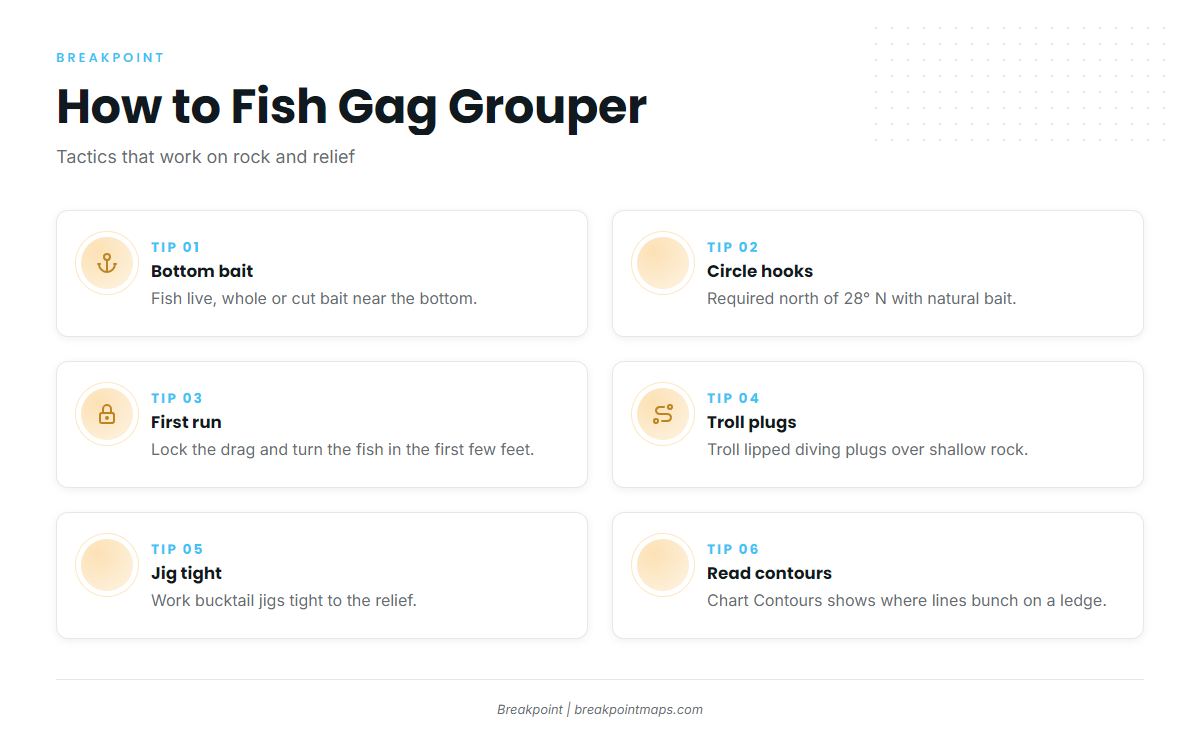
Fish live, whole or cut bait near the bottom on heavy tackle, per FWC. NC DEQ recommends cigar minnows and squid. Pinfish and sardines are typical baits that match the documented diet.
Gear checklist:
- heavy rod and reel,
- circle hooks (required in the South Atlantic north of 28° N with natural bait),
- dehooking tool,
- rigged descending device.
Stopping the First Run
After the bite, a gag heads straight for the rock. Fish with the drag locked and turn the fish in the first few feet. Lift and keep the pressure on. If the fish holes up, ease off and wait.
Trolling Deep-Diving Plugs
Troll lipped diving plugs over shallow rocky bottom and reef.
Vertical and Bucktail Jigs
Work the jig tight to the relief.
Spearfishing Gag Grouper
Spearfishing gear is authorized for South Atlantic snapper-grouper. Powerheads are prohibited. The 24-inch limit applies. More and larger fish sit where diver traffic is lighter, on deeper wrecks and reefs.
Finding Gag Structure
Depth finders locate rock piles, ledges, wrecks and artificial reefs, per NC DEQ. In Chart Contours, look for where the contour lines bunch along a ledge. That is relief, and relief holds gag. Artificial reefs show as isolated pockets of depth change off the main lines. Work from the shallow end of the depth range toward the ledge, and read the line spacing before you commit to a drift. For one worked example, see gag grouper off Tampa Bay.
Chart layers are not for navigation.
Releasing Gag and Barotrauma
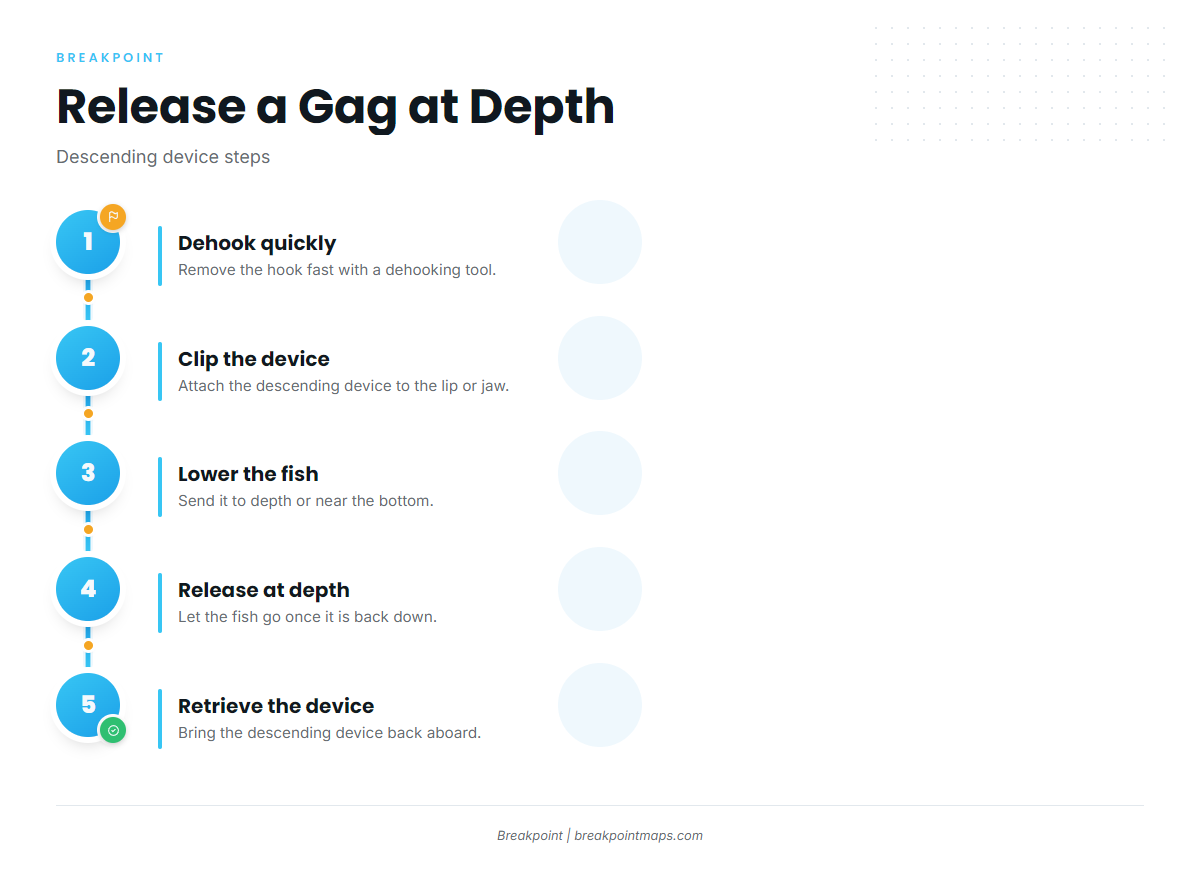
Gas expands as a fish comes up from depth. A descending device returns the fish to depth.
In the South Atlantic, the federal snapper-grouper gear rules require a descending device on board and ready, with at least 16 oz of weight on at least 60 ft of line, plus a dehooking device. For Gulf release-gear rules, check NOAA and the Gulf Council.
Release a fish at depth in five steps:
- Dehook quickly. Cut the leader if the hook is deep.
- Clip the device. Attach it to the lip or jaw.
- Lower the fish. Take it to depth or near the bottom.
- Release at depth. Let the fish swim free of the device.
- Retrieve the device. Rig it again for the next fish.
Frequently Asked Questions
How do I tell a gag from a black grouper?
Check the preopercle. It is notched and lobed on gag and evenly rounded on black grouper. Gag also carries white margins on the tail and anal fins. The size limit is the same for both, so the ID decides which species you log. Confirm any local rule with the agency.
What is the gag grouper size limit?
It is 24 inches total length in North Carolina state waters and South Atlantic federal waters, per NCDMF and SAFMC. Gulf size limits are set by NOAA Fisheries, the Gulf Council and the state agencies, including FWC. Check the agency for your zone before you fish.
Where do state waters end?
State waters run to 3 miles off the Carolinas and 3 nautical miles off Florida’s Atlantic coast. They run to 9 nautical miles off Gulf Florida and Texas. For Alabama, Mississippi and Louisiana, check ADCNR, MDMR or LDWF.
Can I keep a gag caught inshore?
Only if it meets the size limit and the season is open in that jurisdiction. Most inshore gag are juveniles and fall under the minimum. Check FWC or your state agency for the limit that applies at your location.
Why are gag seasons so short?
The stock is overfished, so NOAA and the councils set seasons against a catch limit, and seasons can close early. Sex change adds to the pressure: large males are the oldest fish, and heavy harvest removes them. Check NOAA Fisheries for the current closure status.
Do I need a descending device?
In the South Atlantic, yes. You need 16 oz of weight on 60 ft of line, plus a dehooking device, per the federal rule. In the Gulf, check NOAA and the Gulf Council for the release-gear requirement that applies to you.
Do I need the Florida State Reef Fish Angler designation?
Yes, if you fish from a private boat and are 16 or older, per SAFMC and FWC. It is free and annual. Check FWC for the current requirement before you fish.
What are the spearfishing rules for gag?
Spearfishing gear is authorized for South Atlantic snapper-grouper. Powerheads are prohibited, per SAFMC. The 24-inch limit applies. Check your state agency for any added gear rule in state waters.
Closing Line
Identify the fish, confirm which jurisdiction you are fishing in, and read the agency page before you go. Then use the regional guides for structure. To see where the ledges and relief sit before you leave the dock, download Breakpoint from the App Store or Google Play.