




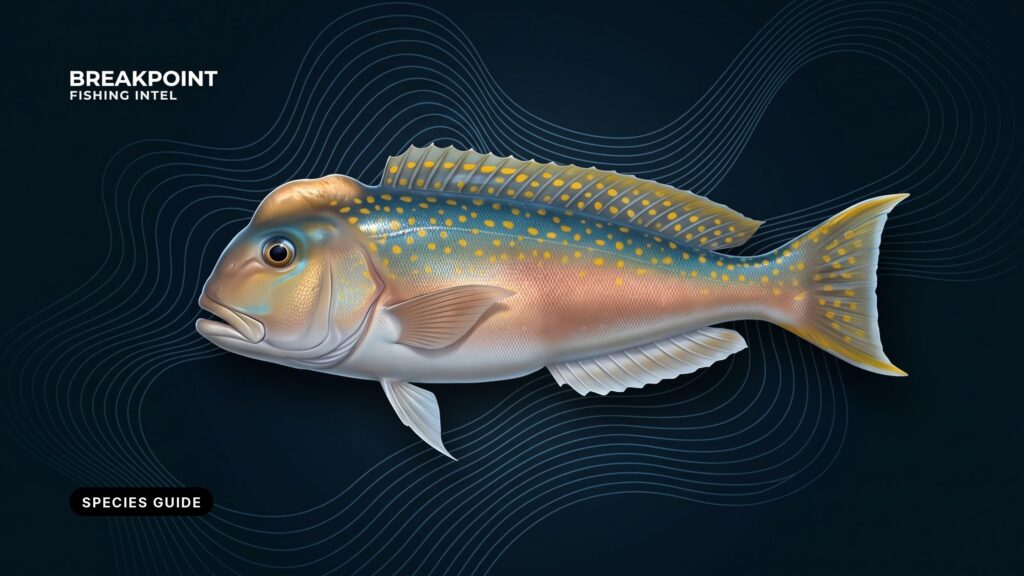
Golden tilefish (Lopholatilus chamaeleonticeps) is a burrowing fish of the outer continental shelf and upper slope, living at 250 to 1,500 ft where bottom water runs 49 to 58°F. You catch it by deep dropping heavy rigs onto mud and clay bottom. This field guide covers how to identify one, where it lives, how to find its bottom on a chart, and how the rules split between federal and state waters. Habitat comes first because where you drop is a chart decision, and the rules determine what you can keep once the fish is on deck.
How to identify a golden tilefish
SAFMC describes the golden tilefish as blue-green and iridescent on the back, with numerous bright yellow and gold spots. The belly is white. The head is rosy, with blue under the eyes. The pectoral fins are sepia, and the margin of the anal fin is purplish-blue.
The feature that settles identification is the crest. A golden has a fleshy predorsal crest forward of the dorsal fin, entirely separate from it. No other tilefish carries one.
Goldens grow big and live long. They reach 66 lb and 44 in and can live 45 years or more.
Golden vs. blueline vs. gray tilefish
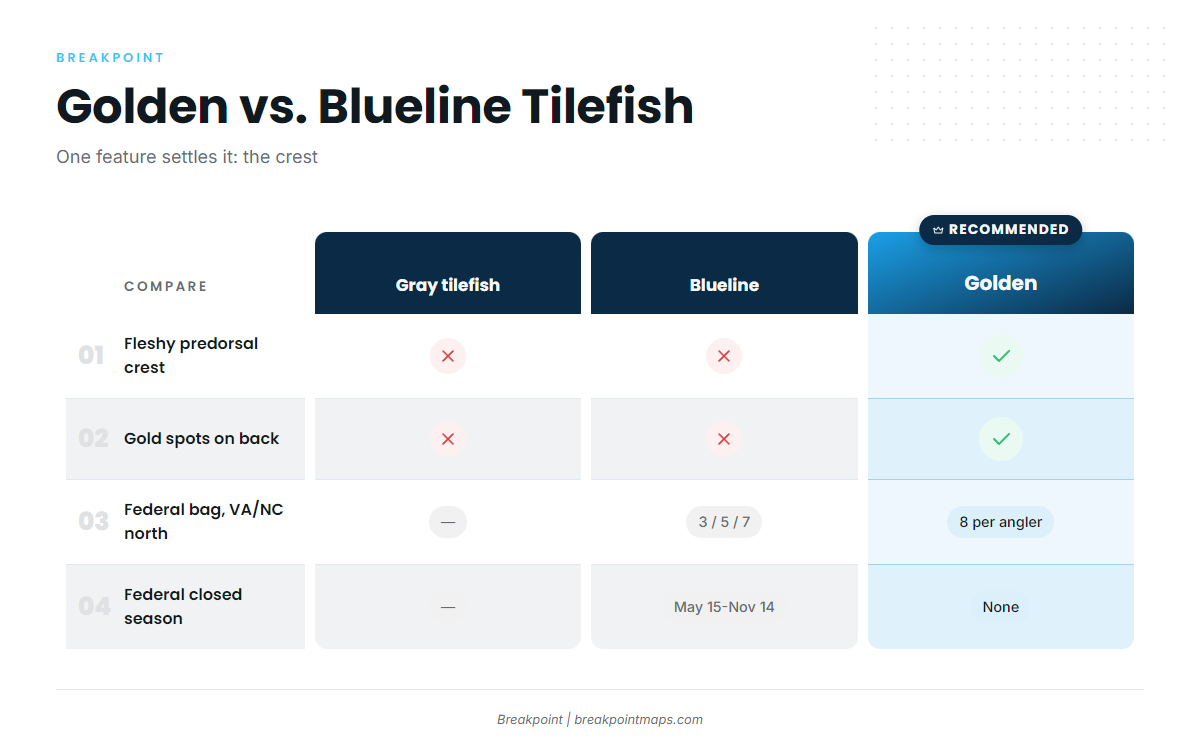
Blueline tilefish share the ground in parts of the range, and the rules for the two species differ. This table sets them side by side.
| Attribute | Golden tilefish | Blueline tilefish | Gray tilefish |
|---|---|---|---|
| Fleshy crest separate from the dorsal fin (key feature) | Yes | No | No |
| Scientific name | Lopholatilus chamaeleonticeps | – | – |
| Back coloration | Blue-green, gold and yellow spots | – | – |
| Federal bag, VA/NC line north | 8 per angler per trip | 3 private / 5 uninspected for-hire / 7 inspected for-hire | – |
| Federal season, VA/NC line north | No closed season in the federal rule | May 15 to November 14 | – |
If the crest is there and free of the dorsal fin, it is a golden.
Where golden tilefish live, region by region
Goldens live on the outer continental shelf and upper slope along the entire US East Coast and in the Gulf of Mexico, south to Venezuela. SAFMC puts them at 250 to 1,500 ft, where bottom temperatures run 49 to 58°F. For place-level grounds, see our regional fishing guides.
The regions break down like this:
- Northeast and Mid-Atlantic: Outer-shelf and canyon-slope ground.
- Southeast: Practitioners report working 500 to 900 ft off South Florida and 600 to 1,200 ft off the Outer Banks, where goldens and bluelines share ground. Treat these as reported ranges.
- Gulf of Mexico: The same shelf-and-slope habitat, on the mud bottom of the upper slope.
Burrows, clay and pueblos
Goldens dig vertical burrows in mud and clay. According to FishChoice, they also dig horizontal burrows, called pueblos, into the sides of canyons. The burrow ties the fish to the bottom type, so finding the mud means finding the colony.
The shelf break and the 600 ft line
Over much of the eastern US the shelf breaks near 600 ft. Just past that break, bottom turns to mud instead of sand and hard substrate, and mud is what goldens require. That makes 600 ft the depth to start your chart work.
Reading a plateau on Chart Contours
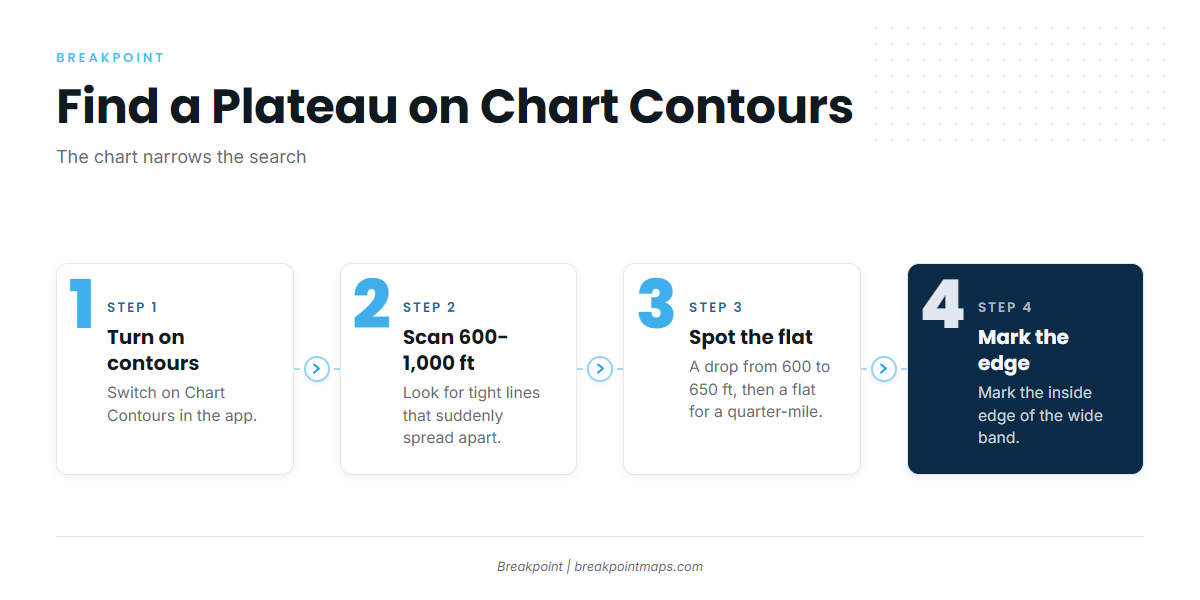
A plateau is a sharp drop followed by a flat. For example, the bottom might fall quickly from 600 to 650 ft, then hold at 650 to 660 ft for a quarter-mile or more before dropping again. Flats like this inside 600 to 1,000 ft are where mud and burrow colonies sit.
To find them with Chart Contours on:
- Look for tightly packed lines that suddenly spread apart into a wide band at 600 to 1,000 ft.
- Mark the inside edge of that band.
- Compare it with the shelf break near 600 ft to confirm you are on the mud side.
Chart layers are not for navigation.
The data has limits. Deepwater bathymetry resolution varies from area to area, and no chart shows burrows. The sounder and the lead confirm the bottom; the chart only narrows the search.
Feeding, movement and life history
Goldens feed by day near the bottom. Per FishChoice, the diet is shrimp, crabs, clams, snails, worms, anemones, sea cucumbers and squid. A bait held just off the bottom works because the fish sits in its burrow looking up.
The life history facts that matter:
- Residency: Goldens hold to their burrows and stay in one area.
- Growth: About 10 cm a year for the first 4 years, then slower.
- Lifespan: Females live to 46 years, males to 39.
- Predators: Monkfish, spiny dogfish, conger eels and large bottom sharks.
Slow growth, long lives and residency mean a single colony can be fished down. That is why the rules cap the bag and require permits and reporting.
How to catch golden tilefish
The goal is a bait held just off soft bottom on a plateau at 600 to 1,000 ft.
Rig and tackle
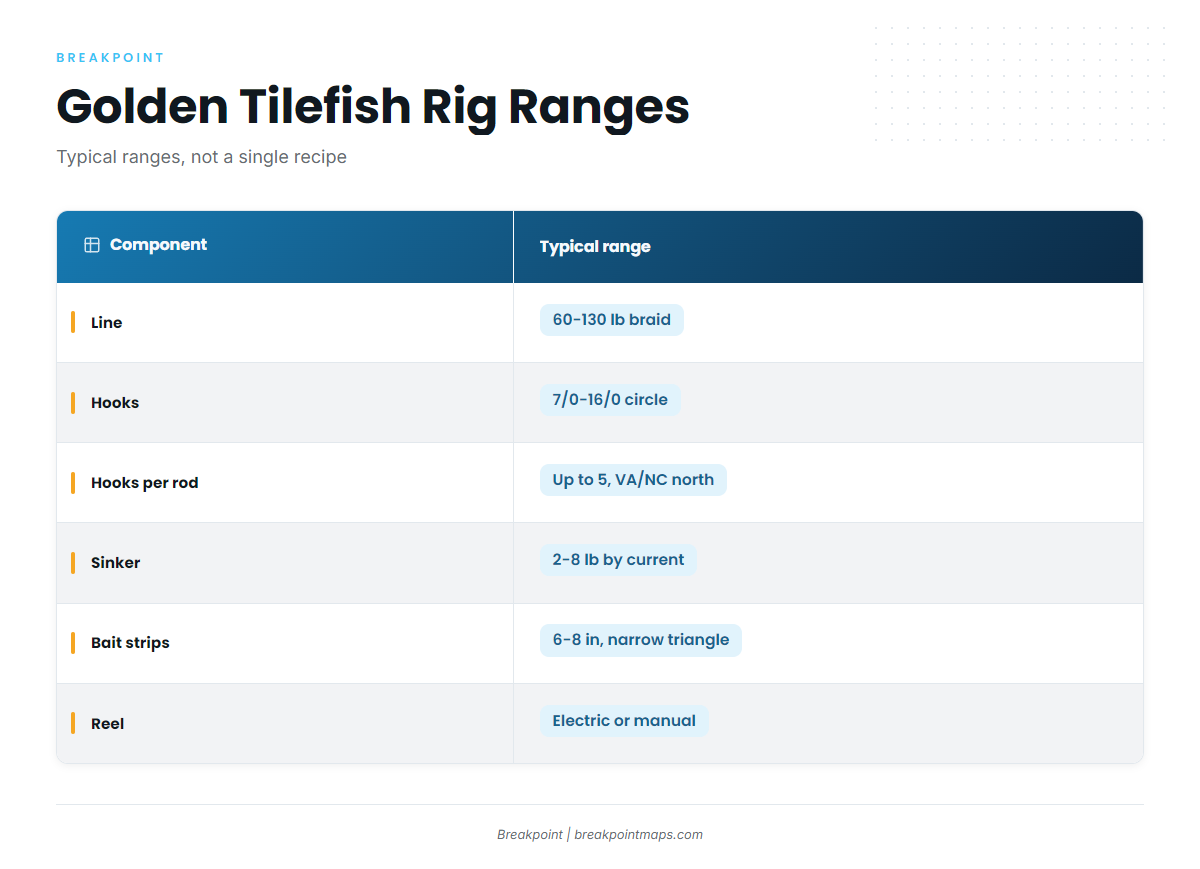
Every figure here is a range, and practitioners differ by region, current and depth.
| Component | Typical range |
|---|---|
| Reel | Electric or manual. Electric is standard for all-day work at 700 to 1,000 ft. |
| Line | 60 to 130 lb braid. At least 800 yd of 60 lb as a minimum. |
| Hooks | 7/0 to 16/0 circle hooks. 10/0 to 12/0 is common. |
| Hooks per rod | Up to 5 north of the VA/NC line (federal rule) |
| Attractors | Glow beads, glow tubing, deep-drop light |
| Sinker | 2 to 8 lb, set by current and depth. 3 lb is a calm-day floor. |
| Sinker attachment | Snap swivel at the bottom of the rig |
| Bait | Squid. Fresh strips of bonito, mackerel or barracuda cut 6 to 8 in in a narrow triangle. |
Cranking a 30 lb fish from 800 ft by hand takes 15 to 20 minutes per drop, a reported practitioner figure. That is the case for electric reels, though manual reels are legal.
Check that your bait species can legally be used as bait. Many reef species cannot.
Depth, drift and feel
Rigging is the easy part. Depth, drift and bottom feel decide the day. Our deep-drop guides cover them by species.
- Depth: Most productive work falls at 600 to 1,000 ft, varying by region.
- Drift: Let the current carry the rig across the bottom. Some anglers free-spool briefly so the bait sits still.
- Bottom feel: The lead should stick in the mud, load the rod, then release. That stick-and-release confirms soft bottom. A clean bounce means hard bottom, so move.
- The bite: A series of steady thumps, or a lead that suddenly goes light.
- The set: Give the fish 5 to 10 seconds, then come tight with a long, steady lift.
Mark and cluster
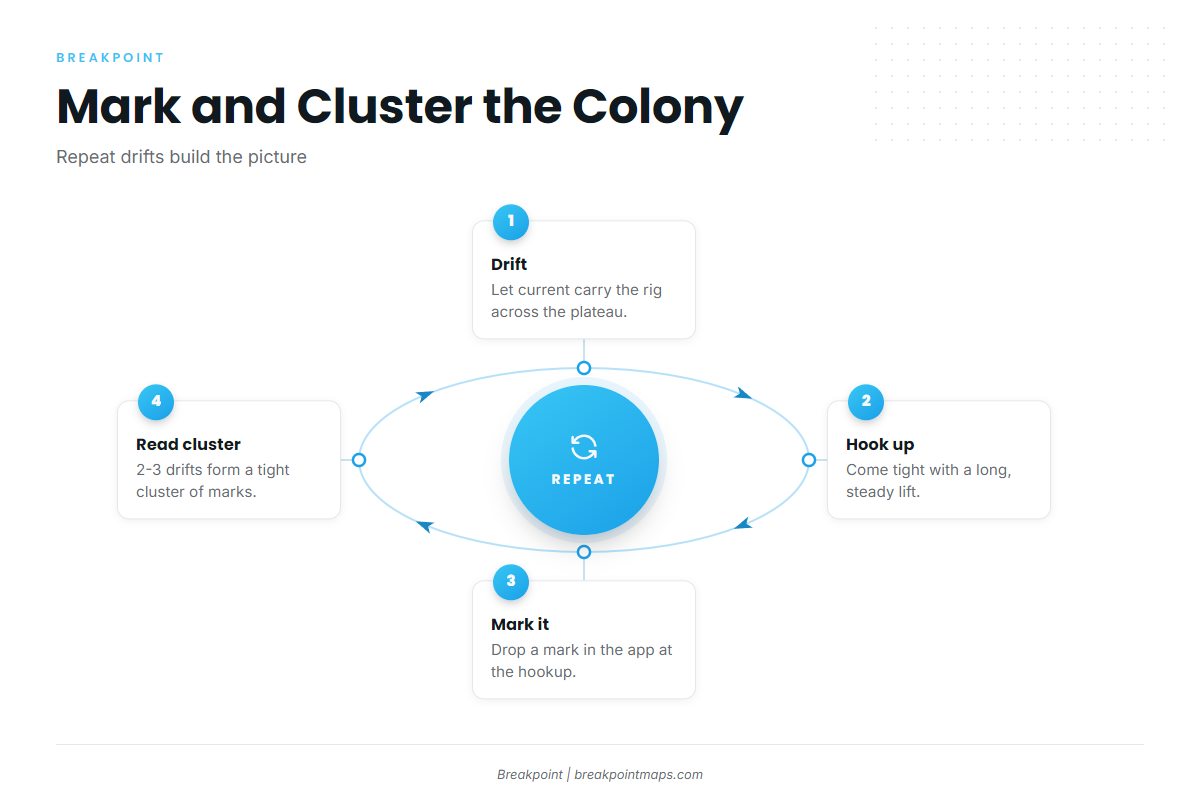
Mark each solid hookup when it happens, not after the fish is boated, because the long crank carries you off the spot. Two or 3 drifts over the same area build a tight cluster of marks, and that cluster is the colony.
Drop a mark in the Breakpoint app at each solid hookup. Over repeat drifts, the cluster shows where to start the next drift.
Region guides for golden tilefish: golden tilefish fishing in the Atlantic Southeast and golden tilefish fishing in the Gulf of Mexico.
Frequently asked questions
What is the difference between golden and blueline tilefish?
Goldens carry a fleshy crest forward of the dorsal fin, separate from it, plus gold spots on a blue-green back. North of the VA/NC line the rules differ. Goldens: 8 per angler, no federal closed season. Bluelines: 3, 5 or 7 by vessel type, open May 15 to November 14.
Do I need a permit to fish for golden tilefish?
North of the VA/NC line, private vessels need the free Private Recreational Tilefish Vessel Permit from GARFO. For-hire vessels need the federal charter/party tilefish permit. File an eVTR within 24 hours of any trip that targets or keeps tilefish. South of the line, check SAFMC, the Gulf council or the state agency.
Can I keep golden tilefish off North Carolina or Florida?
These waters fall under SAFMC, or the Gulf council in the Gulf, with state agencies governing inside state waters. The South Atlantic recreational season is quota-based and closes early. Check the agency page before you fish.
Do I need an electric reel, or will a manual reel work?
Both are legal. A 30 lb fish from 800 ft takes 15 to 20 minutes by hand, so electric is standard for all-day drops at 700 to 1,000 ft.
How deep do golden tilefish live?
They live at 250 to 1,500 ft, where bottom water runs 49 to 58°F. Most fishing happens at 600 to 1,000 ft, on mud plateaus just past the shelf break.
What else comes up on a golden tilefish drop?
Blueline tilefish share the ground in parts of the range. Spiny dogfish and large bottom sharks live there too. Carry a descending device, which is required in the South Atlantic. For rigs and technique by species, see the deep-drop guides.
Are golden tilefish good to eat?
Anglers keep them for the table, though sale of recreational fish is prohibited north of the VA/NC line. For consumption advice, check the FDA’s advice about eating fish.
Conclusion
Goldens burrow in mud, the shelf breaks near 600 ft, and the plateaus that hold colonies sit at 600 to 1,000 ft. A rig held just off the bottom finds them, and marks that cluster show where to drop again. North of the VA/NC line you need a permit and an eVTR. South of it, the agency pages set the season.
The chart narrows the search and the lead confirms the bottom. To see where those plateaus sit before you leave the dock, download Breakpoint from the App Store or Google Play and turn on Chart Contours for your port.