




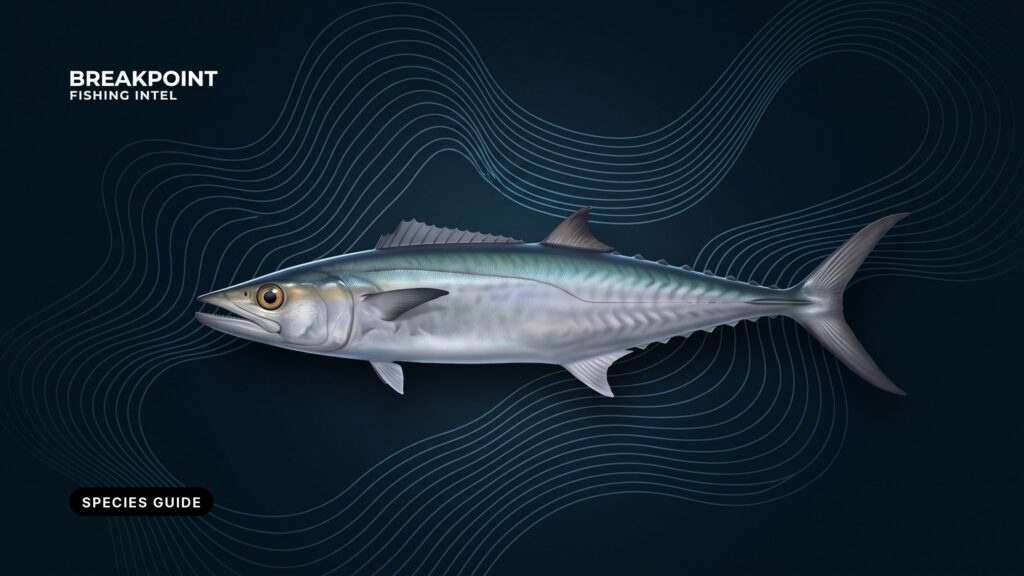
King mackerel (Scomberomorus cavalla, also called kingfish) run nearshore and offshore from the Carolinas to Texas. They follow bait and temperature, and the rules that apply depend on the water you are in when the fish is caught. This guide covers how to identify a king, where and when kings show up by region, how they feed and move, how they are caught, and how federal and state rules divide. It will help you decide where to look, but it can’t promise fish.
How to Identify a King Mackerel
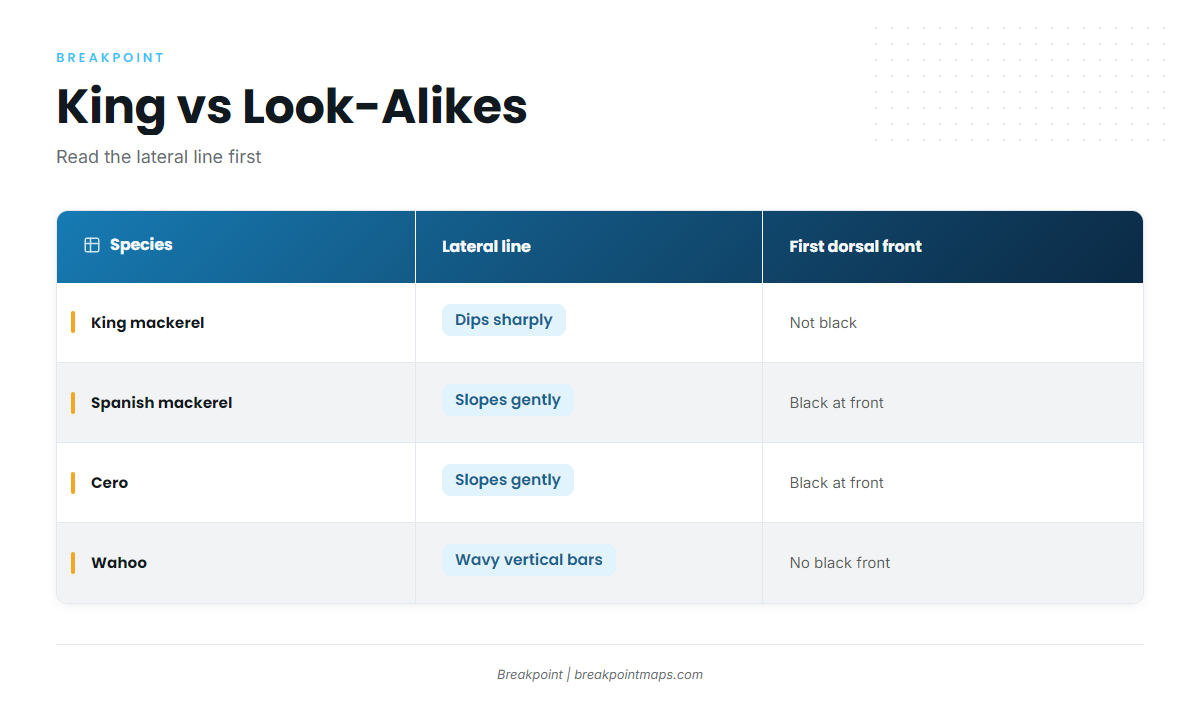
The lateral line separates king mackerel from Spanish mackerel. On a king, the king mackerel lateral line starts high on the shoulder, dips sharply at mid-body, then runs wavy to the tail. On a Spanish mackerel it slopes gently.
Check these field marks:
- Lateral line: The abrupt dip beneath the second dorsal fin is the most reliable mark on any size of king.
- First dorsal fin: It is uniformly blue and never black at the front. Spanish mackerel and cero both show black at the front of the fin.
- Markings: Adults are largely unmarked silver with a blue to olive back. Juveniles carry spots like a Spanish mackerel, so read the lateral line on small fish.
- Wahoo comparison: A king has none of the wahoo’s wavy vertical bars.
- Teeth: The teeth are sharp, much like a bluefish’s. That is why kings cut line, and why the methods section calls for wire.
| Species | Lateral line | First dorsal front | Body markings |
|---|---|---|---|
| King mackerel | Dips sharply under the second dorsal | Uniform blue, never black | Unmarked silver adults; spotted juveniles |
| Spanish mackerel | Slopes gently | Black at the front | Rows of round or oval spots |
| Cero | Slopes gently | Black at the front | Spots plus a streak along the side |
| Wahoo | Runs low and fairly straight | No black front | Wavy vertical bars |
A smoker king is a big king that "smokes" line off the reel on its first run. For the look-alikes, see our guides to other coastal and offshore gamefish.
Where and When: King Mackerel by Region
Kings migrate with warming and cooling water and with the bait. Spring and fall runs drive the fishing along both coasts, while winter fish stack up in the warm water off south Florida.
- Atlantic Southeast (Carolinas, Georgia, Florida’s Atlantic coast): Spring and fall runs bring kings to nearshore hard bottom, Gulf Stream edges and ocean piers. Our guide to king mackerel fishing in the Atlantic Southeast carries the detail. For a North Carolina example of pier and nearshore fishing, see king mackerel off Morehead City.
- South Florida and the Keys: Kings winter in the warm water here. Monroe County waters fall under the Gulf group, which matters for the rules below.
- Gulf (Florida Gulf coast to Texas): Kings winter off Florida and move up the Florida coast into the northern Gulf in warmer months, with some reaching Texas. Spring and fall migrations are the peak periods. See king mackerel fishing in the Gulf of Mexico for spots and timing.
How Kings Feed and Move
Kings are fast predators that slash through bait schools, so finding the bait narrows the search.
- Temperature: Kings follow temperature breaks, so a sharp change in surface temperature is worth marking.
- Water color: Some anglers weight water color as heavily as temperature. Read both and don’t rely on either alone.
- Tail strikes: Kings often hit the tail of a bait, which is why the rig below carries a stinger hook.
- Fronts: Kings tend to feed hard ahead of weather fronts, though this is a tendency rather than a rule.
- Signs of fish: Look for birds working, bait showering at the surface, and tide lines at inlets, especially on an outgoing tide.
Where Kings Hold: Structure and Edges
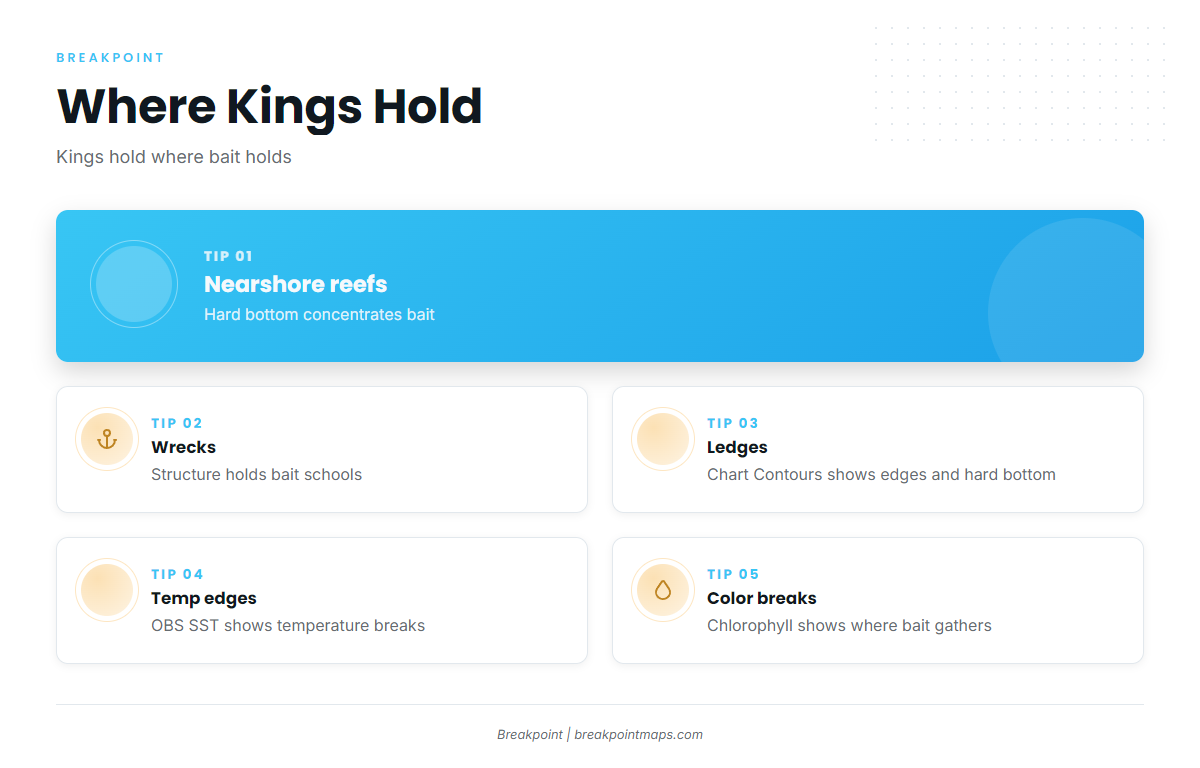
Kings hold where bait holds: nearshore reefs, wrecks, live bottom, ledges, and temperature and color edges.
- Reefs and wrecks: They shelter baitfish, and kings patrol the edges.
- Live bottom and ledges: Relief stacks bait and gives kings a place to ambush.
- Tide lines at inlets: Moving water pushes bait into a line that kings work.
- Temperature and color edges: Bait gathers along the seam, and kings follow.
In Breakpoint, Chart Contours shows ledges and hard bottom, OBS SST shows temperature edges, and Chlorophyll shows the color breaks where bait gathers. Chart layers are not for navigation. Cloud can block a satellite pass, and some shelf areas were last surveyed decades ago, so treat every edge as a place to check, not a guarantee.
How King Mackerel Are Caught
Slow-trolling live bait is the standard method for big kings and the tournament approach. The bait swims naturally while you bump the engine in and out of gear just above idle.
Slow-Trolling Live Bait
Many anglers also troll spoons and dead bait to cover water. Live bait and lures both catch kings, so pick the one that fits the day and your gear.
Live bait is cast-netted and kept in a livewell. Common choices:
- Live: menhaden, blue runners, pilchards, mullet
- Frozen: ribbonfish, cigar minnows, used for chunking or trolling dead bait
Rigs and Leaders
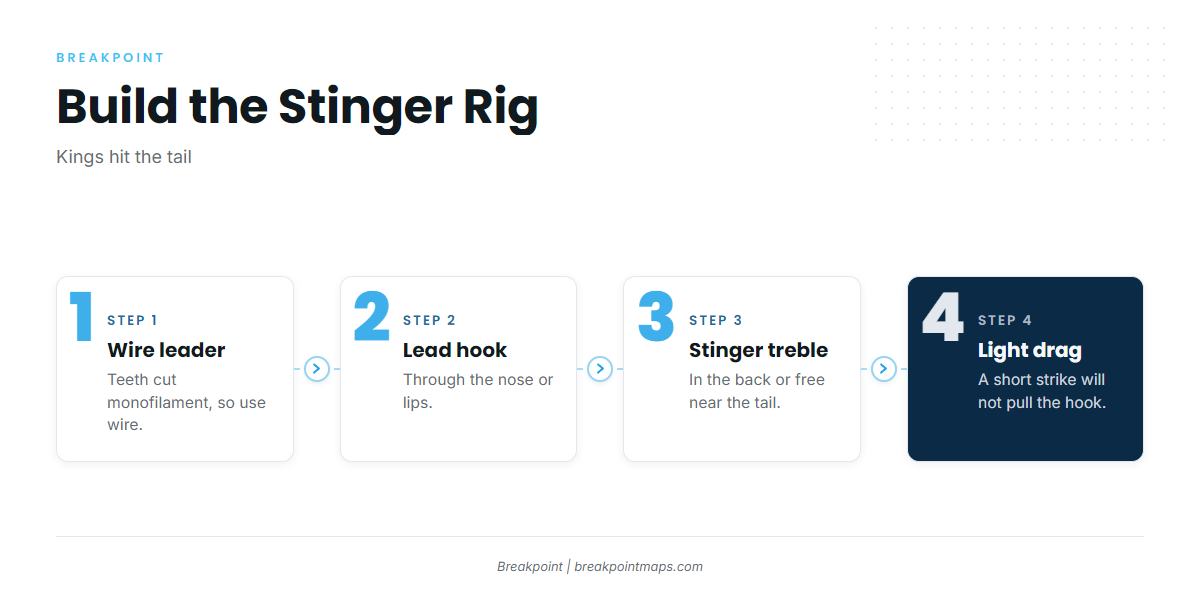
A stinger rig is the standard setup for live bait:
- Wire leader: The teeth cut monofilament, so use wire.
- Lead hook: It goes through the nose or lips of the bait.
- Stinger treble: It goes in the back or swings free near the tail, because kings hit the tail.
- Drag: Set it light so a short strike or a cut bait does not pull the hook.
Pier King Fishing
Kings come close enough to reach from ocean piers in the Carolinas, Georgia and on both Florida coasts. Pier anglers float live bait off the end on a king rig, a dedicated anchor line with the bait rig slid down it. Use a gaff and keep your hands away from the teeth when unhooking.
Frequently Asked Questions
How do you tell a king mackerel from a Spanish mackerel?
Look at the lateral line. On a king it dips sharply beneath the second dorsal fin. On a Spanish mackerel it slopes gently. A king’s first dorsal fin is never black at the front, and adults carry few or no spots.
Which rules apply at the 3 or 9 nautical mile line?
The rules depend on where the fish is caught. Florida’s Gulf state line is 9 nm, and Alabama and Georgia use 3 nm for kings. Beyond those lines, federal rules apply out to 200 nm. Check the agency for the water you fished.
Where does the Gulf group start in Florida?
Federal waters off Monroe County on both coasts are Gulf group. The Atlantic group runs south to the Miami-Dade/Monroe County line, which puts the Keys on Gulf rules even on the Atlantic side.
Do I need a federal permit?
Private anglers do not. For-hire vessels need the federal charter vessel/headboat permit for the species and region they fish. Gulf trips use the Gulf coastal migratory pelagic permit.
Can a cut-off king be kept?
NOAA Fisheries allows recreational anglers to keep cut-off Atlantic kings within the bag limit if they meet the minimum size. Check NOAA Fisheries for the current rule before you keep one.
Do kings have to be landed whole?
In Georgia state waters, and under the federal Atlantic rule off Virginia, kings are kept with head and fins intact. Elsewhere, check the agency.
Do I need a state saltwater license?
Licensing is set by the state where you fish. Check FWC, NCDMF, SCDNR, GADNR, ADCNR, MDMR, LDWF or TPWD for that state before you go.
Where are kings in winter?
Kings winter in the warm water off south Florida and the Keys, then move north and west as the water warms.
Are big kings safe to eat?
Check state and federal consumption advisories for the water you fish. Advisories change, and the agency page is the place to read them.
Closing
For place-level detail, start with our fishing guides by region.