




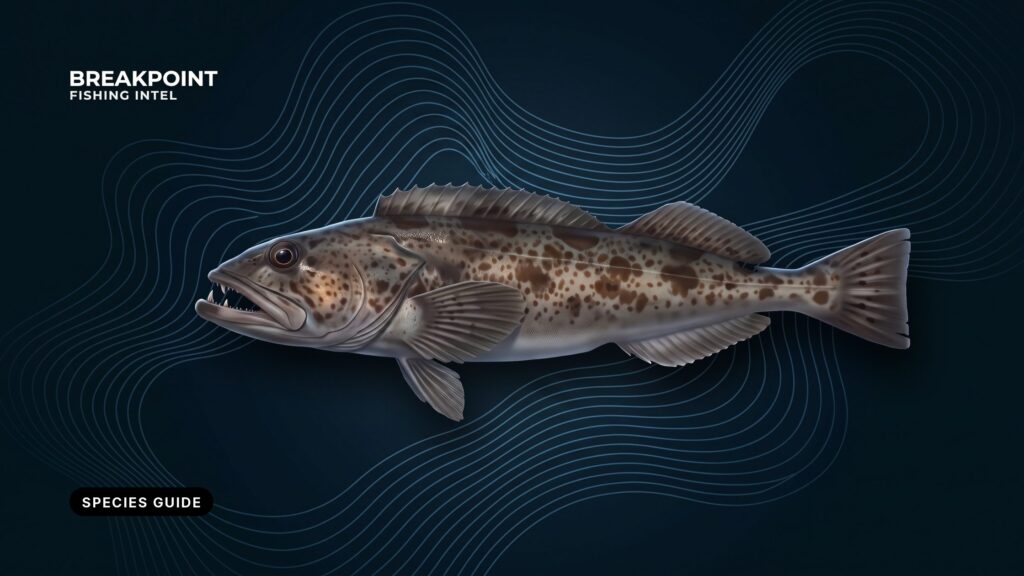
Lingcod is a greenling, not a cod. Ophiodon elongatus is an ambush predator of Pacific rocky reefs, managed as Pacific groundfish. This guide covers how to identify the fish, where it lives by region and depth, when it spawns and why seasons close, how it is caught, and how federal and state rules divide. It is meant as a field reference to check between waypoints, to help you decide where to look and what you can keep.
Identifying Lingcod
Lingcod belong to Hexagrammidae, the greenling family, as the ADF&G lingcod species profile confirms. The name comes from a surface resemblance to true cods, but the family tree is different.
A few traits identify one:
- An elongated body with a long dorsal fin
- A large mouth with prominent teeth
- Mottled coloring that is generally brown, but can run grey, green, reddish-brown or bluish
According to FishBase, the range runs from the Shumagin Islands to Ensenada, Baja California. WDFW gives Kodiak Island to northern Baja California, possibly the Bering Sea. Females grow larger than males. Maximum length is 60 in (152 cm). Maximum weight is reported as 80 lb by NOAA and 130 lb by WDFW. Some lingcod have blue-green flesh, which the FAQ explains.
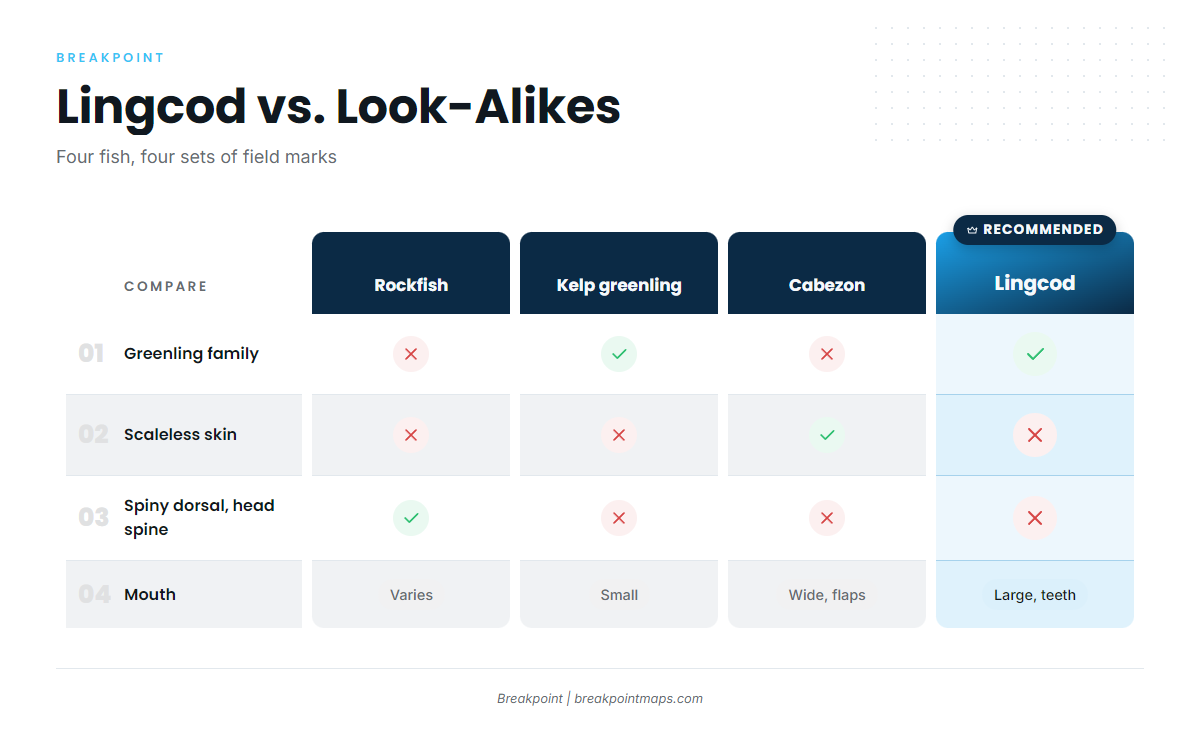
Look-alikes matter at the rail:
| Species | Family/group | Key field marks | How it differs from lingcod |
|---|---|---|---|
| Lingcod | Greenling (Hexagrammidae) | Elongated body, long dorsal fin, large toothy mouth, mottled coloring | The reference fish |
| Cabezon | Sculpin | Scaleless skin, fleshy flaps above the eyes | Blunt, wide head and no scales. Counts in the rockfish, cabezon and greenling complex |
| Kelp greenling | Greenling (Hexagrammidae) | Smaller relative in the same family | Smaller mouth and a much smaller body |
| Rockfish | Rockfish | Spiny dorsal fin, bony head spines | Spiny and stocky, with a different body shape |
Correct ID matters because California counts greenlings and cabezon under a different bag, the RCG complex, than it does lingcod.
Where Lingcod Live, Region by Region
Adults are demersal and live near rock. Young fish use sand or mud bottoms. WDFW puts most fish within 10 to 100 m, roughly 33 to 330 ft (approximate conversion). FishBase records them to 475 m. ODFW reports adults inshore out to 230 fathoms off Oregon.
The Pacific Fishery Management Council splits the stock at 40°10′ N (Cape Mendocino) into northern and southern stocks. That same line is a California management boundary.
| Region | What to know |
|---|---|
| Alaska | Southeast and Southcentral waters. State manages both state and federal waters |
| Washington and Puget Sound | Most abundant near British Columbia and Washington. Common recreational catch in Puget Sound |
| Oregon | Adults hold near rock from inshore to 230 fathoms |
| Northern California | North of 40°10′ N, northern stock |
| Southern California | Southern stock, Southern Management Area begins at Point Conception |
Alaska
Lingcod range into Southeast and Southcentral Alaska. As the NOAA Fisheries lingcod profile notes, the State of Alaska manages lingcod in both state and federal waters. Rules vary by ADF&G region, so read the Regulations section before you go.
Washington and Puget Sound
NOAA reports lingcod are most abundant near British Columbia and Washington. WDFW lists them as a common recreational catch in Puget Sound. Most fish hold on rocky areas within 10 to 100 m. Coastal and inside waters fall under separate marine areas, covered in the Regulations section.
Oregon
Adults hold near rock from inshore out to 230 fathoms. Nearshore reefs and offshore banks are the main fishing grounds. Stonewall Bank is a closed conservation area, covered in the Regulations section.
Northern California
This region lies north of 40°10′ N and belongs to the northern stock. The rocky coast and offshore reefs are the main habitat.
Southern California
South of 40°10′ N the southern stock applies, and the Southern Management Area begins at Point Conception (34°27′ N). Deeper structure and the 50-fathom line shape where you can fish. Nest guarding runs through March in California.
Port-level reefs, ramps and run distances are in our regional and local fishing guides.
Spawning and Nest Guarding
According to Animal Diversity Web, spawning runs December through April across the range. The DFO lingcod spawning profile reports the majority from mid-January to mid-February. The southeast Alaska peak is late February to early March.
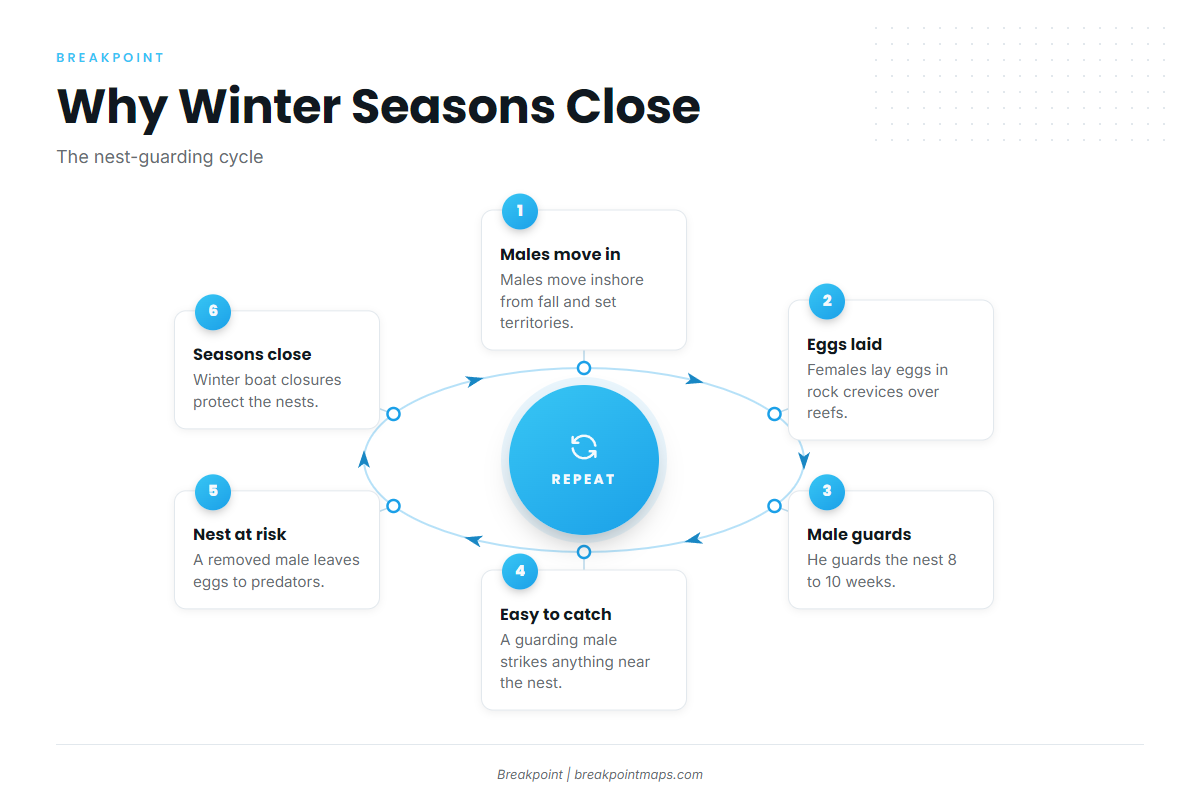
The cycle runs in order:
- Males move inshore from September or late fall.
- Males set territories.
- Females visit in winter and spring and lay eggs in rock crevices over reefs 3 to 10 m deep with strong current.
- Nests are generally shallower than 36 m.
- Males guard eggs for 8 to 10 weeks. Incubation runs 5 to 12 weeks.
This is why boat seasons close. A guarding male strikes anything near the nest, so he is easy to catch, and a removed male leaves the eggs to predators. California’s January 1 through March 31 closure exists for this reason.
Size matters too. Males mature at about 2 years and almost 20 in. Females mature at about 3 years and 30 in, with a range of 3 to 5 years. A minimum size lets fish spawn before they are kept.
How Lingcod Feed and Move
Lingcod are solitary and benthic. They rest in crevices and ambush prey. Adults eat fish, squid, octopus and crab, and they cannibalize. Larvae eat copepods. Adults move shallower at night to feed, per the Animal Diversity Web species account.
With no swim bladder, they rest on the bottom. That sets up the release guidance below.
Site fidelity is strong. Adults spend about 95% of adult life within 8 km² of the home reef, so a reef that holds fish tends to keep holding them. Movement has limits and exceptions:
- Immature fish sometimes move more than 60 miles, per NOAA.
- One record shows 800 km, per ADF&G.
- Migratory and non-migratory populations both exist.
How Lingcod Are Caught
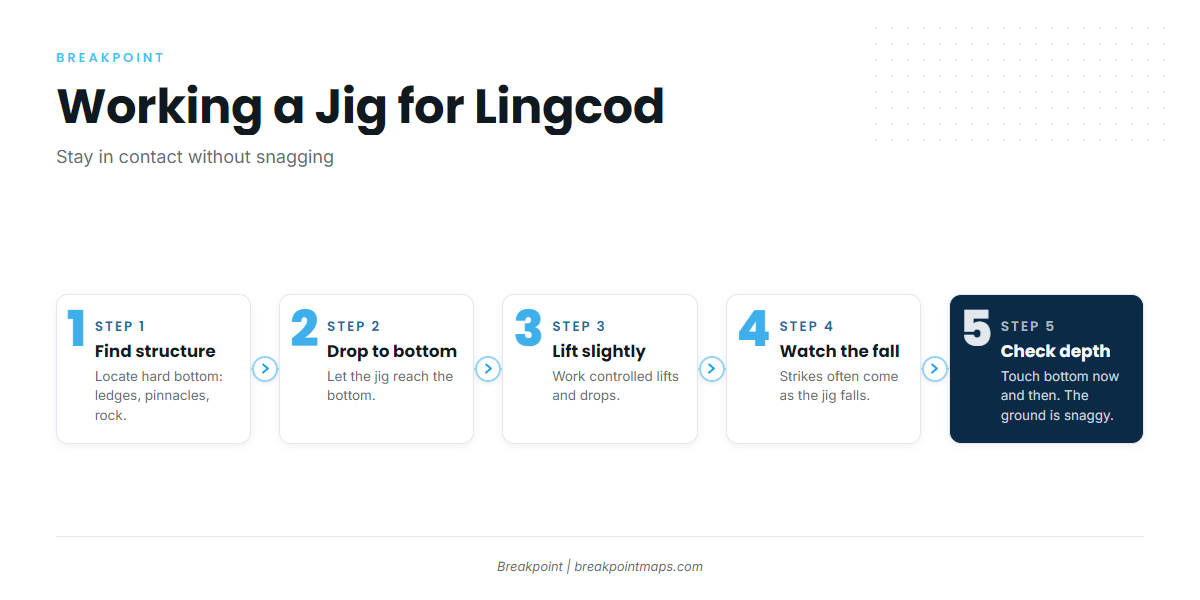
The approach is the same everywhere: find hard structure, keep the offering near the bottom, and stay in contact without dragging through the rocks.
Jigs
Bar jigs and flutter jigs work. The routine:
- Drop to the bottom.
- Lift slightly.
- Work controlled lifts and drops.
Many strikes come on the fall. Watch for a stop in the descent or a sudden weight change. Touch bottom periodically to confirm depth, since lingcod ground is snaggy.
Swimbaits
Rig leadhead swimbaits heavier than you expect. Common practice runs 1 to 2 oz heads in 30 to 60 ft, and 2 to 3 oz in deeper water or current. Paddle tails push more water than shad tails.
Live bait
Practical baits include sanddab, small greenling, herring and mackerel. Herring is a common dead bait in Washington and Alaska. Check state rules on which fish may be used as bait. In California, any rockfish or greenling used as bait counts toward the RCG bag.
Tackle
Common setups fall in these ranges:
| Item | Typical range |
|---|---|
| Rod | Medium-heavy to heavy |
| Main line | Braid |
| Leader | 30 to 50 lb mono or fluorocarbon |
| Hooks | Octopus, 6/0 to 10/0 |
| Sinker (bait fishing) | 4 to 6 oz |
ODFW gives the same sinker range, along with 5/0 or 6/0 hooks and 20 lb line for bottom bouncing. In California, one line and no more than 2 hooks applies when lingcod are aboard. Keep the drag tight and turn the fish’s head up early, because hooked lingcod head for the rocks.
For co-caught rockfish and deeper structure, see our bottomfish and deep-drop guides.
Shore and kayak fishing
Jetties, rock piles and breakwaters hold smaller lingcod. Practice favors the period around the tide change. In California, shore anglers are exempt from boat seasons and depth limits.
Kayaks reach nearshore reefs. In California, a descending device is required aboard any boat or floating device taking groundfish.
Finding Lingcod Structure
Lingcod hold on ledges, pinnacles, steep edges, current-swept rock and kelp-edged reef. Ambush fish sit where current brings prey past cover.
The Chart Contours layer in Breakpoint shows this. Tight contour spacing marks where bottom rises steeply, which is where ledges, pinnacles and drop-offs sit. A depth line on the chart also shows where the 50-fathom boundary falls relative to a reef.
Chart layers are not for navigation and are not a legal boundary determination. Depth closures follow waypoint lines in the federal regulations, not a contour on your plotter, so use the official coordinates. Contours also reflect survey data, and some shelf areas have older or sparser soundings.
Handling and Release
According to ADF&G, lingcod have no swim bladder and show high post-release survival, unlike rockfish. Rockfish brought up from depth suffer barotrauma, which is why vessels must carry descending devices.
Handle the fish with care:
- Net the fish while it is still submerged rather than gaffing a fish you may release.
- Grip the lower jaw in front of the gills.
- Keep pressure off the gills.
- Measure total length before deciding to keep the fish.
Size rules are in the Regulations section.
Frequently Asked Questions
Is lingcod a cod?
Lingcod is a greenling, not a cod. It belongs to the family Hexagrammidae. The name comes from a superficial resemblance to true cods.
Why is lingcod meat blue?
Blue flesh comes from the bile pigment biliverdin. Only some fish show it.
When is lingcod season in California?
Boat fishing is closed January 1 through March 31 in all areas. North of Point Conception, it is open at all depths April 1 through December 31. The Southern Management Area adds depth limits from July on. Check CDFW before you go.
Do I need a descending device?
Yes on vessels in California and Oregon federal groundfish fisheries. Lingcod survive release well, but co-caught rockfish do not.
Can I keep lingcod from shore when boats are closed?
In California, yes. Shore anglers and divers are exempt from seasons and depth limits. The 22 in minimum and the bag of 2 still apply.
How big do lingcod get?
Up to 60 in (152 cm). Weight records range from 80 to 130 lb across agencies. Females grow larger and live longer. Males reach 14 years and females 20 per WDFW, and up to 25 years per FishBase.
How do I clean lingcod, and should I book a charter?
California fillets must be at least 14 in with the entire skin attached. A charter suits a first trip in an unfamiliar region.
Conclusion
Identify the fish before you keep it, and fish structure, since lingcod hold on home reefs. Winter closures protect nest guarders. When state and federal rules differ, the stricter one governs, so check the agency.
This guide covers the biology and the rule structure; the reef is your call. If you want help reading the bottom before you leave the dock, download Breakpoint from the App Store or Google Play and look at where ledges and drop-offs sit relative to your depth line.