




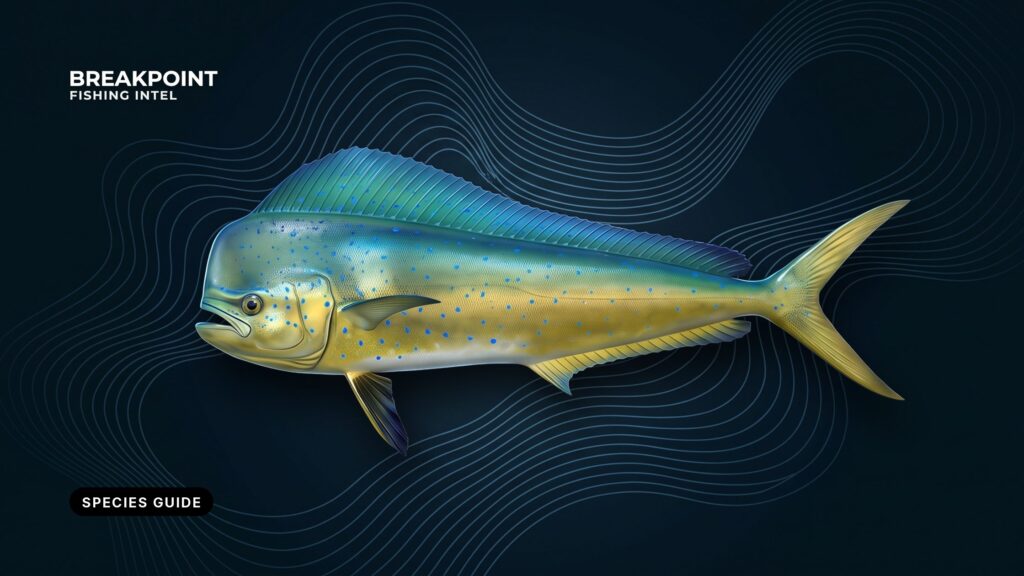
Mahi live where things float and where water changes, and the rules that govern them change with distance from shore.
This guide covers Coryphaena hippurus, the dolphinfish. Agencies list it as "dolphin," though it is a fish and no relative of the marine mammal. "Mahi-mahi" is the Hawaiian name, and anglers also say "dorado." Mahi run with wahoo, blackfin tuna and billfish, and our offshore gamefish guides cover those species.
We read the water (temperature, color, weed) and the rules carefully, and we don’t promise fish. What we offer is a better decision about where to look. This page covers how to identify the fish, where and when it runs by region, how it feeds and moves, how it is caught, and which rule set applies at your numbers.
Identification
Mahi have a long, compressed body and a single dorsal fin that runs from the head almost to the tail. Live fish show electric blue, green and gold, and the color fades fast after death. Anglers read lit-up color as an excited, feeding fish. A fish that has gone dull in the water is usually done biting.
Use these ID cues:
- Bulls: a steep, blunt forehead that squares off as the fish grows.
- Cows: a rounded, sloping head.
- Pompano dolphin: a smaller look-alike, covered below.
Bull or Cow
Look at the forehead. A bull’s head rises almost vertically from the snout and gets squarer with size. A cow’s head slopes back in a smooth curve. The difference is easy to see on a fish at the gunwale.
Pompano Dolphin, the Look-Alike
The pompano dolphin (Coryphaena equiselis) turns up in mahi water and is smaller. Look for a deeper body for its length and a broader, squarer tooth patch on the tongue. Confirm the ID before you keep fish.
Mahi Terms
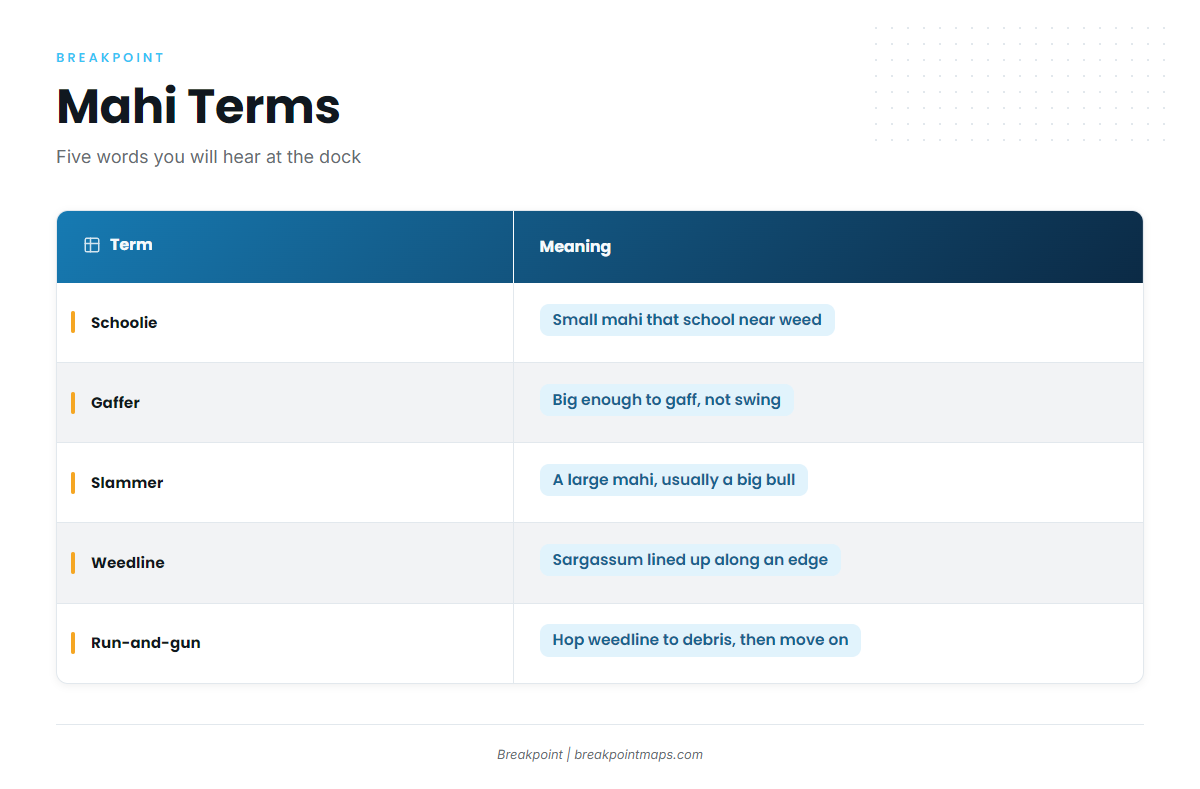
- Schoolie: a small mahi that travels in schools, often around weed and debris.
- Gaffer: a fish large enough that you gaff it rather than swing it aboard.
- Slammer: a large mahi, usually a big bull.
- Weedline: a line of floating sargassum gathered by current or wind along an edge.
- Run-and-gun: running from weedline to weedline or debris to debris, casting or trolling, then moving on.
Where and When to Find Mahi
Mahi are warm-water, open-ocean fish found off every US coast where warm currents run. Timing follows water temperature and weed rather than the calendar. Both change day to day, so a season describes tendencies, not guarantees.
The regional summaries below point to local detail. Our fishing guides by region carry the rest.
| Region | Main structure | Season shape |
|---|---|---|
| Gulf of America | Weedlines, floating debris, platforms | Summer peak |
| Florida and Southeast Atlantic | Sargassum, Gulf Stream edges | Spring run north, fall push south |
| Mid-Atlantic and Northeast | Weed, pot buoys, flotsam on temperature edges | Shorter, later summer window |
| Southern California | Kelp paddies, warm intrusions | Warm-water years |
| Hawaii | FADs, floating debris | Less tied to a single run |
Gulf of America
Weedlines and floating debris hold fish. Oil and gas platforms act as fish aggregating devices (FADs). The peak runs in summer, and anglers run offshore from Destin, Pensacola and Galveston.
Florida’s Gulf state waters run to 9 nautical miles, which matters for the rules below. For more, see mahi fishing in the Gulf.
Florida and the Southeast Atlantic
This region covers the Keys, the Florida east coast, Georgia and the Carolinas. The Gulf Stream drives Atlantic movement. Fish ride warm Gulf Stream water north in the spring run, then concentrate off Florida’s east coast in the fall push south as northern water cools.
The Keys and the Outer Banks are classic stops. See the Southeast Atlantic mahi guide for local detail.
Mid-Atlantic and Northeast
Gulf Stream eddies and warm-water intrusions push fish north in summer. They hold on weed, lobster pot buoys and other flotsam along temperature edges. The window is shorter and later than in the Southeast. Our Northeast mahi fishing guide has the detail.
Southern California
Warm-water years and warm intrusions bring mahi within range. Floating kelp paddies play the role that sargassum plays in the Atlantic: find the paddy, then work it. The Southern California mahi guide covers the rest.
Hawaii
Mahi are a staple pelagic around the islands. FADs and floating debris are the key structure, and the season is less tied to a single run than on the mainland.
How Mahi Feed and Move
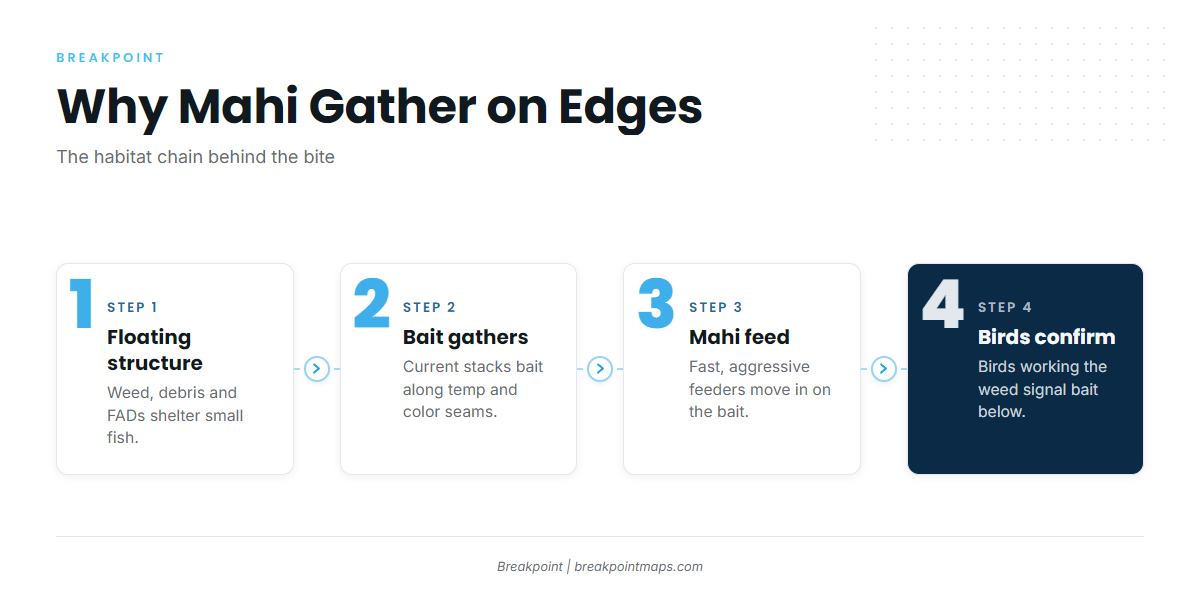
Mahi are fast, aggressive feeders. Sargassum and any floating object (debris, pallets, buoys, FADs) shelter small fish, and small fish draw mahi. Weed alone is not enough, and weed on an edge is better.
Two edges matter most:
- Temperature break: a sharp change in surface temperature over a short distance.
- Color change: where clean blue water meets green, productive water.
Current gathers weed and bait along these seams, and birds working over the weed confirm bait. Learn the blue-meets-green edge by reading Chlorophyll for color breaks.
Fish move with warm water and weed, which is why the regional seasons above shift north and south with the Gulf Stream.
What the Map Shows Before You Leave the Dock
Two layers do most of the pre-trip work:
- OBS SST shows where the temperature break sits and how tight it is.
- Chlorophyll shows the color change between blue and green water. Weedlines often line up along these edges.
The data has limits. Cloud cover can block a satellite pass and leave gaps. Weed and edges shift overnight, so treat yesterday’s image as a starting point. Chart layers are not for navigation.
How Mahi Are Caught
Casting or pitching and trolling are the two core methods. Everything starts with finding structure on an edge.
Finding Fish Before You Fish
Plan the run toward clean blue water on an edge rather than green water. We explain choosing clean blue water in a separate guide. On the water, look for weed, debris, birds and bait, and approach floating structure quietly.
Trolling Weedline Edges
Troll along the edge of the weedline, not through it. The standard spread is rigged ballyhoo and skirted lures at a steady pace. Wahoo, blackfin tuna and billfish take the same spread.
Run-and-Gun
Move from weed patch to debris to weedline, fishing each briefly and moving on if nothing shows. This saves fuel and time on a short trip when the edge is long.
Pitching to Schoolies
- Set up up-current of the structure.
- Chum lightly with cut squid or cut bait.
- Pitch baits or bucktails to the fish that come out.
The common mistake is casting onto the fish and spooking the school.
Holding the School
Keep one hooked fish in the water beside the boat. The school tends to stay with it while others cast. Watch the hooked fish’s color: when it fades, the school may drift off.
Tackle, Plainly
- Outfits: a light spinning outfit for pitching and a heavier outfit for trolling, matched to the school size you find.
- Leader: a short mono leader.
- Baits: ballyhoo, squid, cut bait and bucktails. Live bait and kite fishing also work.
Handling and the Table
Gaff fish you plan to keep. Release unwanted or short fish quickly with minimal handling. Mahi is prized table fare and should go on ice fast. Florida requires fish landed whole, covered in the gear note under the table below.
Frequently Asked Questions
Is mahi-mahi the same as dolphin?
Yes. It is the dolphinfish, Coryphaena hippurus, and agencies list it as "dolphin." It is a fish, not a relative of the marine mammal. Mahi-mahi is the Hawaiian name.
How do you tell a bull mahi from a cow?
Look at the head. Bulls have a steep, blunt forehead that squares off with size. Cows have a rounded, sloping head.
Which mahi rules apply past 3 or 9 nautical miles?
Florida state rules apply to 3 nautical miles on the Atlantic and 9 nautical miles in the Gulf. Beyond 3 nautical miles on the Atlantic, federal Dolphin Wahoo FMP rules apply, so check SAFMC and NOAA Fisheries. Beyond 9 nautical miles in the Gulf, 50 CFR 622 lists no federal dolphin limit, though state possession rules may apply.
How do Florida’s state rules differ between the Atlantic and Gulf?
On the Atlantic side the rule is 20 inches fork length, 5 per person and 30 per private vessel. In the Gulf there is no minimum size, the bag is 10 per person and the private vessel limit is 60. Both are open year-round under FWC.
How does the vessel limit work with several anglers aboard?
The lower of the two limits applies. In Florida Atlantic state waters, 4 anglers can keep 20 (4 × 5), under the 30 cap. With 8 anglers the math gives 40, so the boat stops at 30. In the Gulf, 7 anglers give 70, capped at 60. For-hire captain and crew keep no bag.
Why keep a hooked mahi in the water?
A hooked fish beside the boat tends to hold the school while others cast. This is established practice, and it works best with one healthy fish kept in the water at all times.
What is a pompano dolphin?
It is a smaller look-alike of the mahi, with a deeper body and a broader, squarer tooth patch on the tongue. Confirm the ID before you keep fish.
Close
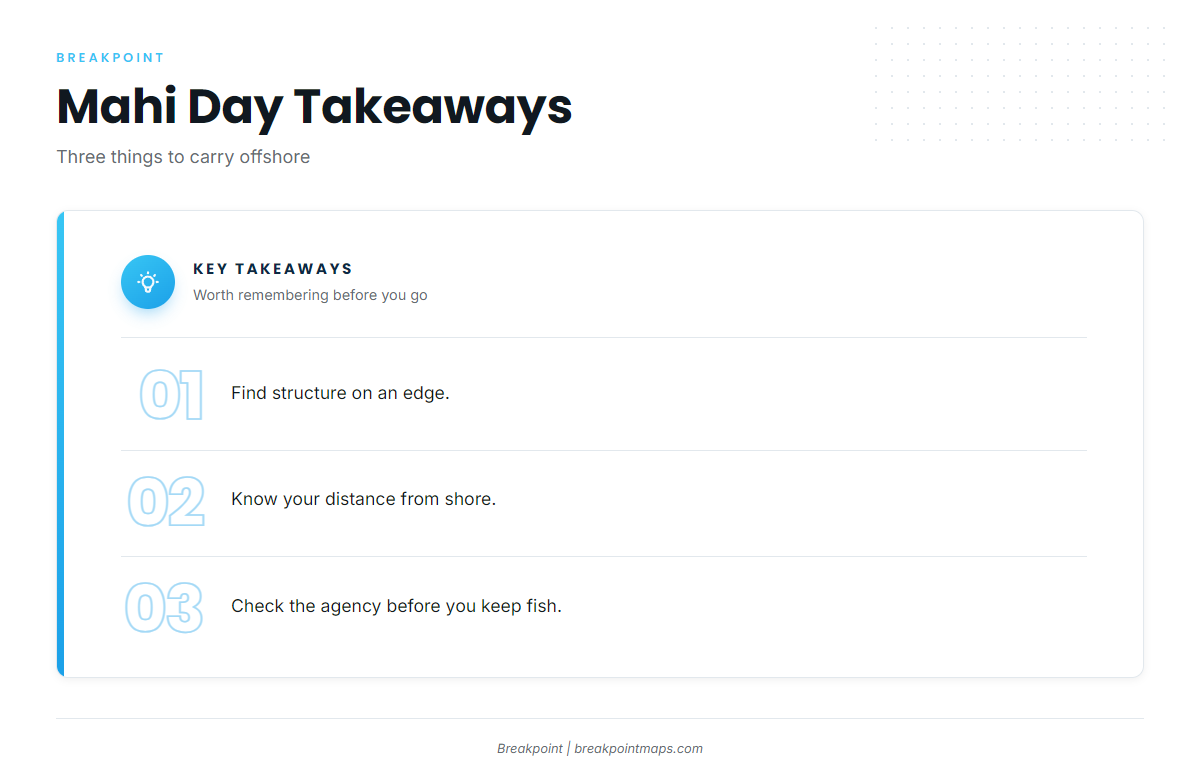
Find structure on an edge, know your distance from shore, and check the agency before you keep fish.
Mahi sit with other offshore species on the same edges, so see our other offshore gamefish. To plan the next run, read the regional guides and the OBS SST and Chlorophyll layers in the app. The layers can’t promise fish, but they will help you decide where to look.