



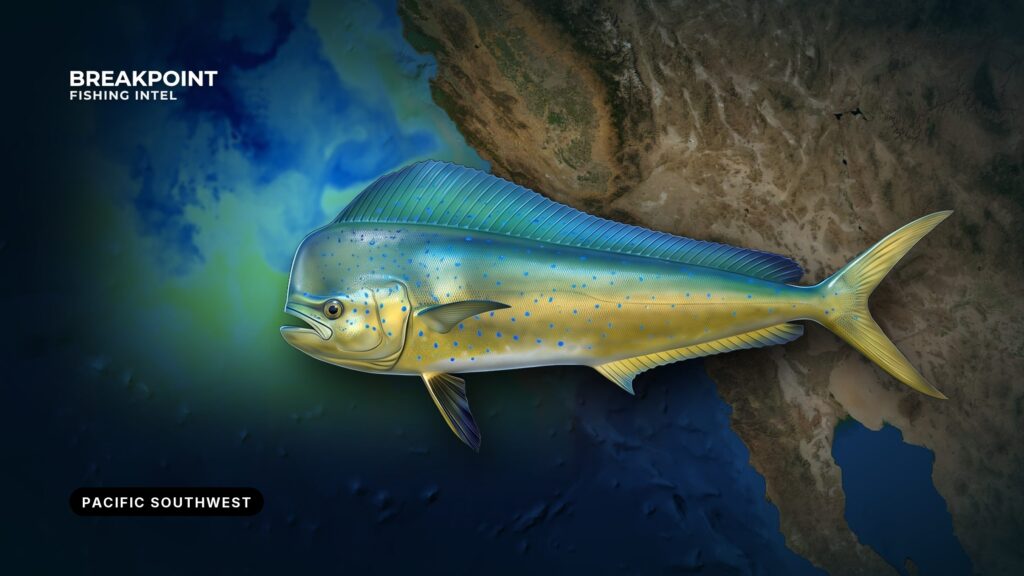
Dorado reach Southern California on warm water pushing up from the south. Good years follow warm-water intrusions and El Niño conditions, and offshore the fish key on floating kelp paddies. Finding them in the Pacific Southwest comes down to two things: warm water and floating structure.
This page covers central and southern California, plus the cross-border grounds toward the Coronado Islands. It explains how to read the water (the warm edge, paddies, current seams and the outer banks) and ends with a summary of who regulates what. The aim is a better decision about where to look, not a guarantee of fish. Dorado years vary because the fish depend on warm water arriving, and some years it doesn’t. For the rest of the region’s offshore fishery, including yellowtail, yellowfin and bluefin, see our Pacific Southwest fishing guide.
Where and when mahi-mahi show up in the Pacific Southwest
Dorado in Southern California are a late-summer to fall fish. They show up on the offshore banks and on the paddies that drift over them, in years when warm water arrives from the south.
The eastern Pacific range runs from Oregon and California south to the Galapagos Islands and Peru. Southern California sits near the northern edge of that range, which is why the fishery switches on and off. According to the Western Pacific Fishery Management Council, dolphinfish move away from the equator in warmer months. For anglers here, that means fish arriving from Baja.
El Niño and other warm-water years bring dorado north. No chart predicts a dorado year in advance, so watch for warm water building to the south.
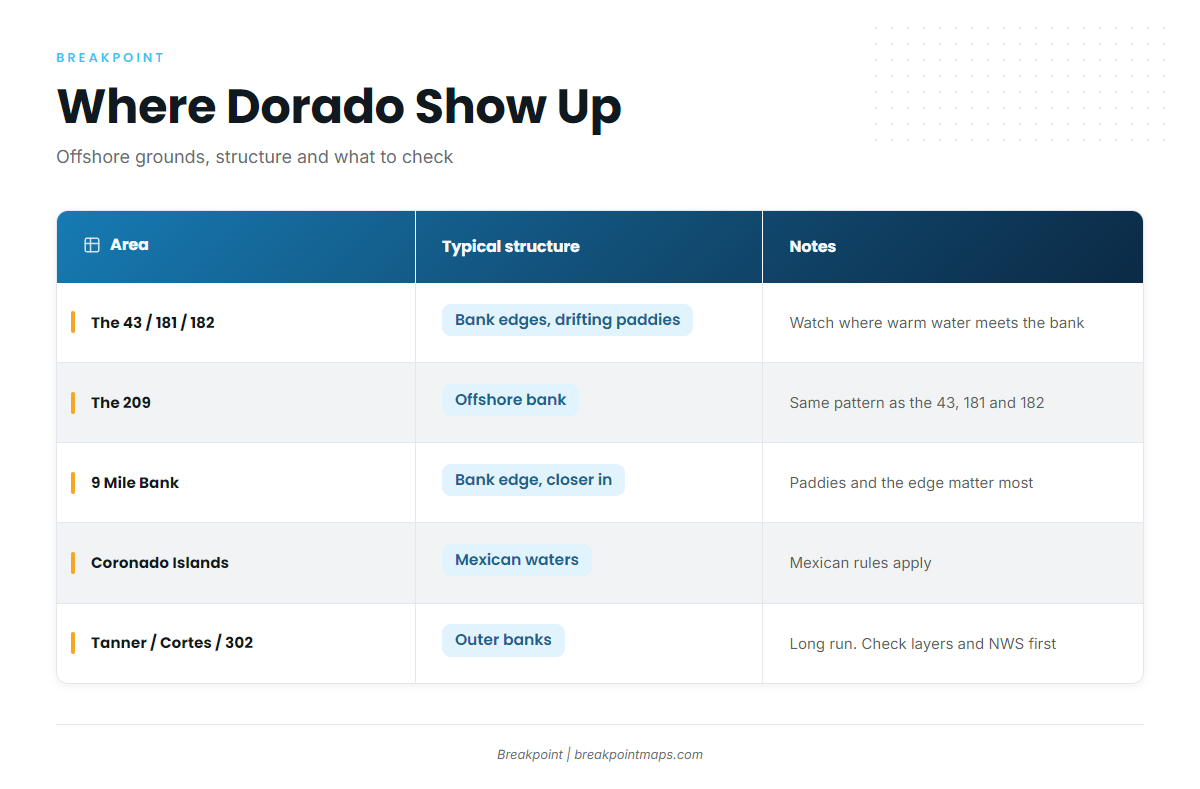
| Area | Typical structure | Notes |
|---|---|---|
| The 43, the 181, the 182 | Offshore bank edges and drifting paddies | Watch where warm water meets the bank |
| The 209 | Offshore bank | Same pattern: warm edge, paddies, bank |
| 9 Mile Bank | Bank edge closer in | The paddies and the edge matter more than the spot itself |
| Coronado Islands | Island structure in Mexican waters | Mexican rules apply (see Regulations) |
| Tanner Bank, Cortes Bank, the 302 | Outer banks | A long run, so check the layers and the NWS marine forecast first |
Late summer through fall is the usual window. Its start and length follow the water, not the calendar.
The water and structure that hold them
Three things line up when dorado are around: a warm edge, floating kelp, and a bank or current seam that holds both in place. Start with the water, then the paddies, then the chart.
The warm edge
Mahi-mahi live in water from 21°C to 30°C (about 70°F to 86°F), according to the temperature range on FishBase. The Western Pacific council species descriptions treat the 20°C (68°F) isotherm as a boundary on their range.
On an SST chart, find where water at or above that boundary pushes toward the banks, and fish the edge and the warm side of it.
The chart has limits. Cloud blocks an SST pass, edges move between passes, and a warm edge on the chart is a place to look, not a guarantee of fish.
Blue water and color breaks
Pair the SST edge with Chlorophyll. Clean blue water against greener water marks a color break. Current tends to collect floating kelp along that seam, so a temperature break and a color break that coincide are worth the run.
Paddies and why they hold fish
Dolphinfish associate strongly with floating objects, as the council’s species descriptions note. A paddy gives shade and holds bait, and gamefish follow the bait. In the Pacific, kelp breaks free inshore and drifts offshore as paddies.
Schools often roam well away from the paddy rather than sitting directly under it, so work the area around it.
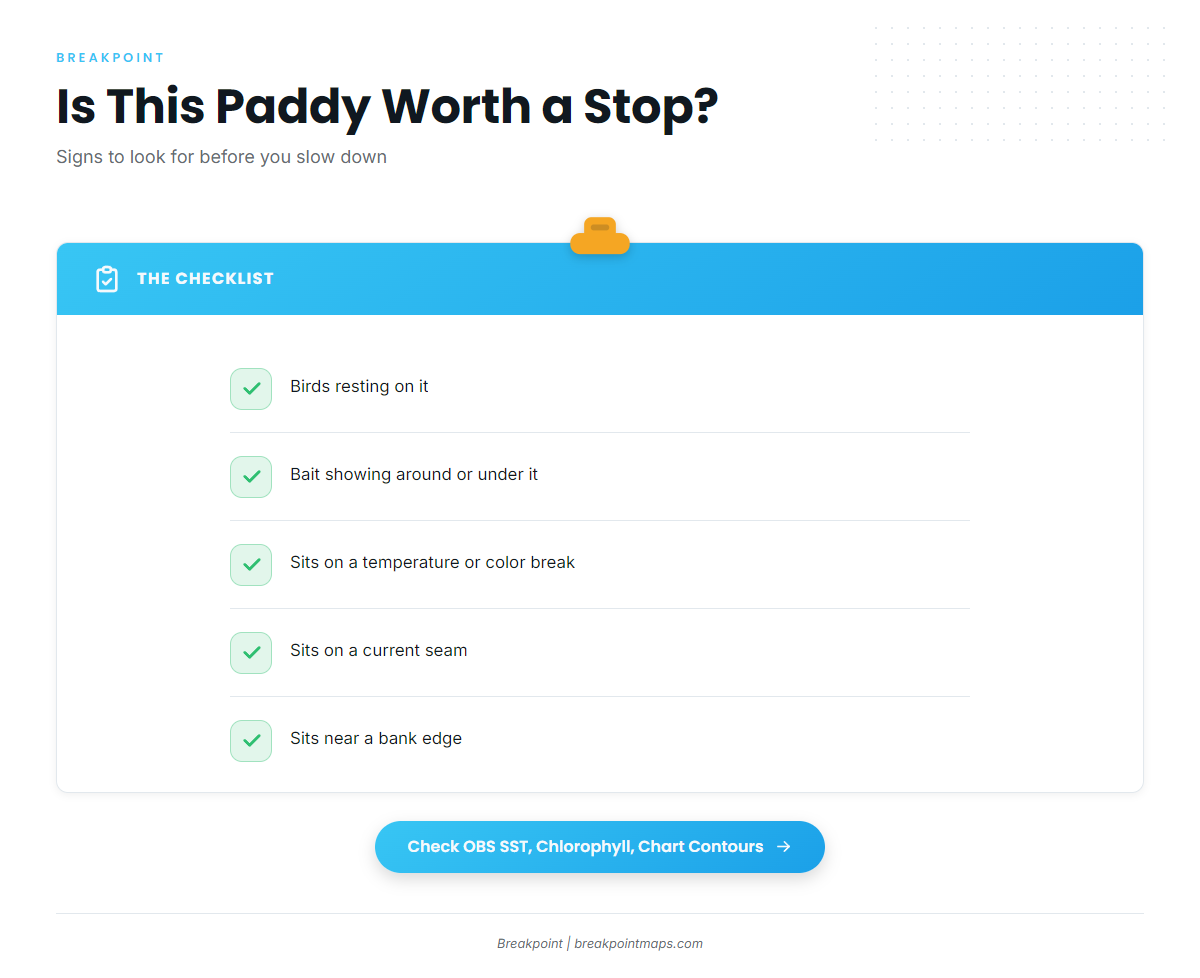
Signs a paddy is worth stopping at:
- Birds resting on it. Gulls and shearwaters favor paddies that hold bait.
- Bait showing around or under it.
- It sits on a temperature or color break, or on a current seam.
- It sits near a bank edge.
Bank edges
Use Chart Contours to find where the banks rise. Paddies and edges that cross the banks give you a place to start the search.
Putting the layers together
Check OBS SST for the warm edge, Chlorophyll for the blue-water color break where paddies collect, and Chart Contours for the bank edges. Run the boat toward where all three line up. Chart layers are not for navigation.
How anglers fish them here
Most Southern California dorado come from paddy hopping: running between floating kelp, scanning from the tower with binoculars, and stopping only where the signs line up. Move on from a paddy that shows no birds, no bait and no fish.
- Feathers on the run. Troll tuna feathers while traveling and prospecting. Schools sometimes turn up in open water between paddies.
- Live bait. Fly-line live sardine or anchovy. Approach the paddy without running over it, and work the area around it.
- Chum. Toss live bait to bring the school to the boat.
- Keep a hooked fish in the water. The school follows a hooked fish. Leave one in the water while the others are baited, and the bite holds near the boat.
On a sportfishing boat, the crew scans from the tower and chums live bait when the boat stops on a paddy. Passengers rotate along the rail, follow the crew’s calls, and keep a hooked fish in the water when the crew asks.
Yellowtail and yellowfin tuna often share the paddy with dorado, and skipjack can show too. Each species has its own California limit, covered under Regulations. For the wider picture, see the offshore gamefish guides.
Before committing fuel to a long run, check the NWS marine forecast for wind, wave height and period, and the OBS SST and Chlorophyll layers for where the warm, blue edge sits.
Taking care of the catch
Bleed dorado and get them on ice quickly. Their colors fade fast after death, so the blue and gold in the fish box is not what the fish looked like in the water. Bleeding and icing early keeps the meat in better shape for the ride home.
Identification and biology
The mahi-mahi (Coryphaena hippurus), called dorado or dolphinfish, is a fast-growing, short-lived pelagic fish in the family Coryphaenidae.
- Maturity comes at 4 to 5 months.
- Lifespan runs about 4 to 5 years.
- Common length is about 100 cm (about 3 feet).
- Diet is fish, squid and crustaceans.
- Juveniles school. Older fish are more often alone or in pairs.
Bulls and cows differ in head shape. The full ID and biology are in our mahi-mahi species guide.
Guides to mahi-mahi fishing from specific ports: Avalon, Dana Point, Marina del Rey, Mission Bay, Morro Bay, Newport Beach, Oceanside and Redondo Beach.
FAQ
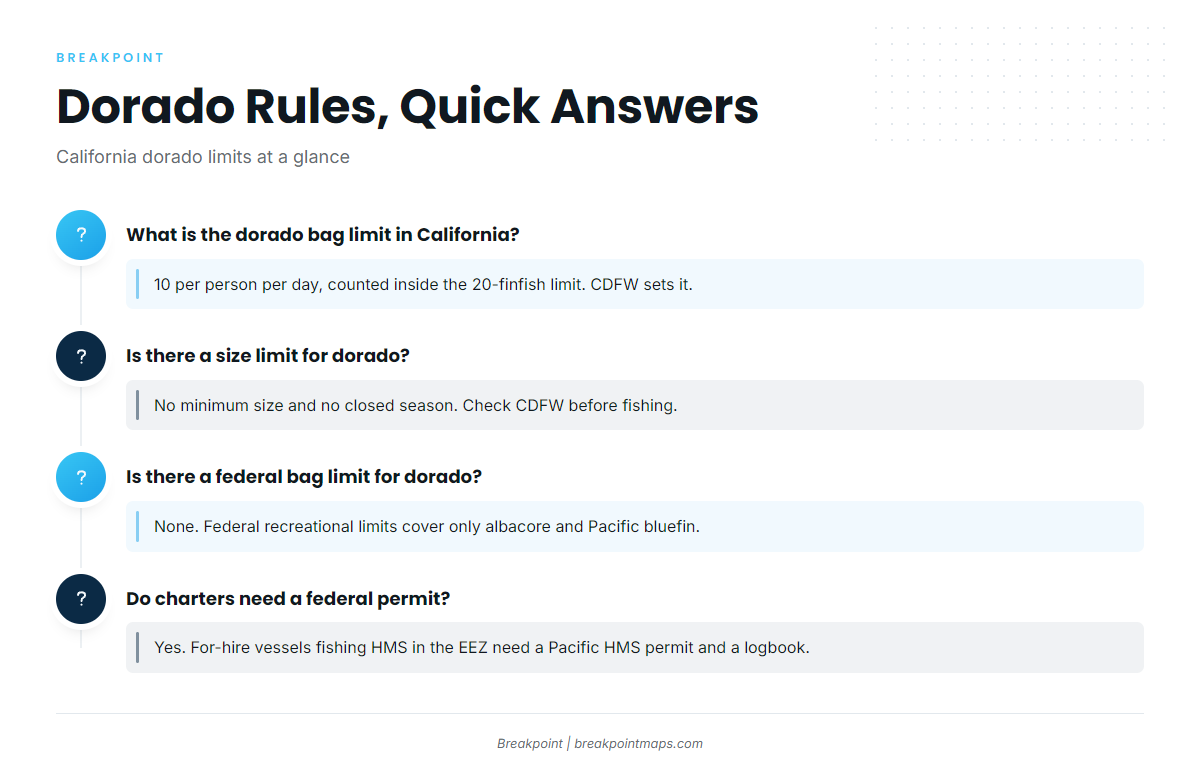
What is the dorado bag limit in California?
10 per person per day, counted inside the 20-finfish general limit, with no more than 10 of any one species. CDFW sets the limit. Check its ocean regulations before fishing.
Is there a size limit for dorado in California?
No. California sets no minimum size and no closed season for dorado. The limit is on numbers: 10 per person per day inside the 20-finfish total. CDFW is the agency to check.
Is there a federal bag limit for dorado?
No. Dorado are covered by the HMS Fishery Management Plan under 50 CFR 660 Subpart K, but federal recreational bag limits exist only for albacore and Pacific bluefin.
Do the rules change past 3 miles?
The EEZ (3 to 200 nautical miles) is federal, but there is no federal dorado bag limit. California’s limits apply to fish landed in California, and federal rules are not intended to override a stricter state rule.
What rules apply in Mexican waters?
Mexico’s license and limits apply, and U.S. rules do not cover them. The California boat limit does not apply to trips that start in California where fish are taken in other jurisdictions. Check Mexican requirements before the trip.
Do charters need a federal permit?
Yes, for for-hire vessels fishing HMS in the EEZ. They need a Pacific HMS permit and a logbook. A CDFW CPFV logbook can meet the logbook requirement.
When is the best time for dorado off Southern California?
Late summer through fall, in years when warm water arrives from the south. The OBS SST layer shows where the edge sits. The start and length of the window follow the water, not the calendar.
Are the rules the same as Florida?
No. West Coast dorado are managed under the Pacific HMS plan with no federal recreational bag limit, and California sets the limit. See "Coming from another coast" under Regulations.
The warm edge, the color break and the bank are on the map before you leave the dock. If you want them in one place, download Breakpoint from the App Store or Google Play and see where they line up for your port.