




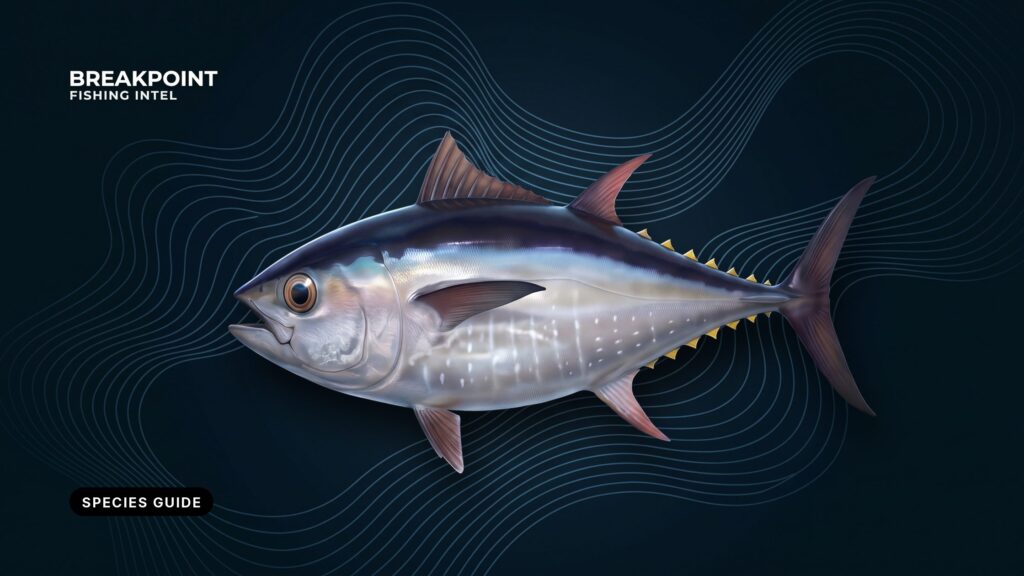
Pacific bluefin (Thunnus orientalis) crosses an ocean to feed off California. Most of the US catch comes from within about 100 nautical miles of the California coast, according to NOAA’s Pacific bluefin profile. Smaller numbers turn up in the blue and green water off Washington and Oregon.
This page is a standing reference covering five topics:
- how to identify the fish,
- where and when it lives,
- how it feeds and moves,
- how it is caught,
- how federal and state rules divide.
It will help you tell the fish apart from albacore and yellowfin before you count it, find the water it holds in, and work out which agency’s limit applies where you land. It covers Pacific bluefin only, not Atlantic bluefin.
Identification: Pacific Bluefin vs Yellowfin, Bigeye and Albacore
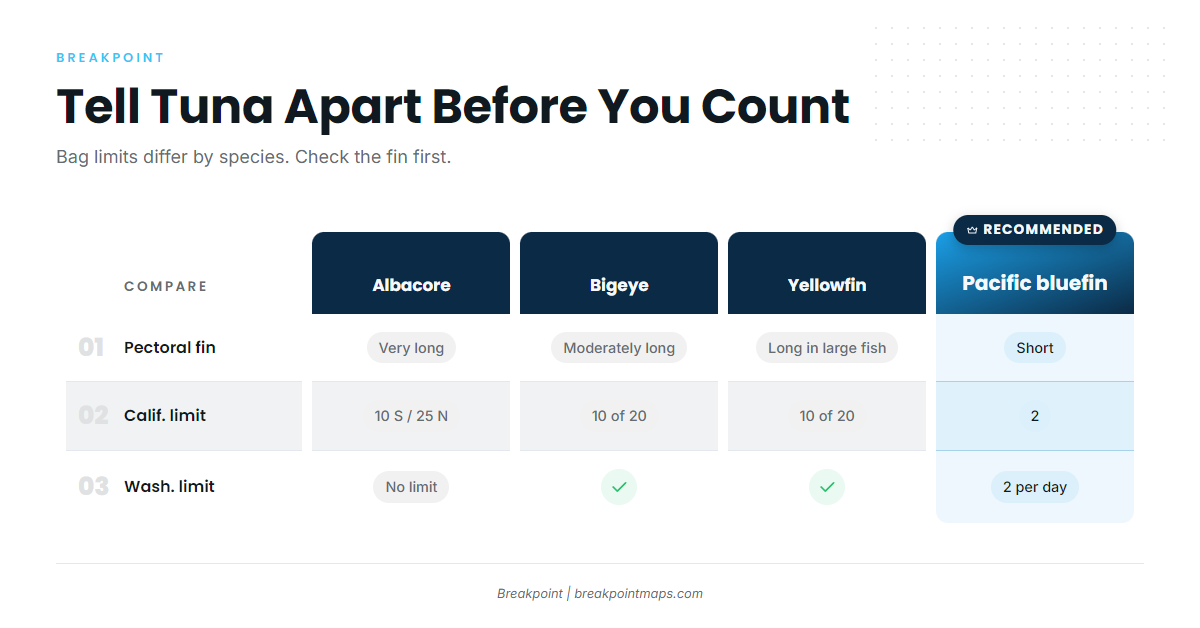
The quickest way to separate bluefin from yellowfin or albacore is the pectoral fin. On bluefin it is short and stops well before the second dorsal fin. Albacore carry a very long pectoral that reaches past the second dorsal. Bag limits differ by species, so identify first and count second.
| Species | Pectoral fin | Body and finlets | Where US anglers meet it | Why it matters for the bag limit |
|---|---|---|---|---|
| Pacific bluefin | Short, ending well before the second dorsal | Deep, heavy-bodied tuna with dark finlets | Southern California banks and islands, plus offshore Oregon and Washington | California: 2. Washington: 2 |
| Yellowfin | Long in larger fish | Slimmer body with yellow finlets | Warm water off Southern California | California: 10, within the 20-finfish limit |
| Bigeye | Moderately long | Thick body, large eye | Deep, warm offshore water | California: 10, within the 20-finfish limit |
| Albacore | Very long, reaching past the second dorsal | Slender body with a long pectoral | Offshore blue water from California to Washington | California: 10 south and 25 north of Point Conception. Washington: no limit |
Swipe the table sideways to see every column.
Juvenile bluefin school with albacore off Washington, according to WDFW, so check every tuna in the box before you count it.
Size is a second check. Pacific bluefin reach a maximum of 3 m (9.8 ft) and 990 lb, per NOAA. A typical adult runs about 4 ft 11 in and 130 lb. Juveniles off Washington typically weigh 10 to 40 lb.
For albacore, yellowfin and the rest of the family, see our other tuna guides.
Pacific Bluefin Life History and Migration
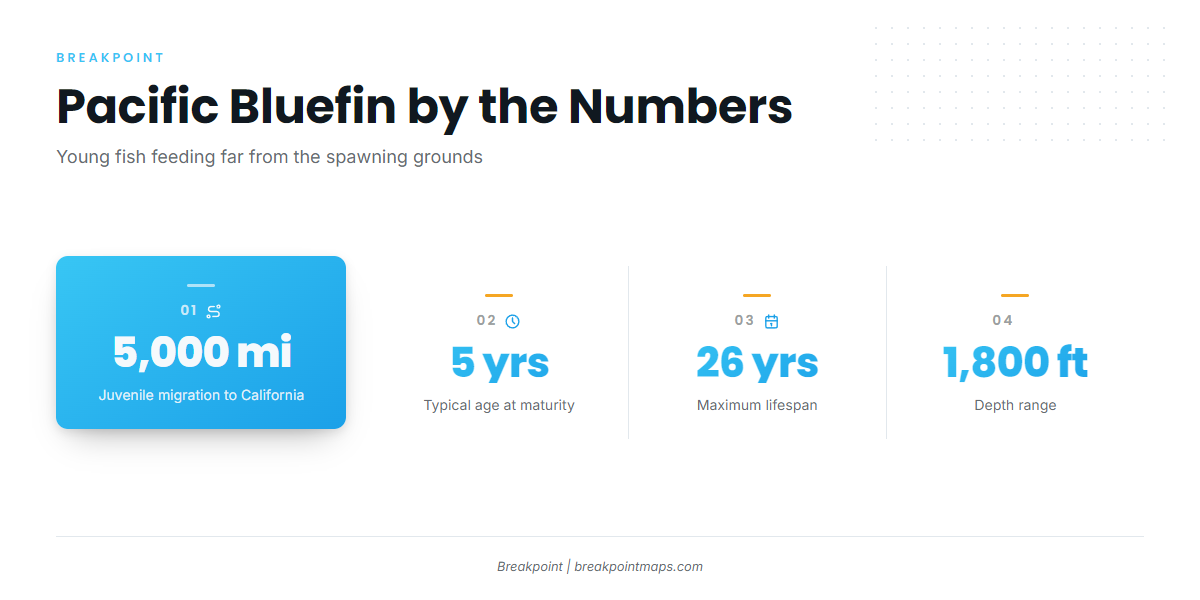
US waters are a feeding ground for young fish. Pacific bluefin spawn in the Sea of Japan and off the Ryukyu Islands, according to the California Sea Grant species profile. Juveniles then travel more than 5,000 mi (8,000 km) to California. They move up and down the coast between Washington and Mexico until about age 7, then return west to spawn.
Fish mature at about 5 years and live up to 26 years. Bluefin move north along Baja California and California from June to September, per the FishBase entry for bluefin.
They range to 1,800 ft, which explains marks on the meter with no sign at the surface and sets up the deep-fishing tactics below.
Size and timing off the US coast follow feed and temperature rather than spawning. The IATTC and the WCPFC manage the stock as a whole. Their rules matter most for commercial fisheries; the Regulations section below covers how they touch recreational anglers.
Where and When to Find Pacific Bluefin
The regional fishing guides carry place-level detail for your own coast. This table summarizes the range.
| Region | Typical sizes | When | Where |
|---|---|---|---|
| Pacific Southwest | See the Pacific Southwest guide | Northward movement from June to September | Southern California Bight banks and islands |
| Washington | Juveniles of 10 to 40 lb, with larger fish in the green water | Larger fish in late summer and fall | Blue water 40 or more miles out, and green water 10 to 25 miles off southwest Washington. Most often caught out of Ilwaco and Westport |
| Oregon | See ODFW | With the albacore fishery | ODFW lists bluefin among the species caught by Oregon tuna anglers |
Pacific Southwest
The Southern California Bight holds the fish most US anglers target. Look to offshore banks and ridges, including Tanner and Cortes Banks, and to San Clemente Island and Catalina. Juveniles feed and grow along the coast for several years. Banks, islands and ports are covered in more detail in Pacific bluefin fishing in the Pacific Southwest.
Pacific Northwest
WDFW documents the Washington pattern. Juveniles of 10 to 40 lb travel with albacore in warmer, clearer blue water 40 or more miles offshore. Larger fish appear in the outer green water 10 to 25 miles off southwest Washington in late summer and fall. Most are caught out of Ilwaco and Westport.
Runs of 40 miles or more depend on the official marine forecast and bar conditions, so check the National Weather Service forecast before you go.
For ports, ranges and local pattern, see Pacific bluefin off Oregon and Washington.
How Pacific Bluefin Feed and Move
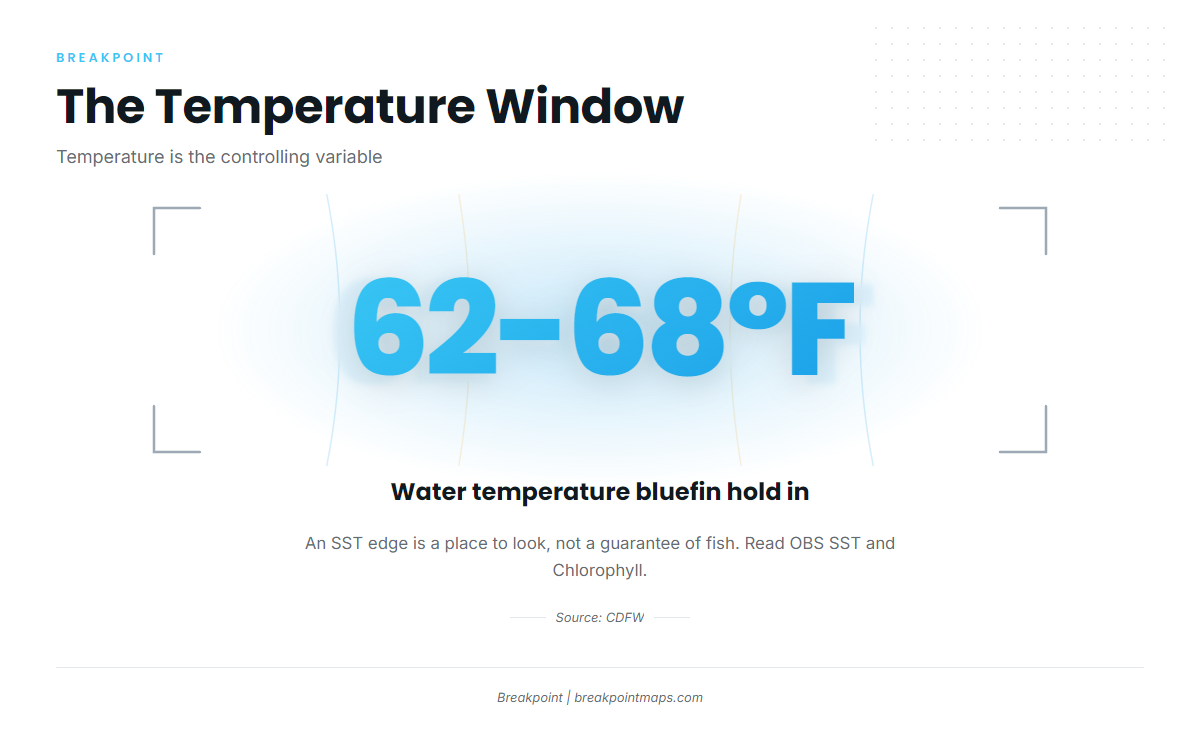
Temperature is the controlling variable. CDFW ties bluefin availability to water of 62 to 68°F (16.5 to 20°C). Inside that band, structure and bait decide where fish hold.
Bluefin eat:
- sardines,
- anchovies,
- saury,
- herring,
- mackerel,
- hake,
- other tunas and squids.
They also take red crabs and krill on occasion, per NOAA.
Fish hold where an SST break or chlorophyll edge meets a bank, ridge or current line, with bait stacked against it.
We read OBS SST and Chlorophyll to see where 62 to 68°F water and its edges sit. A satellite pass blocked by cloud leaves gaps. An edge is a place to look, not a guarantee of fish, and chart layers are not for navigation.
How Pacific Bluefin Are Caught
Bluefin are line-shy and boat-shy, so presentation and distance from the boat matter more than anything else. Start with what you see.
| What you see | What to do |
|---|---|
| Foamers: fish blowing up on bait at the surface | Cast a popper, stickbait or jig into the leading edge. Approach without running over the school |
| Puddlers: fish dimpling at the surface but not feeding hard | Flyline a live sardine, or use a kite or helium balloon to hold bait at the surface away from the boat |
| Meter marks with no surface sign | Drop a sinker rig with live bait, or a flat-fall jig, to the depth of the marks |
| Blue water in the north | Troll plastic squid or plugs with the albacore spread. Some anglers troll large plugs well behind the boat on stout rods, per WDFW |
Kite fishing. A kite carries live bait far from the boat, so the fish are not spooked by the noise and shadow. It takes practice and is harder to manage than trolling. Switch to it when fish hold deep or ignore baits near the hull.
Helium balloon. A balloon does the same job on days with no wind to fly a kite, holding a bait at the surface well away from the boat.
Sinker rig. When fish stay deep but show on the meter, a sinker rig puts live bait at their depth. Use it when the surface is quiet and the marks are real.
Flylined sardine. A live sardine on light, free-drifting line suits finicky fish at the surface. Switch to it when fish ignore everything else or show only as puddlers.
Popper or stickbait. Throw these at foamers. They match the commotion of a bait ball and draw strikes from fish already feeding hard.
Flat-fall jig. A flat-fall jig works the depth where marks sit. Use it when the meter shows fish and bait on the bottom of the school.
Trolled plugs. In the northern blue water, trolled plugs and plastic squid cover ground between albacore bites and pick up the occasional bluefin.
In Oregon, chumming and unlimited rods are allowed beyond 3 miles when you keep only offshore pelagic species. The Regulations section covers it.
Checking the edges before the run helps you decide where to look, but it does not promise fish.
After the Catch
Bleed the fish promptly and ice it well. Meat quality depends on how fast you cool the fish.
A federal fillet rule applies from south of Point Conception (34°27′ N) to the US-Mexico border. Filleted tuna must be:
- bagged individually,
- marked with the species’ common name,
- cut into 6 skin-on pieces: 4 loins, the collar with both pectoral fins attached, and the belly with the vent and both pelvic fins attached.
The fins on those pieces let an officer identify the species. On many charters the crew handles the cutting, but the rule still applies to the fish you carry off the boat.
Pacific Bluefin FAQ
How many bluefin can you keep in California?
2 per person, in addition to the 20-finfish general limit. The limit applies to all bluefin possessed, wherever taken, according to CDFW.
Is the bluefin limit per person or per boat?
It is per person. Under the federal rule, boat limits let anglers aboard keep fishing until the combined limits of all licensed and juvenile anglers aboard are reached.
What are the bluefin limits in Oregon and Washington?
- Oregon: 25 offshore pelagic species per day, combined, with an Ocean Endorsement required (ODFW).
- Washington: 2 bluefin per day (WDFW).
Does a private boat need a federal HMS permit?
No. The federal permit applies to commercial and charter vessels. Charters also keep a logbook, per NOAA Fisheries.
How do you tell bluefin from albacore?
Look at the pectoral fin. It is short on bluefin and very long on albacore. Off Washington, the difference decides between a 2-fish limit and no limit, per WDFW.
What water temperature do bluefin hold in?
62 to 68°F (16.5 to 20°C), according to CDFW. An edge in that range is a place to look, not a guarantee of fish.
Can you fillet tuna at sea in Southern California?
Yes, south of Point Conception, under the federal rule. Cut the fish into 6 skin-on pieces with the fins attached, then bag and label each fish.
Is Pacific bluefin the same as Atlantic bluefin?
No. They are separate species, Thunnus orientalis and Thunnus thynnus, and the Atlantic fish falls under different rules.