




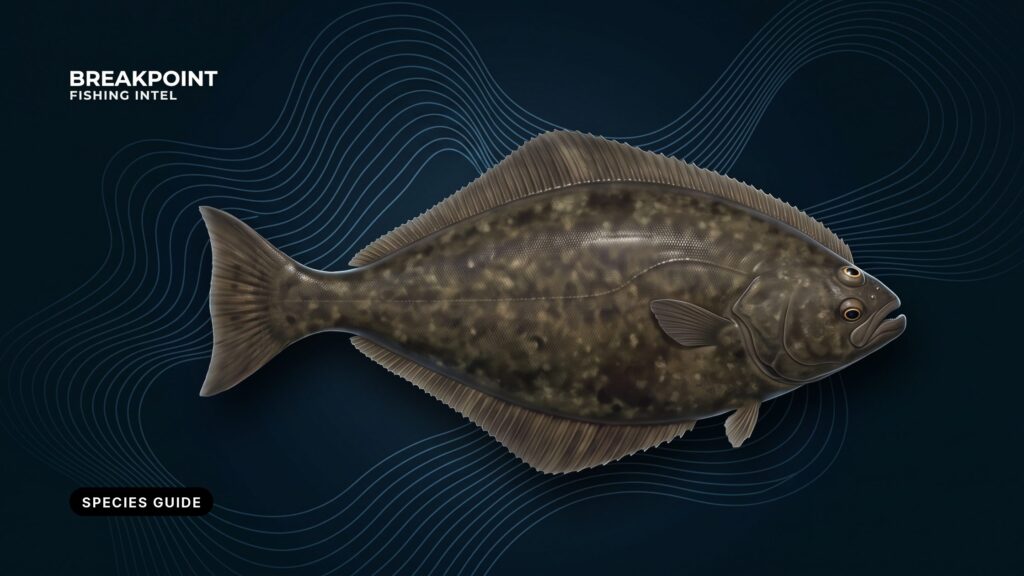
Pacific halibut is the largest flatfish US anglers target, fished from Northern California to Alaska under four layers of management. This guide covers how to identify the fish, where it lives, how it feeds on the tide, how it is caught, and how the rules stack.
The IPHC sets the catch limit, the states set the days, and seasons close when the quota is caught. By the end you should be able to identify the fish, read where it feeds on the tide, and know which subarea’s rules apply and where to check the dates. This guide can’t promise fish, but it can help you decide where to look.
Identification
The Pacific halibut, Hippoglossus stenolepis, is a right-eyed flatfish in the family Pleuronectidae. Both eyes sit on the right side, which is the upper, dark side. The underside, or blind side, is white. Females grow larger than males, and the largest fish are females.
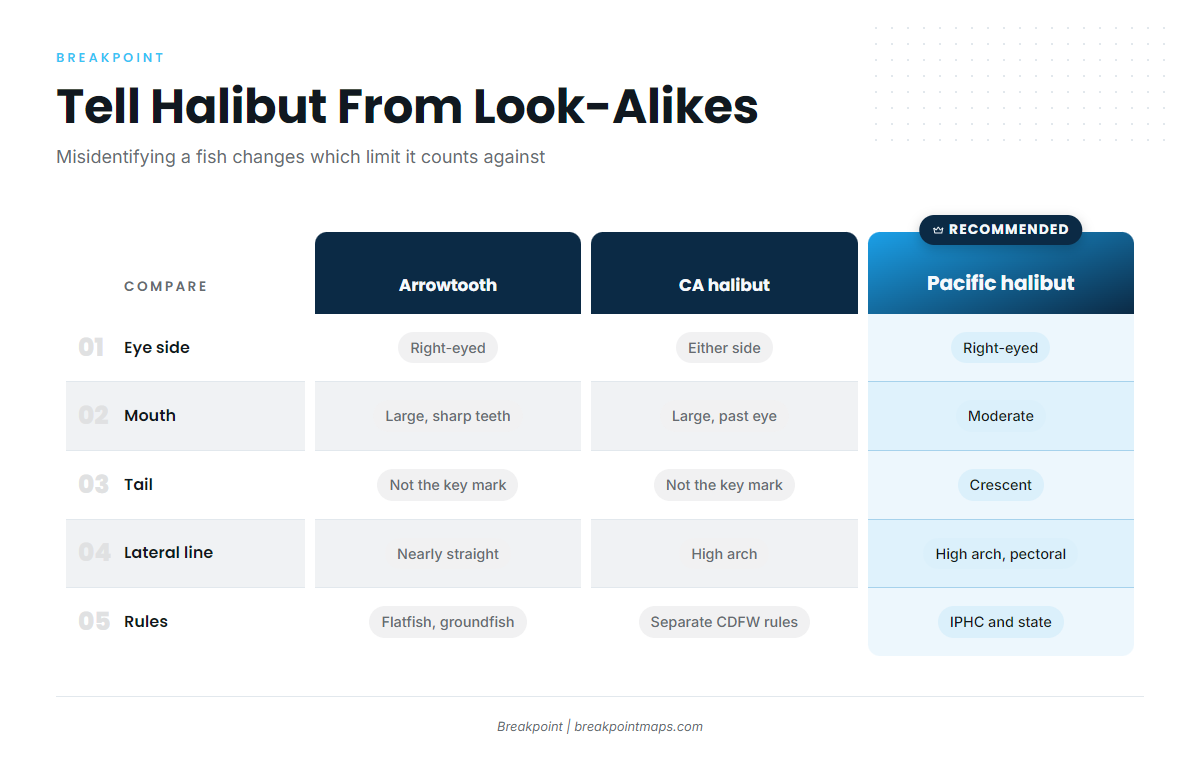
Three marks settle the identification: the lateral line makes a high arch over the pectoral fin, the tail is slightly crescent shaped (lunate), and the eyes are on the right.
| Species | Eye side / family | Mouth and teeth | Tail | Lateral line | Rules |
|---|---|---|---|---|---|
| Pacific halibut | Right-eyed, Pleuronectidae | Moderate mouth | Crescent | High arch over the pectoral fin | IPHC and state halibut rules |
| Arrowtooth flounder | Right-eyed flatfish | Large mouth, long, sharp, arrow-shaped teeth | Not crescent | Nearly straight | Counts as flatfish or groundfish, not halibut |
| California halibut | Different family. Either eye side occurs | Large mouth that reaches past the eye | Not crescent | High arch | CDFW California halibut rules, separate from Pacific halibut |
Swipe the table sideways to see every column.
In Washington, flatfish other than halibut fall under the bottomfish limit, so misidentifying a fish changes which limit it counts against.
Where and When
Mature halibut concentrate on spawning grounds at the shelf edge in winter, at 600 to 1,500 ft. In summer many fish move shallower onto banks and into bays to feed, and fishing follows that move. West Coast openers are set to quota, so timing depends on agency announcements rather than a fixed calendar.
- Southeast Alaska (IPHC Area 2C). Inside waters and the outer coast. Rules are split between charter and unguided anglers. See Regulations.
- Southcentral Alaska (Area 3A). Cook Inlet, Kachemak Bay, the Kenai Peninsula, Prince William Sound and Kodiak.
- Washington (Area 2A). Puget Sound and Strait, North Coast, South Coast and Columbia River subareas.
- Oregon (Area 2A). Columbia River, Central Coast and Southern Oregon subareas.
- Northern California (Area 2A). The southern edge of directed effort.
Port-by-port grounds, runs and bar notes are in our regional fishing guides. Before you run, read the NWS marine forecast and the bar reports for bar conditions and weather.
How Halibut Feed and Move
Halibut are opportunistic predators. They eat fish, squid, octopus and crab, lying on the bottom and ambushing what moves past.
Gravel, sand and mixed bottoms near relief hold fish. They sit on the flats beside the structure, not usually on the hard rock pinnacle. Bait and scent move along the edges of banks, the shoulders of channels and the tops of plateaus where current pushes over, so look for a transition line: where a slope flattens, or where gravel meets mud.
Chart Contours shows the edges, plateaus and gravel humps where halibut stage on the tide. Chart layers are not for navigation. Contours show bottom shape only. Bottom type needs your sounder or a bottom-type chart, and some soundings come from older surveys.
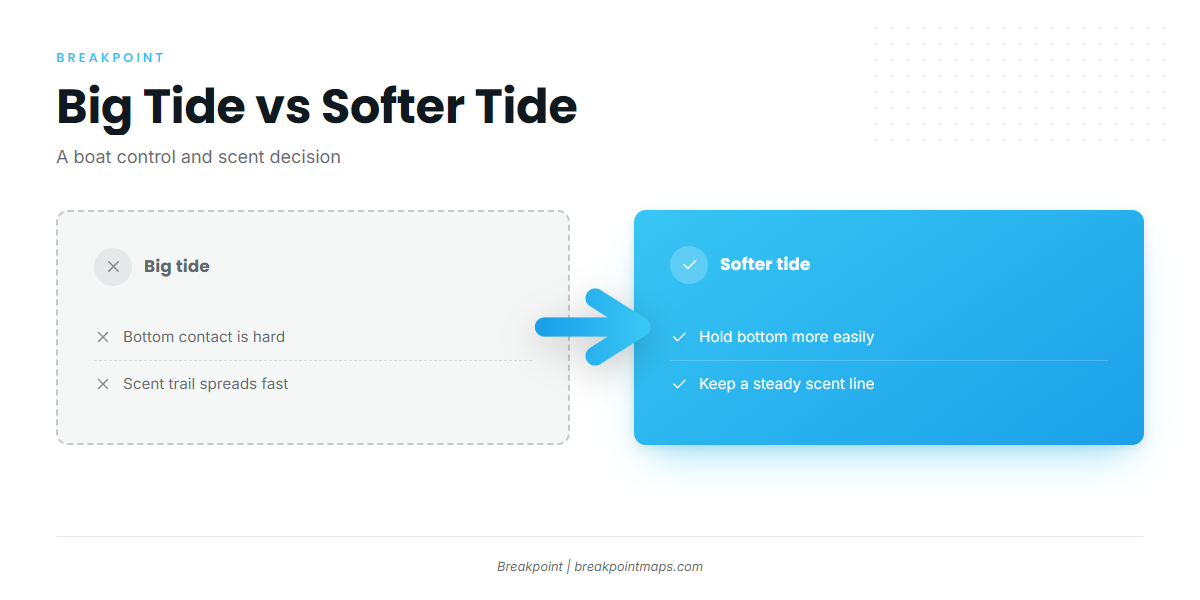
Tide changes the problem in three ways:
- Big tides make bottom contact hard and spread the scent trail fast.
- The softer part of the tide, around the change, lets you hold bottom and keep a scent line.
- Local grounds differ. Some fish best on moving water and others at the turn. The tide book and the chart tell you which.
Treat the tide as a decision about boat control and scent. Halibut find bait by scent down-current. An anchored boat builds a trail, while a drift covers ground.
How Halibut Are Caught
Most halibut are caught on the bottom with bait or a jig.
Drift or anchor. Drift to cover an edge or plateau and find fish. Anchor up-current of a known spot to build a scent trail on the tide. Current and wind decide which method works.
Bait or jig. Herring, octopus and salmon parts (heads, bellies) are standard baits. Jigs and large soft swimbaits cover water and keep your hands on the rod, and many anglers tip a jig with bait.
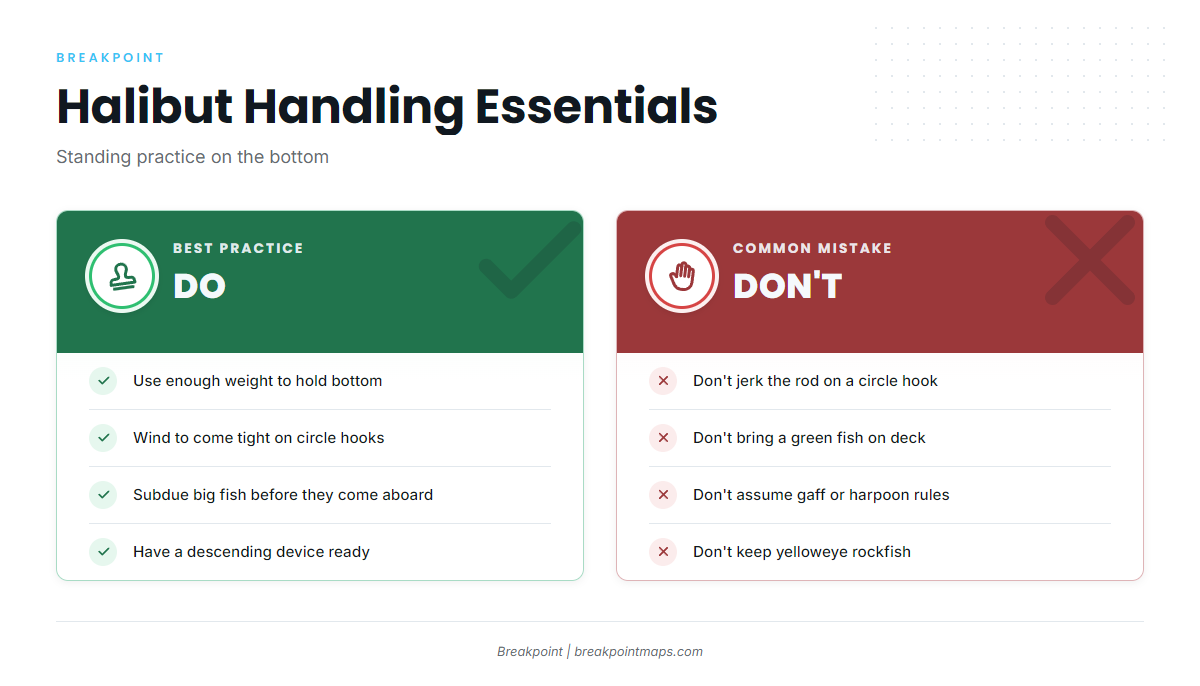
Rig. The standard bait rig is a sliding-sinker setup: main line through a slider and weight to a swivel, then a leader to one or two circle hooks. Circle hooks set themselves as the fish turns, so do not jerk the rod. Wind to come tight. Use enough weight to hold bottom at the depth and tide you fish. Washington allows one line with up to 2 hooks.
Heavy gear. Use stout rods and reels sized to the depth and the weight needed to hold bottom. Braid helps you feel bottom in current.
Landing and dispatch. A large halibut on deck can injure people and break gear, so subdue the fish before or as it comes aboard. Many Alaska charters use a harpoon on big fish, so check the state rule on landing gear. Washington allows a gaff only to land halibut (and lingcod, tuna or dogfish) that will be kept. Every Washington halibut kept goes on the catch record card at once. Oregon fish go on the Combined Angling Tag with length.
Groundfish on the same grounds. Halibut grounds produce lingcod, rockfish and sablefish. Yelloweye rockfish are prohibited in all Washington marine areas and protected in Oregon. A descending device must be aboard and ready. Which groundfish you may keep with halibut aboard changes by subarea and depth. See Regulations. Lingcod, rockfish and deep-drop sablefish are covered in our bottom fish and deep-drop guides.
Plan the drift line on the map against the tide, then check the regional guide for your port before you run.
FAQ
What is the halibut limit in Washington?
It is 1 per day, with an annual limit of 6 and no minimum size. Record each fish on the catch record card at once. Seasons are set to quota by subarea, so check WDFW before you fish.
What is the halibut limit in Oregon?
It is 1 per day in the Columbia River subarea and 2 per day in the Central Coast and Southern Oregon subareas, any size. Record each adult halibut on the Combined Angling Tag with its length. You also need the Ocean Endorsement.
What is a reverse slot limit?
It lets you keep one fish under a set length and one over a larger length. The middle sizes go back. It applies to Alaska charter anglers in Areas 2C and 3A. NOAA sets the lengths each year, so ask your captain.
What is the difference between Pacific halibut and California halibut?
They are different species in different families. California halibut can be left- or right-eyed and has a large mouth. It falls under separate CDFW rules, so do not apply Pacific halibut limits to it.
Where do halibut count if I land in another port?
They count against the subarea of the landing port, and that subarea’s rules apply. In Washington, you may not land at a port in a closed area, except fish lawfully kept in Area 5, which may be landed in Area 4.
Do I need a descending device?
Yes. In Washington one must be on board and rigged for immediate use when fishing for or holding halibut or bottomfish. Federal rules require one on every recreational groundfish vessel off Washington and Oregon.
How do I tell a halibut from arrowtooth flounder?
Arrowtooth has a large mouth with long, sharp teeth and a nearly straight lateral line. Halibut has a high arch in the lateral line over the pectoral fin and a crescent tail.
Why did the season close early?
Each subarea fishes to an allocation, and the season closes when that allocation is caught. Call the NOAA hotline at (800) 662-9825 and check the WDFW and ODFW pages for announced closures.