




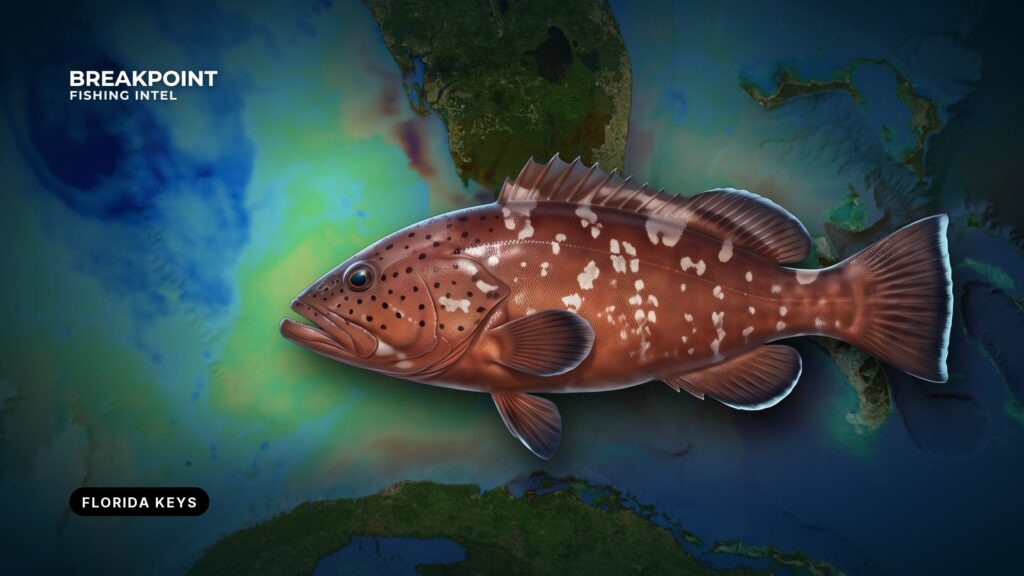
Red grouper fishing in the Florida Keys centers on Gulf-side hard bottom and on the rubble and ledges beyond the reef line. All Monroe County state waters, Gulf side included, are closed to keeping red grouper January 1 to April 30.
This guide covers where to launch, which bottom to run to, and which rulebook applies once the anchor drops. Biology and general tactics are in our red grouper species guide; this page stays local. By the end you should know the port, the bottom, and whether the fish in your hand is legal.
Ports: Key West, Marathon and Islamorada
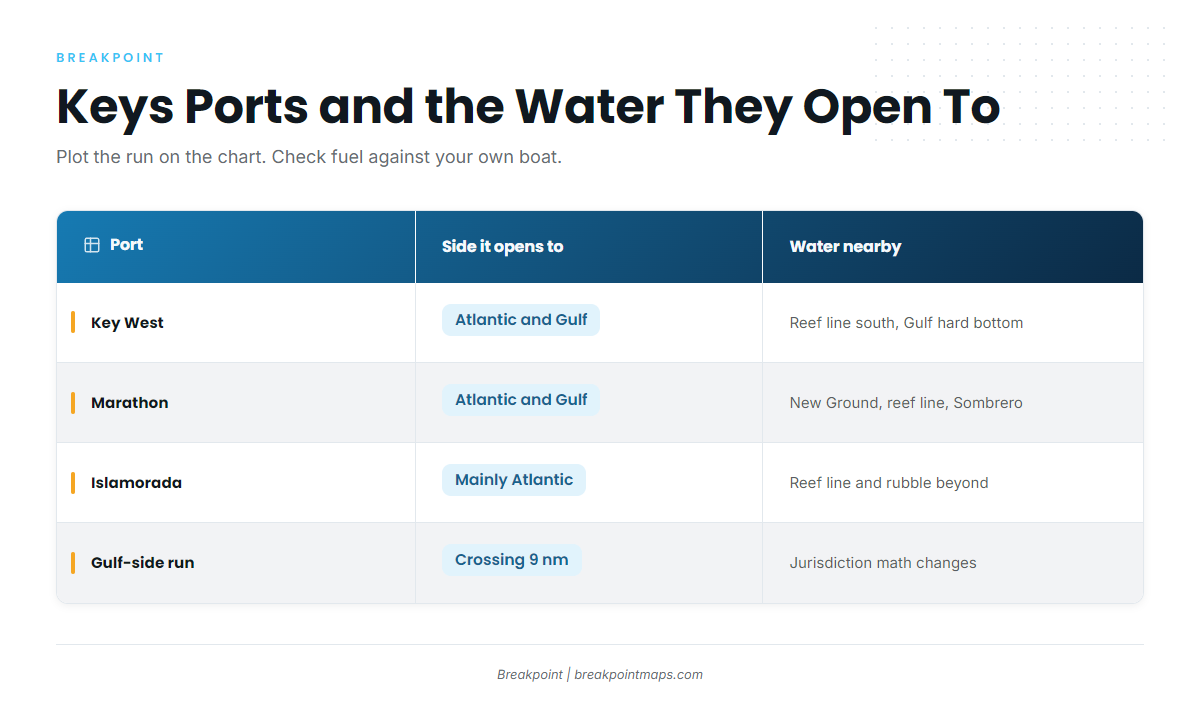
The Atlantic lies south and east of the island chain. The Gulf and Florida Bay lie north and west. Most red grouper water is on the Gulf side, so Gulf-side ramps and the passes between keys matter. Atlantic departures put you on the reef line and the rubble beyond it. We give no run times or distances here; plot the run on your chart and check fuel against your own boat.
| Port | Side it opens to | Water type nearby |
|---|---|---|
| Key West | Atlantic and Gulf; western gateway to the Marquesas and Tortugas range | Reef line and Sand Key to the south; Gulf-side hard bottom to the north and west |
| Marathon | Atlantic and Gulf | Gulf-side hard bottom, the "New Ground" area; reef line and Sombrero to the south |
| Islamorada | Primarily Atlantic; Florida Bay behind | Reef line and the rubble beyond it |
The county grouper rule is the same on both sides in state waters. Past 9 nm on the Gulf side, the jurisdiction changes. The Regulations section lays out the lines.
Where Red Grouper Hold: Structure and Water
Red grouper live in holes and under ledges, and that shapes what you look for on the chart and the sounder.
Gulf-side hard bottom and ledges
Look for low-relief hard bottom, ledges, rock and holes. The Gulf-side hard bottom off Marathon and Key West is the core of this fishery, including the area locals call the "New Ground." Ten Fathom Ledge is public structure worth marking.
West of Key West, the Marquesas and Tortugas range is a longer run. The Tortugas contain Ecological Reserves, which are no-take, so read the sanctuary section below before you plan that trip.
- Hard bottom: broad and low-relief, so the search matters as much as the stop.
- Ledges: the lip and the base both hold fish.
- Holes in rock: the places a grouper backs into when hooked.
- Ten Fathom Ledge: a named public mark on the Gulf side.
Atlantic side: beyond the reef line
The rubble and ledges deeper than the main reef hold fish. Sand Key, Looe Key and Sombrero are landmarks to fish outside of, in deeper water beyond the zone markers. They are not grouper spots themselves.
Sanctuary no-take zones
A Sanctuary Preservation Area (SPA) is a Florida Keys National Marine Sanctuary zone where all harvest is prohibited. Ecological Reserves are also no-take.
- Examples: Western Sambo, Looe Key, Sombrero and the Tortugas Ecological Reserves.
- On the water: large yellow buoys mark SPAs, but the buoys are not the boundary itself. Check NOAA’s official charts and the Florida Keys National Marine Sanctuary zone maps before the run.
- Anchoring: sanctuary anchoring rules apply. Check them with the sanctuary before you set the hook.
- Same bottom, same bag: gag, black grouper and mutton snapper share this bottom. Gag and black grouper count in the same grouper aggregate as red grouper.
When to Go: Red Grouper Season in the Keys
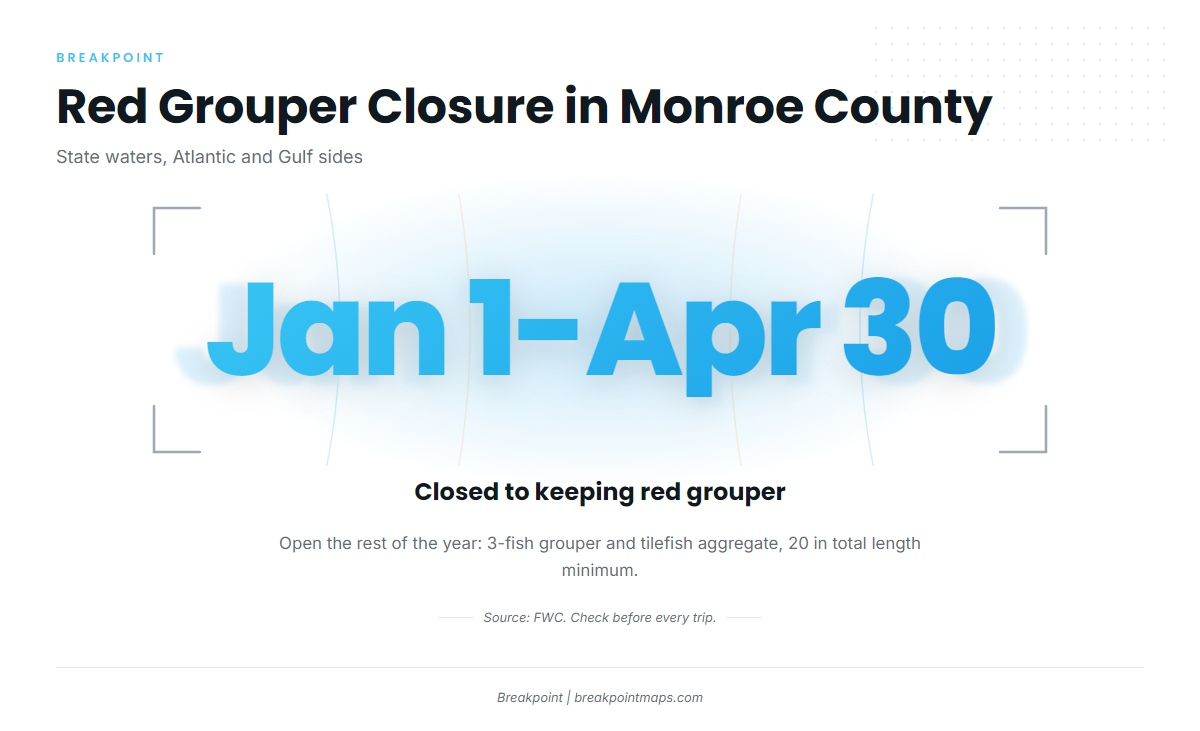
In all Monroe County state waters, Atlantic and Gulf sides, red grouper are closed to harvest January 1 to April 30. They are open the rest of the year under the 3-fish grouper and tilefish aggregate and a 20-inch total length minimum.
In federal Gulf waters, beyond 9 nm, there is no federal closed season for red grouper. In federal Atlantic waters, beyond 3 nm, check SAFMC and NOAA Fisheries before you go.
- State waters, both sides: closed January 1 to April 30.
- Federal Gulf: no federal closed season.
- Federal Atlantic: confirm with SAFMC and NOAA Fisheries.
Rules change by executive order, so check FWC before every trip.
Tactics That Fit Keys Bottom
General rigging is covered in the red grouper guide. What follows applies to Keys bottom specifically.
- Baits: live pinfish, grunts and blue runners, or strips of bonito or squid.
- Hooks: non-stainless-steel hooks are required with natural bait in Atlantic state waters south of 28° N, which covers the Keys. Circle hooks are required in federal Gulf waters. Carrying non-stainless circle hooks covers both.
- Presentation: anchor up-current of a ledge or hole, or drift low-relief rubble to find fish, then settle on them.
- Hooked fish: a grouper heads for its hole and locks in. Take all pressure off and wait. Reel hard when it swims out, as long as the leader is not chafed.
Gulf-side bottom is broad and low-relief, so searching matters. Atlantic-side fish sit on the deeper edges beyond the reef, where precise positioning outside the zones matters.
For conditions, watch wind, wave height, wave period, and the length of the run if you’re towing a trailer boat. The official source is the NWS Key West marine forecast.
Finding the Bottom on the Chart
Chart Contours in Breakpoint shows where contours tighten. Tight contours mark ledges and rubble edges worth checking before you burn fuel. Open Chart Contours over the Gulf side before the run and mark the edges you want to check.
The data has limits. Low-relief rubble may not resolve on older surveys, and some of this bottom was surveyed long ago. Your sounder has the final word. Chart layers are not for navigation, so check sanctuary boundaries against NOAA’s official charts.
Release and Handling
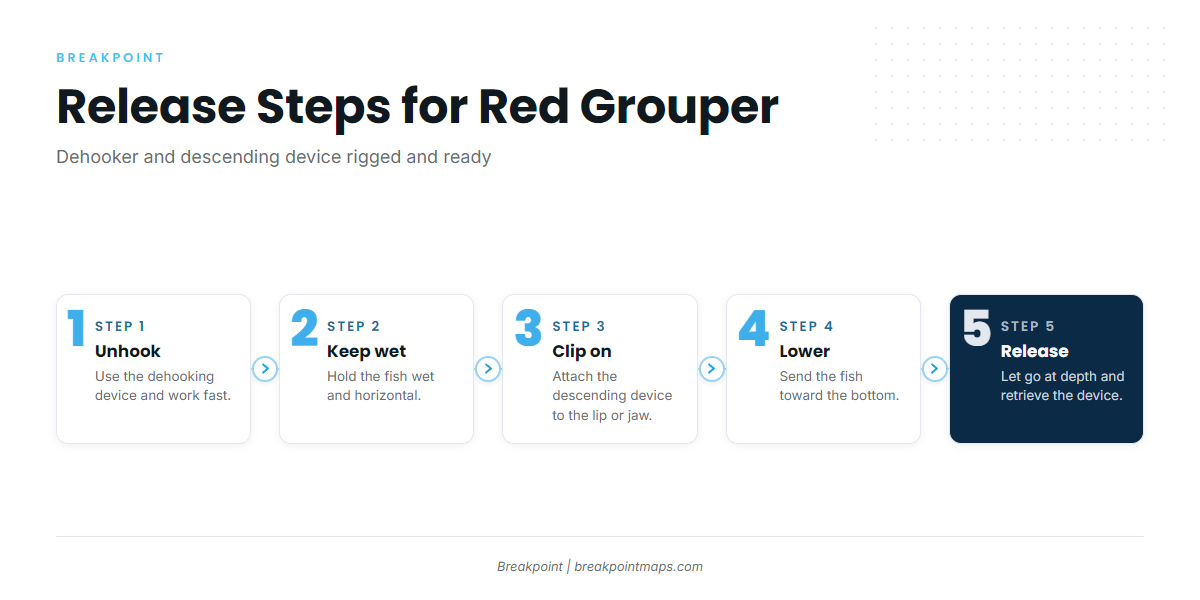
Have a dehooking device and a descending device or venting tool rigged and ready. A descending device needs at least a 16-ounce weight and 60 feet of line.
- Unhook quickly with the dehooking device.
- Keep the fish wet and horizontal.
- Clip the descending device to the lip or jaw.
- Lower the fish toward the bottom.
- Release it at depth and retrieve the device.
If the closure is on, move off grouper bottom to avoid repeated hookups.
Frequently Asked Questions
Do Gulf grouper rules apply on the Gulf side of Marathon?
Not in state waters. All Monroe County state waters follow the Atlantic grouper rules, Gulf side included. Federal Gulf rules apply only beyond 9 nm.
I have 3 red grouper and run into federal Gulf water. Am I legal?
The federal Gulf limit is 2 red grouper, and possession counts. The stricter limit governs what is in the box. Check FWC’s guidance before you mix zones.
Do visitors need the State Reef Fish Angler designation?
Yes, when fishing for reef fish from a private vessel. It is separate from the saltwater license and is obtained through FWC.
Does a charter license cover me on my own boat?
No. The charter exemption applies only aboard a licensed for-hire vessel. On a private boat, you need your own license unless another FWC exemption applies.
Descending device or venting tool?
Either one, rigged and ready, satisfies the rule. A descending device needs at least a 16-ounce weight and 60 feet of line. The release steps are in the Release and Handling section.
How do I spot SPA boundaries?
Large yellow buoys mark SPAs. Confirm the boundaries on NOAA charts and the sanctuary’s zone maps. All harvest is prohibited inside.
Can I catch and release red grouper during the closure?
The closure bars harvest. A saltwater fishing license is required even for catch and release. Use the required release gear, and check FWC for any further limits on targeting.