



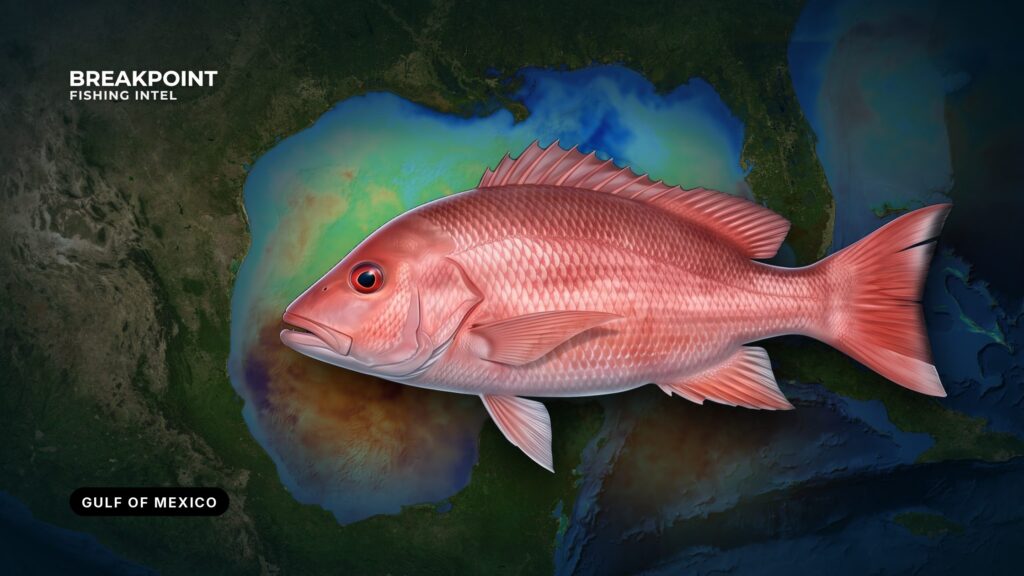
Red snapper (Lutjanus campechanus) is a bottom fish of the continental shelf that lives on hard structure. The NOAA Fisheries red snapper profile puts it generally 30 to 620 feet deep in the Gulf of America (Gulf of Mexico), near reefs, ledges, rocks and limestone. This guide covers how to tell red snapper from look-alikes, where it lives by region, how it feeds, spawns and moves, how it is caught and released, and how federal and state rules divide. The fish is worked across the Gulf and the South Atlantic, and it is rare north of the Carolinas.
How to identify red snapper
Red snapper has a pinkish-red to red body, paler below, with a red eye. The anal fin is pointed and the mouth carries snapper canine teeth. An adult has no dark spot on its side. Juveniles can show a dark blotch below the soft dorsal.
Size depends on the source. NOAA says red snapper may reach 40 inches and 50 pounds. The Florida Museum gives a lower maximum of 39 inches and up to 20 pounds, with an average length of 24 inches.
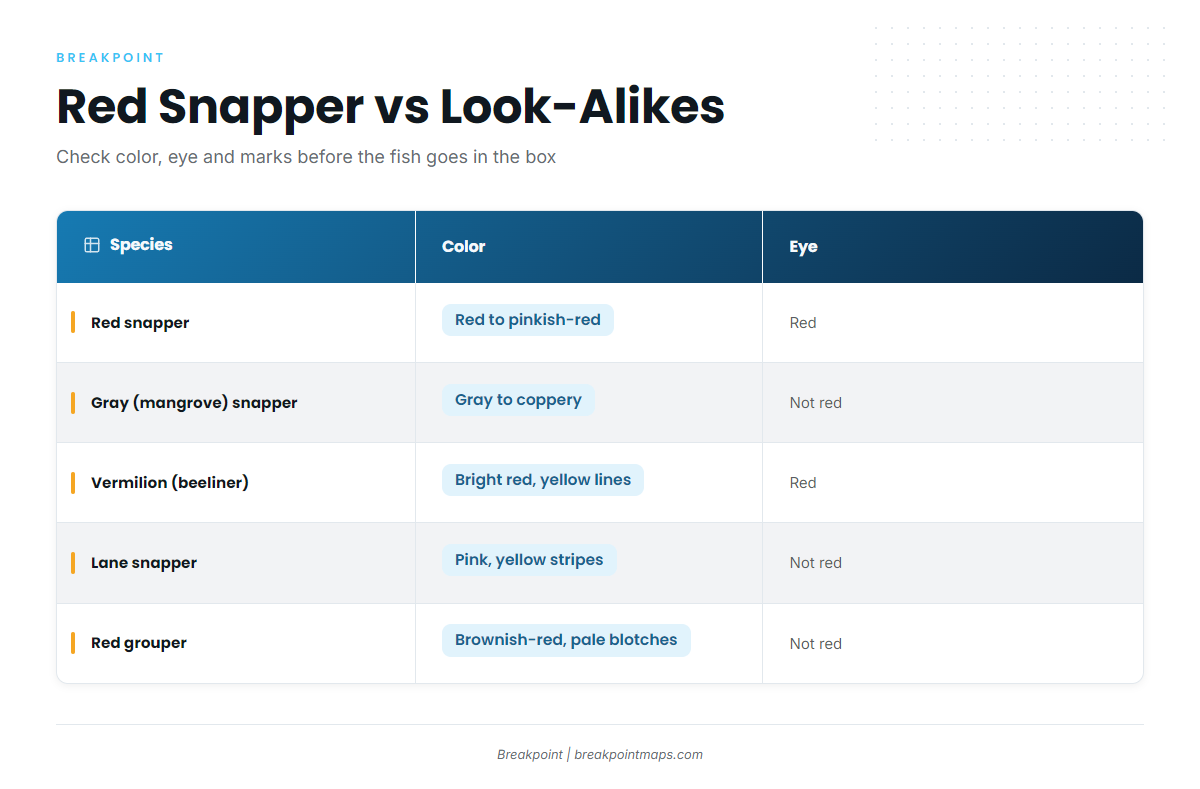
Look-alikes share the same bottom:
| Species | Color | Eye | Mouth and teeth | Dorsal or other mark | Typical habitat |
|---|---|---|---|---|---|
| red snapper | red to pinkish-red | red | snapper canines | adults have no spot | shelf hard structure |
| gray (mangrove) snapper | gray to coppery | not red | 2 prominent upper canines | dark band through the eye on young fish | inshore to reef structure |
| vermilion snapper (beeliner) | bright red with thin yellowish lines | red | smaller mouth, lower jaw projects | slimmer body, no spot | reef structure |
| lane snapper | pinkish with yellow horizontal stripes | not red | snapper canines | dark spot below the soft dorsal | reef and sand edges |
| red grouper | brownish-red with pale blotches | not red | wide grouper mouth | square tail, not a snapper | reef and ledge |
Swipe the table sideways to see every column.
Vermilion, gray and lane snapper, and red grouper each have their own entry in our reef fish fishing guides.
Size and bag rules differ by species, and a misidentified fish is a violation. Before any fish goes in the box, confirm it is a red snapper.
Where red snapper live, region by region
The range covers the Gulf and the eastern coasts of North America, Central America and northern South America, according to NOAA. The Florida Museum describes it as the western Atlantic from Massachusetts to Brazil.
- Gulf: NOAA gives a general depth of 30 to 620 feet. Adults sit near coral reefs, artificial reefs, rocks, ledges, caves, sloping soft-bottom areas and limestone deposits. Oil and gas platforms and artificial reefs add hard structure to the shelf.
- Florida Panhandle: the worked local example. See red snapper fishing off Destin for place-level detail.
- Atlantic Southeast (Florida Atlantic coast to North Carolina): a survey of Southeast red snapper by Bacheler et al. found relative abundance highest in mid-shelf waters off eastern Florida and Georgia, and to a lesser extent off the Outer Banks. Fish are less common off southern North Carolina and South Carolina. Abundance was highest where there was a moderate amount of natural structured habitat.
- North of the Carolinas: NOAA, FishBase and the Florida Museum all describe red snapper as rare here, though the range reaches Massachusetts.
Port-level detail is in the regional fishing guides.
Biology: feeding, spawning, growth and movement
Life stages and depth
Each stage lives somewhere different:
- Larvae: swim freely in the water column (NOAA).
- Juveniles: live in shallow water over sandy or muddy bottoms. As they mature they seek ledges, rocky outcroppings and wrecks (Florida Museum).
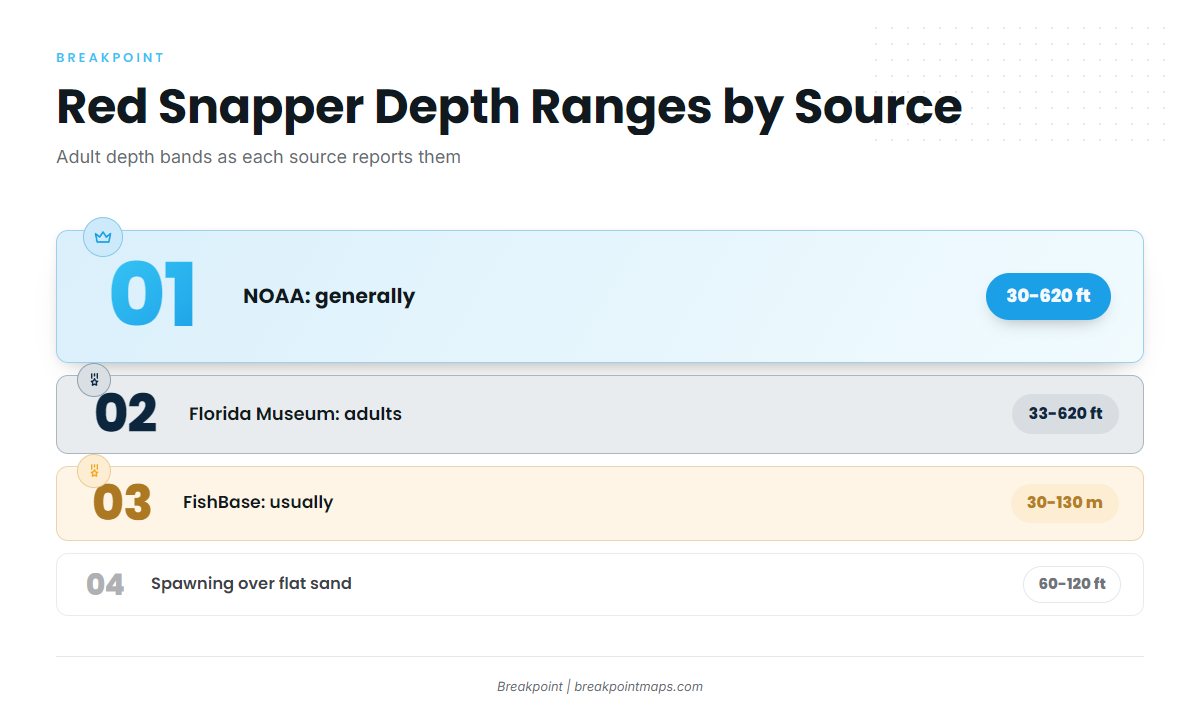
- Adults: sit on the bottom near hard structure on the shelf. NOAA gives generally 30 to 620 feet. The Florida Museum gives 33 to 620 feet. FishBase gives usually 30 to 130 m.
In winter, northern red snapper move offshore to avoid cooler, shallow inshore water (Florida Museum), so cold months push the search deeper.
What red snapper eat
Adults eat fish, shrimp, crab, worms, cephalopods and some plankton (NOAA). Juveniles start on zooplankton and shift to shrimp, squid and octopus as they mature (Florida Museum). Squid and fish baits match that diet.
Spawning season
NOAA says red snapper spawn May to October, depending on location. The Florida Museum puts spawning at June to August in the northwestern Gulf and August to September off southwestern Florida. According to the Florida Museum species profile, spawning happens at 60 to 120 feet over flat sand bottom away from reefs. In summer, flat sand near structure can hold fish.
Age and growth
Red snapper are long-lived. NOAA reports lifespans up to 57 years in the Gulf and 51 years in the South Atlantic. The Florida Museum estimates a maximum of 40 to 50 years.
Growth runs about 4 inches per year for the first 6 years, then slows. Females can reproduce as early as age 2 (NOAA). Because the fish lives so long, every released fish matters, which is why barotrauma gets its own section below.
Finding structure
Red snapper are a structure fish. Bacheler et al. never observed them at 197 randomly selected stations that lacked structured habitat.
Look for two kinds of bottom:
- natural ledges, banks, rocky outcroppings and limestone bottom;
- artificial reefs, wrecks and platforms.
Match depth to life stage and season, as above. Chart Contours and the bathymetry layers in the app show ledges, banks and reef sites across the 30 to 620 foot band NOAA cites. Chart layers are not for navigation.
Bathymetry is only as good as the last survey. A contour shows where structure is likely, not where fish are.
How red snapper are caught
NOAA says recreational fishing is primarily hook-and-line. You fish the bottom, at the structure.
Two rigs cover most trips:
- Knocker rig: the sinker slides down onto the hook. It is compact, gets to the bottom fast and suits fish holding tight to structure.
- Carolina (fish-finder) rig: a sliding sinker above a swivel, then a leader. The bait moves more naturally.
Use circle hooks. They are required with natural bait in Texas, Alabama and federal Gulf waters, and federal and Alabama rules specify non-stainless steel circle hooks. See Regulations below.
The Florida Museum names squid and ladyfish as baits. Standard practice adds cut squid, cigar minnows, live pinfish and menhaden, and menhaden chum draws fish up off the structure.
The same bottom trip often holds several species, and the guides to reef fish species cover what else you may hook.
Handling and release
A fish pulled from depth expands its swim bladder. Barotrauma shows as a stomach pushed out of the mouth, bulging eyes and a fish that floats and cannot swim down.
Two tools address it:
- Descending device: returns the fish to depth so the gas recompresses.
- Venting tool: releases gas through the body wall.
NOAA encourages venting tools and recompression devices for fish with barotrauma.
Gear rules vary by jurisdiction:
- Texas requires a descending device or venting tool ready for reef fish, and requires its use in state waters.
- Federal Gulf rules require a dehooking device on board.
- Alabama points to MRD for its descending device rule.
Texas measures in a straight line from the snout tip to the extreme tail tip, with the jaw closed. Release fish quickly, get them back down, and keep the device rigged before the first drop.
Frequently asked questions
What is the difference between red snapper and mangrove snapper?
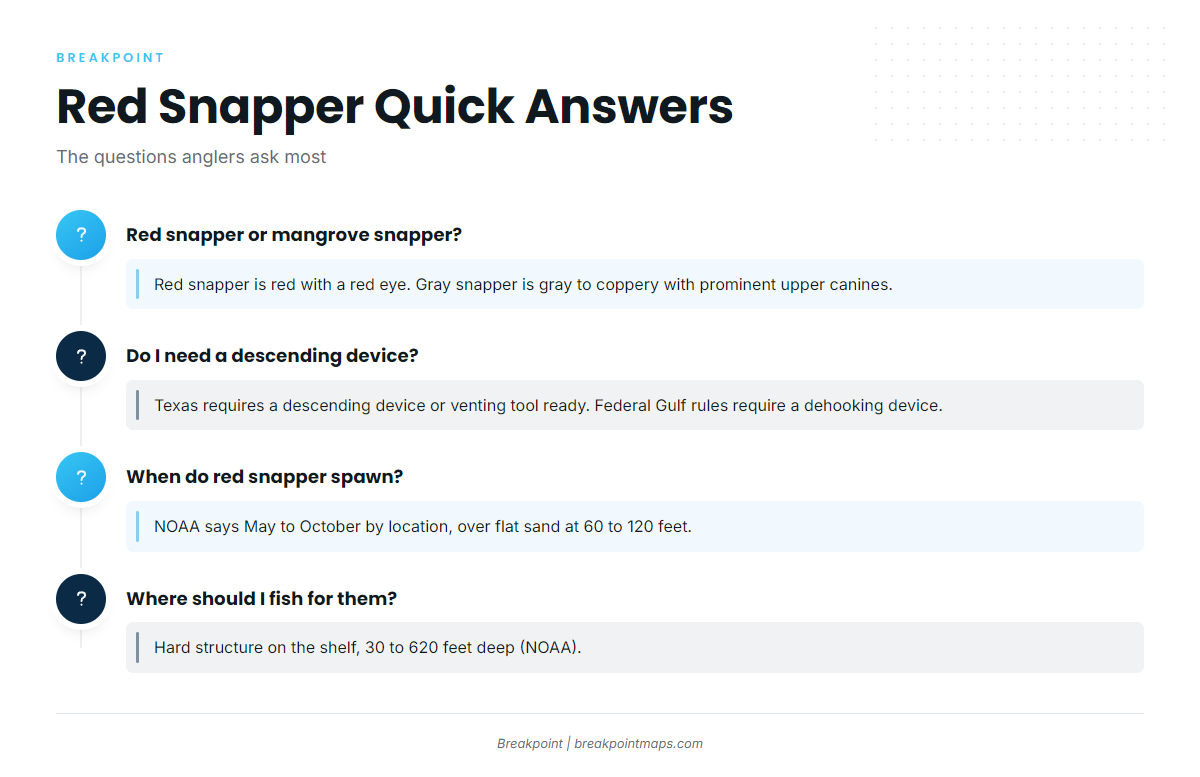
Red snapper is red with a red eye. Gray (mangrove) snapper is gray to coppery, has prominent upper canines, and young fish show a dark eye band. Limits differ by species. Alabama, for example, sets 12 inches and 10 fish for gray snapper.
Do I need a descending device for red snapper?
Texas requires a descending device or venting tool ready for reef fish, and requires its use in state waters. Federal Gulf rules require a dehooking device. NOAA encourages recompression. Check the state agency page for other states.
Why do federal and state red snapper rules differ?
Under 50 CFR 622.23, Gulf states set the private season, bag and size, including in federal waters. For-hire boats follow NOAA’s season. The South Atlantic is federally managed. Fish must meet the rules where they are landed.
Do charter customers need a license or endorsement?
Federally permitted for-hire boats follow the federal season, and captain and crew keep 0. In Alabama, private anglers need a license or registry plus the Gulf Reef Fish Endorsement. Ask the captain and check the state agency page.
When do red snapper spawn?
NOAA says May to October, depending on location. The Florida Museum puts it at June to August in the northwestern Gulf, at 60 to 120 feet over flat sand away from reefs.
Where should I fish for red snapper?
Fish hard structure on the shelf, 30 to 620 feet according to NOAA. Port-level detail is in the regional fishing guides.
The regional guides and Chart Contours will not put a fish on the line, but they help you decide where to look. You can also download Breakpoint from the App Store or Google Play.