




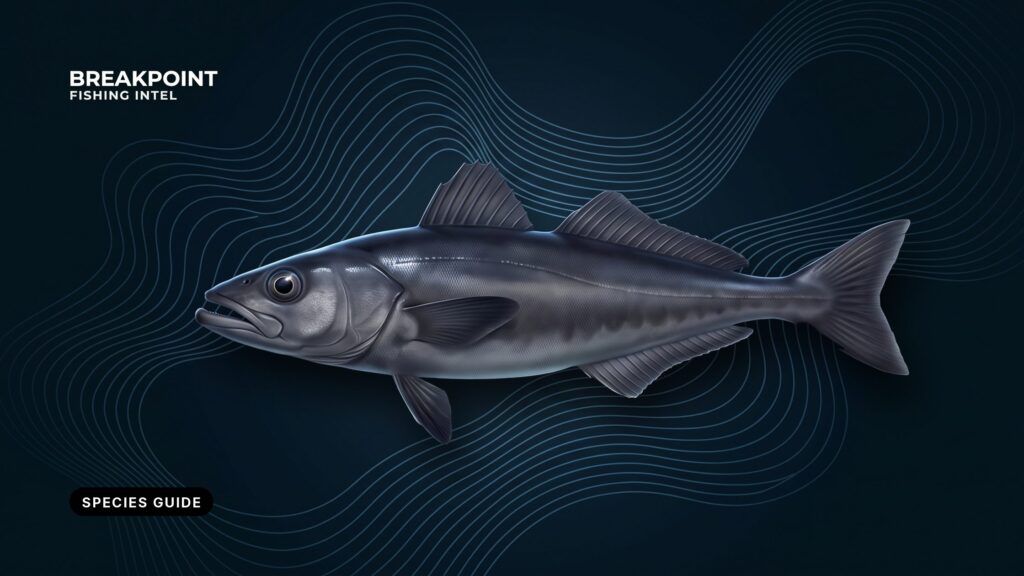
Sablefish, Anoplopoma fimbria, is the fish most West Coast and Alaska anglers call black cod. It lives on the continental slope and in submarine canyons, and adults are caught by deep-dropping baited rigs with an electric reel.
This guide covers how to identify the fish, where it lives from California to Alaska, how it feeds and moves, how to rig and fish for it, and how federal and state rules divide. Use it as a field reference between waypoints. It won’t promise fish, but it will help you decide where to look. The regulation figures come from the agencies, so check the agency page before fishing.
Sablefish Identification
A sablefish has two widely spaced dorsal fins and a slate-black to greenish-gray body that fades to pale gray or white below.
"Black cod" is a market name. Sablefish is not a true cod and belongs to its own family, and lingcod is not a cod either. Go by fins and color rather than the label.
ID Quick Reference
Check these on deck:
- Two dorsal fins, set well apart.
- Dark back and sides, from slate-black to greenish-gray, with a lighter belly.
- Long, tapered body with a forked tail.
- Smooth head with no heavy spines.
- Smallish mouth compared with a lingcod.
Sablefish vs Lingcod and Other Lookalikes
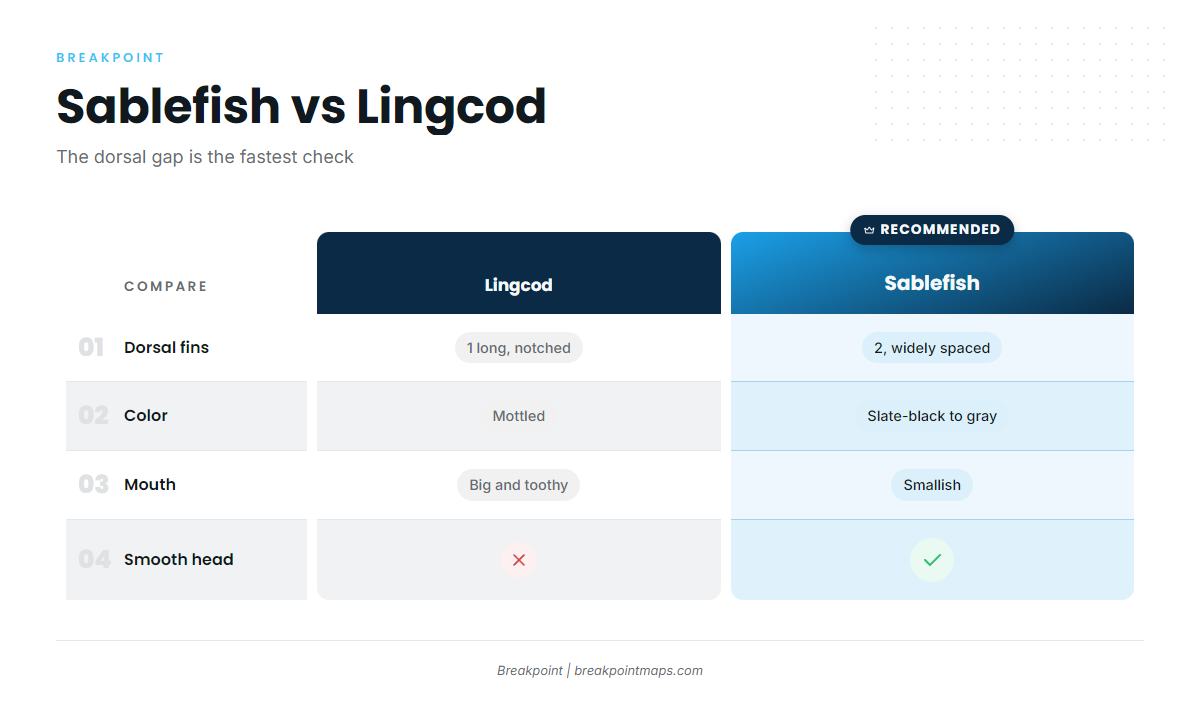
| Species | Dorsal fins | Color | Tell |
|---|---|---|---|
| sablefish | 2, widely spaced | slate-black to greenish-gray | Gap between the two dorsals. |
| lingcod | 1 long, notched | mottled | Big toothy mouth. |
| Pacific hake | 2, long notched second | silvery | Silver body. |
| grenadier | first short, second runs into tail | dark gray | Large head, tapering rat-like tail. |
| rockfish | 1, spiny | varies | Spines on the head. |
The dorsal gap is the fastest check on a crowded deck.
Where and When Sablefish Live
Adult sablefish live on the continental slope, along canyon walls and drop-offs over mud or clay bottom, from California to Alaska.
They sit in deep water beyond the shelf break, well past typical rockfish depths. Legal depth access off California and Oregon is set by the agencies, and the Regulations section covers it. California allows sablefish year-round at all depths outside Groundfish Exclusion Areas. Seasons elsewhere are set by the agency.
Habitat by region:
- Southern California: Adults are almost always deep.
- Northern California: Adults sometimes show shallower along the far north coast.
- Oregon and Washington: Adults hold on slope and canyon edges, with juveniles nearshore.
- Southeast Alaska: Deep, silty bottom, where sablefish mix with deep halibut catches.
- Southcentral Alaska: Fished deep alongside halibut.
Regional Summary
| Region | Habitat notes | Onward link |
|---|---|---|
| Southern California | Deep slope water, adults almost always deep | Regional guides |
| Northern California | Slope and canyon edges, adults sometimes shallower | Regional guides |
| Oregon | Slope and canyon edges, juveniles nearshore | Regional guides |
| Washington | Slope and canyon edges, Puget Sound nursery | Regional guides |
| Southeast Alaska | Deep silty bottom, mixed in with deep halibut catches | Regional guides |
| Southcentral Alaska | Deep water fished alongside halibut | Regional guides |
For ports, banks and canyons by name, see our regional fishing guides.
Feeding and Movement
Sablefish are opportunistic bottom feeders that hunt by scent and eat fish, squid and dead animals. They start life in shallow nearshore water, especially farther north, and move to the slope as they grow. Puget Sound is a nursery, and recreational anglers occasionally catch juveniles there. Adults travel long distances along the slope.
Scent carries in the dark, so oily, fresh bait matters more than action. The fish nose along the bottom and find a bait that sits still, which shapes the bait and rig choices below.
How Sablefish Are Caught
You catch sablefish by deep-dropping a weighted, multi-hook bait rig to slope structure on an electric reel, then retrieving slowly so the hook holds.
Gear Checklist
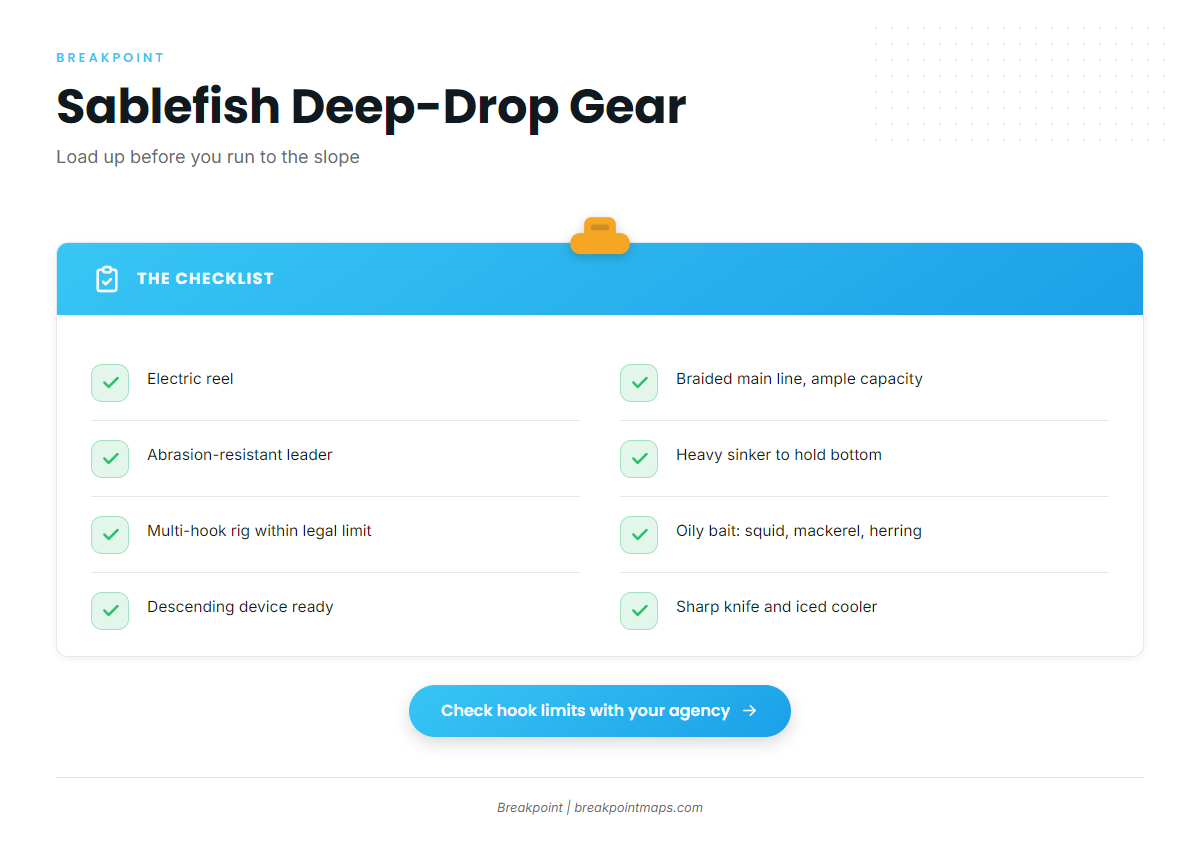
- Electric reel. Hand-cranking from slope depths is slow, tiring work.
- Braided main line with ample capacity.
- Abrasion-resistant leader.
- Heavy sinker sized to hold bottom in the current you have.
- Multi-hook bottom rig. Count hooks against the legal limit. California allows no more than 2.
- Oily bait.
- Descending device aboard and ready.
- Sharp knife and a cooler with ice.
Rig and Hooks
Run a dropper-loop or halibut-style bottom rig, with the weight at the bottom and the hooks on short droppers above it.
Circle hooks versus J hooks is angler preference. Circle hooks set themselves on a steady pull, while some anglers prefer J hooks on soft-mouthed fish. Pick one and fish it well.
Hook count follows the state rule. California’s rule is one line with no more than two hooks, so check the agency page. Port-specific rigs, drift notes and depths are in our bottom fish and deep-drop guides.
Bait
Use squid, mackerel or herring, oily and scented, cut to hold on the hook. Sablefish feed by scent, so fresh bait outfishes washed-out bait.
Finding Slope Structure
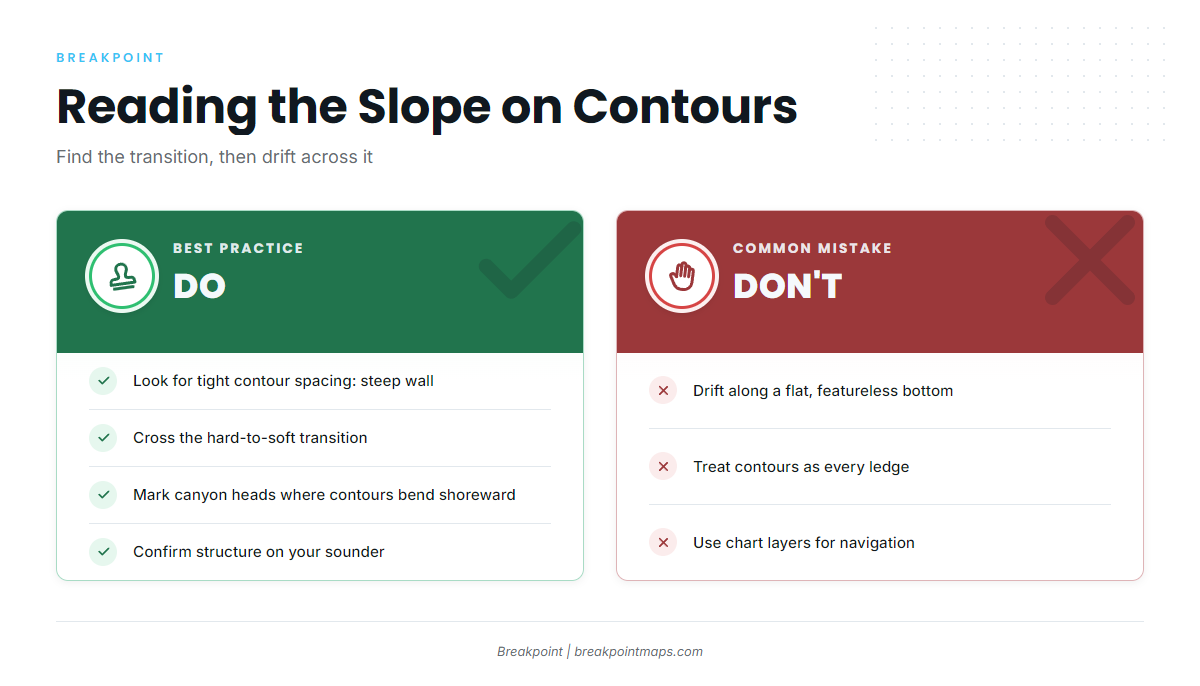
Look for slope breaks, canyon walls and drop-offs, plus the transition where hard structure meets soft mud or clay. A flat, featureless bottom is the common miss.
Read the slope on contours:
- Tight contour spacing marks a steep wall.
- Spacing that widens marks the break onto a flat or bench.
- A contour that bends shoreward marks a canyon head.
- Set your drift to cross the transition rather than run along a featureless line.
The Chart Contours layer shows slope breaks and canyon walls before you run. Chart layers are not for navigation.
Deep slope bathymetry has coarser resolution than nearshore surveys. Contours show the shape of the slope but not every ledge, so confirm on your sounder.
Drift, Current and Line Angle
Current bows a long line, so the weight lands well away from where the boat sits and you end up off the structure you marked.
- Lower slowly and keep contact.
- Set up uptide of the target so the drift carries the rig onto the edge.
- Re-drop rather than drag across flats.
If wind or swell comes up, read the numbers (wind, wave height, period) and go to the official marine forecast.
The Fight
Bites can be subtle. Sablefish have soft mouths, so retrieve slowly, avoid jerking and keep steady pressure.
Handling Bycatch and Using a Descending Device
Rockfish from deep water show barotrauma: bulging eyes and an inflated swim bladder. A descending device returns the fish to depth quickly so it can recover. Release prohibited species such as yelloweye rockfish fast.
Federal rules require a working descending device aboard every vessel in the West Coast recreational groundfish fishery, and California requires one aboard.
Sablefish also come up on halibut gear. In Alaska they mix in with deep halibut catches. Off Oregon’s Central Coast, on all-depth halibut days when groundfish fishing is depth-restricted, sablefish is among the groundfish that may be kept with halibut aboard. The Regulations section has the detail.
Frequently Asked Questions
What is black cod?
Black cod is the common market and angler name for sablefish, Anoplopoma fimbria. It is a deep-water fish of the continental slope from California to Alaska. The two names refer to the same species.
Is black cod a cod?
No. "Cod" is a market name, and sablefish sits in its own family. Lingcod is not a true cod either. When one comes up on deck, check for two widely spaced dorsal fins, which identify a sablefish.
Can you keep sablefish in Alaska?
Yes in Southeast Alaska, under ADF&G rules. Residents keep 6 per day and 6 in possession. Nonresidents keep 4 per day and 4 in possession, with an annual limit of 8. No size limit applies, and a harvest record is required. For other areas, check ADF&G.
How do you tell sablefish from lingcod?
Sablefish has two widely spaced dorsal fins and a smooth, slate-dark body. Lingcod has one long notched dorsal fin, a large toothy mouth and mottled color. Check the dorsal fins first.
What is the sablefish bag limit off California and Oregon?
California allows 10 per species within the 20-fish general finfish limit, with no minimum size. Oregon allows 10 per day, outside the general marine bag. Federal bags count fish from state and federal waters together, and the stricter state rule governs. Check CDFW and ODFW before you go.
Do I need a descending device when fishing for sablefish?
Yes, off the West Coast. Federal rules require a working descending device aboard every recreational groundfish vessel, and California requires one aboard. It returns barotrauma-affected rockfish to depth, which matters on any deep-drop trip where rockfish come up with the sablefish.
Why is sablefish prized as table fare?
Sablefish has rich, oily, buttery white flesh. That is why the market calls it butterfish, and why it ranks among the best-eating deep-water fish.