




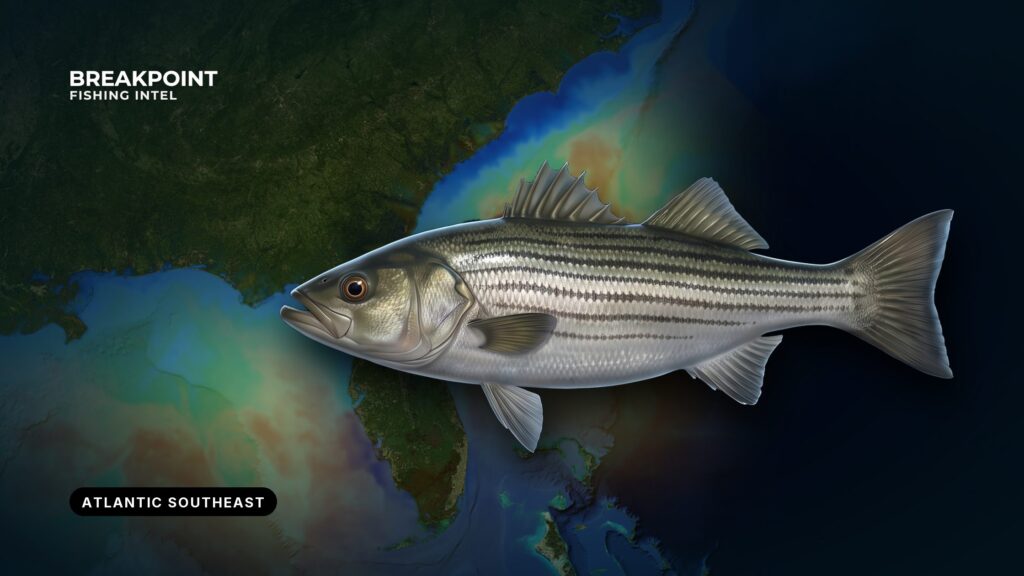
Striped bass fishing in the Atlantic Southeast is a river and sound fishery at the southern edge of the species’ range, with a winter inshore bite off North Carolina. It isn’t the Northeast run moved south. Southeast stripers live in tidal rivers, sounds and tailraces, they run out of cool water by summer, and in places the fishery depends on stocking.
This guide covers where and when the fish are found, the water and structure that hold them, how anglers fish for them here, and how federal and state rules divide. The region runs from North Carolina to Florida’s Atlantic coast, and the Atlantic Southeast fishing guide covers the other species you will meet along the way. By the end you should know where to look, which water holds fish, and which agency’s rules apply.
Identification and biology in brief
Atlantic striped bass are anadromous. Adults live in the ocean and enter fresh or brackish water to spawn in spring. According to NOAA’s Atlantic striped bass profile, the Atlantic range runs from the St. Lawrence River to the St. Johns River in Florida.
The Southeast sits at the southern end of that range, and Florida held the southernmost native Atlantic-strain populations. That position explains why the fishery here is limited and partly stocked. For identification and full biology, see the striped bass guide.
Where and when
Stripers here follow a spring spawning run up tidal rivers, then move toward cooler refuges as the water warms. Off North Carolina, fish also show nearshore in winter. The systems below run north to south.
Albemarle Sound, Roanoke River and the Outer Banks
Albemarle Sound and the Roanoke River make up the Southeast’s best-known spawning system. In spring, fish move from the ocean through Albemarle Sound and up the Roanoke, and that run is the main event of the year for this fishery.
Off the Outer Banks and around Oregon Inlet, fish show nearshore in late fall and winter. Only the inshore band inside 3 miles is open to fishing. The waters from 3 to 200 miles are federal and closed, as the Regulations section explains.
The migratory coastal stock concentrates north of Cape Hatteras. To follow the main run, read about striped bass in the Atlantic Northeast.
Cape Fear River
The Cape Fear is a southern North Carolina river fishery with its own management area. Harvest rules here differ sharply from those in other parts of the state. The Regulations section points you to the agency.
Santee-Cooper and the Cooper River
Santee-Cooper is South Carolina’s best-known striper system, and the lake and river fisheries connect through it. The Cooper River is the tidal link. Tailraces below the dams provide current and cool, oxygenated water, which is where fish hold when the rest of the system warms.
Savannah River
The Savannah is shared Georgia and South Carolina water. Check both states’ rules before fishing.
St. Johns River
The St. Johns is the southern limit of the Atlantic range. Natural reproduction there has ceased, and the population persists through stocking.
Seasonal pattern by system
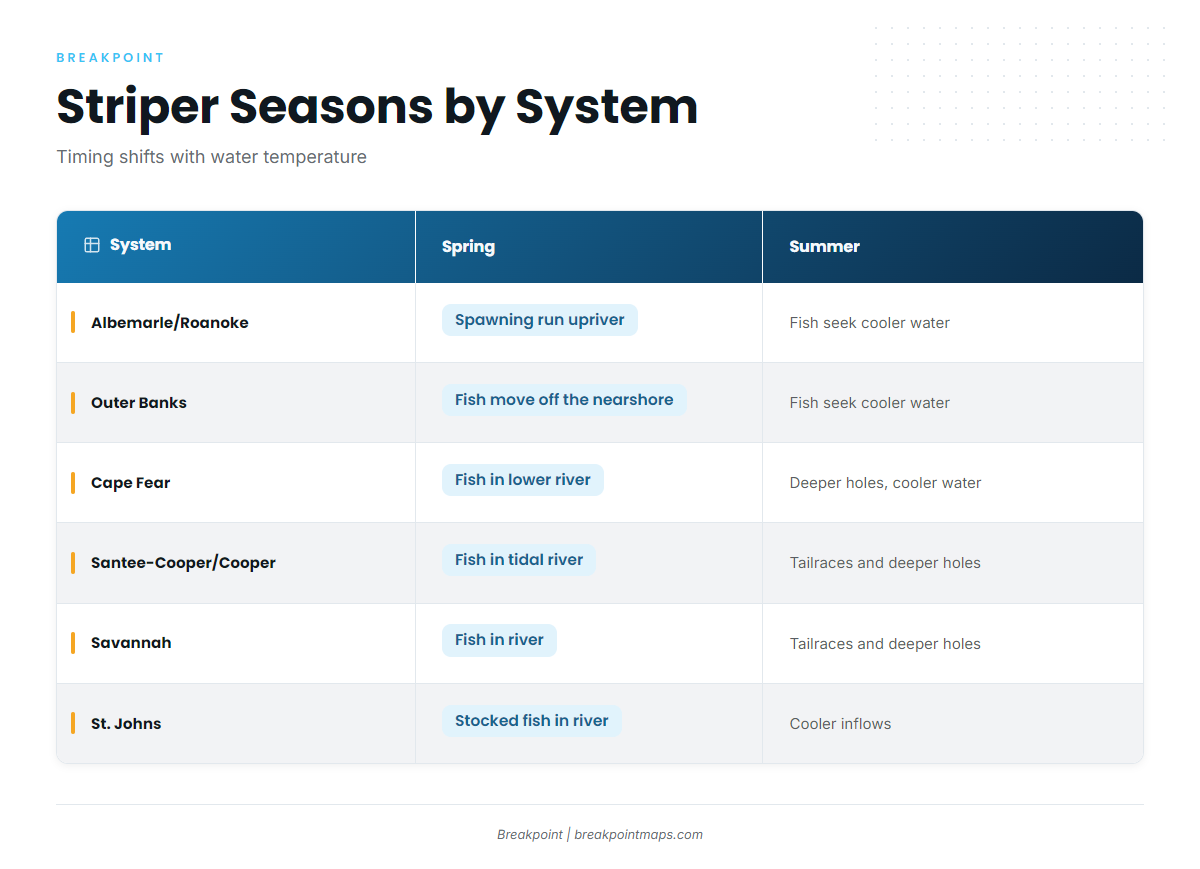
| System | Winter | Spring | Summer | Fall |
|---|---|---|---|---|
| Albemarle/Roanoke | Fish in sound and lower river | Spawning run upriver | Fish seek cooler water and deeper holes | Fish stage in the sound and lower river |
| Outer Banks nearshore | Nearshore inside 3 miles | Fish move toward the sounds | Few fish nearshore | Fish arrive in late fall |
| Cape Fear | Fish in the lower river | Spawning movement upriver | Fish seek cooler water and deeper holes | Fish move back toward the lower river |
| Santee-Cooper/Cooper | Fish in the Cooper and lake | Spawning movement upriver | Fish hold at tailraces and deeper water | Fish disperse as water cools |
| Savannah | Fish in the lower river | Spawning movement upriver | Fish seek cooler water and deeper holes | Fish move back toward the lower river |
| St. Johns | Stocked fish in the river | Stocked fish in the river | Fish seek deeper, cooler water | Stocked fish in the river |
Swipe the table sideways to see every column.
Timing shifts with water temperature each year.
Summer heat note
As rivers warm, fish move toward thermal refuges such as tailraces, deeper holes and cooler inflows. When the rivers run too warm for stripers, see the coastal and offshore gamefish guides for what to fish instead.
Water and structure
Temperature determines where Southeast stripers can live, and current determines where they feed.
Temperature
Striped bass tolerate water from 8°C to 25°C, about 46°F to 77°F, per the FishBase temperature range. Delaware reports a spawning range of 57 to 68 degrees in Delaware’s striped bass spawning data. Treat that as a general cue rather than a Southeast-specific trigger.
Summer surface water in Southeast rivers pushes toward the top of that tolerance range, and fish compress into whatever cooler water the system offers.
Current, tide and structure
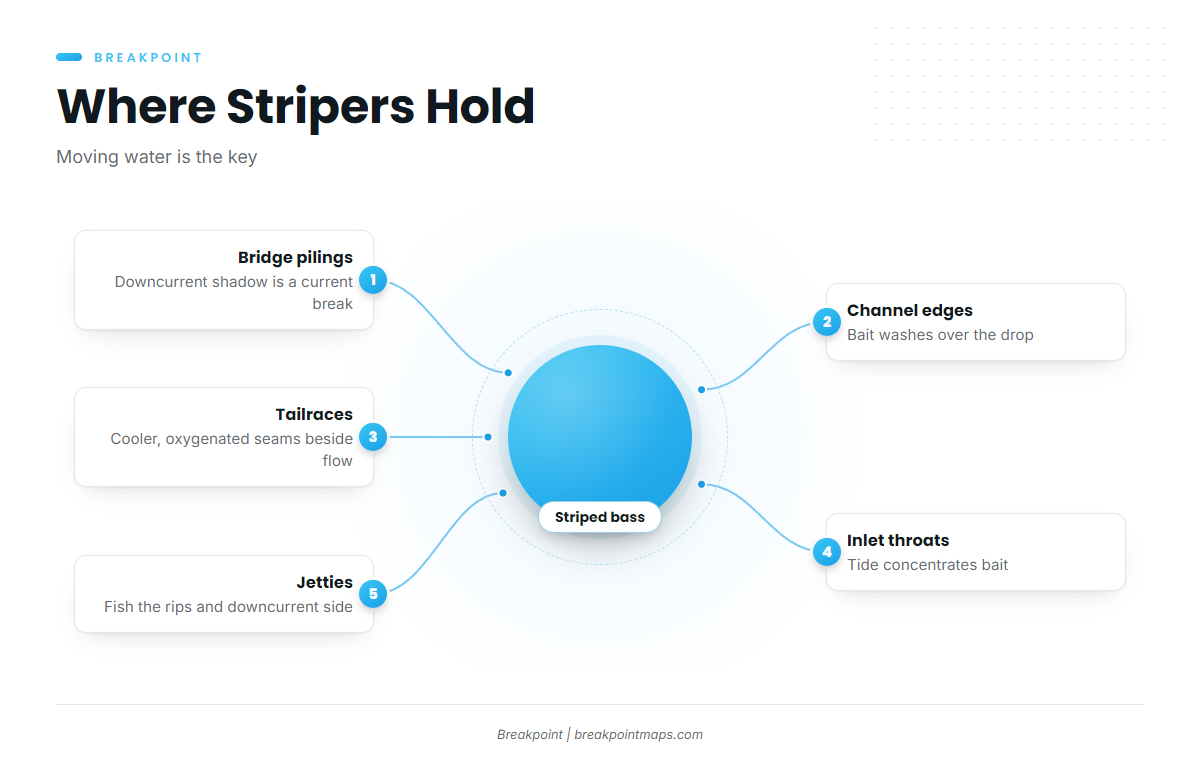
Structure matters because it breaks current and concentrates bait.
- Bridge pilings: The downcurrent shadow is a current break where fish ambush bait swept past.
- Channel edges and ledges: Bait washes over the drop, and fish sit just below the lip.
- Tailraces: The discharge brings moving, often cooler and oxygenated water. Fish hold on the seams beside the main flow.
- Inlet throats and jetties: Tide concentrates bait. Fish the rips and the downcurrent side.
Tide phase determines which side of a structure fishes. On the ebb, fish sit on the downcurrent side. On the flood, the current reverses and so do the fish. Moving water is what matters, and slack water shifts fish.
North Carolina’s Division of Marine Fisheries lists piers, jetties, surf troughs, rips, flats and rocks as the structure stripers use.
Reading it on the map
Chart Contours shows channel edges and holes in tidal rivers. Tight contour spacing marks the drop, and closed contours mark holes. OBS SST shows nearshore temperature breaks off the Outer Banks in winter, where fish sit inside the 3-mile line.
There are limits. Cloud blocks satellite passes, SST shows the surface rather than the bottom, and inland river structure may not appear on Chart Contours. Chart layers are not for navigation.
To get that read in one place before the trip, download Breakpoint from the App Store or Google Play.
How anglers fish them here
Most Southeast stripers come on live bait drifted along current structure, or on lures worked along edges at low light.
- Live bait: Shad, herring, eels and menhaden. Fish them on current seams below bridges and in tailraces. Check state rules on catching or possessing herring and shad for bait.
- Bucktails and soft plastics: Work them along channel ledges and piling shadows.
- Topwater: Fish it early and late, when stripers push bait shallow. Midday light pushes them deeper.
- Trolling: Troll along river contours and sound edges.
- Breaking fish: Approach quietly on the trolling motor and make long casts. Don’t run up on birds.
Release handling
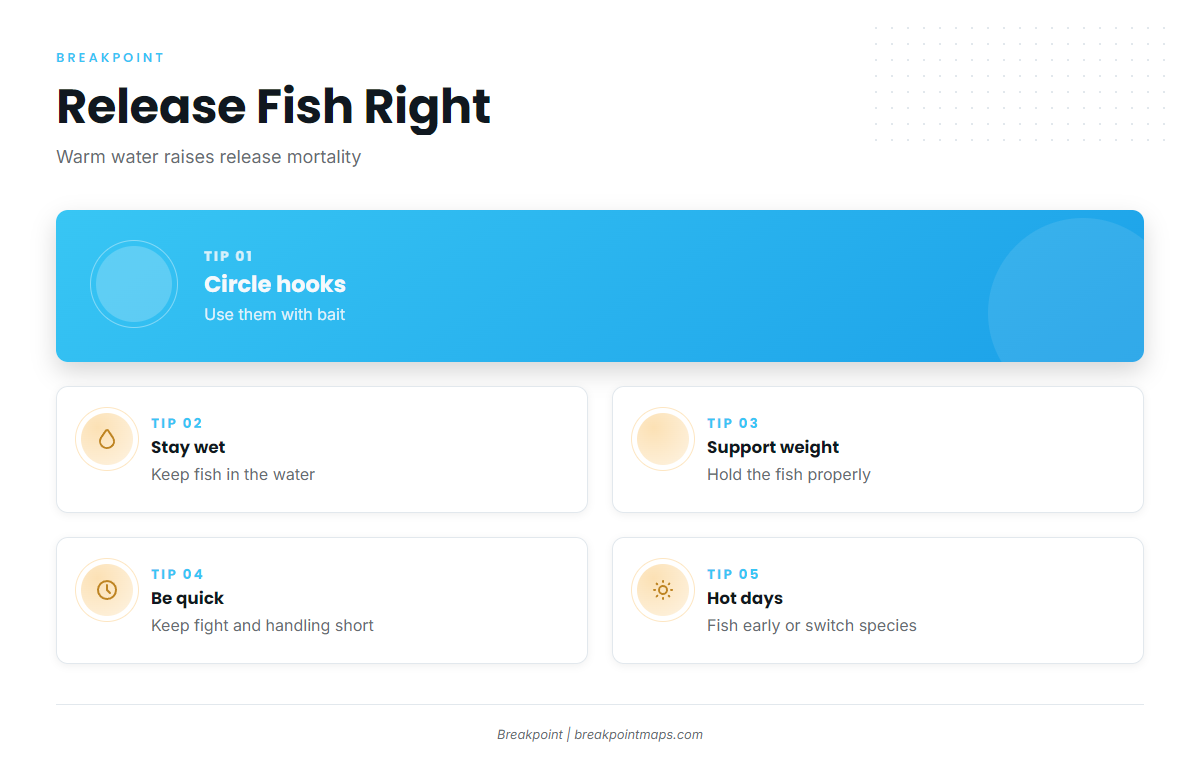
Warm-water release mortality is a management concern, and ASMFC’s Amendment 7 includes measures to improve the survival of released fish.
- Use circle hooks with bait.
- Keep fish in the water and support their weight.
- Keep the fight and handling short.
- On hot days, fish early or switch species.
Guides to striped bass fishing from specific ports: Folly Beach and Georgetown.
FAQ
Can you keep a striped bass in federal waters off the Carolinas?
No. Fishing for, harvesting or possessing striped bass from 3 to 200 miles offshore is prohibited under federal rules, coastwide. The open fishing is inside 3 miles and in rivers and sounds, under state rules.
When is the best time for stripers in the Southeast?
The cool months. The spring spawning run peaks in the rivers, and winter brings fish nearshore off North Carolina. Timing follows water temperature, so it shifts from year to year.
Where do stripers go in summer?
They move toward thermal refuges: tailraces, deeper holes and cooler inflows. Handle fish with extra care in warm water, or switch species on the hottest days.
Are there stripers in Florida?
Yes, in the St. Johns River. It is the southern limit of the Atlantic range, and the population persists through stocking because natural reproduction has ceased. Check FWC before fishing.
How do you tell a striper from a hybrid?
Stripers show continuous lateral stripes. Hybrids often show broken stripes and a deeper body. For more, see the full identification in the striped bass guide.
Which agency’s rules apply on a coastal river?
It depends on whether the water is coastal, joint or inland. In North Carolina, that means NCDMF versus NCWRC. Check the agency for the stretch you fish.
Do I need circle hooks?
Circle-hook requirements for bait fishing vary by state and water. Amendment 7 directed states to adopt gear measures that improve release survival. Check your state agency before fishing.