




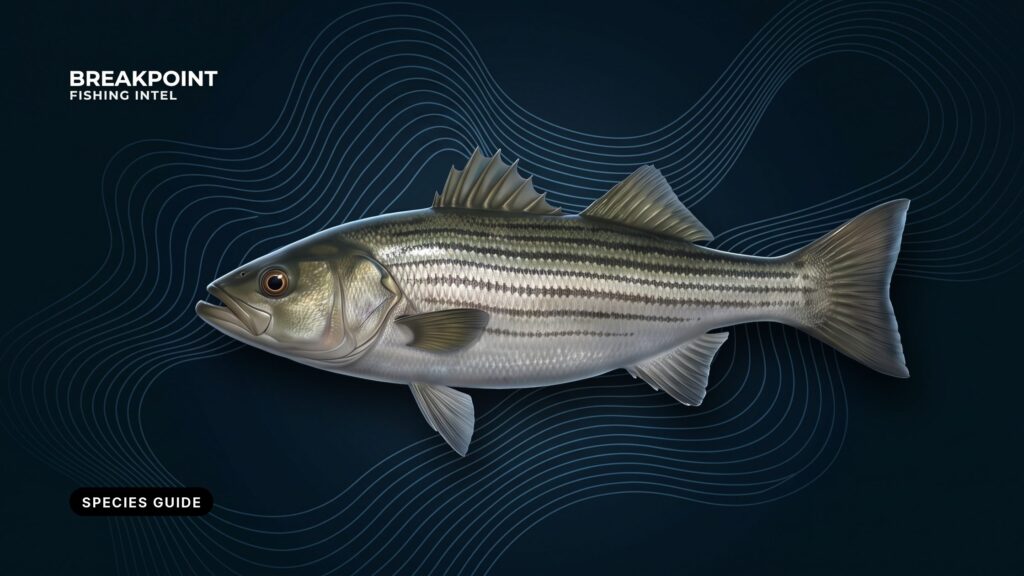
Striped bass (Morone saxatilis) live in the ocean and run into fresh or brackish water to spawn. This life history, called anadromous, puts them in bays, rivers, surf and reservoirs across the country. This guide covers striped bass in US waters. According to the NOAA striped bass species profile, the fish is native along the Atlantic coast from the St. Lawrence River to the St. Johns River in Florida, and in the Gulf from Florida to Louisiana. It has been introduced to inland lakes, reservoirs and the West Coast, and is now found from Mexico to British Columbia.
The Atlantic coastal stock migrates across state lines, so an interstate commission manages it and the rules change when you cross a border. Details are in Regulations.
The guide covers identification, range by region, feeding and movement, methods, release, and the rules by state and federal zone. Striped bass share water with bluefish, fluke and black sea bass. See our coastal and offshore gamefish guides for those species.
Identification
Striped bass belong to the family Moronidae. They are named for the dark horizontal stripes that run along each silver side, from behind the gill plate toward the tail. The body is long and muscular.
Official sources give different size figures, so treat them as source-attributed numbers rather than a single answer:
- Typical adults: 16 to 30 inches (FWS).
- NOAA maximum: 5 feet and 77 pounds.
- FWS maximum: a reported length of 6 feet 6 inches, with a largest capture of 125 pounds, per the FWS striped bass species page.
- FishBase maximum: 200 cm and 57.0 kg.
Striped bass can live up to 30 years (NOAA, FishBase). The oldest known fish was 31 (NCDMF). Males mature at 2 to 4 years and females at 4 to 8 years (NOAA). A fish reaches about 10 to 12 inches in its first year (TPWD).
Striped Bass vs Hybrid vs White Bass
Inland waters can hold hybrid striped bass and white bass, both close relatives in the same family. If you fish a reservoir or river that holds more than one, confirm the ID with the state wildlife agency, since keeper rules can differ by species.
Where and When: By Region
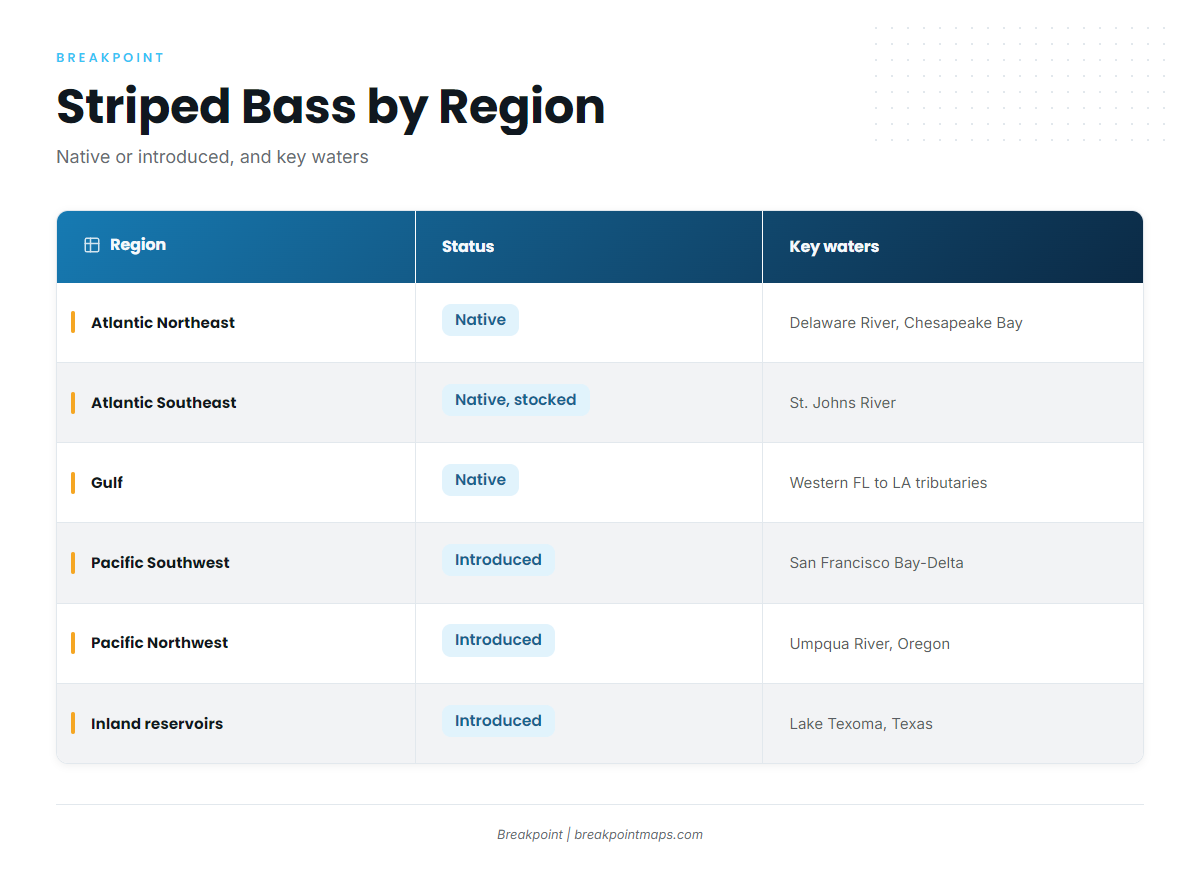
Striped bass spawn in spring in fresh or brackish water (NOAA). DNREC puts the spawning temperature at 57 to 68 degrees, and TPWD says it approaches 60°F. Coastal fish may travel as far as 100 miles inland, and successful hatches generally need at least 50 miles of stream (TPWD). Females spawn more than once per season, though not necessarily every year (FWS).
| Region | Native or introduced | Key waters | Spawning notes | Guide |
|---|---|---|---|---|
| Atlantic Northeast (NC to Maine) | Native | Delaware River, C&D Canal, Chesapeake Bay, Hudson River | Freshwater tidal rivers; main Delaware grounds run from Wilmington to Marcus Hook (DNREC) | Atlantic Northeast guide |
| Atlantic Southeast (FL Atlantic to NC) | Native, stocking-dependent in FL | St. Johns River | Natural reproduction has ceased in the St. Johns (FWC) | Atlantic Southeast guide |
| Gulf | Native | Fresh and brackish tributaries, western FL to LA (FWS) | See FWS | Fishing guides by region |
| Pacific Southwest | Introduced | San Francisco Bay-Delta; Sacramento, Feather and San Joaquin rivers | Spawning observed at 16 °C (Bay-Delta study) | Fishing guides by region |
| Pacific Northwest | Introduced | Umpqua River, Oregon | Oregon record 68 lb 0 oz (ODFW) | Fishing guides by region |
| Inland reservoirs | Introduced | Texas reservoirs, Lake Texoma | Most need stocking; Lake Texoma is self-sustaining (TPWD) | Fishing guides by region |
Swipe the table sideways to see every column.
Atlantic Northeast
Fish run up the freshwater portion of tidal rivers. The main Delaware grounds lie between Wilmington, Delaware, and Marcus Hook, Pennsylvania. Runs also go above Marcus Hook and into the C&D Canal (DNREC). Tagged Delaware River fish have been recaptured from North Carolina to Maine (DNREC). The Chesapeake Bay and the Hudson River are the other major spawning systems.
Juveniles stay in estuaries 2 to 4 years before joining the coastal migration (NOAA). For place-level detail, use the Atlantic Northeast striped bass guide.
Atlantic Southeast
Florida held the southernmost native Atlantic-strain fish. Natural reproduction in the St. Johns River has ceased, and the population persists through stocking (FWC). Place-level detail is in the Atlantic Southeast striped bass guide.
Gulf
Striped bass are native in fresh and brackish tributaries from western Florida into Louisiana (FWS).
Pacific Southwest
These fish are introduced. The Sacramento, Feather and San Joaquin rivers are thought to be spawning sites. Spawning has been observed at 16 °C, according to a peer-reviewed Bay-Delta study.
Pacific Northwest
The Oregon state record is 68 pounds, 0 ounces, taken from the Umpqua River (ODFW).
Inland Reservoirs
Texas is outside the native range. Most stocked reservoir populations need continued stocking. Lake Texoma is the exception, with a self-sustaining population (TPWD).
Place-level guides for every region are in our fishing guides by region.
How Striped Bass Feed and Move
Adult striped bass eat almost any small fish, plus crabs and squid (NOAA). NCDMF names menhaden, anchovies, flounder, weakfish and herrings. Larvae eat zooplankton. Juveniles eat insect larvae, small crustaceans and larval fish (NOAA).
Fish move between rivers, estuaries and inshore marine areas, over soft and hard bottoms (STRI). FishBase lists a temperature range of 8°C to 25°C, about 46°F to 77°F. It classes the species as demersal, with depths of 30 m and deeper. STRI gives 0 to 30 m.
What that means on the water:
- Bait sets the location. Stripers sit where forage concentrates, so matching local forage matters more than any single lure.
- Edges hold fish. Rips, channel edges and drop-offs funnel bait past waiting bass.
- Water moves them. Fish shift between river, estuary and coast with the season.
SST shows only the surface. Stripers hold to 30 m and deeper per FishBase, so surface temperature tells you where to start, not where fish sit.
Use the OBS SST layer to see where spring and fall water sits. Use Chart Contours to find rips, channel edges and drop-offs. Chart layers are not for navigation.
How Striped Bass Are Caught
Recreational striped bass fishing is mainly hook and line (NOAA). Methods fall into four groups.
Natural Bait
Anglers fish floating or bottom rigs with natural bait, live bait or cut bait (NCDMF, TPWD). Menhaden, herring and live eels are common baits.
Bait fishing usually calls for circle hooks. A circle hook’s point turns back toward the shank, so it tends to set in the corner of the mouth. That lowers the chance of gut hooking and helps released fish survive. Several states require circle hooks with bait. See Regulations.
Artificial Lures
Anglers troll, cast or jig. Lures include those that imitate small fish, such as silver spoons, plus deep-running lures (NCDMF, TPWD). Bucktails, plugs and soft plastics all have a place, matched to the forage in the water.
Surf, Pier and Jetty
Shore anglers fish piers, jetties, surf troughs, rips, flats and rocks (NCDMF). Surf anglers throw spoons or heavy lures. Start at inlets and structure where bait is pinched. Big fish often feed at night.
Boat and Reservoir
From a boat, troll and jig along edges and drop-offs. Inland fishing follows the same methods under freshwater rules.
Build a trip in the app around a tide stage and a contour edge.
Handling and Release
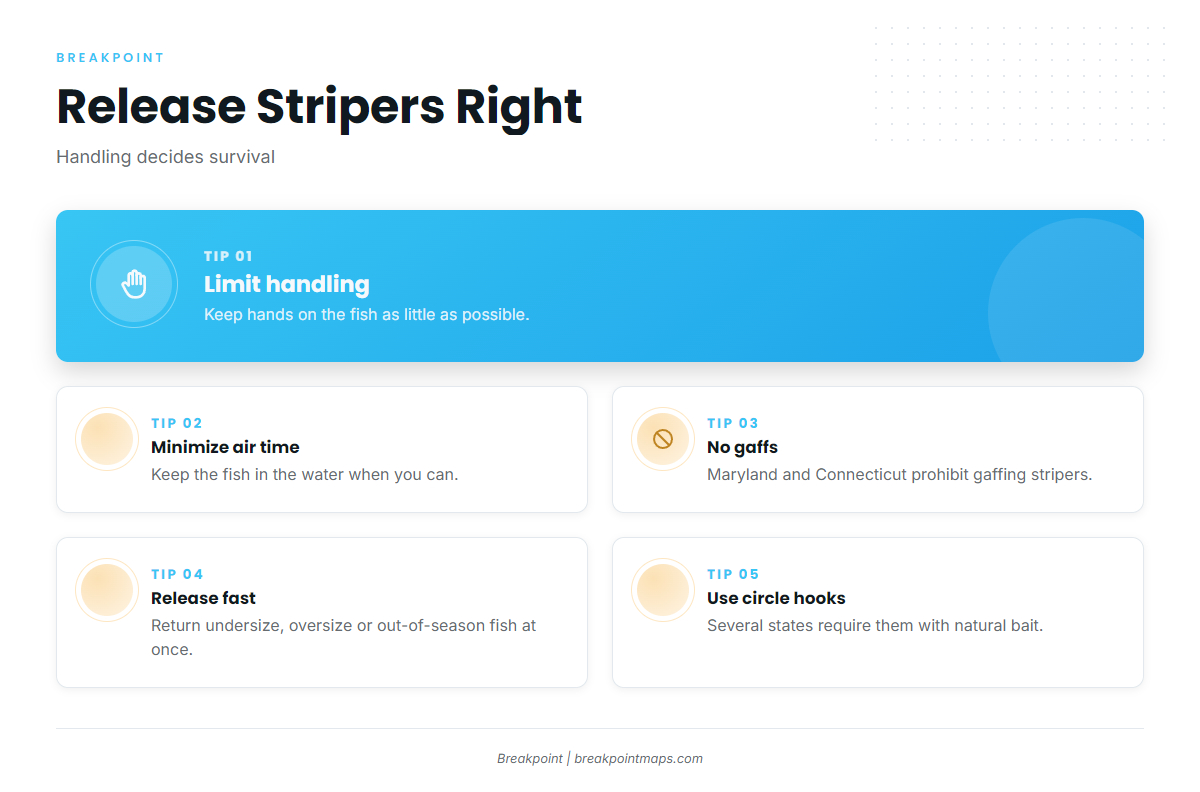
Many striped bass go back because of slot limits and stock status, and handling decides whether they survive.
- Limit handling. Maryland DNR encourages anglers to limit handling and minimize air exposure.
- Skip the gaff. Maryland and Connecticut prohibit gaffing striped bass.
- Release promptly. Return undersize, oversize or out-of-season fish immediately, without avoidable injury.
- Mind the hook. In Connecticut, a striper caught on bait with a non-circle hook must be released, even at legal size.
If you plan to eat your catch, check your state’s fish consumption advisories first.
FAQ
Can you fish for striped bass in federal waters?
No. It is unlawful to fish for, harvest or possess striped bass in the EEZ, 3 to 200 nautical miles out. Fishing is allowed only in state waters, under state rules.
What is the striped bass slot limit?
It varies by state. In Connecticut it is 28 to under 31 inches. In Maryland Atlantic waters it is 28 to 31 inches. Check the agency page for your water.
Are circle hooks required for striped bass?
In Connecticut, Maryland’s Atlantic waters and Massachusetts, they are required with natural bait. Lures are treated differently, so read the state rule.
How do you measure a striped bass?
Measure in a straight line from the snout to the tail, with the tail squeezed together. Do not measure over the curve of the body.
What is the difference between a striper and a hybrid?
They are close relatives, and both turn up in inland waters. Use the state wildlife agency’s identification guide to confirm which one is on your line.
What do striped bass eat?
Adults eat menhaden, anchovies, flounder, weakfish and herrings, plus crabs and squid (NOAA, NCDMF).
Is striped bass good to eat?
Whether you keep one depends on your state’s slot limit. Check your state’s fish consumption advisories before you do.
Where to Go From Here
Pick the water you fish and read its guide. Start with the Atlantic Northeast or Atlantic Southeast guide, or find your port in the state and port guides on breakpointmaps.com. Download Breakpoint from the App Store or Google Play to see where the water edges and contours line up before you leave the dock.