




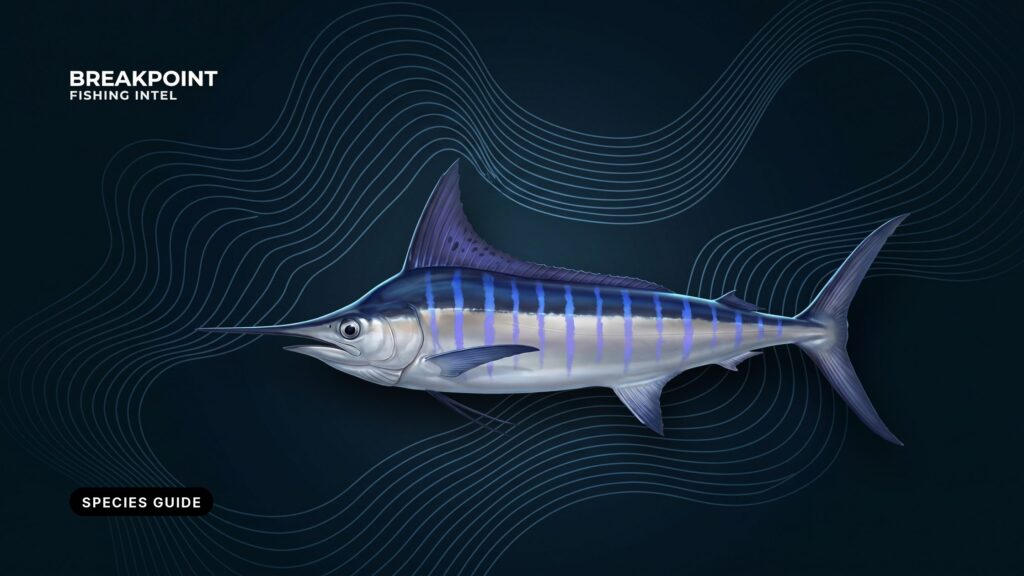
Striped marlin (Kajikia audax) is a Pacific billfish. In US waters, the sport fishery concentrates off Southern California, with Hawaii as the other main region. This guide covers how to tell the species apart, where and when it shows, why it sits where it does, how it is caught, and how state and federal rules divide. The aim is to help you decide where to look, not to promise fish.
How to identify striped marlin
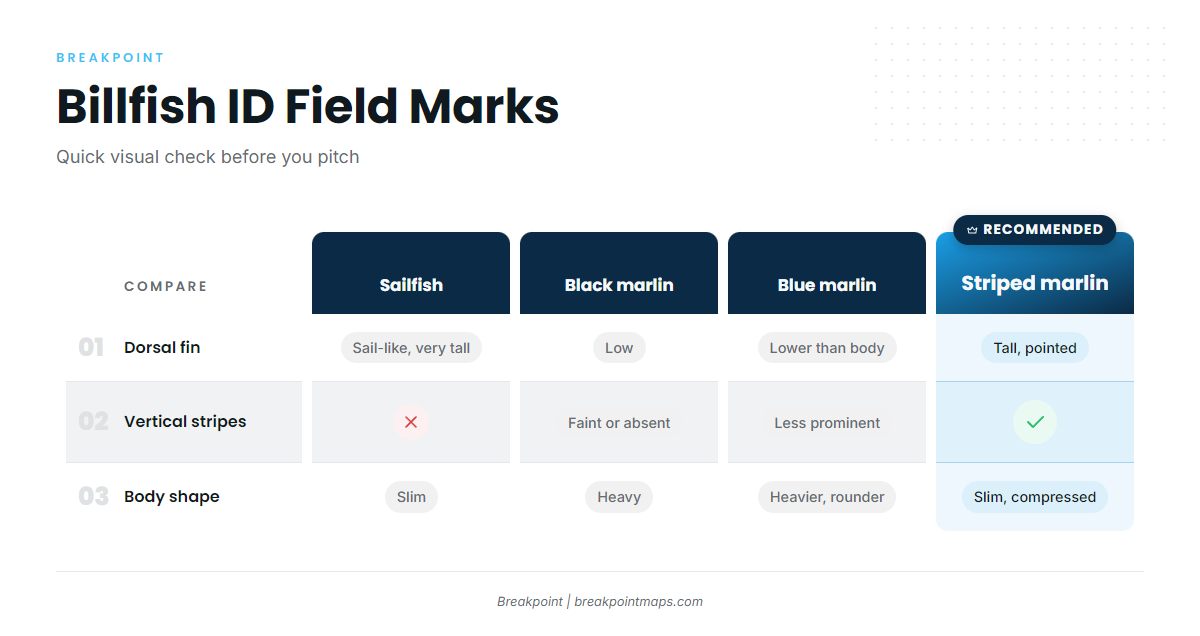
Striped marlin is a slim billfish (family Istiophoridae) with pale vertical stripes along the flanks, a tall, pointed first dorsal fin, and a laterally compressed body that is thinner than a blue marlin’s. The dorsal is more moderate than a sailfish’s sail. NOAA lists the species at up to 14 feet; published sizes beyond that vary.
Fish often light up with brighter stripes when excited behind a teaser. That color change is the cue for the bait-and-switch described in the catch section below.
The table covers the main look-alikes. Telling striped from blue marlin comes down to body depth, dorsal height and stripe contrast.
| Species | Dorsal fin height | Stripes | Body shape |
|---|---|---|---|
| striped marlin | Tall, pointed first dorsal | Pale vertical stripes | Slim, compressed body |
| blue marlin | Lower dorsal relative to body depth | Stripes less prominent | Heavier, rounder body |
| black marlin | Low dorsal | Faint or absent | Heavy body; rigid pectoral fins that do not fold flat |
| sailfish | Sail-like, much taller than body depth | Not a defining mark | Slim body |
| shortbill spearfish | Low dorsal | Not a defining mark | Slender body; very short bill |
For species-level detail on blue marlin, black marlin, sailfish and spearfish, see the other billfish guides.
Where and when striped marlin are fished in US waters
In US waters, striped marlin are a Pacific fish. Southern California is the core sport fishery. Fish arrive with warm water in late summer, and the Southern California sight-fishing peak falls in September and October, according to Sport Fishing. Hawaii is the other main region. The regional fishing guides carry the place-level detail.
NOAA describes the species as a fish of tropical and subtropical waters of the Pacific and Indian Oceans. It is highly migratory and crosses international boundaries.
| Region | Presence | Timing | Go deeper |
|---|---|---|---|
| Pacific Southwest (Southern California) | Core US sport fishery | Late summer into fall; peaks around September and October | striped marlin in the Pacific Southwest |
| Hawaii and Pacific Islands | Present around the islands and seamounts | See the regional guides | Regional fishing guides |
| Pacific Northwest | Listed among highly migratory species targeted by West Coast recreational anglers | Not stated | See agency |
How striped marlin feed and move
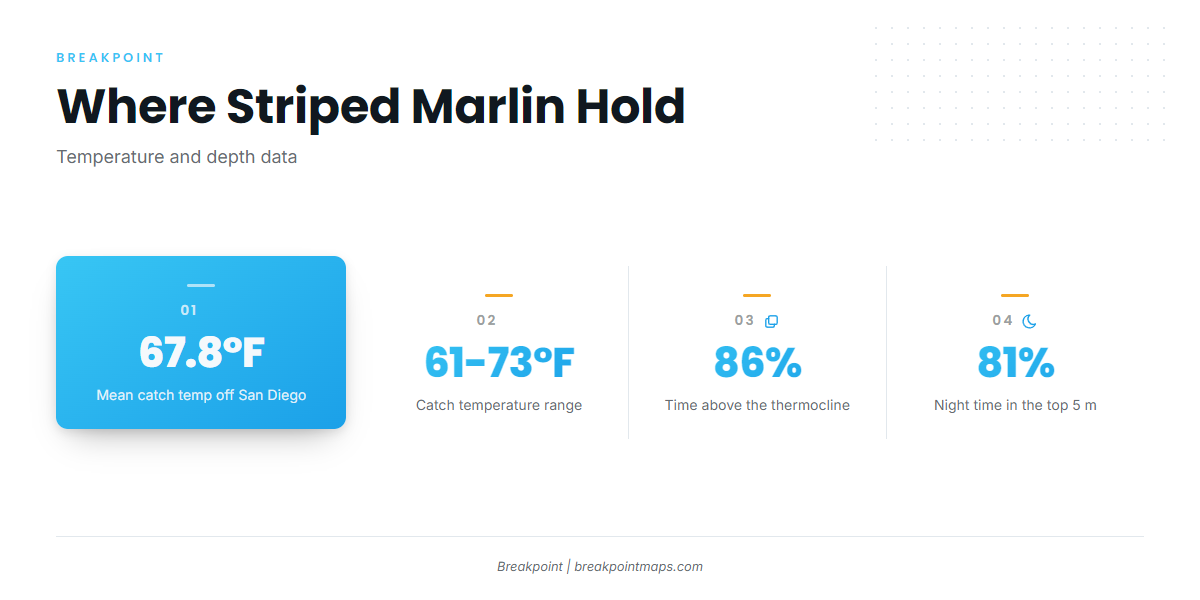
Striped marlin feed near the surface on mackerel, sardine, anchovy and squid. Off San Diego, fish are caught in 61 to 73°F water, with a mean of 67.8°F. They hold mostly above the thermocline, sit shallower at night, and gather where deep water meets structure.
Diet
NOAA lists mackerel, sardine, anchovy, squid and other invertebrates as the diet, so find the bait first. Mackerel and sardine on the meter or under birds are reason enough to slow down.
Temperature
The NOAA Marine Fisheries Review data puts the catch temperatures for fish landed at San Diego at 61 to 73°F, with a mean of 67.8°F. The optimum sea surface temperature runs 64.4 to 75.1°F. A temperature break raises the odds of finding fish but does not guarantee them.
Depth and the thermocline
A tagging study around Hawaii reported depths in meters. Tagged fish showed:
- a median depth of 44 m by day and 2 m by night
- 38% of the day and 81% of the night in the top 5 m
- a maximum recorded depth of 472 m
NOAA puts 86% of their time in the surface layer above the thermocline, which is why surface sightings and surface baits make sense. Daytime fish may sit deeper near structure.
Structure
The FishBase species profile notes that abundance rises with distance from the continental shelf. Fish come close to shore only where deep drop-offs occur. They are most often seen near islands, seamounts and boundary currents, and tagged fish used seamounts and fracture zones by day.
Off Southern California, the end of Catalina Island rising from the seafloor is a place to start. Work the bottom end and up the sides while looking for life.
The Baja connection
Per NOAA, juveniles move east toward Mexico’s coast and are abundant around the tip of the Baja Peninsula. Spawning occurs in the central Pacific and off central Mexico. The same warm water that pushes north in late summer carries fish toward Southern California.
Reading it on the map
Three Breakpoint layers answer the questions above:
- OBS SST shows the temperature band from the data above and the sharpest breaks inside it.
- Chlorophyll shows color edges where bait collects.
- Chart Contours show where those edges cross drop-offs, banks and island ends.
A cloud-blocked satellite pass leaves gaps in SST, and the map shows those gaps rather than filling them in. Chart layers are not for navigation.
How striped marlin are caught
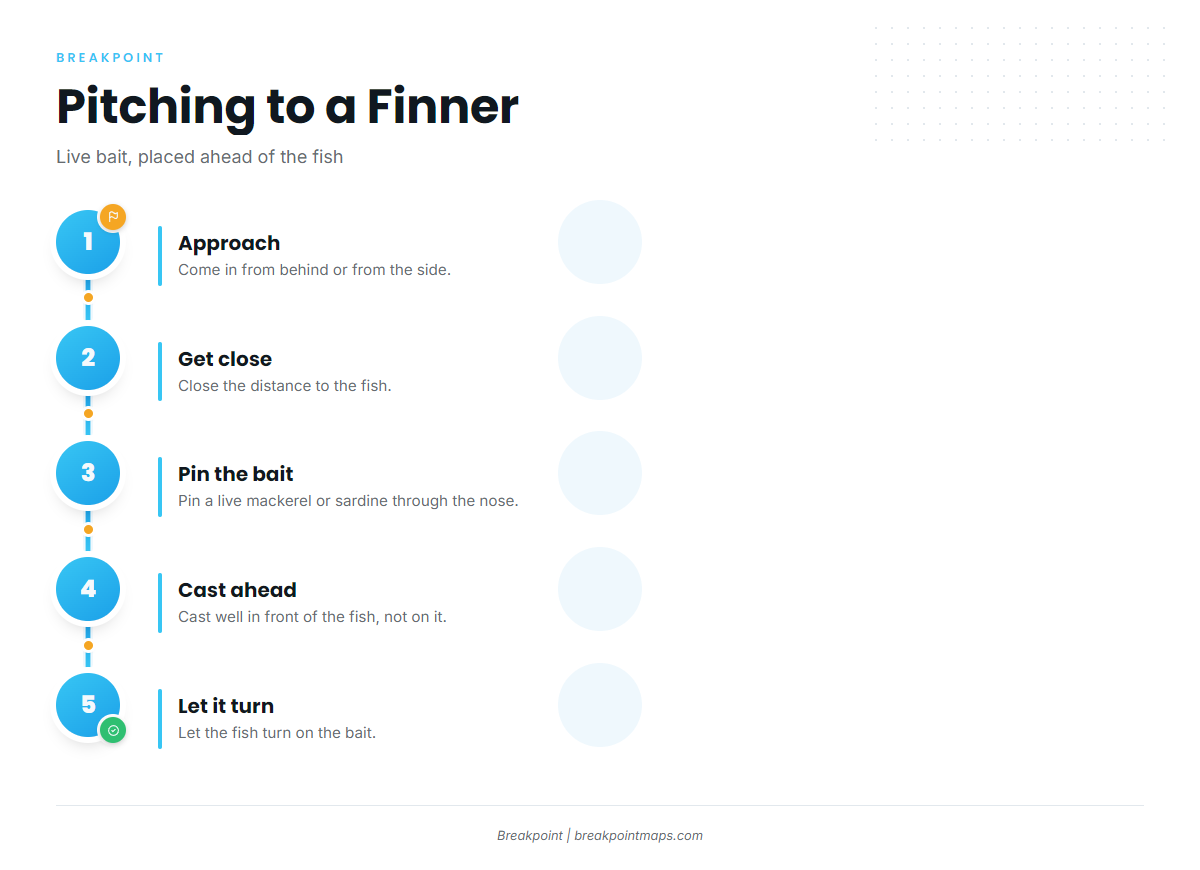
Most striped marlin in US waters are found by sight. Spot surface fish or raise them with teasers, then pitch a live mackerel or sardine ahead of the fish, or switch a bait in behind a teaser. Use circle hooks, and release fish in the water.
Spotting surface fish
Marlin Magazine describes four types of surface marlin. Learn to read them from a distance:
- Sleepers: laze at the surface, look nearly black, dorsal fin retracted, tail exposed.
- Tailers: ride down-swell with tail and fins out. These are the classic finners.
- Feeders: slash through bait balls.
- Jumpers: jump clear of the water and are thought to be shedding parasites.
Birds and bait balls are signs worth slowing for.
Trolling and teasers
Troll a spread of skirted lures or hookless teasers, such as daisy chains and squid spreader bars, along breaks and structure to raise fish.
Bait-and-switch
Hookless teasers pull a fish into the spread. When it lights up behind a teaser, pull the teaser away and present a rigged live bait or fly.
Pitching to a finner
- Approach from behind or from the side.
- Get close. A distant bait gets ignored.
- Pin a live mackerel or sardine through the nose.
- Cast well in front of the fish, not on it.
- Let the fish turn on the bait.
Kite fishing
A kite keeps the bait at the surface, which suits fish that attack from below.
Circle hooks
Circle hooks improve both hookups and releases. For what the rules require, see the Regulations section below.
The fight and release
Let the fish run and jump. Ease the drag when it goes airborne to avoid a pulled hook. Fights range from minutes to well beyond that. Keep the fish in the water for a clean release. Per NOAA, most fish caught in recreational tournaments are tagged and released, so tag-and-release is standard practice in the fishery.
For local banks and finner tactics, the striped marlin in the Pacific Southwest guide goes deeper.
FAQ
Can you keep a striped marlin in California?
Retention rules are set by CDFW, and anglers need a license plus the Ocean Enhancement Validation south of Point Arguello. Catch-and-release is the norm. Check CDFW for current bag and size rules.
Can you sell striped marlin?
No. The Billfish Conservation Act prohibits the sale and commercial possession of billfish. Fish caught in Hawaii and the Pacific Insular Areas are an exception.
Do I need a federal permit?
Federal waters fall under NOAA Fisheries and the regional councils. Permit requirements depend on the vessel and the fishery, so check NOAA Fisheries West Coast or Pacific Islands. In California, a state license is still required.
What water temperature do striped marlin like?
Fish landed at San Diego were caught in 61 to 73°F water, with a mean of 67.8°F. Optimum SST is 64.4 to 75.1°F. A temperature break raises the odds but does not guarantee fish.
Striped vs. blue marlin?
Striped marlin is slimmer, with a taller, pointed dorsal and bold vertical stripes. Blue marlin is heavier, with a lower dorsal relative to body depth.
Find the water, then the fish
This guide comes down to a short list. Find the temperature band and the bait. Work breaks over structure, look for finners, pitch ahead of the fish and release in the water. To plan that on one map, download Breakpoint from the App Store or Google Play.