




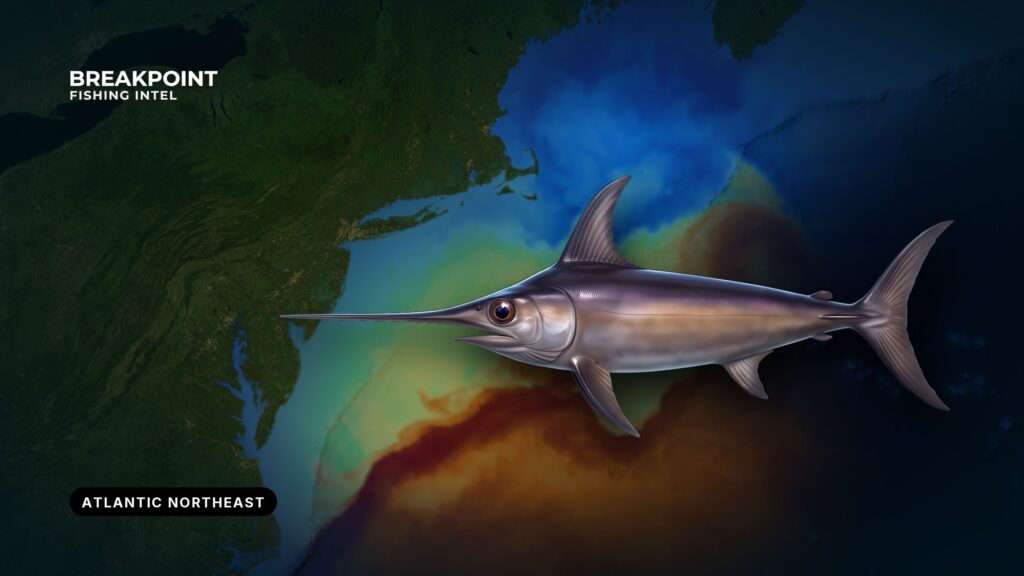
Swordfish fishing in the Atlantic Northeast starts at the shelf-break canyons. Anglers fish them by day near the bottom and by night under lights. Federal HMS rules govern the fish, and state agencies add their own rules in state waters.
This guide covers where and when the fish are found, the water and structure that hold them, day and night methods, and the federal rules along with the state agencies. If you already run the canyons for tuna, you know the ground. For ports, canyons and the rest of the offshore fleet, see our Atlantic Northeast fishing guide.
Swordfish at a Glance
Swordfish are a single species with a long, flat bill. Adults have no pelvic fins and no scales. They dive deep by day and rise toward the surface at night. Identification, range and life history are in our swordfish guide.
Marlin and sailfish are different fish with different federal limits. See our billfish fishing guides for those species. ICCAT assesses Atlantic swordfish as 3 separate stocks, and the swordfish stock status assessments track them.
Where and When Swordfish Show Up in the Northeast
The fish sit on the shelf edge, and the canyons cut it. From southwest to northeast, the names to know are:
- Hudson Canyon
- Block Canyon
- Atlantis Canyon
- Veatch Canyon
- Hydrographer Canyon
- Oceanographer Canyon
Georges Bank marks the northern edge of the region and is a historic swordfish ground. The Gulf Stream is the warm-water source that feeds the shelf edge. Steep walls cut the shelf break and bring deep water close to the shelf, which puts deep bottom within reach of a run from Mid-Atlantic and southern New England ports.
The season runs summer into fall. The Maine Sea Grant swordfish guide lists June to August and notes that the fish are usually caught at night. Timing shifts with where the warm water sits each year, so the water tells you more than the calendar does.
| Canyon area | Position in the region | What to look at |
|---|---|---|
| Hudson Canyon | Mid-Atlantic and New York Bight | Wall steepness, warm water pushing in from the east |
| Block, Atlantis, Veatch | Southern New England shelf break | Contour spacing along the wall, eddy edges |
| Hydrographer, Oceanographer | Eastern end of the canyon chain | Temperature breaks crossing the wall |
| Georges Bank | Northern edge of the region | Where Gulf Stream water reaches the bank |
Reading the Water and Structure
Work from the surface down. Start with the temperature and color signal, then find the structure it crosses.
SST Breaks and Warm-Core Eddies
Temperature breaks concentrate bait. Warm-core eddies spun off the Gulf Stream push warm water onto the shelf edge and over the canyons, and an SST break on the edge of an eddy is a good place to start looking.
The data has limits:
- Cloud blocks satellite passes, so a clouded area has gaps rather than readings.
- SST measures the surface only. It says nothing direct about conditions near the bottom, where a daytime swordfish holds.
Chlorophyll Edges
Color edges mark where productive green water meets clean blue water, and bait often stacks along them. Treat a color edge as a signal to combine with temperature. It does not show that fish are present.
Canyon Walls and the Shelf Break
Daytime swordfish orient to the bottom. Steep canyon walls and the contour lines along the shelf break show where deep bottom lies within reach of a drift, and a drift across a wall moves the bait through the depth band where the fish sit. On Chart Contours, tight lines mean a steep wall and wide lines mean a gentle slope.
Putting the Layers Together
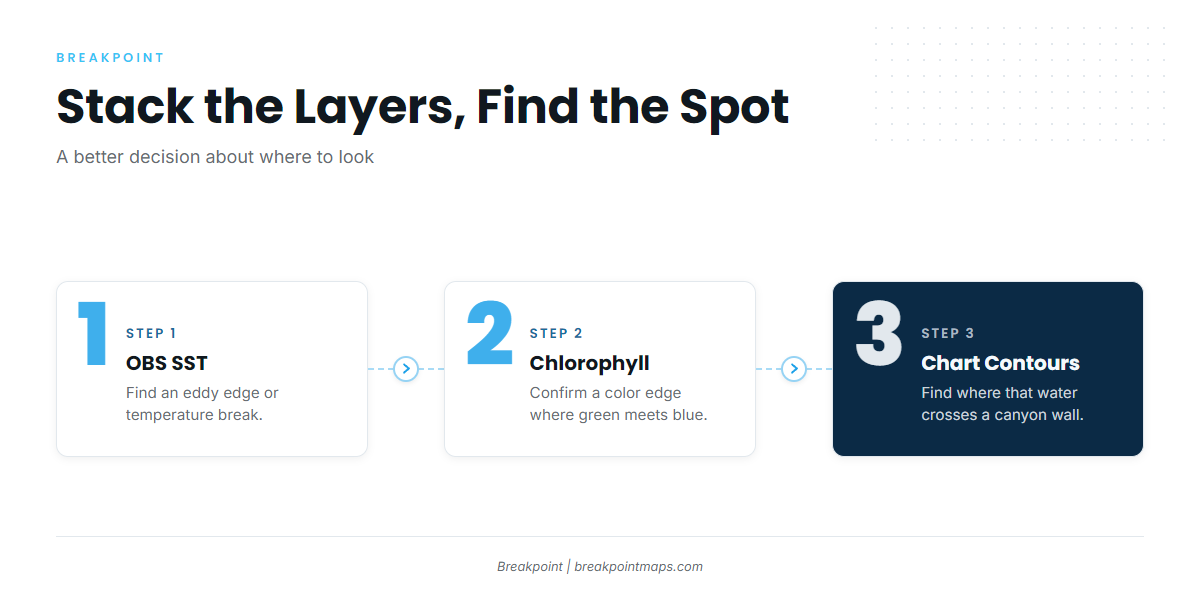
Stack the signals in this order:
- Look for an eddy edge or temperature break on OBS SST.
- Confirm a color edge on Chlorophyll.
- Find where that water crosses a canyon wall on Chart Contours.
That sequence narrows where you look, but it doesn’t promise fish. Chart layers are not for navigation.
How Anglers Fish for Swordfish Here
Pick the method after you read the water. Day and night fishing put the bait in different parts of the water column.
Daytime Deep-Drop
Bait goes near the bottom along the canyon walls. Standard gear is an electric reel, thin braid, deep-drop lights and heavy weights, with squid or bonito strip baits. The bite is subtle. Swordfish can also bite well above the bottom, so a bait is not out of the zone just because it is off the seafloor.
Night Drift
At night, fish rise in the water column, and anglers drift baits shallower under lights. This is the traditional Northeast method.
Day Versus Night Comparison
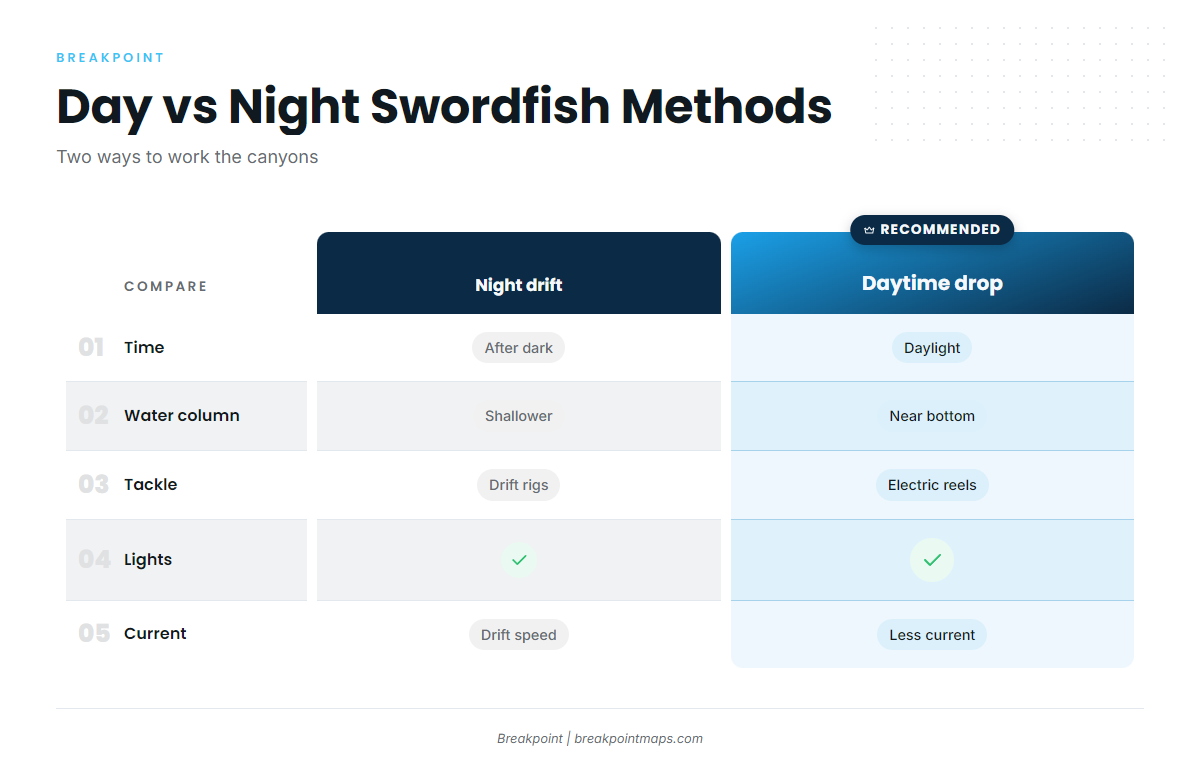
| Method | Time | Position in water column | Tackle | Lights | Current |
|---|---|---|---|---|---|
| Daytime deep-drop | Daylight | Near the bottom along canyon walls | Electric reel, thin braid, heavy weights | Deep-drop lights | Drift across the wall |
| Night drift | After dark | Shallower, with fish rising toward the surface | Lighter terminal gear, no heavy weights | Lights at the bait | Drift with the current |
Swipe the table sideways to see every column.
Northeast Versus Florida
Daytime deep-drop technique developed in the Southeast. Northeast daytime fish are typically worked in less current than in the Florida Gulf Stream, so you usually need less lead. The runs to the canyons are the longer part of the trip. For the Florida side, see swordfish fishing in the Southeast.
Combining Swordfish With a Tuna Trip
Canyon trips often mix trolling the edge by day, chunking for tuna overnight, and deep-dropping for swordfish. Bigeye and bluefin tuna also hit swordfish baits. The tuna rules fall under the same federal HMS framework.
Releasing a Fish
A swordfish you do not keep must be released immediately, without removing it from the water. This is a federal requirement, and the detail is in Regulations below.
Before You Run
Check OBS SST and Chart Contours before you commit fuel to a canyon run. For wind, wave height and period, use the National Weather Service offshore forecast.
Guides to swordfish fishing from specific ports: New London / Waterford, Indian River Inlet, Ocean City, Falmouth / Woods Hole, Atlantic City, Freeport, Point Judith and Virginia Beach.
Frequently Asked Questions
Do I need a federal permit to fish for swordfish?
Yes. A private boat needs an HMS Angling permit. A for-hire vessel needs an HMS Charter/Headboat permit. If you land in another state, also check that state’s licensing agency before you go.
What is the minimum size, and how is it measured?
The minimum is 47 inches LJFL with the head naturally attached. If the head is not attached, it is 25 inches cleithrum-to-keel (CK), measured along the curve of the body. The bill may be removed to the tip of the lower jaw and the head still counts as attached.
How many can a private boat keep compared with a charter?
An HMS Angling permit allows 1 per person, up to 4 per vessel per trip. A charter vessel with an HMS Charter/Headboat permit keeps 1 per paying passenger, up to 6 per trip. A headboat keeps 1 per paying passenger, up to 15 per trip.
How fast must I report a landed swordfish?
Within 24 hours. Report online, through the HMS Catch Reporting App, or by phone at (888) 872-8862. Fish entered in a registered tournament are reported by the tournament operator instead.
Can I fillet a swordfish at sea?
No. A swordfish may be headed and gutted at sea, but it may not be cut into pieces. Bring it in whole enough to be measured and counted.
Do state rules override federal ones?
Only when the state rule is stricter. Federal HMS rules follow a permit holder into state waters, and federal and state limits do not stack. Check your landing state’s agency before fishing.
Are the rules the same in the Gulf or on the West Coast?
In the Gulf, yes. The same federal HMS rules apply there. On the West Coast, no. Atlantic HMS rules cover only the Atlantic, the Gulf and the Caribbean. For the Pacific side, see swordfish fishing in the Pacific Southwest.
What do I do with an undersized swordfish?
Release it immediately, without removing it from the water. A fish that does not meet the minimum size cannot be kept. Identification help is in our swordfish guide.