




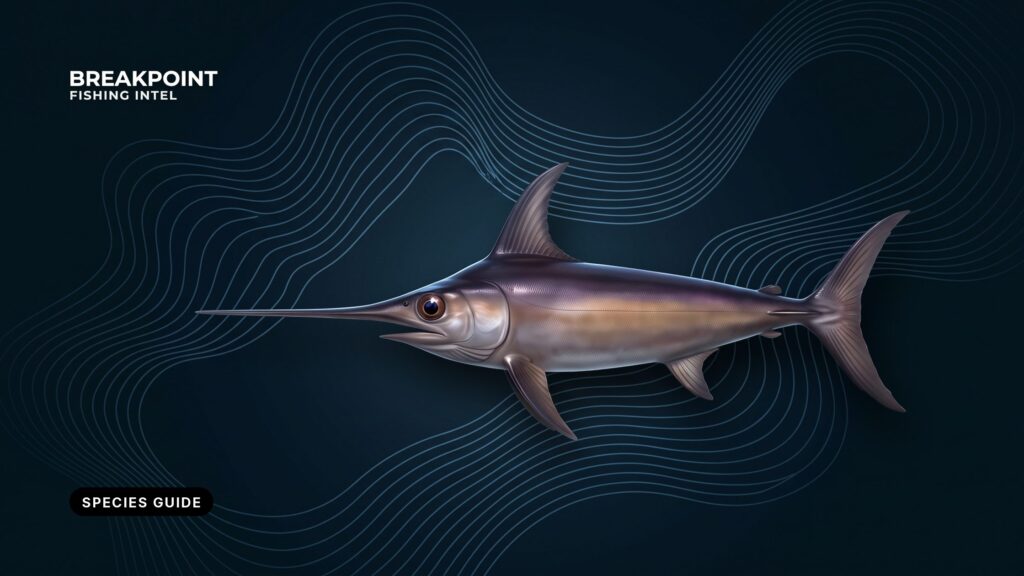
US anglers catch swordfish two ways: by dropping a bait near the bottom of the deep scattering layer in daylight, or by drifting lit baits shallow at night as the fish rise. This is a field guide to the swordfish, or broadbill (Xiphias gladius), for anglers fishing US waters. In the Atlantic, Gulf and Caribbean, the rules that matter are federal.
The main grounds are the Florida Straits, DeSoto Canyon, the Northeast canyons, and Catalina and the Channel Islands. The guide covers identification, movement, where and when each region fishes, how the rigs work, and how the rules divide. Place-level detail is in our regional fishing guides.
Identification
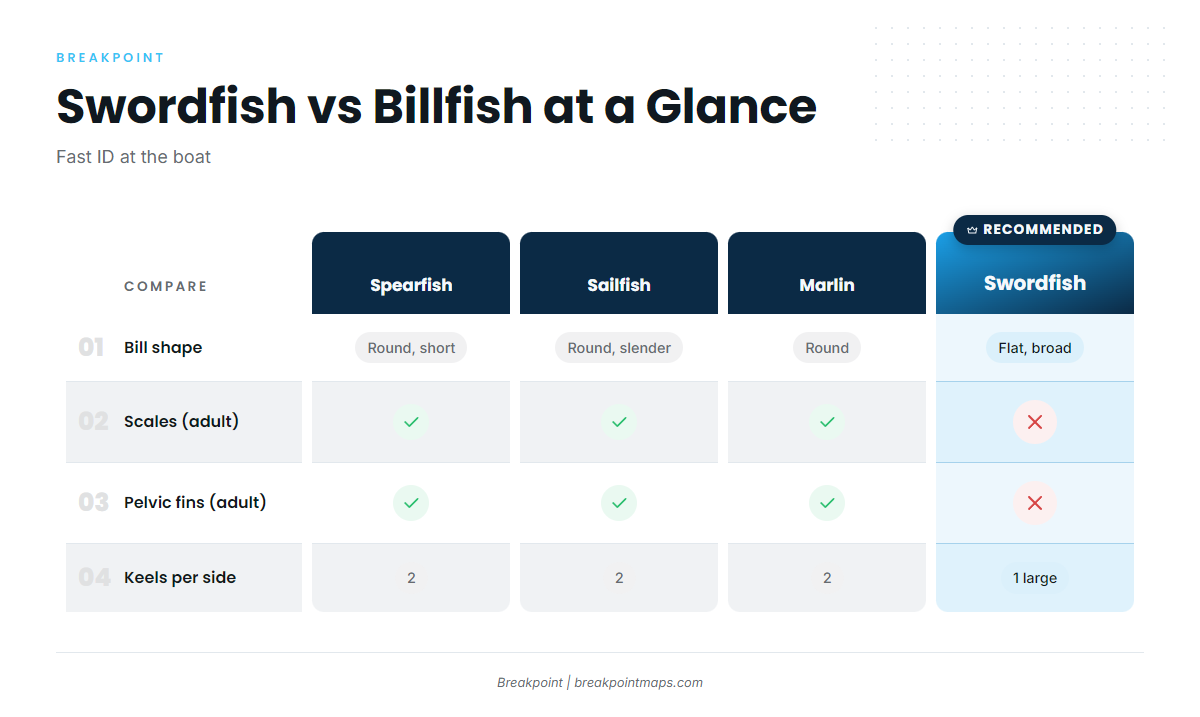
An adult swordfish has a long, flat, broad bill, no scales, no pelvic fins, and a single large keel on each side of the tail base.
| Trait | Swordfish | Blue / white marlin | Sailfish | Spearfish |
|---|---|---|---|---|
| Bill shape | Flat, broad, long | Round in cross-section | Round, slender | Round, short |
| Scales (adult) | None | Present | Present | Present |
| Pelvic fins (adult) | None | Present | Present, long | Present |
| Keels at tail base | 1 large keel per side | 2 keels per side | 2 keels per side | 2 keels per side |
| First dorsal fin | Tall, short-based, rigid | Long base, depressible | Sail-like, very tall | Long, moderately high |
Swipe the table sideways to see every column.
At night or in the wake you rarely get a long look. The flat bill and the missing pelvic fins are the fastest tells. The large eye suits a fish that feeds in the dark.
Our billfish guides compare the species side by side.
Biology and Movement
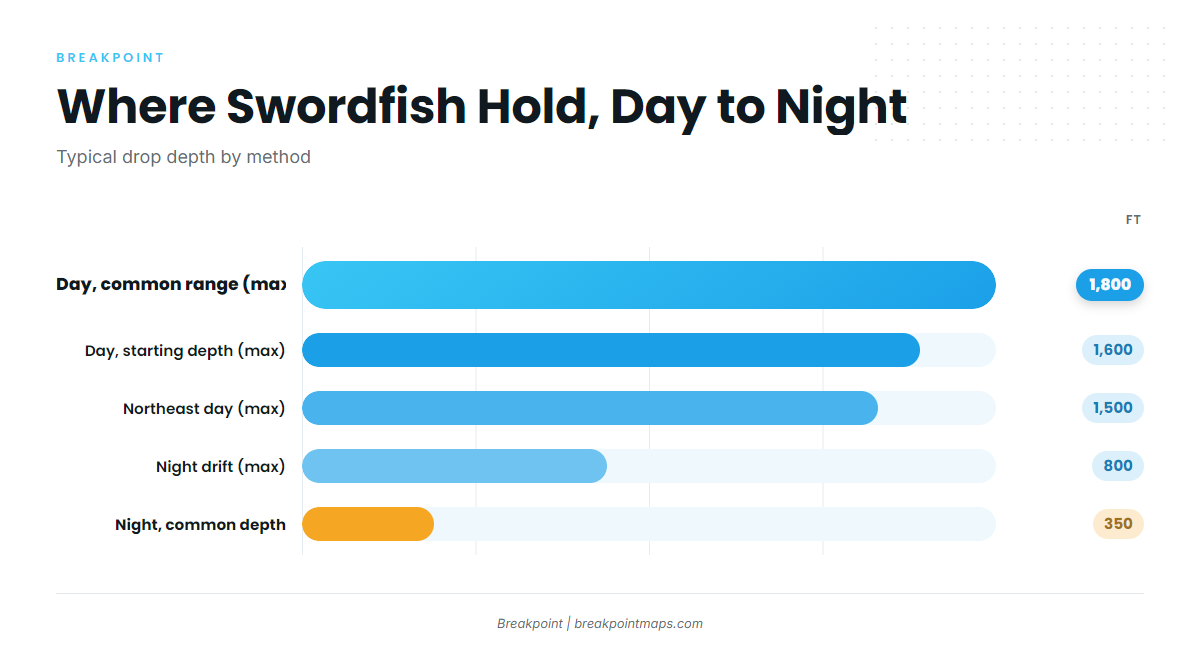
The deep scattering layer is a band of squid, small fish and plankton that sits deep by day and rises toward the surface at night. Swordfish follow it, and this daily up-and-down travel is called diel vertical migration.
In daylight, most anglers fish swordfish between 1,200 and 1,800 ft, and 1,200 to 1,600 ft is a reasonable place to start. The range varies because the layer’s depth shifts with light, water clarity and region. Northeast canyon drops commonly run shallower, around 1,000 to 1,500 ft. At night the layer rises to within a few hundred feet of the surface, and the fish come with it.
Swordfish track darkness and food more than depth itself, which is why a bright moon pushes night baits deeper (covered under Finding Fish).
What the fish eats shapes the tackle:
- Opportunistic feeders. They forage from the bottom to the surface over great depths and distances.
- Prey. Squid and fish such as mackerel, barracuda and filefish.
- Solitary and migratory. You are rarely marking a school.
- Bill slashing. They slash at prey with the bill, so baits need to be tough.
Swordfish are found in water from 41°F to 81°F. Daytime fish hold in roughly 60 to 70°F water at depth.
Where and When
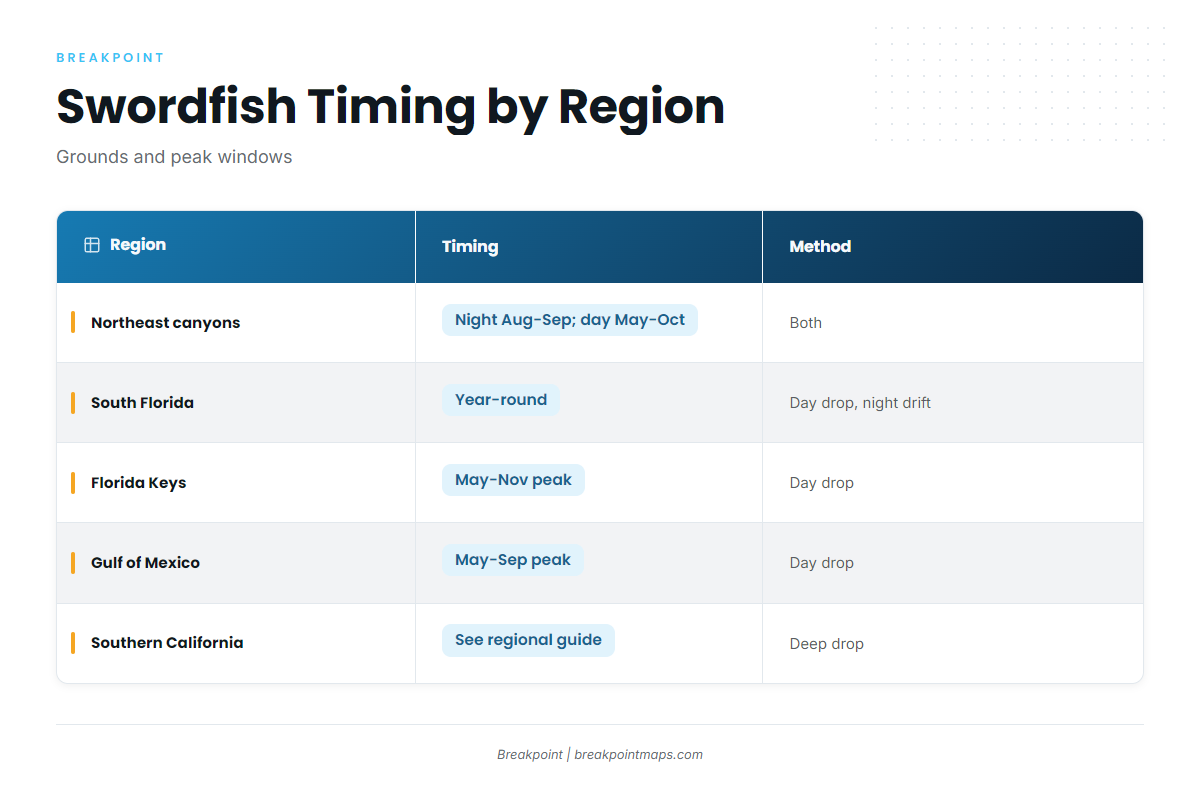
Timing and method differ by coast.
| Region | Typical grounds | Timing | Primary method | Guide |
|---|---|---|---|---|
| Northeast and Mid-Atlantic | Hudson, Norfolk, Washington canyons, Cape May to Montauk | Night drift Aug–Sep; day drops May–Oct | Both | See below |
| South Florida / Florida Straits | Gulf Stream edge, Miami to Fort Lauderdale | Year-round | Day drop, night drift | See below |
| Florida Keys | Islamorada, 25 to 50 miles out | May–Nov peak | Day drop | See below |
| Gulf of Mexico | DeSoto Canyon, off Alabama | May–Sep peak, fish year-round | Day drop | See below |
| Southern California | Catalina, Anacapa, Channel Islands | See regional guide | Deep drop, harpoon tradition | See below |
| Hawaii | Offshore | See agency and local sources | None listed | None |
Swipe the table sideways to see every column.
Northeast and Mid-Atlantic Canyons
The grounds run from Cape May to Montauk, with Hudson, Norfolk and Washington canyons as the named anchors. Night drifting is strongest in August and September. Day drops at 1,000 to 1,500 ft produce from May through October. The run offshore is long, so plan fuel and daylight around it.
Our Northeast and Mid-Atlantic swordfish guide has the canyon detail.
Southeast: Florida Straits and the Keys
The Gulf Stream pushes deep water close to shore, and fish are present year-round off South Florida. The Keys peak May through November, and Islamorada boats reach swordfish water 25 to 50 miles out. Both day and night methods are fished hardest here.
Our Florida Straits and Keys guide has the local detail.
Gulf of Mexico
DeSoto Canyon and the water off Alabama hold fish year-round, with the peak from May to September. Daytime drops dominate.
Our Gulf of Mexico swordfish guide covers the grounds.
Southern California
Fish hold on the deepwater banks around Catalina, Anacapa and the Channel Islands. California’s harpoon fishery dates to the early 1900s, and the commercial deep-set buoy gear fishery works the same grounds.
Our Southern California swordfish guide has the rest.
Hawaii
Hawaii produces some of the largest swordfish fished in US waters. Rules fall under NOAA’s Pacific management.
Each regional guide above carries the named grounds and seasonal detail for its coast.
Daytime Deep-Dropping
Daytime fish sit in the deep layer, so you put a lit, tough bait at that depth and hold it there against the current.
The Rig, Reel to Bait
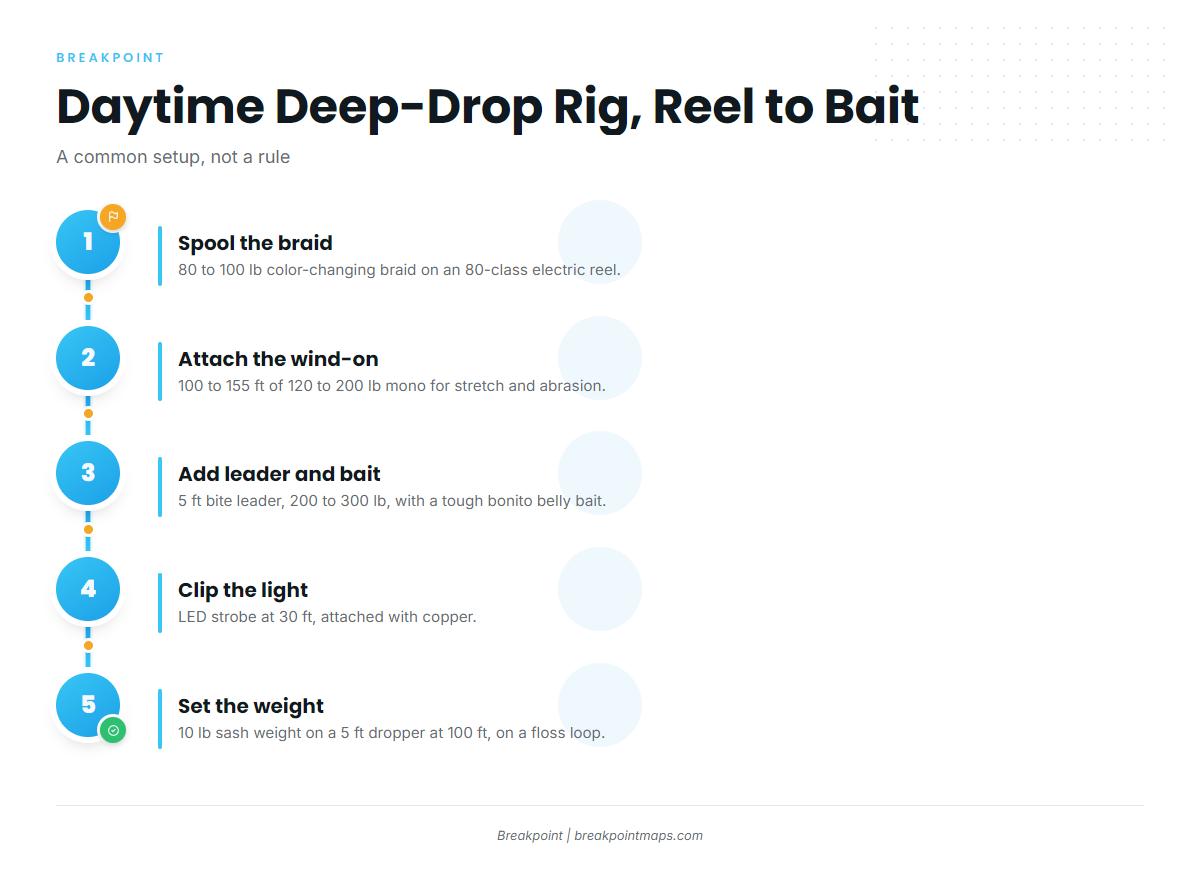
This is a typical daytime deep-drop rig. Treat the numbers as a common setup rather than a rule.
| Component | Common setup | Why |
|---|---|---|
| Reel | 80-class electric | Retrieving 1,500 ft of line by hand is impractical |
| Main line | 80 to 100 lb braid, color-changing every set interval | Thin diameter cuts current drag; colors read depth |
| Wind-on | 100 to 155 ft of 120 to 200 lb mono | Stretch and abrasion at the end game |
| Bite leader | 5 ft, 200 to 300 lb, swivel to the wind-on | Survives bill slashes |
| Light | LED strobe at 30 ft, attached with copper | Copper lets the line pass when the light hits the rod tip |
| Weight | 10 lb sash weight on a 5 ft dropper at the 100 ft mark, clipped to a rigging-floss loop | Breaks away so the fish is fought without the lead |
| Hooks | 11/0 to 12/0 J-hooks are common; circle hooks favored for release | See Fighting and Handling |
Build it in this order:
- Spool the braid. Fill the reel with color-changing braid.
- Attach the wind-on. Join the mono wind-on to the braid.
- Add the bite leader and bait. Swivel the 5 ft leader to the wind-on and rig the bait.
- Clip the light. Attach the LED strobe at 30 ft with copper.
- Tie the floss loop and weight. At 100 ft, add a loop of heavy waxed rigging floss, then clip the 5 ft dropper and sash weight to it.
Reinforce your rod holders, because the load will test them.
Baits
Bonito belly "tacos" are favored because the tough skin survives bill slashes. Illex squid is the standard backup, and rigged eels and strip baits are also used. A bait that tears on the first slash is gone before the fish commits.
The Drop and the Bite
The main failure is a tangle on the way down, so control the drift and drop clean.
Watch the line on the descent. Slack line means a bite, because the fish hit the falling bait and took the weight off.
Fish often hit several times before they commit. Set the hook by reeling tight and lifting, without cranking the drag and swinging. Expect fights on a big fish to run for hours.
Night Drifting
At night the layer rises, so baits go shallow.
Drift squid baits with battery lights, typically 100 to 800 ft down, staggered at different depths. Fish the inshore humps and canyon edges. Around 350 ft is a common depth, and many crews treat roughly 2 to 4 AM as the productive window.
Night fishing is the traditional method. Daytime fishing replaced the wait for dark with depth, current management and subtle bite reading.
US swordfishing began with the harpoon roots of swordfishing. California’s harpoon fishery developed in the early 1900s. Longlining later dominated the commercial side, and deep-set buoy gear is the Pacific commercial method.
Finding Fish
Scouting comes down to where structure, temperature and current meet.
- Edges. Look for breaks in the 60 to 70°F range at depth, with surface temps of 72 to 82°F depending on region.
- Structure. Canyon walls, deep ledges and drop-offs where depth changes sharply. Sonar and local bottom knowledge decide the actual drop.
- Current. Crews watch for fish feeding deep during tidal flow and rising in slack water. Treat it as an observed pattern, not a law.
- Moon. Spreads run deeper around the full moon, about 200 to 500 ft, and shallower around the new moon, about 50 to 300 ft. This is common practice.
OBS SST and Chart Contours in the app show where a surface edge crosses a canyon wall or ledge, which narrows where to drop. Chart layers are not for navigation.
SST shows the surface, not the 60 to 70°F water at depth where the fish hold. Use it to choose the area, then let sonar and the drop confirm.
For weather, check the NWS marine forecast for wind, wave height and period.
Fighting and Handling
Keep steady pressure and let the weight break away. Long fights are normal.
Watch the bill. When the fish is within about 100 ft of the surface, expect surface charges at the boat. Keep hands, legs and crew clear of the bill, and do not reach for it.
For release:
- Circle hooks. They produce cleaner hookups and better release survival.
- Keep it in the water. A swordfish that is not kept goes back without being removed from the water.
Decide whether to keep or release before the fish is at the boat. Measuring is covered under Regulations.
FAQ
How deep do you fish for swordfish during the day?
1,200 to 1,800 ft is most common, and 1,200 to 1,600 ft is a good starting point. The depth varies with light, water clarity and region, and Northeast canyons often run shallower.
What is the difference between a swordfish and a marlin?
Swordfish have a flat bill, no scales, no pelvic fins and a single keel on each side of the tail. Marlin have a round bill, scales and pelvic fins, and two keels per side.
What is the swordfish size limit?
47 in lower jaw fork length or 25 in cleithrum to keel, per FWC and HMS. Check HMS before you fish.
Do I need a permit to fish for swordfish?
Yes, in Atlantic, Gulf and Caribbean federal waters. You need an HMS Angling or HMS Charter/Headboat permit. FWC says the federal permit is not required in Florida state waters.
Do I need my own permit on a charter?
On a for-hire trip, the vessel’s HMS Charter/Headboat permit applies. Captain and crew keep a zero bag and possession limit.
When is swordfish season?
It depends on the region. South Florida fishes year-round, the Keys peak May through November, and the Gulf peaks May through September. Northeast canyons fish May through October by day and August through September at night.
Should a first-timer book a day or night trip?
Day trips mean deep drops and long fights. Night trips mean lit baits drifting shallow. Both are fished hard in South Florida, and neither guarantees fish.
Is swordfish safe to eat?
Swordfish is high in mercury. Check the FDA and EPA fish advice before you decide how often to eat it.
Is the swordfish population healthy?
For the Pacific, assessments describe the Western and Central North Pacific and Eastern North Pacific stocks as healthy. See the Pacific swordfish stock assessment.