




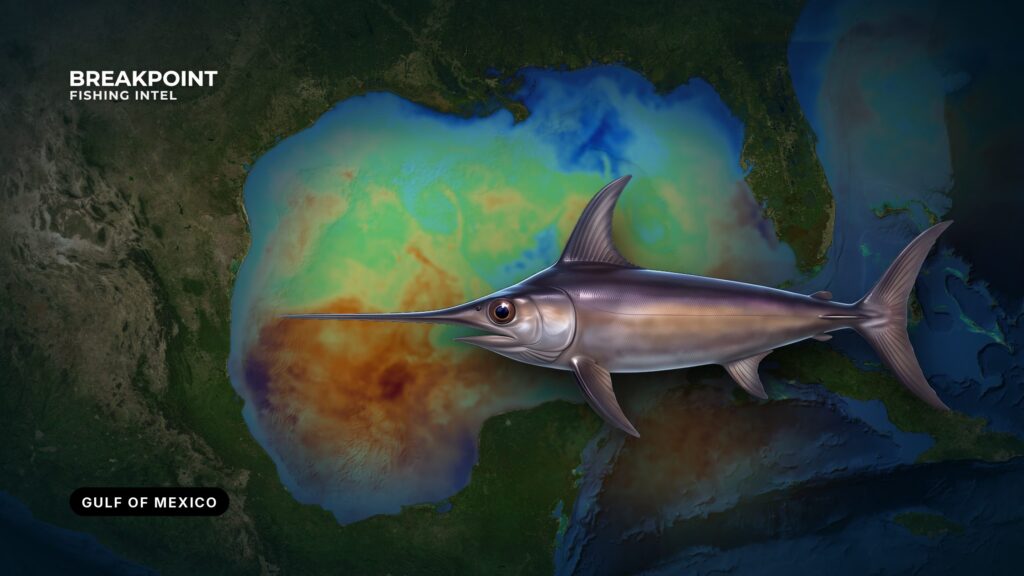
Swordfish fishing in the Gulf of Mexico happens in deep water off the shelf break. By day anglers drop baits near bottom, and at night they drift lights and baits higher in the column. Swordfish fall under federal Atlantic HMS rules, with state rules layered on top in state waters and at the dock.
This page covers how the canyons, the Loop Current and temperature edges shape where swordfish hold, and how to read those features before you leave the dock. The Gulf supports far more offshore fishing than this one species, and our Gulf of Mexico offshore fishing page covers the rest. No page can promise fish, but this one should help you decide where to look. It runs through where and when to fish, the water that holds swordfish, the two methods, and the rules state by state.
Swordfish at a Glance
A swordfish has a flat, broad bill, no pelvic fins, no scales as an adult, a tall rigid first dorsal fin and a deeply forked tail. The eyes are large and built for low light. Swordfish feed on squid and fish, and they move up and down the water column every day: deep by day, shallower at night as squid rise toward the surface. That daily movement drives how and where you fish for them. Our full swordfish species guide covers identification and biology in more depth. If you are sorting a swordfish from marlin, sailfish and other billfish, look for the flat bill and missing pelvic fins. A marlin has a round bill.
Where Swordfish Hold in the Gulf
Gulf swordfish hold along the shelf break, the canyon walls and the steep slope below them, from the Texas rigs to the Dry Tortugas. Think in terms of structure rather than coordinates: look for where contours tighten, where the slope steepens and where current pushes against a wall.
| Area | Structure | Ports that run to it |
|---|---|---|
| DeSoto Canyon and Panhandle edge | Canyon cutting into the shelf, steep walls | Destin, Orange Beach |
| Mississippi Canyon and Louisiana slope | Deepwater indentation west of the river mouth | Venice, Port Fourchon |
| Texas and Louisiana rigs | Deepwater platforms along the shelf break | Port Aransas, Freeport |
| Keys and Dry Tortugas | Gulf deep water meeting the Straits of Florida | Florida Keys ports |
DeSoto Canyon and the Florida Panhandle Edge
The DeSoto Canyon cuts into the shelf south of the Panhandle and Alabama, and its steep walls bring deep water close to the shelf. Farther southeast, the Florida Middle Grounds edge marks the shelf margin. Destin and Orange Beach are the ports that run to this ground.
Mississippi Canyon and the Louisiana Slope
The Mississippi Canyon is a deepwater indentation into the continental shelf west of the river mouth. Deep water sits close to Venice and Port Fourchon, so the run is short compared with most of the Gulf. Look for the canyon walls and the slope below them.
Texas and Louisiana Rigs and the Shelf Break
Deepwater platforms act as structure that holds bait along the break. Fish the water around them and the slope beyond. Port Aransas and Freeport serve the Texas side. For the broader Gulf offshore picture, including other species you can pair with a swordfish trip, start there.
The Florida Keys and Dry Tortugas Transition
Here the Gulf’s deep water meets the Straits of Florida, and the fishery continues up the Atlantic side. For that side, read about swordfishing the Atlantic Southeast.
When to Fish for Swordfish in the Gulf
Swordfish live in the Gulf’s deep water year-round, and late spring through early fall is the window most anglers fish. Weather and sea state decide most trips.
- Wind, wave height and period: read all three on the National Weather Service marine forecast before you commit to a run.
- Daytime trips: deep-drop near bottom structure.
- Nighttime trips: drift with lights and baits higher in the column.
- Combo trips: many operators pair the two.
The Water and Structure That Hold Them
Swordfish follow their food up and down the water column, so the best Gulf ground puts deep, steep bottom under moving, productive water.
The Deep Scattering Layer and the Daily Migration
The deep scattering layer is a band of squid and small fish that sits deep in daylight and rises toward the surface after dark. Swordfish follow it, which is why one method fishes near bottom by day and the other fishes higher in the column at night.
The Loop Current and Its Eddies
The Loop Current carries warm water in through the Yucatán Channel and out through the Straits of Florida. Eddies pinch off and drift west, and their edges concentrate bait and set up temperature breaks.
Temperature Edges and Upwelling Over Steep Bottom
A slightly cooler patch over a canyon wall can signal upwelling. Upwelling over good structure is the setup worth checking.
What the Data Can and Cannot See
- Cloud blocks the satellite SST pass.
- Surface SST does not show temperature at depth.
- Chlorophyll shows the color of surface water, not where fish are.
- Some deep bathymetry rests on old surveys.
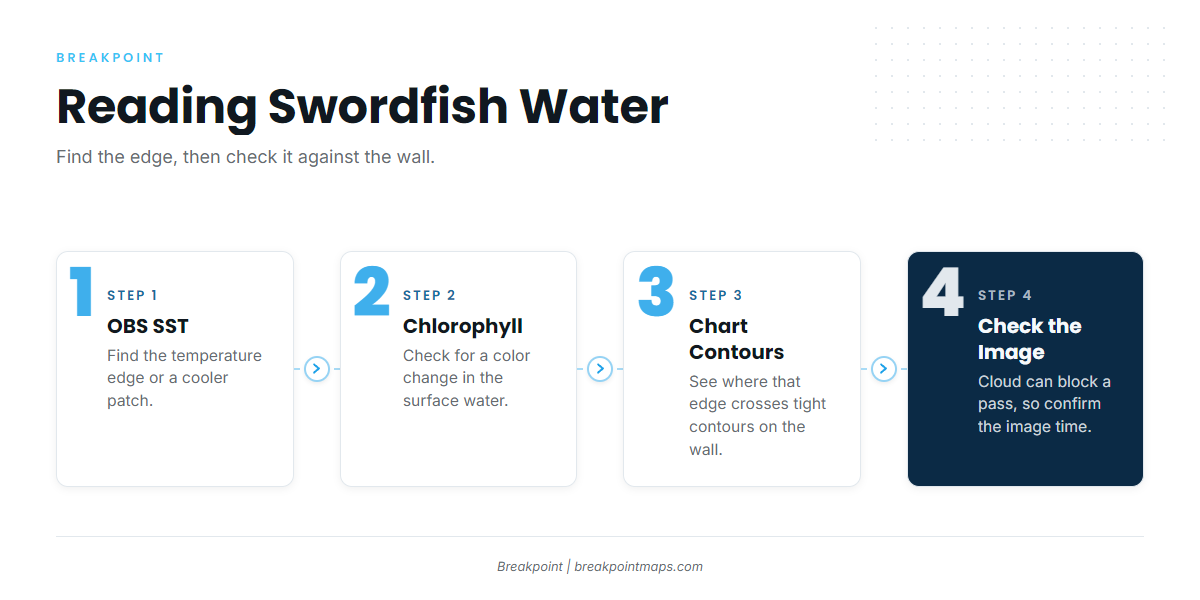
Turn on OBS SST to find the edge, then check Chlorophyll for the color change. Overlay Chart Contours to see where that edge crosses tight contours on a canyon wall. Check the image time, since cloud can block a pass. Chart layers are not for navigation.
How Anglers Fish for Swordfish in the Gulf
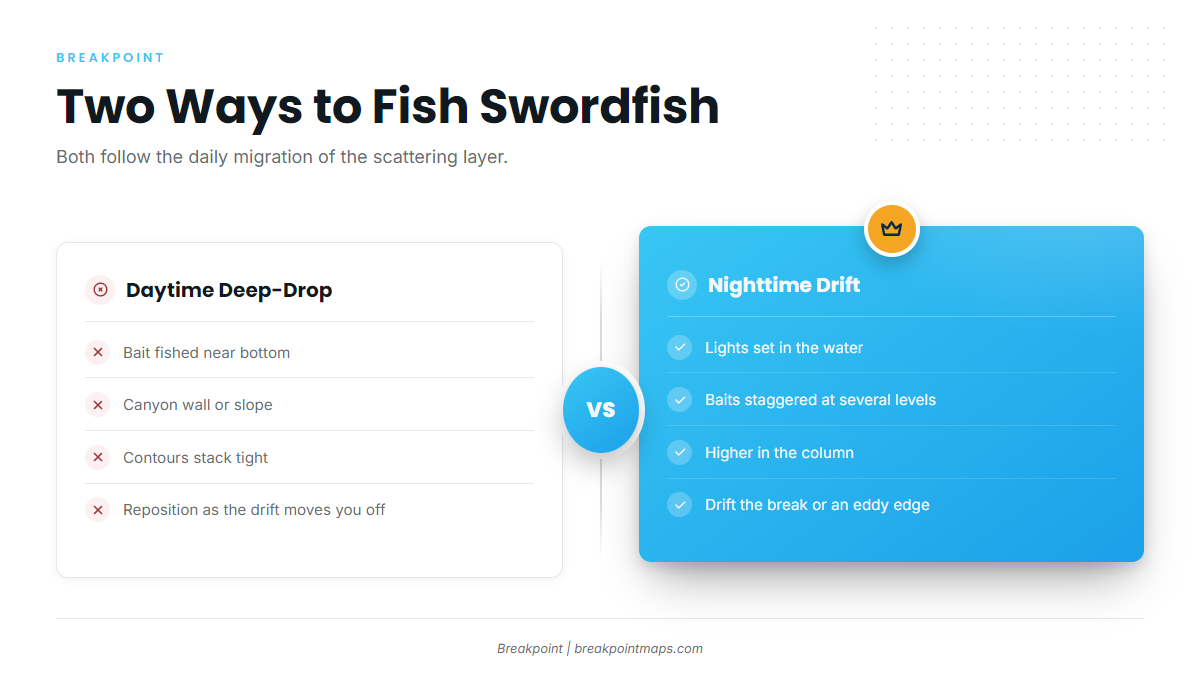
Gulf anglers fish swordfish two ways: a daytime deep-drop near bottom structure, and a nighttime drift with lights and baits set higher in the column. Both trace back to the scattering layer.
Daytime Deep-Drop
Fish the bait near bottom on a canyon wall or slope where the contours stack tight, and reposition as the drift pulls you off the structure. A typical rig uses:
- an electric reel spooled with braid
- a stout deep-drop rod
- a wind-on or mono leader
- a single hook rigged to the bait
- a strobe or light near the bait
- a breakaway weight on a light link that releases on the bite or the retrieve
- a float or ball off the rod tip, if used
Squid and bonito belly strips work well as bait. Sew them so they swim straight.
Nighttime Drift
Set lights in the water and stagger baits at several levels higher in the column. Drift along the break or an eddy edge.
Fighting, Gaffing and Releasing
Keep steady pressure on the fish and respect the bill at boatside. Gaff once the fish is under control, and keep the deck clear. Release fish you will not keep in the water to give them the best chance of survival.
Plan your drop zone in the app before you leave the dock: the edge, the wall and the drift line.
Guides to swordfish fishing from specific ports: Orange Beach, Apalachicola, Cocodrie, Biloxi, Corpus Christi, Destin, Grand Isle and Pascagoula.
Frequently Asked Questions
Do I need an HMS permit, and does it cover the boat?
Yes, to fish for swordfish in federal waters. The HMS Angling Permit is issued to the vessel through NOAA HMS. In Florida state waters it is not required for swordfish.
What is the size limit for swordfish?
FWC lists 47" lower jaw fork length (25" cleithrum to keel). Confirm with NOAA HMS before fishing.
How many swordfish can I keep?
Retention limits change by rule, so check NOAA HMS before each trip. Federal and state limits cannot be stacked.
Do I have to report a swordfish?
Reporting rules are set by NOAA HMS. Check its current reporting instructions before you land a fish.
Can I sell a swordfish caught on an HMS Angling Permit?
Sale falls under NOAA HMS rules in 50 CFR part 635. Check NOAA HMS before you fish.
Can I fish federal waters and land in another state?
The federal rules apply where the fish was taken, and the landing state’s license and limits also apply. Texas requires both explicitly, and Florida requires its saltwater license to land.
When is the best time to swordfish in the Gulf?
Fish are present year-round in deep water. Late spring through early fall is the window most anglers fish. Check the NWS marine forecast for wind, wave height and period.
How do I tell a swordfish from a marlin?
A swordfish has a flat bill, no pelvic fins and a tall, rigid dorsal fin. A marlin has a round bill. Our swordfish species guide has the full comparison.