




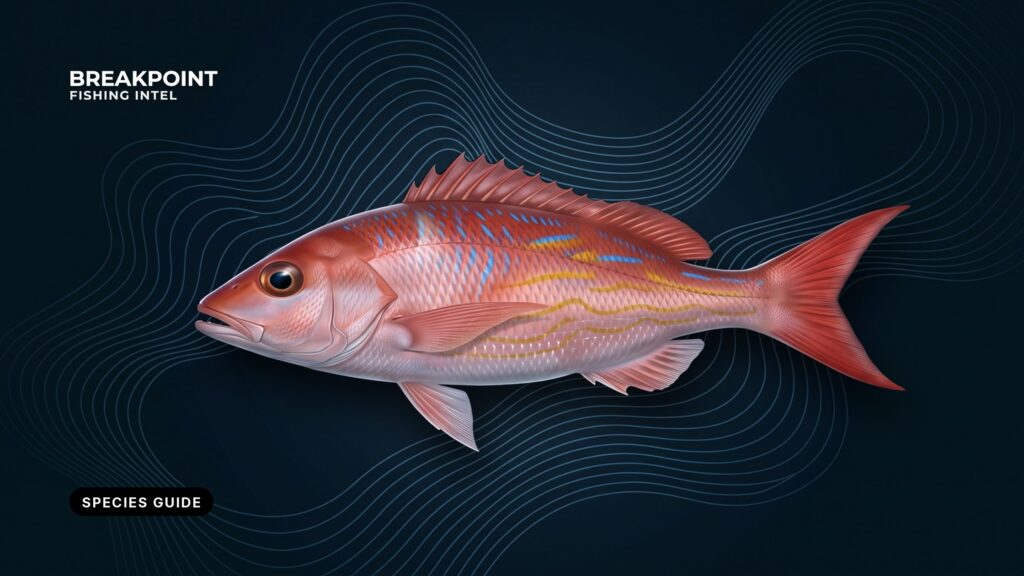
Vermilion snapper are small, red, schooling snapper that feed up off the bottom on shelf-edge hard bottom from North Carolina through the Gulf. The species is Rhomboplites aurorubens, family Lutjanidae. Anglers call it beeliner, B-liner and mingo, and the Gulf Council vermilion snapper page uses the same names. It schools in numbers and stays open in many zones, which makes it a dependable reef fish.
This guide covers vermilion snapper in US waters, from North Carolina to Florida and across the Gulf of America (Gulf). It includes identification, range and season, feeding behavior, how to find and catch them, and how the rules divide between state and federal waters.
How to Identify Vermilion Snapper
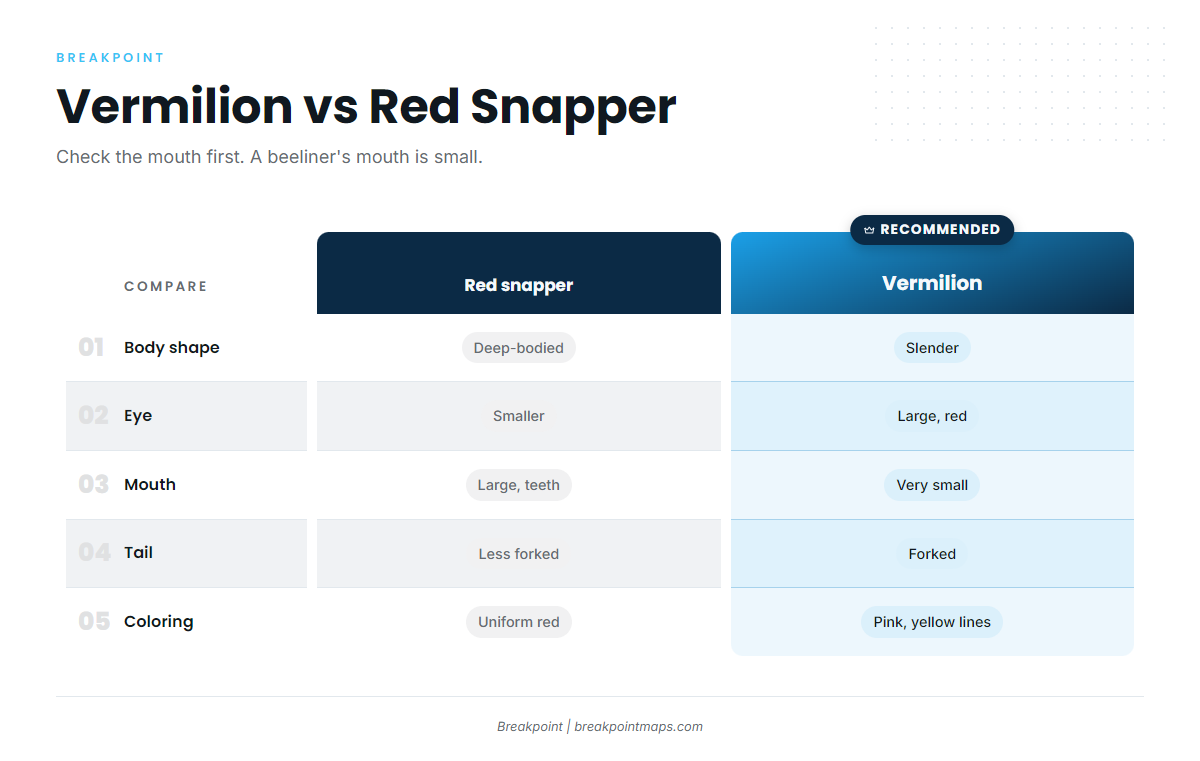
A vermilion snapper has a slender body, a very small mouth, a large red eye and a forked tail. It is red to pink with yellowish lines along the sides. A red snapper is deep-bodied with a large mouth, prominent teeth and a smaller eye. Check the mouth first: a beeliner’s is small.
| Feature | Vermilion snapper | Red snapper |
|---|---|---|
| Body shape | Slender, elongated | Deep-bodied |
| Eye | Large, red | Smaller |
| Mouth | Very small | Large, with prominent teeth |
| Tail | Forked | Less forked |
| Coloring | Red to pink, yellowish lines, pale belly | Uniform red |
The distinction matters because size, bag and season rules differ sharply between the two species. Red snapper seasons are short and quota-driven, and a misidentified fish in the box is a violation.
Vermilion snapper grow to about 2 feet and 7 pounds. The maximum observed age is 19 years in the South Atlantic.
Lane snapper, mangrove (gray) snapper and tomtate share the same bottom and get mixed in with vermilion on deck, so sort your catch before you bag it. For the rest of the family, see the rest of our reef fish guides.
Where and When Vermilion Snapper Live
The range runs through the western Atlantic from Cape Hatteras, North Carolina, to southeastern Brazil, including Bermuda, the West Indies, the Caribbean and the Gulf. This guide covers US waters only.
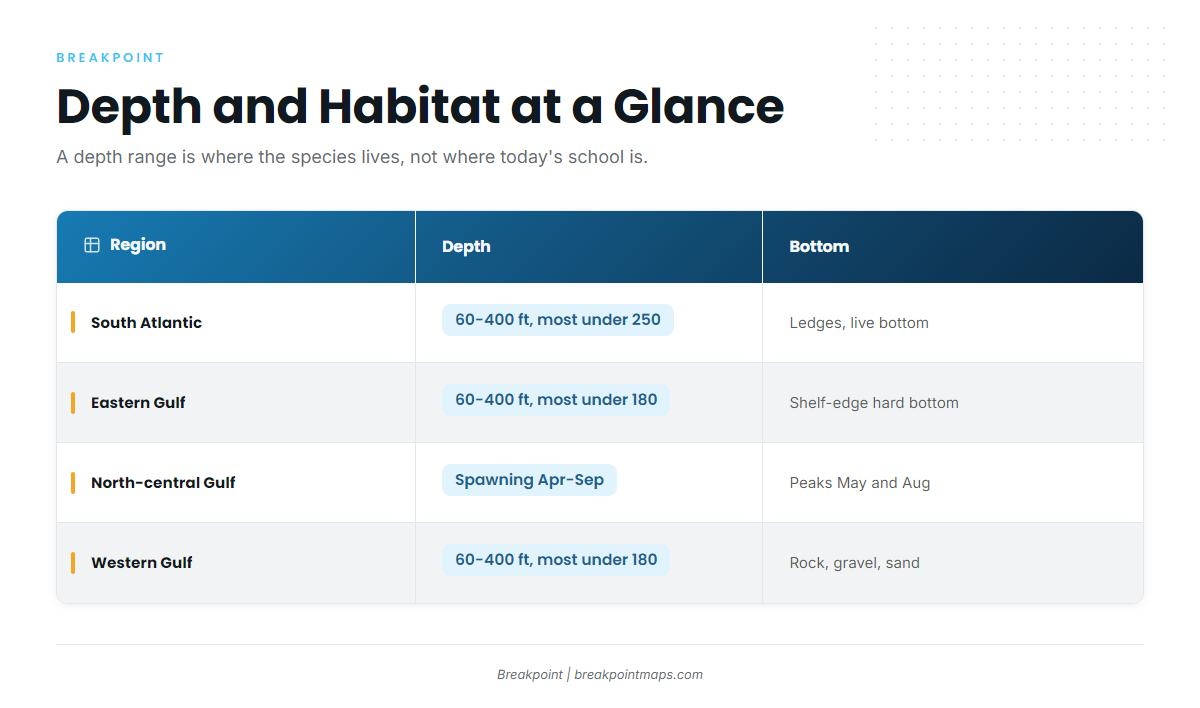
Vermilion snapper live in 60 to 400 feet of water and are most abundant under 180 feet. Off the Southeast Atlantic coast they are most abundant shallower than 250 feet. These ranges describe where the species lives in general, not where a given school is on a given day.
They sit over rock, ledges, live bottom, gravel and sand near the edge of the continental shelf, and they also hold on artificial reefs and wrecks. They do not travel far, so structure that holds fish today usually holds fish next week.
| Region | Depth | Bottom | Notes |
|---|---|---|---|
| South Atlantic (NC to Florida Atlantic) | 60 to 400 ft, most abundant under 250 ft | Ledges and live bottom near the shelf edge | Spawning April through late September |
| Eastern Gulf | 60 to 400 ft, most abundant under 180 ft | Shelf-edge hard bottom | 90% of fish are mature by 200 mm TL (about 7.9 in) and all by 250 mm |
| North-central Gulf (Pensacola to the Mississippi River) | Shelf and slope waters | Hard bottom | Spawning fish found April through September. Female spawning condition peaks in May, with a second peak in August |
| Western Gulf | 60 to 400 ft, most abundant under 180 ft | Rock, gravel or sand near the shelf edge | None |
Spot-level detail is in the regional fishing guides for North Carolina, South Carolina, Florida Atlantic, the eastern Gulf, Alabama and the western Gulf.
How Vermilion Snapper Feed, School and Spawn
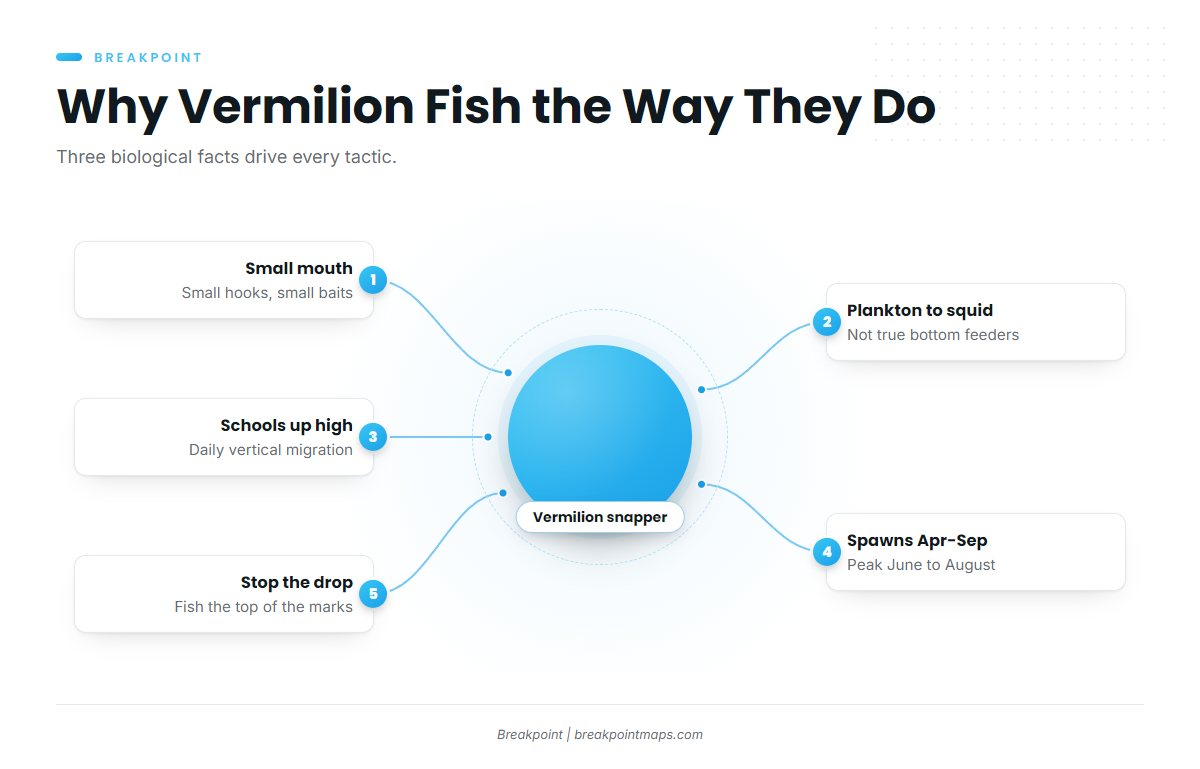
Three facts shape the tactics below: a small mouth, a diet of plankton and small prey, and schools that hang off the bottom.
Diet and the Small Mouth
Vermilion snapper eat copepods and other plankton, shrimp, crabs, worms, small fish and squid. Small juveniles eat mostly tiny crustaceans. They are not true bottom feeders, and the small mouth calls for small hooks and small baits.
Schooling Up off the Bottom
Adults and young form large schools. They use the upper water column and make daily vertical migrations, as the South Atlantic vermilion stock assessment documents. A school can sit tens of feet off the reef, so stop the drop at the marks rather than on the bottom.
Spawning
Spawning: April → late September, peak June to August.
In the north-central Gulf, female spawning condition peaks in May and again in August. Females spawn about every 2.2 days through the season, and fish spawn in aggregations. Maturity comes early: most fish are mature at age 1 and all by age 2. Fish gather on the same hard bottom through the warm months.
How to Find Vermilion Snapper
Look for shelf-edge ledges, live bottom, rock and gravel patches, wrecks and artificial reefs. Work inside the 60 to 400 foot band, weighted toward the most abundant depths for your region.
Use your sonar to find the school itself:
- The school shows as a cloud or band suspended above the structure, not tight to the bottom.
- Mark the top and bottom of the school. The top sets your stop depth.
- Run the area again to confirm the hard bottom under it.
Chart Contours in Breakpoint draws the depth lines. Tight, bunched contours near the shelf edge flag ledges and steps worth a sonar pass. Steps hold bait, and bait holds beeliners. Contours show bottom shape rather than fish, so run the area, confirm hard bottom and marks on your sonar, then fish. Chart layers are not for navigation.
How to Catch Vermilion Snapper
The fish has a small mouth and often sits off the bottom, so light, small terminal tackle fishes best.
Rig and Bait
- Chicken rig (double dropper): Two small baits fished vertically, so you can read where in the column the bites come from.
- Small circle hooks: Match the hook to the bait, because the fish has a small mouth.
- Braid with a fluorocarbon leader: Braid gives sensitivity in depth.
- Baits: Small strips of squid, cut bait (sardine, threadfin, other cut fish) and shrimp.
- Sabiki or dropper loop: Both work as alternatives.
Chumming
Chum draws the school up and holds it near the boat.
Drift vs Anchor
Drifting covers ground and finds the school. Anchoring holds you on a school you have already located. Each gives up something the other provides.
Stay Above the School
Stop the drop at the top of the sonar marks, since a bait that free-falls past the school misses it. Count line or use a line counter, then adjust up or down based on where the bites come.
Bait-Stealers and Bigger Fish
Pinfish, porgies and triggerfish strip baits near the bottom, so fishing higher in the column helps. Juveniles hold on shallower reefs and adults go deeper. If you catch mostly small fish, move deeper or to a different piece of bottom.
Expect a mixed bag. Triggerfish, lane snapper and porgies share the bottom, and amberjack, barracuda and sharks may take hooked fish on the way up. Our other reef fish guides cover them. Depth and structure choices vary by coast, so use the regional fishing guides to match the plan to your port.
Catch Care
Ice fish promptly. For spot-level depth and structure, the regional guides are the next step.
Releasing Vermilion Snapper
Fish pulled from depth can show a bloated belly or bulging eyes. That is barotrauma. Return released fish to depth with a descending device, use a dehooking tool and keep handling time short. The legal gear requirements by region are listed under Regulations below.
Region guides for vermilion snapper: vermilion snapper fishing in the Atlantic Southeast and vermilion snapper fishing in the Gulf of Mexico.
Vermilion Snapper FAQ
What is the difference between vermilion and red snapper?
Vermilion snapper have a slender body, a very small mouth, a large red eye and a forked tail. Red snapper are deep-bodied with a large toothy mouth and a smaller eye. The two species have different rules, so identify the fish before it goes in the box.
Can I keep vermilion snapper when red snapper is closed?
In most zones, yes. They are separate species with separate limits, and Gulf federal waters have no listed vermilion closed season. Check Regulations above and the agency page for the water you fish.
What is the vermilion snapper size limit?
Gulf federal waters and Louisiana use a 10 in TL minimum. South Atlantic federal waters and North Carolina use 12 in TL. For other states, check the agency.
How deep do vermilion snapper live?
They live in 60 to 400 feet of water and are most abundant under 180 feet. In the Southeast Atlantic they are most abundant shallower than 250 feet.
Why are they called beeliners?
They are commonly called beeliner, B-liner and mingo. Anglers use all three names for the same fish.
Are vermilion snapper good to eat?
Yes. They are a popular table fish.
Do I need a descending device?
In South Atlantic federal waters, yes. It must be rigged with at least 16 oz of weight and at least 60 ft of line. In Gulf federal waters, a descending device or venting tool must be rigged and ready when you fish for reef fish.