




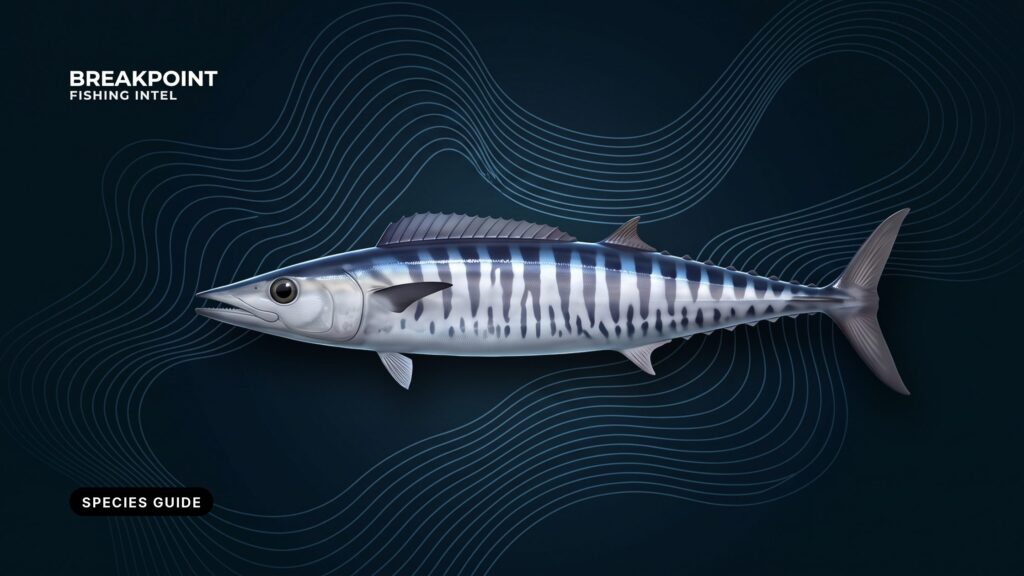
Wahoo feed on edges: temperature breaks, current edges, structure and clean blue water. The species (Acanthocybium solandri) is a fast, long-bodied offshore fish in the mackerel and tuna family. It lives in warm US waters from the Atlantic and Gulf to the US Caribbean and the Pacific, where Hawaii anglers call it ono, and it is prized both as a fast fish and a good table fish.
Much of finding wahoo can be done before you leave the dock. This guide covers identification, where and when to fish by region, how wahoo feed, how they are caught, how to handle them, and how federal and state rules divide. Place-level detail is in the regional guides by coastline.
How to identify wahoo
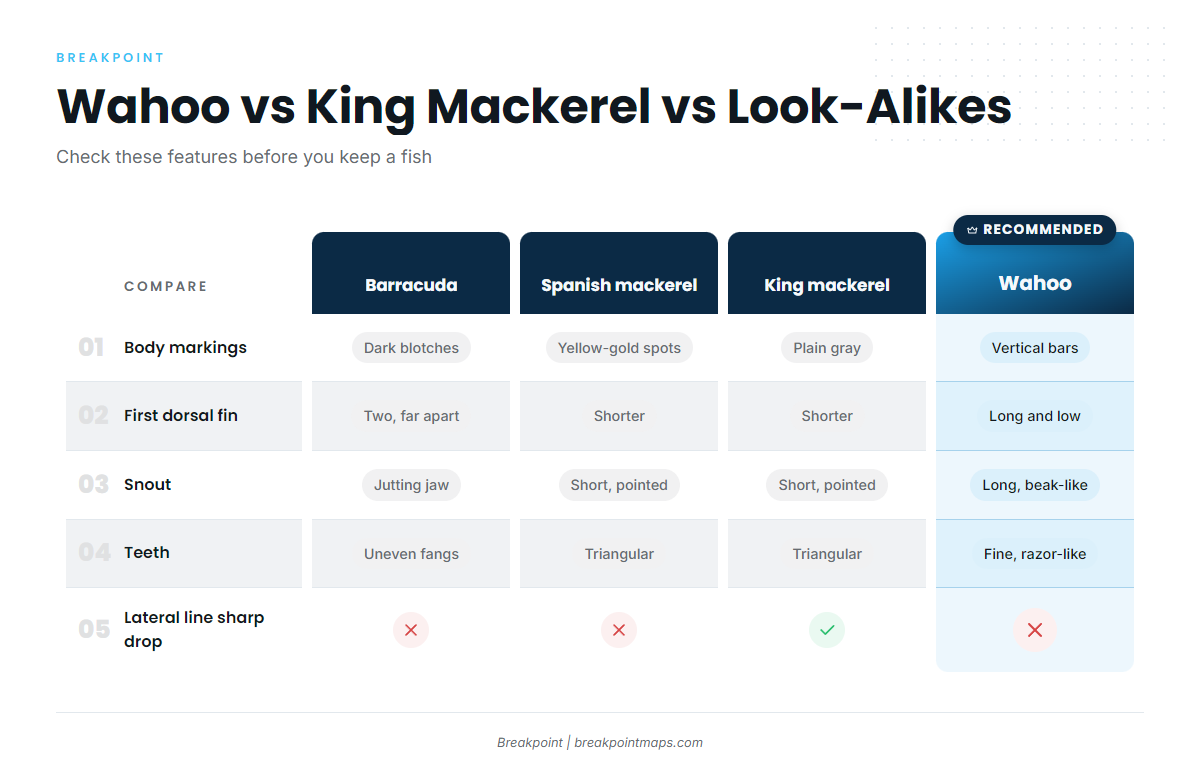
A wahoo is long and torpedo-shaped, with a beak-like snout and razor teeth. Learn the markings before you keep a fish, because a misidentified fish can put you over the wrong bag or size limit.
| Feature | Wahoo | King mackerel | Spanish mackerel | Barracuda |
|---|---|---|---|---|
| Body markings | Vertical blue-gray bars that can fade after death | Plain gray, no bars on adults | Yellow-gold spots | Scattered dark blotches toward the tail |
| First dorsal fin | Long and low, running far down the back | Shorter | Shorter | Two widely separated dorsal fins |
| Snout | Long and beak-like | Shorter and pointed | Shorter and pointed | Long, with a jutting lower jaw |
| Teeth | Fine and razor-like | Triangular and sharp | Triangular and sharp | Large, uneven fangs |
| Lateral line | No sharp drop | Drops sharply under the second dorsal fin | Not a deciding feature | Not a deciding feature |
Swipe the table sideways to see every column.
Wahoo and king mackerel are the pair most often confused. A king mackerel kept under wahoo rules is a different legal fish with its own size and bag limit. For help telling these fish apart, see the offshore gamefish species guides.
Where and when wahoo live
Wahoo follow warm water and bait, and current systems and bottom structure decide where they sit in each region. The summaries below run north to south on the Atlantic, then the Keys, the Gulf, the US Caribbean and the Pacific.
Atlantic Northeast
Wahoo are a late-summer fish here, found at the canyons and on the warm-water edge. They show up when Gulf Stream eddies push blue water onto the shelf edge, and cold water keeps them rare the rest of the year. Details are in the guide to wahoo along the Northeast canyons.
Cape Hatteras and the Carolinas
The Gulf Stream makes its closest approach near Hatteras, which puts blue water and wahoo within reach of the inlet. Hatteras has a reputation for wahoo across a long stretch of the year, and anglers also fish the Outer Banks as wahoo arrive with warming water. The full picture is in wahoo fishing off Cape Hatteras.
The Southeast: Carolinas to Florida’s Atlantic coast
Ledges and rough bottom along the Gulf Stream’s western edge hold wahoo. The Charleston Bump is the standard example: deep relief there turns current and holds bait. Farther south the Stream runs close to shore off South Florida, which shortens the run to blue water. See the Southeast Atlantic wahoo guide.
Florida Keys
Humps and reef-edge drop-offs push current up over relief, and wahoo work those edges. The cooler months are widely reported as a strong time near the reef edge. More detail is in wahoo on the Islamorada humps.
Gulf of Mexico
Oil and gas rigs and floaters act as structure in open water. The Loop Current and its eddies move blue water around, and deep water near the mouth of the Mississippi off Venice and Grand Isle is a known wahoo area. The Gulf of Mexico wahoo guide has the place-level detail.
US Caribbean: Puerto Rico and the USVI
Deep water lies close to shore along drop-offs and banks. These waters are covered by their own federal wahoo rules, described in the Regulations section below.
Pacific: Hawaii and Southern California long-range
In Hawaii, wahoo is ono, a staple trolling fish around the islands and offshore buoys. Southern California long-range boats run south into Mexican waters for wahoo. Those waters fall under Mexican rules and permits, which the boat operator handles. The Pacific Southwest wahoo guide covers the local picture.
How wahoo feed and move
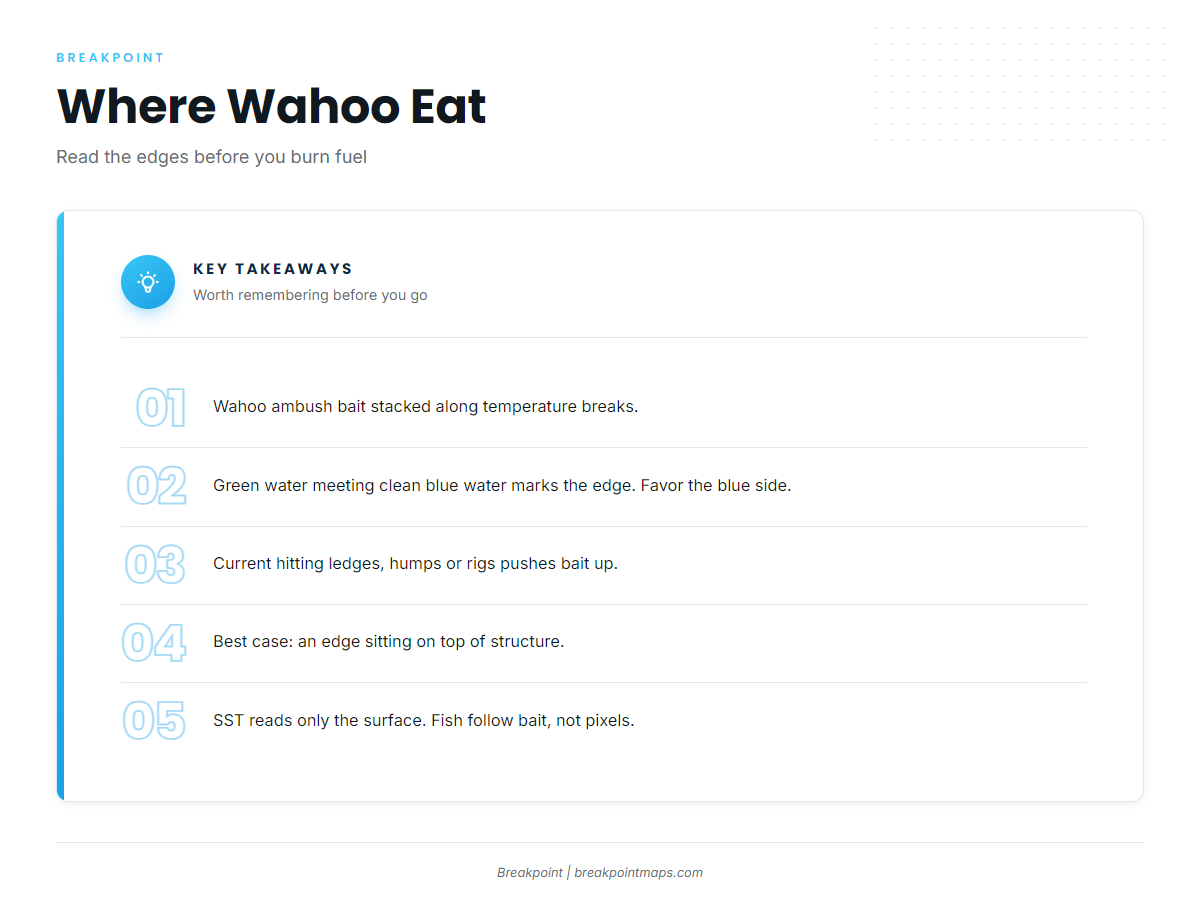
Wahoo are ambush feeders. They sit where bait is concentrated and disoriented, and they hit it fast.
Four patterns account for most of where they show up:
- Temperature breaks. A sharp change in surface temperature over a short distance marks where two water masses meet. Bait stacks along that edge, and wahoo work it.
- Color changes. Green water meeting clean blue water marks the line between productive water and clear hunting water. Wahoo favor the blue side of the edge.
- Structure and current. When current hits ledges, humps or rigs, it pushes bait upward. The best case is an edge sitting on top of structure, such as the Charleston Bump, the Keys humps or a Gulf rig.
- Moon and light. Many anglers time wahoo trips to the strong current around new and full moon, and to dawn and dusk. These are widely held views, not fixed rules.
Wahoo move with warm water and can travel alone or in loose groups. They follow bait rather than anything visible on a chart, and SST reads only the surface skin, so a break at the top may not reflect what sits deeper.
You can check where the temperature break and the color change sit on OBS SST and Chlorophyll before you burn fuel. Cloud blocks the satellite pass, so a clear-day image is worth more than a gappy one.
How wahoo are caught
High-speed trolling is the core method, run well above the speed of a mahi spread. Speed covers ground between edges and triggers reaction strikes. Run the line along the edge you found in the last section, especially where it crosses structure.
Build the setup around these points:
- Spread. A short spread of 2 to 4 lines works best. Weighted, bullet-profile or jet-head lures track true at speed. Most rigged natural baits wash out.
- Shock leader. A heavy mono shock leader between the trolling weight and the lure absorbs the strike.
- Wire leader. Use single-strand or cable wire, because wahoo teeth cut mono and fluorocarbon. A strike at speed can sever a leader before the hook sets. Haywire twist the single-strand.
- Tackle. Stout conventional trolling rods and reels, with low-stretch braid backing.
Slower methods also catch wahoo. Slow-trolled rigged dead bait and live bait work on structure, especially on humps and around rigs, and a fast-retrieved metal jig is another option there.
Most losses are avoidable. Bite-offs come from leaders that are too light or not wire, and pulled hooks come from slack line after the first run.
Pair Chart Contours for ledges and humps with the OBS SST edge to pick a trolling line where the two overlap. Chart layers are not for navigation.
Handling and keeping wahoo
Land the fish with control. Gaff decisively and keep your hands away from the mouth, because the teeth cut. Settle the fish before it comes over the gunwale.
For the best meat, bleed the fish and get it on ice quickly. Wahoo has firm white meat.
Handling can also be a legal matter. In Atlantic federal waters, the federal plan requires wahoo to be kept with head and fins intact. See Regulations below.
FAQ
What is ono?
Ono is the Hawaiian name for wahoo, the same species (Acanthocybium solandri). Anglers troll for it around the islands and offshore buoys. Hawaii DAR sets the state rules, so check with that agency before you fish or keep one.
Is wahoo good to eat?
Yes, wahoo has firm, mild white meat. Bleeding the fish and getting it on ice quickly protects the quality. Handle it carefully from the moment it comes aboard.
What is the wahoo bag limit in Florida?
It is 2 per person per day, with no minimum size and an open season year-round in Atlantic and Gulf state waters, per FWC. Check FWC before fishing, because rules can change.
Do I need a federal permit for wahoo?
Private recreational anglers in the Gulf face no federal wahoo permit or limit, and the landing state’s rules apply. In the Atlantic EEZ, for-hire vessels fall under the federal dolphin and wahoo plan, so check SAFMC. State licenses still apply. A Texas license and saltwater endorsement are needed to land fish in Texas from federal waters.
Which rule applies when I cross into federal waters?
In the Atlantic, federal rules apply in the EEZ. In the Gulf, there is no federal wahoo rule, and the landing state’s rule follows the fish, as with Louisiana and Texas. In the US Caribbean, the federal Caribbean rules apply. See the Regulations section above.
How do I tell a wahoo from a king mackerel?
Look for vertical bars, a long low first dorsal fin and a beak-like snout on wahoo. The king mackerel’s lateral line drops sharply under the second dorsal fin. Adult king mackerel are plain gray with no bars.