




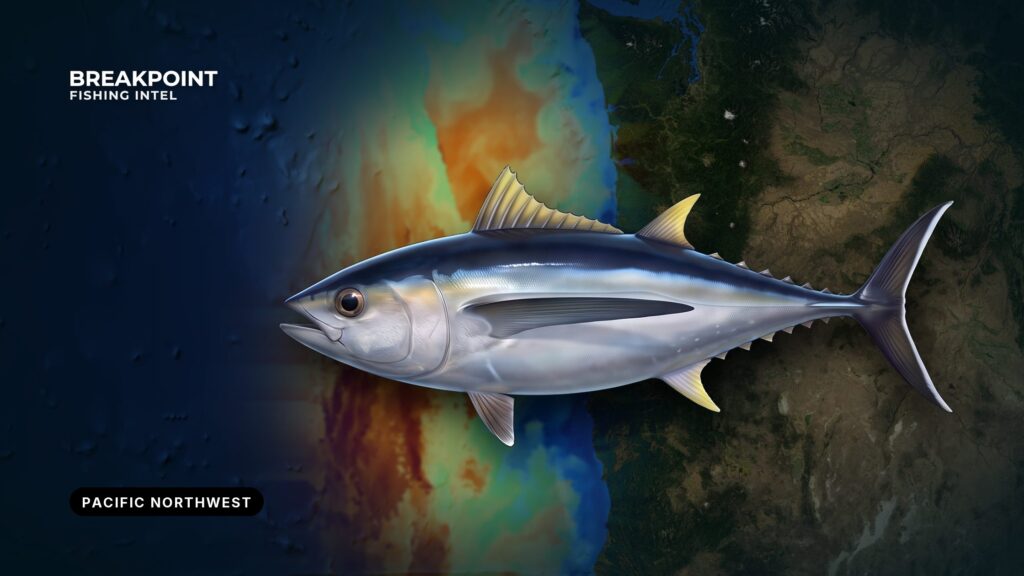
Albacore fishing off Washington and Oregon comes down to finding the edge where warm, clean water meets cooler, greener water. The fish follow that water, and so does the bait. According to NOAA Fisheries, most Pacific albacore landings come ashore in Washington and Oregon. This page covers where the fish sit and why, how to read the water on a map, how anglers fish them, and how federal and state rules divide. For the coast’s other offshore and bottom fisheries, see the Pacific Northwest fishing guide.
Albacore in Brief
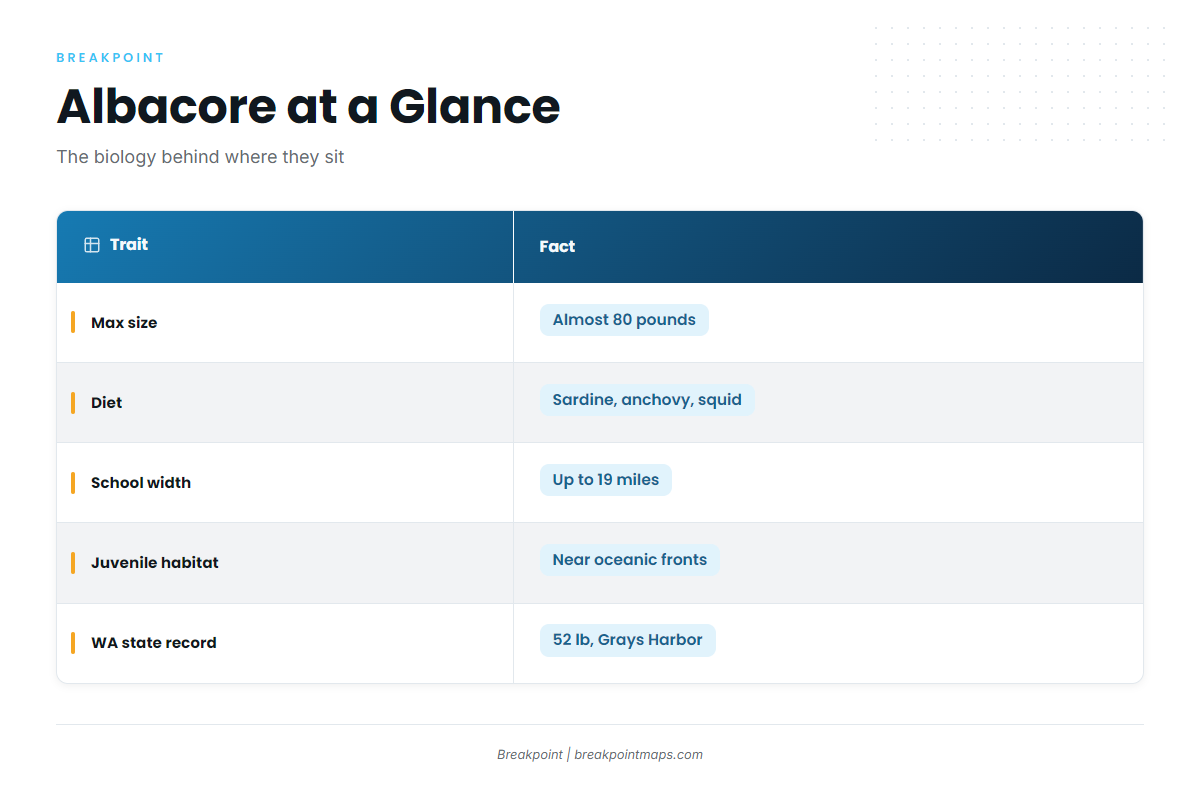
North Pacific albacore (Thunnus alalunga) are a highly migratory species (HMS). They cross whole ocean basins, so no single state manages them alone.
- Size: up to almost 80 pounds.
- Diet: sardine, anchovy and squid.
- Schooling: similarly sized fish school together, and schools can run up to 19 miles wide.
- Migration: juveniles of 2 to 4 years move inshore off the U.S. Pacific coast by late summer, then spend late fall and winter in the western Pacific.
Juveniles are often found near oceanic fronts, which is why the rest of this page is built around finding them. The NOAA Fisheries albacore profile covers size and migration in full. The Washington state record is 52 pounds, from Grays Harbor County.
For identification and general biology, see the full albacore guide.
When and Where Albacore Show Up
The fish arrive with the warm water, from summer into fall. NOAA puts juveniles inshore off the U.S. coast by late summer, though exact timing moves with the water.
Ports that serve the fishery:
- Washington: Westport, Ilwaco, Neah Bay
- Oregon: Astoria, Garibaldi, Depoe Bay, Newport, Charleston, Bandon, Port Orford, Brookings
The fishery varies a lot from year to year. Warm water sits farther offshore in some years and closer in others, so the run from port changes. Marine heatwaves, which are warm-water years, shift where the fish sit. Plan from the water rather than the calendar.
Charters that fish for HMS in the EEZ must hold a federal Pacific HMS permit and keep logbooks. The EEZ is federal water, 3 to 200 nautical miles offshore. See Regulations below for details.
The Water and Structure That Hold Albacore
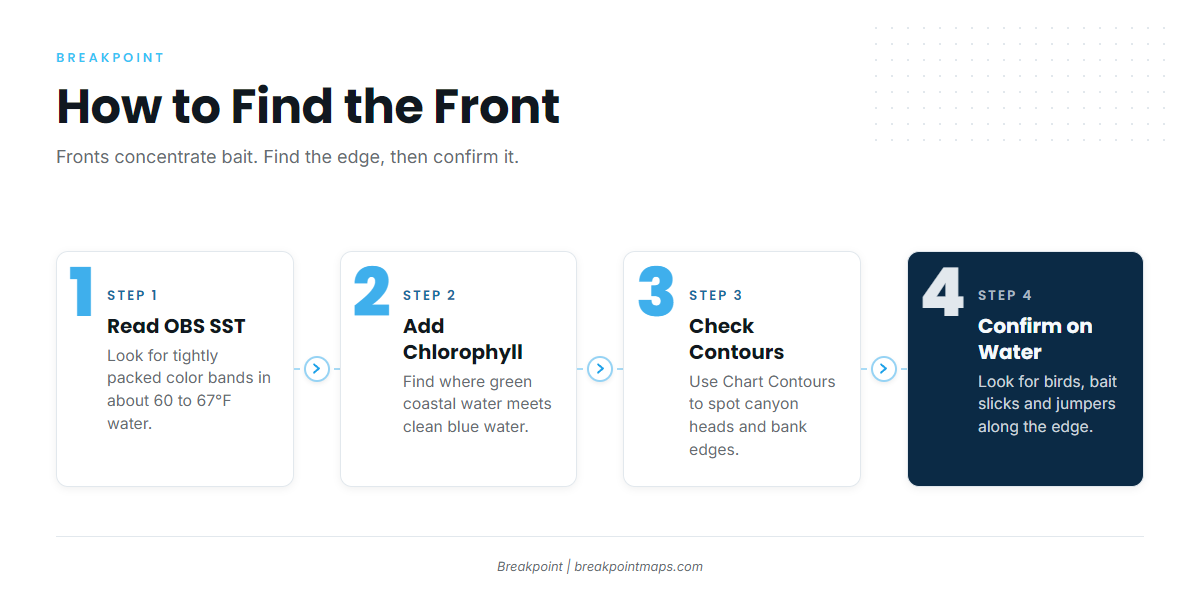
The method has three steps. Fronts concentrate bait. You find the front on SST and Chlorophyll. Then you confirm it on the water.
Temperature: Where the Warm Water Sits
FishBase albacore temperature data lists albacore as abundant in surface water of about 60 to 67°F (15.6 to 19.4°C). Treat that as a search window, not a guarantee.
The useful feature is the break, where temperature changes fast over a short distance. On OBS SST, a break shows as tightly packed color bands. A sharp gradient tells you more than a wide, even one.
Chlorophyll and Color Edges
A color edge is where green, plankton-rich coastal water meets clean blue water offshore. Bait gathers along it. Albacore usually work the clean, warm side, though they may slide into off-color water when the bait is there.
Lay SST against Chlorophyll. Where a temperature break and a color edge line up, the front is stronger and worth the fuel.
Fronts, Canyons and Banks
Fronts come first. NOAA finds juveniles near oceanic fronts, so the front is your primary target.
Structure comes second. Astoria, Grays and Quinault canyons and Heceta and Stonewall banks are places where the bottom rises or drops. Canyon heads and bank edges disturb the current, push nutrients up and hold bait. When warm water lies over them, they become search targets, though they guarantee nothing.
Use Chart Contours to see where the bottom rises. Some offshore soundings come from old surveys, so treat the contours as a guide to likely structure and not a precise survey.
Reading the Water: Signs That Confirm the Edge
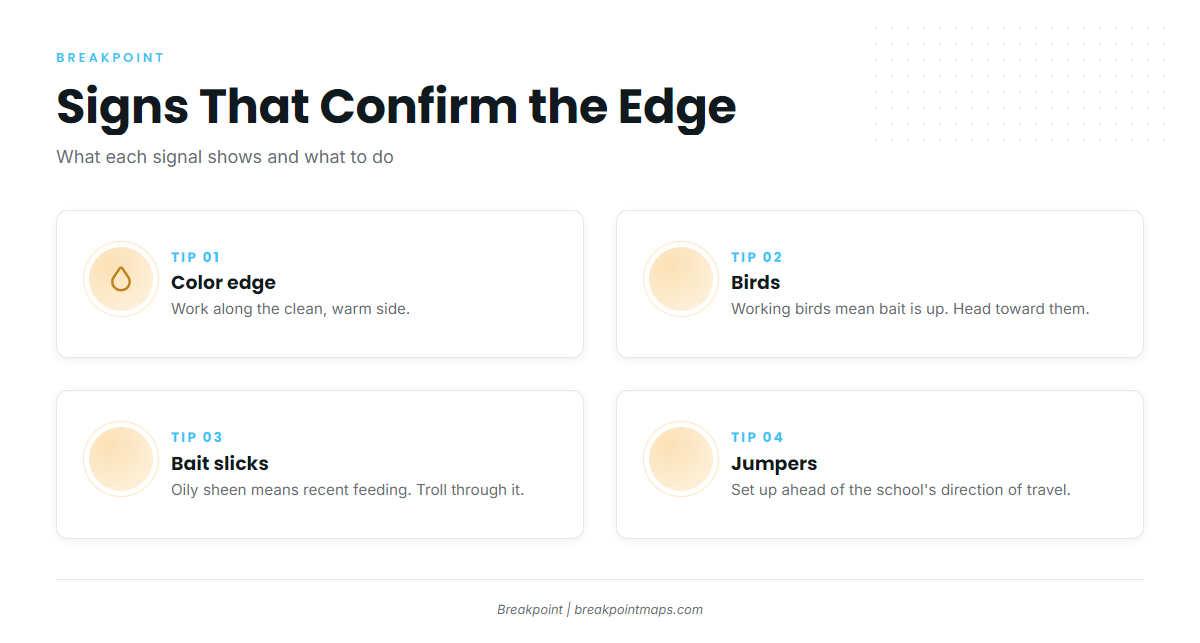
Once you reach the edge, the surface tells you whether fish are working it.
| Sign | What it shows | What to do |
|---|---|---|
| Clean side of the color edge | Warm, clear water against green | Work along it |
| Birds | Working or diving birds mean bait is pushed up | Head toward them |
| Bait slicks | An oily sheen or bait on the surface means feeding happened recently | Troll through and around it |
| Jumpers | Fish breaking the surface are a school on top | Set up ahead of their direction of travel |
In Breakpoint, OBS SST shows the temperature edge, Chlorophyll shows the color edge, and Chart Contours shows the canyons and bank edges underneath. Stack them to pick a search box. Cloud cover blocks satellite passes on some days, which leaves gaps. Chart layers are not for navigation.
How Anglers Fish Albacore
Most anglers troll to find fish, then stop to catch more of them.
Troll. Run cedar plugs, feathers and rubber squid in a spread behind the boat. Work along the edge you picked and toward signs on the water. NOAA names troll and pole-and-line as the main West Coast commercial methods, which mirrors the recreational approach.
Search. Cover water. Schools move, and an empty edge means moving on, since a spot that was good yesterday may hold nothing today.
Stop. When the troll hooks up, keep the boat moving briefly, then stop. Live anchovy holds the school at the boat.
Cast. Swimbaits and iron work when the school is up or holding near the boat.
Fish Care: Bleed Fast and Ice
Quality is set in the first minutes. Bleed the fish quickly, get it on ice fast and keep it cold until it is cut. Canning and smoking are common uses for the catch.
Running Offshore
On a long run, the forecast and the bar decide the day. The variables are wind, wave height and period. Read the National Weather Service marine forecast and the Coast Guard bar report before you go, and check the numbers against your boat and crew. Offshore conditions can change faster than the model.
Plan fuel with a reserve, since a front that moved overnight can add distance. Carry offshore safety gear and reliable communications.
Other Fish on the Albacore Grounds
WDFW lists Pacific bluefin, skipjack, mahi mahi and striped marlin as sporadic catches while targeting albacore. Yellowfin tuna turn up too. Limits for these species differ from albacore, so see Regulations below. For more on tuna in general, see the tuna fishing guides.
The night before, open the Breakpoint map, stack OBS SST and Chlorophyll, and pick tomorrow’s search box.
Guides to albacore tuna fishing from specific ports: Crescent City, Astoria-Warrenton, Ilwaco, Eureka, Bandon, La Push, Fort Bragg and Brookings.
Frequently Asked Questions
Do I need a license or endorsement to keep albacore in Oregon, and in Washington?
Oregon requires an ODFW Ocean Endorsement to retain tuna. For Washington, check WDFW for license requirements before fishing.
Do private boats need a federal HMS permit?
The federal permit rule names commercial and charter vessels, not private recreational boats. Charters need a Pacific HMS permit and logbooks.
How many albacore can I keep off Washington?
WDFW sets no daily or possession limit. Federal EEZ text sets 25 north of Point Conception. The stricter applicable rule governs, so check NOAA and WDFW before keeping more than 25.
What water temperature holds albacore?
FishBase gives about 60 to 67°F (15.6 to 19.4°C) as the surface range where they are abundant. Breaks and color edges matter more than a single number.
When do albacore show up off Washington and Oregon?
They arrive summer into fall, inshore by late summer per NOAA. Where they sit varies year to year with the warm water.
What else might I hook?
Bluefin, yellowfin, skipjack, mahi mahi and striped marlin turn up occasionally. Each has its own state limits.
How big are Northwest albacore?
Albacore reach up to almost 80 pounds, according to NOAA. The Washington state record is 52 pounds, from Grays Harbor County.