




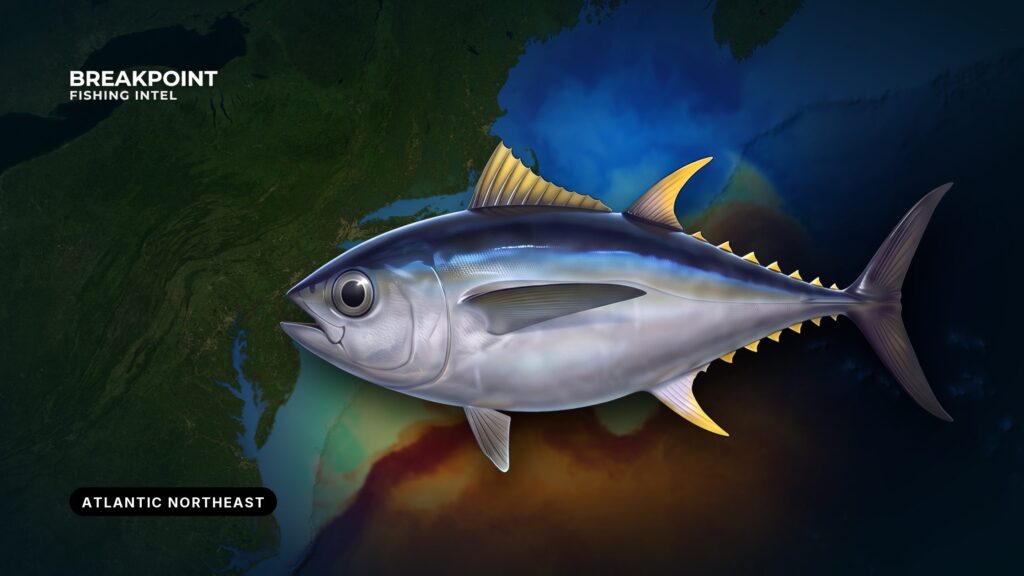
Bigeye are the most structure-bound tuna on the canyon edge, and they feed only where blue water sits over that structure. Bigeye tuna fishing in the Atlantic Northeast comes down to two things lining up: a steep canyon wall and warm blue water on top of it. This page covers how to pick water over bottom, fish the low-light windows and land fish legally. We can’t promise fish, but we can help you decide where to look.
Know the Fish
The NOAA Fisheries bigeye species page lists a western Atlantic range from southern Nova Scotia to Brazil. Bigeye reach about 5.5 feet, live at or near the surface, and dive to about 800 feet during the day. The FishBase profile for Thunnus obesus confirms a diet of fish, squid and crustaceans, taken both day and night. Yellowfin tuna are often confused with them, and the species guide covers the differences.
The deep daytime dive shapes every tactic below, because the fish has to come up before you can reach it. Full ID and biology are in our bigeye tuna guide.
Where Bigeye Tuna Fishing in the Atlantic Northeast Happens: The Shelf-Edge Canyons
The fish hold on the shelf break, where the continental shelf drops into the canyons. The chart feature to know is the 100-fathom curve, which sits at 600 feet. The canyons that matter are Hydrographer, Veatch, Atlantis, Block and Hudson. Boats work them from ports such as Montauk and Point Judith. The Atlantic Northeast fishing guide covers the region and its ports.
What to look for on the edge:
- The 100-fathom curve where the shelf breaks into a canyon
- Tight contour lines that mark steep walls
- Corners and notches where a wall meets the shelf
- Blue water lying across any of the above
Why steep walls hold bigeye
Three things happen in order:
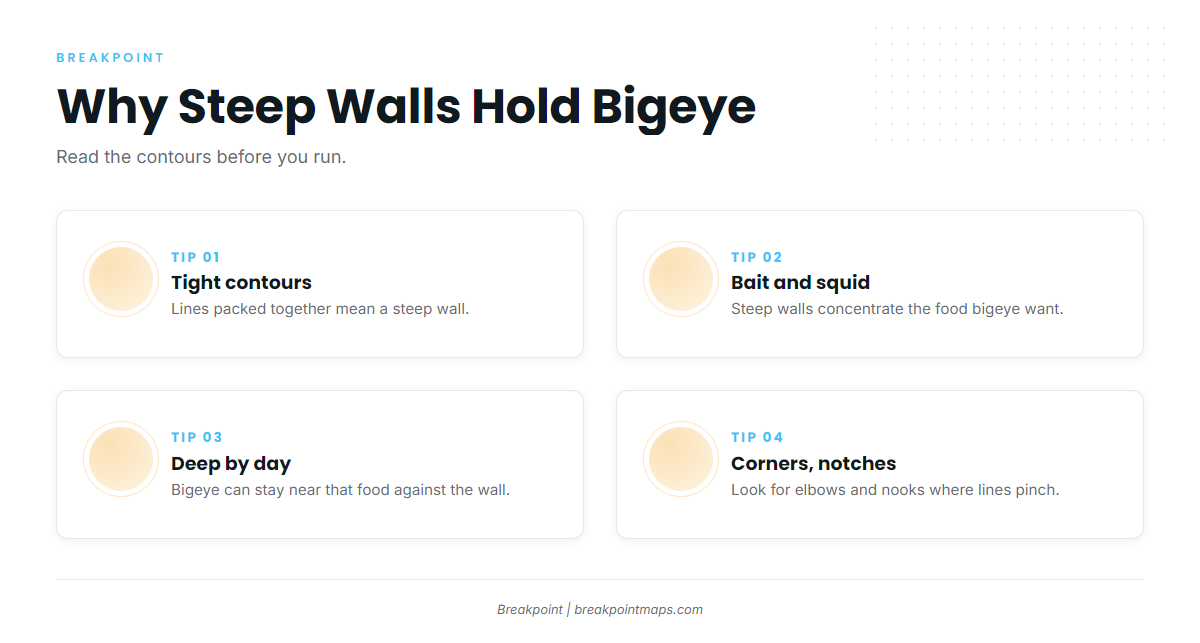
- Tight contours on the chart mean a steep wall.
- Steep walls concentrate bait and squid.
- Bigeye that spend daylight deep can stay near that food against the wall.
Corners and notches
Canyon corners and notches, where the walls meet the shelf, show up on a contour chart as elbows and nooks where the lines pinch together. Current and bait stack up at those pinch points.
Bigeye versus yellowfin on the wall
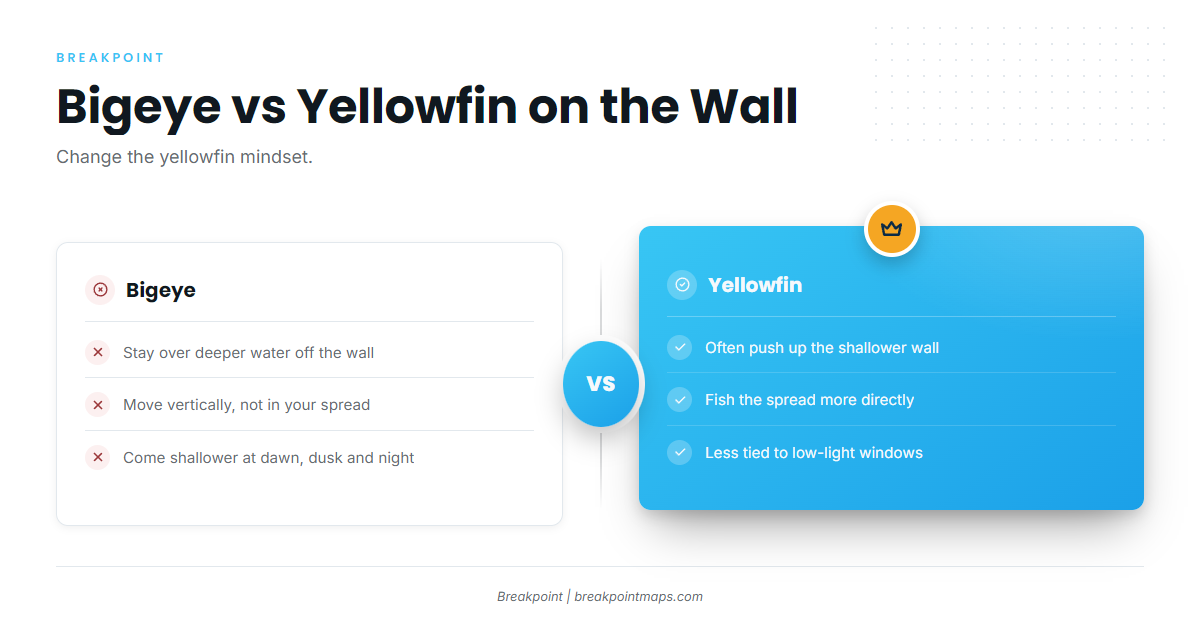
Yellowfin often push up the wall into shallower water. Bigeye are rarely on the shallower part of the wall and stay over deeper water off the edge. They also move vertically rather than living in your spread, which changes how you fish them.
When the Fish Show
The bite runs from summer into fall. Warm, blue Gulf Stream water over the edge drives it, not the date. Some summers the blue water never sits over the canyons, and the fishing suffers for it. When you pick trip days, watch the water picture; a fixed month tells you less than where the blue water is lying.
- Check where warm blue water sits relative to the canyon walls
- Look for a clean edge crossing structure
- Watch how the edge moves from day to day
The range runs south to Brazil, so the fishery continues down the coast. See bigeye tuna fishing in the Atlantic Southeast.
Reading the Water
Structure holds the bait, and water decides whether bigeye feed on it. This section covers how to read the water over the structure.
Warm-core eddies
Warm-core eddies peel off the Gulf Stream and push blue water onto the shelf edge. Their western edge is a known feeding zone, where blue water meets green. The best case is an eddy edge lying across a canyon wall.
Temperature and color breaks
A temperature break and a color break often mark the same boundary. A chlorophyll edge shows where productive green water meets clear blue water. When the two line up with a canyon wall, you have a place worth fishing.
Squid and pilot whales
Pilot whales and bigeye both feed heavily on squid. Whales working a canyon edge are a signal to slow down and look, though not a guarantee of fish.
Seeing it on the layers
A workable routine the night before:
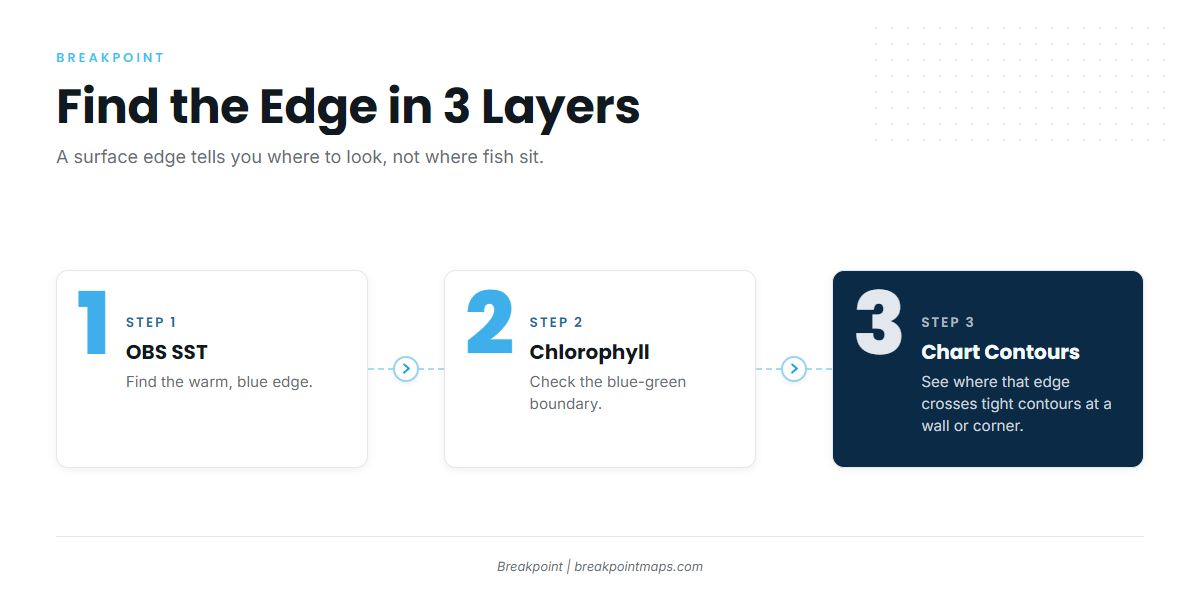
- Open OBS SST to find the warm, blue edge.
- Check Chlorophyll for the blue-green boundary.
- Overlay Chart Contours to see where that edge crosses tight contours at a canyon wall or corner.
Chart layers are not for navigation. Cloud blocks satellite SST passes, so a clear edge on one day may be a gap the next. SST also shows only the surface. Bigeye spend daylight deep, so a surface edge tells you where to look, not where the fish sit.
How Anglers Fish Them
Fish the windows when bigeye come up: dawn, dusk and night. They sit deep by day and move shallower at low light as bait rises, so match your effort to those windows.
Dawn and dusk trolling
Run a mixed spread of spreader bars and rigged ballyhoo under heavy skirts. Add patterns that imitate squid, since squid is what bigeye eat.
Deep-diving plugs
Deep-diving plugs reach fish below the surface spread. Run them where the water over the wall is blue.
Night drifting and chunking
At night, drift squid at staggered depths on lighted rigs. Chunking with butterfish is the other night option. Stay on the canyon edge, over deeper water.
Adjusting from yellowfin tactics
Three adjustments:
- Stay over deeper water off the wall.
- Expect vertical movement, not a fish that lives in your spread.
- Time your effort to the low-light windows rather than grinding through midday.
Bigeye share the canyon edge with yellowfin and bluefin. For the other canyon tunas, see our tuna guides. A bluefin hookup falls under separate rules, covered under Regulations.
Gaff only at boatside on a fish already hooked. Release fish you are not keeping without taking them out of the water.
Planning the Run
Check wind, wave height and wave period on the NWS offshore forecast for the zones you will cross and fish, and recheck it before you leave the dock.
Fuel decisions follow the water:
- A long run makes sense when blue water sits over the structure you are running to.
- Without that, the run is a gamble on bottom alone.
- Check the edge again the morning you go.
Before you commit fuel to a run, check the edge on OBS SST, Chlorophyll and Chart Contours.
Guides to bigeye tuna fishing from specific ports: New London / Waterford, Indian River Inlet, Ocean City, Chatham, Atlantic City, Freeport, Point Judith and Chincoteague.
Frequently Asked Questions
Do I need a permit to fish for bigeye tuna?
Yes. Private boats need an HMS Angling permit. For-hire boats need an HMS Charter/Headboat permit. Both come from NOAA’s HMS permit site. Connecticut is the exception to the federal tuna permit requirement in coastal state waters, so check CT DEEP if you fish there.
What is the size limit, and how is CFL measured?
The minimum is 27 inches curved fork length. CFL is measured along the curve of the body to the fork of the tail. On a headless fish, measure from the forward edge of the cut to the fork of the tail. That distance must still be at least 27 inches.
Is there a bag limit on bigeye?
There is no federal bag limit on bigeye. A stricter state rule applies in that state’s waters if one exists. Federal and state limits do not stack, so check the agency for the state where you land the fish.
Can I keep a shark-bitten bigeye?
Only if the remaining fish is still at least 27 inches. The damaged area may not be trimmed or altered. If trimming would be needed to reach the minimum, the fish does not qualify.
How is a bigeye different from a yellowfin?
Behavior is the first difference. Bigeye stay deeper off the wall and move vertically, while yellowfin push up the shallower wall. For ID, look at body shape and fin length. Our bigeye tuna guide covers the details.
When do bigeye show up in the Northeast canyons?
Summer into fall, when warm blue water sits over the edge. Some summers it never does. Watch the water picture rather than a calendar date.
Why do bigeye bite at dawn, dusk and night?
They dive to about 800 feet by day, according to NOAA. At low light they come shallower as squid and bait rise, and that is when your spread or drifted bait can reach them.
How are bigeye rules different from bluefin rules?
Bigeye have a 27-inch CFL minimum and no bag limit. Bluefin have quota-set limits that change, so check hmspermits.noaa.gov before fishing. Every retained bluefin must be reported within 24 hours.