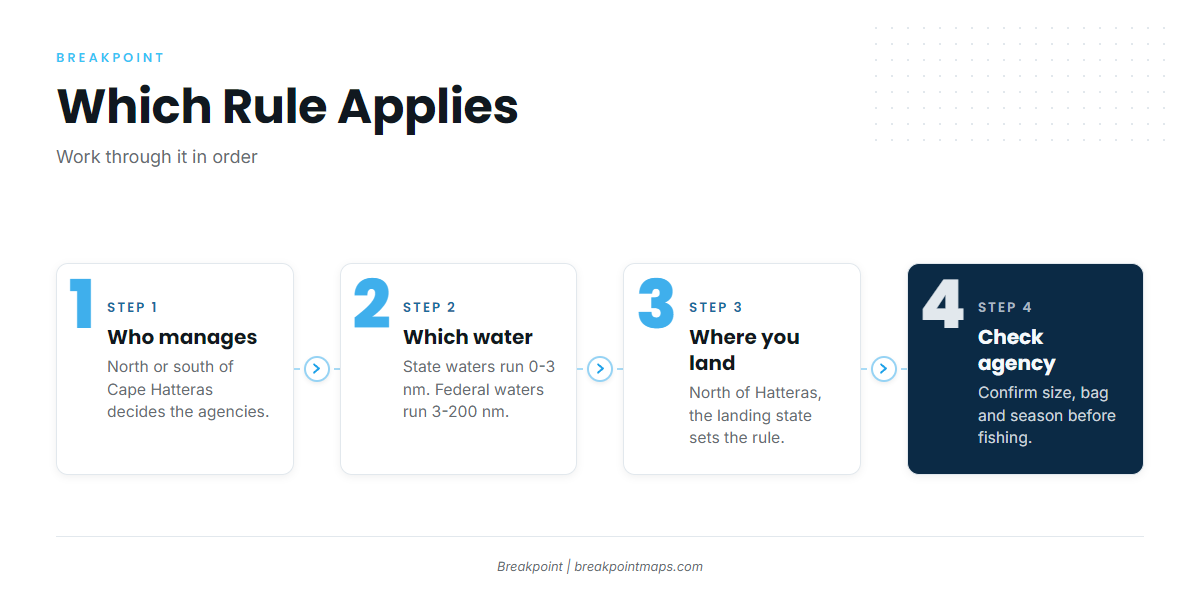




The same black sea bass carries different rules depending on which side of Cape Hatteras it lives, which water it came from and which dock it lands at. This guide covers what the fish is, where it sits by region and month, how to catch it, and which agency’s rule applies to US anglers fishing for black sea bass (Centropristis striata). If you only need the rule, skip to the Regulations table near the end.
How to Identify Black Sea Bass
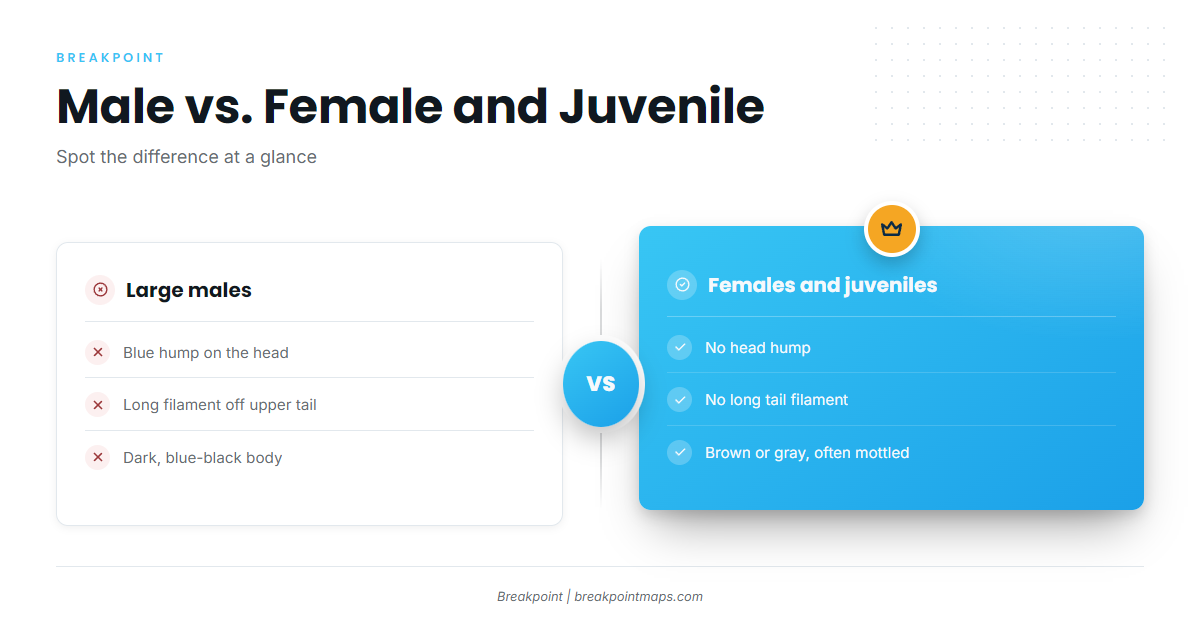
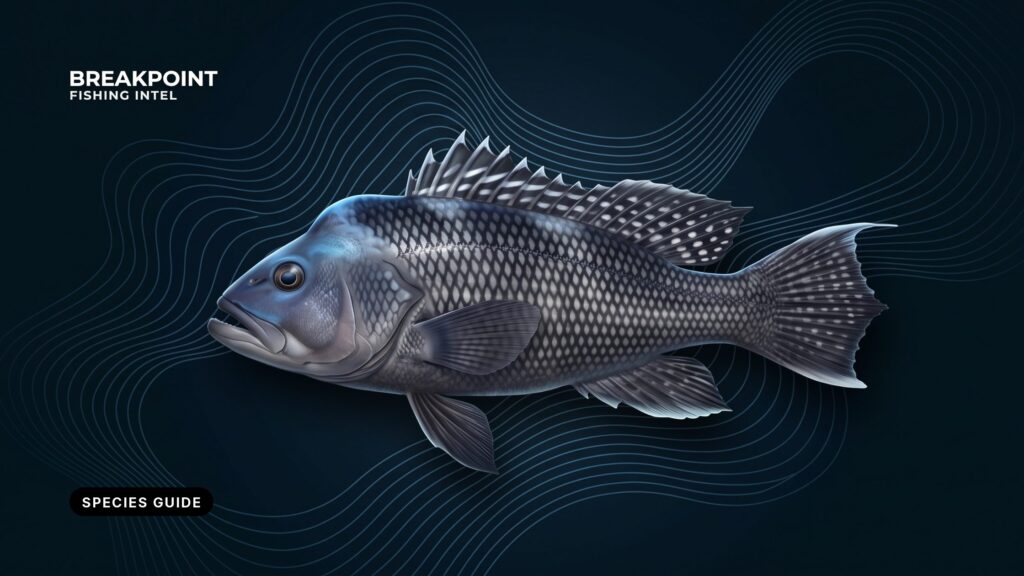
A black sea bass is a stout, dark-bodied bottom fish with a large mouth and a spiny dorsal fin. Large males show a blue hump on the head and a long filament trailing off the top of the tail fin. Females and juveniles are brown or gray.
Male vs. female and juvenile
| Feature | Large male | Female and juvenile |
|---|---|---|
| Head | Blue hump | No hump |
| Tail | Long upper filament | No long filament |
| Color | Dark, blue-black | Brown or gray, often mottled or striped |
Why the big ones are males
Black sea bass are protogynous hermaphrodites: they mature as females and many later change to males. The biggest fish are mostly blue-humped males, so heavy harvest of large fish cuts into spawning. That is part of the reason minimum sizes exist.
Lookalikes
Check the fish against these before you keep it:
- Bank sea bass and rock sea bass: related US Atlantic sea bass that turn up on the same southern bottom. Confirm identification against the state agency guide before keeping a fish.
- European sea bass: a different fish from European waters. It is not caught in US waters, though the name appears on menus and in recipes.
- Shared structure: scup, tautog and summer flounder live on the same bottom and have their own rules.
Where and When: Range and Seasons by Region
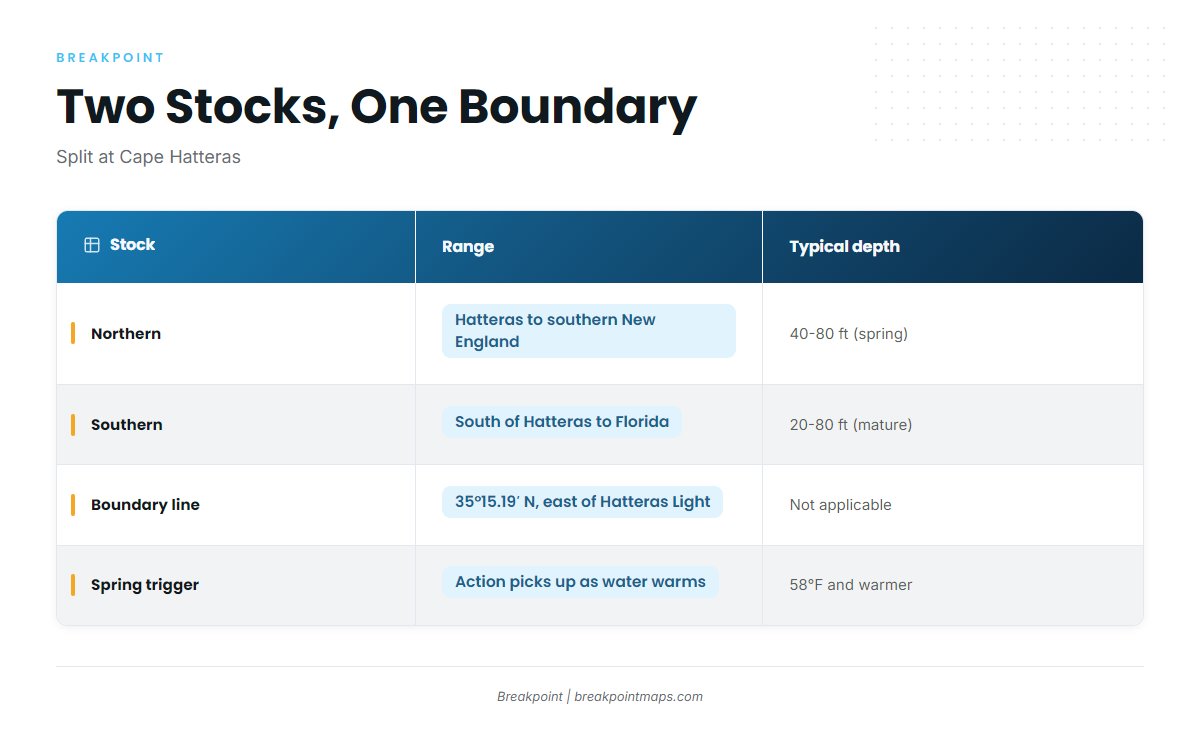
Two stocks are split at Cape Hatteras. The northern stock runs from Hatteras north into southern New England, and the southern stock runs from Hatteras south to Florida. The South Atlantic snapper-grouper fishery includes black sea bass south of 35°15.19′ N, due east of Cape Hatteras Light, per the NOAA Fisheries black sea bass page.
North of Hatteras, fish move inshore in spring as the water warms and offshore to deeper shelf water as it cools. The year runs roughly like this:
- Spring: target nearshore wrecks and reefs in 40 to 80 feet. Action picks up as the water reaches 58°F and warmer.
- Mid-May: fish show around Cape Cod in Buzzards Bay, Vineyard Sound and Nantucket Sound.
- Fall: bigger fish stack on structure before they move offshore.
- Winter: party boats target jumbo fish in November, December and January.
South of Hatteras, mature fish generally sit in 20 to 80 feet, with juveniles shallower over grass and near jetties and reefs, according to the FWC black sea bass profile.
| Stock | Range | Spring | Summer | Fall and winter | Typical depth |
|---|---|---|---|---|---|
| Northern | Southern New England to Cape Hatteras | Move inshore, wrecks and reefs, action at 58°F and warmer | Varies, see regional guides | Stack on structure, then move offshore | 40 to 80 feet in spring |
| Southern | Cape Hatteras to Florida | Varies, see regional guides | Varies, see regional guides | Varies, see regional guides | 20 to 80 feet for mature fish |
Swipe the table sideways to see every column.
Wrecks, reefs and timing in your own water are covered in the regional fishing guides. Temperature tells you when fish move, but it won’t tell you which wreck they are on that day.
How Black Sea Bass Feed and Use Structure
Black sea bass are opportunistic feeders that eat crustaceans, mollusks, small fish and squid, which is why the baits below work.
They live tight to hard bottom: wrecks, artificial reefs, rock piles, live bottom and jetties. You will rarely find them suspended in open water.
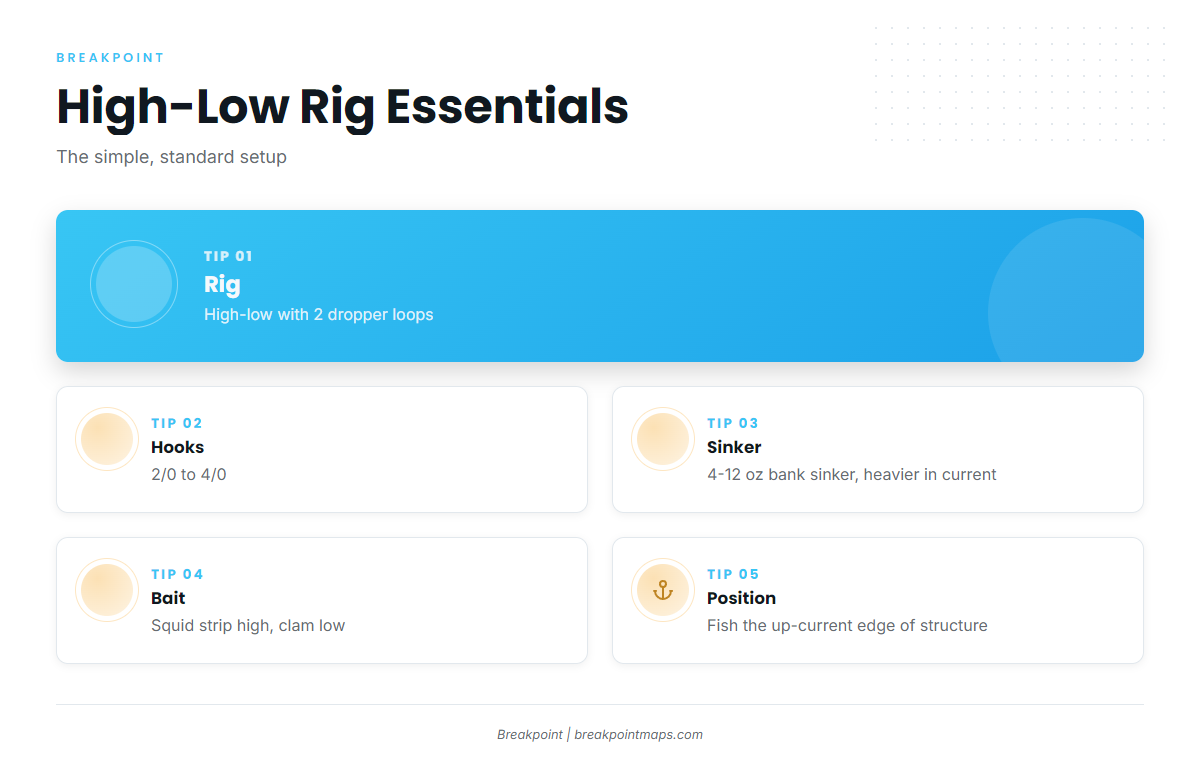
Fish the up-current side. Current carries bait to the structure, and the fish hold where the food arrives and use the structure as cover. Set your baits on the up-current edge rather than over the middle of the wreck.
The same structure holds other bottom fish. In northern waters that means scup, tautog and summer flounder. In southern waters it is the snapper-grouper complex, and black sea bass are commonly caught while bottom fishing for snapper and grouper there. Our reef fish guides cover those species.
How to Catch Black Sea Bass
The high-low rig
The high-low rig with 2 dropper loops is the standard rig and the simplest for beginners. Tie it top to bottom:
Main line to a swivel
2 to 3 ft of 50 lb leader
Upper dropper loop with hook
Lower dropper loop with hook
Bank sinker at the bottom
- Hooks: 2/0 to 4/0.
- Sinkers: 4 to 12 oz bank sinkers. Go heavier as current and depth increase.
- Line: 20 lb mono is a common choice for northern wrecks. In Florida waters, light to medium tackle with 10 to 20 lb line is sufficient.
Terminal tackle rules apply in South Atlantic federal waters. See the SAFMC regulations in the Regulations section below.
Bait
Squid strips, clams and crab all work, and clam is a strong choice on northern wrecks. For a simple beginner setup, put a squid strip on the high hook and clam on the low hook.
Jigs and bucktails
Fish a 1 to 3 oz white or chartreuse bucktail with a soft plastic trailer, run on a 3-way swivel above a heavy sinker. When the jig touches bottom, give the reel one half-turn to hold it 12 to 18 inches off bottom. Deeper water and faster current call for heavier jigs. Slow-pitch jigs are another option.
Jigs also help you avoid shorts. A bigger profile worked vertically draws larger fish and fewer undersized ones than a soft bait sitting on bottom.
Anchor or drift
Drifting covers the wreck from different angles, while anchoring fishes the same spot repeatedly. On a fast drift, each pass over the structure is very short, so anchoring up-current of the wreck is more effective.
Shore, pier and party boat options
- Shore: fish move onto inlet rock jetties, piers and bridges in spring and fall when they are shallow. Inlet jetties are the best shore bet.
- Party boat: bring a 7 ft medium rod, 20 to 30 lb line and high-low rigs with 4 to 8 oz sinkers. Many boats supply gear.
Finding structure before the run
Charts and plotter software help you find marked reefs and wrecks, and the sounder confirms what is there. Breakpoint’s Chart Contours and bottom layers help you shortlist ledges, wrecks and reefs before you leave the dock. Chart layers are not for navigation, and a chart contour is not a survey of every rock pile, so the sounder has the final word.
Handling and Release
Use sharp hooks, remove them quickly, wet your hands before touching the fish and measure fast. Measure total length, from the tip of the snout to the tip of the tail, unless the agency specifies otherwise. Confirm the method on the agency page.
Barotrauma is expanded gas from a fast ascent from depth that can keep a fish from swimming back down. A descending device returns the fish to depth, so use it promptly on any fish showing barotrauma. In South Atlantic federal waters one is required on board. Gear specs are in the Regulations section.
To decide where to look, start with the regional fishing guides above, then open the Breakpoint map and check the structure and water near your port.
Region guides for black sea bass: black sea bass fishing in the Atlantic Northeast and black sea bass fishing in the Atlantic Southeast.
Frequently Asked Questions
What does a black sea bass look like?
A black sea bass is a dark, stout bottom fish with a spiny dorsal fin. Large males carry a blue hump on the head and a long filament off the top of the tail. Females and juveniles are brown or gray, often mottled.
Is black sea bass in season where I’m fishing?
North of Hatteras, it depends on the state where you land, so check that state’s agency before the trip. South of Hatteras, the federal season is set from the quota, so check NOAA Fisheries and SAFMC. Season status can change, so confirm it before you leave.
Do I need a license to fish for black sea bass?
Most coastal states require a saltwater license or saltwater registry enrollment for boat and shore anglers, including visitors. Check the state where you fish and land. Requirements and exemptions differ by state, so confirm with the agency.
How do I measure a black sea bass?
Lay the fish on a flat board with its mouth closed. Measure total length, from the tip of the snout to the tip of the tail. Confirm the measuring method on the agency page for the state where you land.
What is the best rig and bait for beginners?
Start with a high-low rig, 2/0 to 4/0 hooks and a 4 to 12 oz bank sinker. Squid strips or clam are the easiest baits. Put squid on the high hook and clam on the low hook.
Where can I find black sea bass near me?
Look for wrecks, reefs, rock piles and inlet jetties. Timing and structure vary by region, and the regional fishing guides cover the places in your water.
Are black sea bass good to eat?
Yes. The meat is firm, mild and white. Fillet with a sharp knife. Baking with olive oil, lemon and garlic is a simple preparation.