




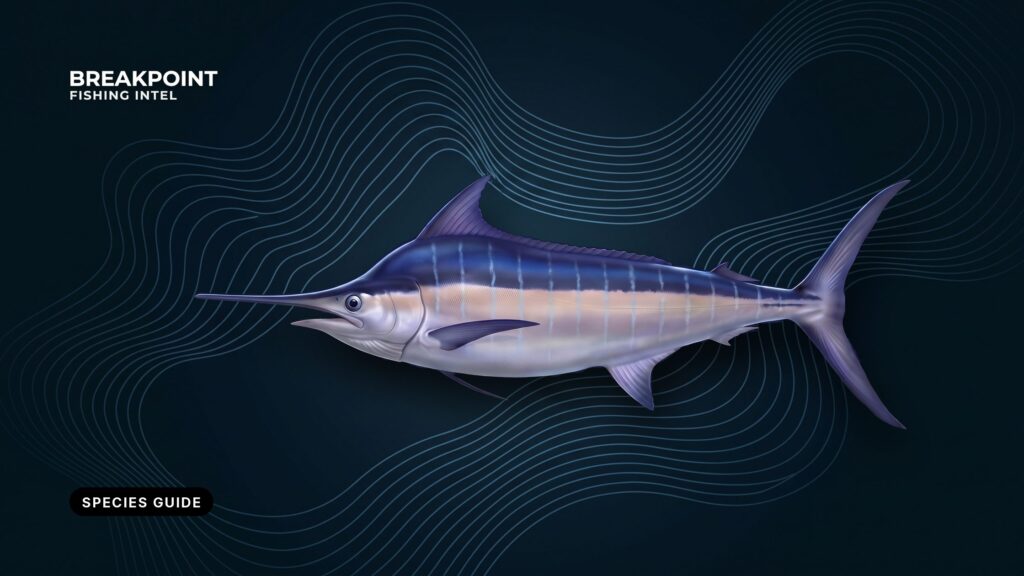
Blue marlin (Makaira nigricans) is the big bluewater billfish of US offshore fishing. US anglers meet it in the Mid-Atlantic canyons, off the Outer Banks and Florida, in the Gulf, around Puerto Rico and the USVI, and off Kona. Most blue marlin are released, and the rules decide what can be kept.
This guide covers how to identify a blue marlin in the water, how to choose a region, how to set a spread, and which rule set governs which water.
Identification
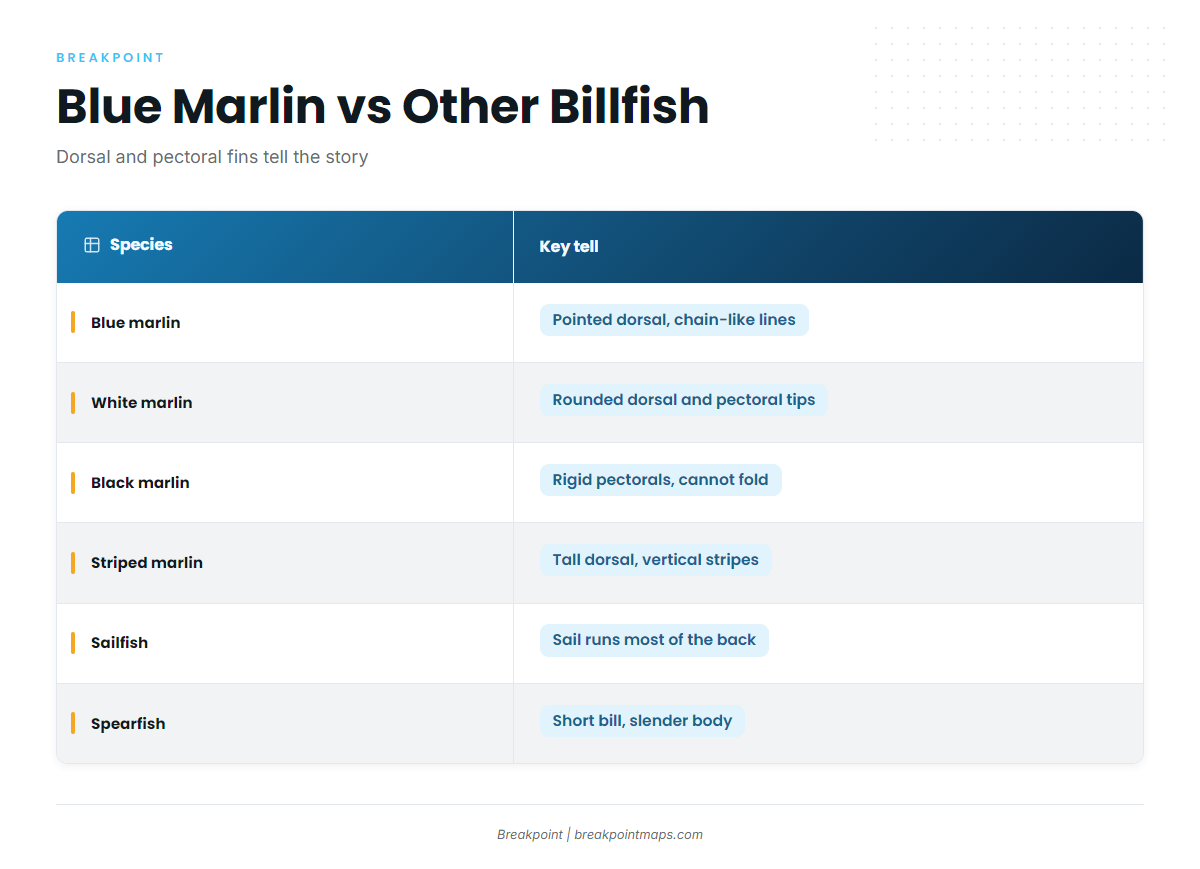
A blue marlin has a pointed front dorsal fin that is lower than its body depth, and a chain-like lateral line pattern. A white marlin has rounded dorsal and pectoral fin tips. The blue is the larger, heavier-shouldered fish, and its pectoral fins fold flat against the body.
Black marlin look similar at a glance, and color does not separate them. Pectoral fins do: an adult black marlin’s pectorals are rigid and cannot fold back. That check matters most in the Pacific and off Kona.
The other billfish are easier to rule out:
- Striped marlin: the front dorsal is tall, often taller than the body depth, and the body carries vertical stripes. It is a Pacific fish.
- Sailfish: the sail-like dorsal runs most of the length of the back.
- Spearfish: a short bill, a slender body and a vent set well forward of the anal fin. Roundscale spearfish are the Atlantic species. Shortbill spearfish are the Pacific species.
Females grow far larger than males. Some biologists treat the Atlantic and Indo-Pacific blue marlin as separate species. US management handles them under separate Atlantic and Pacific frameworks.
Billfish comparison table
| Species | Dorsal shape | Pectoral behavior | Lateral line | Ocean |
|---|---|---|---|---|
| Blue marlin | Pointed, lower than body depth | Folds flat against the body | Chain-like loops | Atlantic, Gulf, Caribbean and Pacific |
| White marlin | Rounded tip | Rounded tip | Faint, straight | Atlantic, Gulf, Caribbean |
| Black marlin | Pointed, low | Rigid, does not fold (adults) | Not prominent | Pacific |
| Striped marlin | Tall, often above body depth | Folds | Not prominent | Pacific |
| Sailfish | Sail running most of the back | Folds | Not prominent | Atlantic, Gulf, Caribbean and Pacific |
| Spearfish (roundscale or shortbill) | Tall, rounded | Folds | Not prominent | Roundscale in the Atlantic, shortbill in the Pacific |
Swipe the table sideways to see every column.
For white marlin, sailfish and spearfish, see our other billfish guides.
Where and When
Blue marlin follow warm, bait-rich bluewater. On the East Coast that means the Gulf Stream and its eddies. In the Gulf it means the Loop Current and its rings. Around Hawaii and the Caribbean, deep water lies close to land. The seasons below are broad patterns, and each regional guide carries the detail.
Region table
| Region | Key water features | Broad season | Go deeper |
|---|---|---|---|
| Mid-Atlantic canyons | Baltimore, Washington and Norfolk canyons; warm-core eddies | Summer into fall | Northeast and Mid-Atlantic canyon guide |
| Outer Banks and Southeast | The Point off Hatteras; Gulf Stream wall | Spring through fall, peaking in summer | Southeast Atlantic blue marlin guide |
| Florida and the Keys | Gulf Stream close to shore | Warm months, with fish around much of the year | Southeast Atlantic blue marlin guide |
| The Gulf | Loop Current, eddies, deep water off the northern Gulf | Warm months | Gulf blue marlin guide |
| Puerto Rico and USVI | North Drop off St. Thomas | Warm months, with a strong late-summer pattern | Fishing guides by region |
| Hawaii (Kona) | Kona ledges, deep water near shore | Year-round, peaking in the warm months | Fishing guides by region |
Mid-Atlantic canyons
Warm-core eddies peel off the Gulf Stream and push bluewater over the shelf edge into the canyons. Bait stacks up where that water meets the canyon walls. Baltimore, Washington and Norfolk canyons are the main names, and the White Marlin Open draws boats to this water. Our Northeast and Mid-Atlantic canyon guide covers the local detail.
Outer Banks, Southeast and Florida
The Gulf Stream runs closest to land at the Point off Hatteras, which puts the wall within reach of day boats. Off Florida and the Keys, the Stream also runs close to shore. The Big Rock tournament is the best-known event on this stretch. Our Southeast Atlantic blue marlin guide goes deeper.
The Gulf
The Loop Current pushes warm Caribbean water north. Eddies that break off it carry bluewater and bait over the deep water off the northern Gulf, and boats work the edges of those eddies. Our Gulf blue marlin guide has the place-level detail.
Puerto Rico, USVI and Hawaii
The North Drop off St. Thomas is a steep drop where deep water and bait meet close to port. Off Kona, the ledges fall into deep water within a short run, so fish are reachable year-round, with a peak in the warm months. Local detail for these waters is in our fishing guides by region.
How Blue Marlin Feed and Move
Blue marlin feed by day on fish and squid. Prey includes:
- small tunas such as skipjack and blackfin
- dolphin
- flying fish
- mackerel
- squid and octopus
Lures and rigged baits imitate these profiles. Showers of flying fish and balls of bait are the signs that fish are working an area.
Why edges hold fish
Current edges and eddy boundaries concentrate bait. Warm, clear bluewater meets greener, nutrient-rich water, bait gathers on the color and temperature break, and predators work it. Satellite tagging studies show blue marlin travel long distances and spend time deep as well as near the surface, so a fish you see on top is only part of the picture.
Reading SST and Chlorophyll
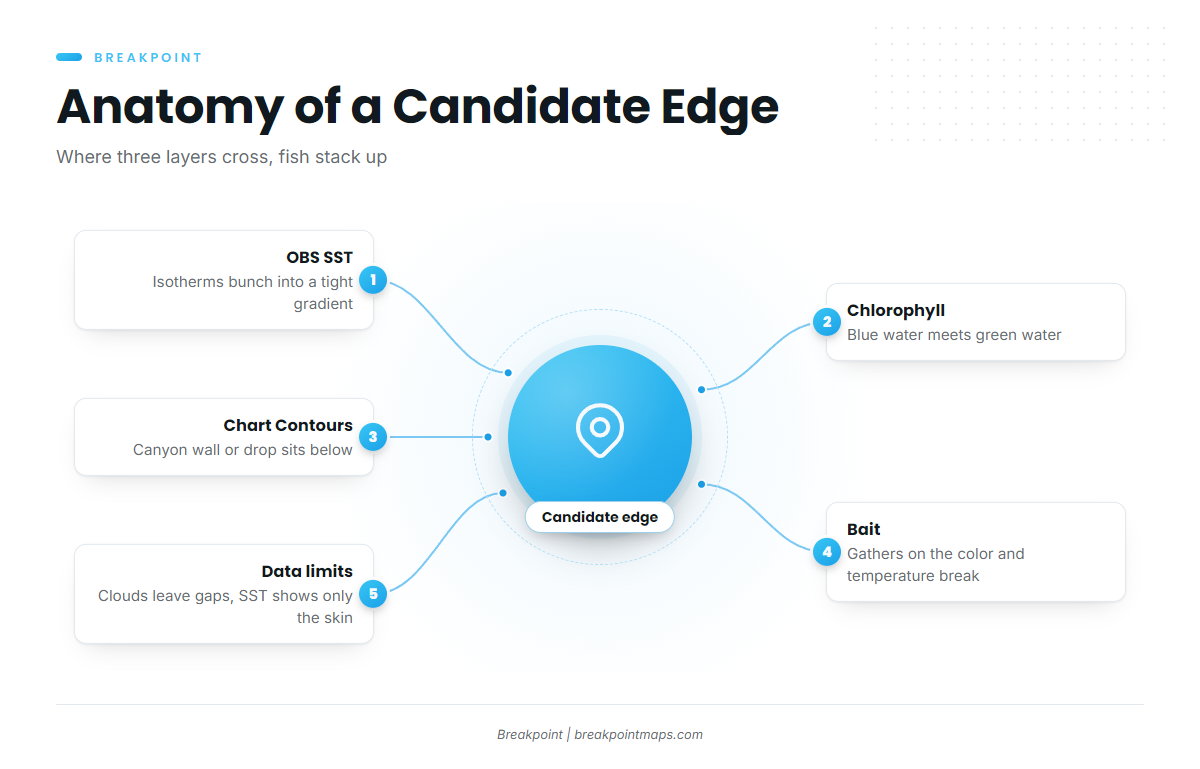
Look for a tight temperature gradient on OBS SST, where the isotherms bunch up, often along an eddy edge or the Stream wall. Then check Chlorophyll for the line between blue, low-chlorophyll water and green water. Where the temperature break and the color break line up, and Chart Contours show a canyon wall or a drop under them, you have a candidate edge.
In Breakpoint you can overlay OBS SST, Chlorophyll and Chart Contours on one map to see where those edges cross structure.
The data has limits. Cloud blocks satellite passes, so a clouded area shows a gap or older data. SST shows the skin of the ocean, not the thermocline. Chart layers are not for navigation.
How Blue Marlin Are Caught
Trolling is the main method. Most of what follows is common practice, and where practice varies, the range is real.
The trolling spread
Most boats troll four to six lures. Two run from the outriggers and two from the flat-line positions off the transom. Larger, more active lures run closer to the boat, and straighter-running lures run farther back, as in a basic four-lure trolling spread. Trolling speed varies by boat and lure, and captains disagree on the right number of lures. Lures are large skirted heads or rigged natural baits.
Teasers and dredges
A teaser is a hookless lure or bait that raises fish to the spread. A dredge is a subsurface array of baits or strips that pulls fish up from deeper water. Sea witches work as hookless teasers. The goal is to bring the fish up behind the boat where the crew can see it.
Switch-baiting and pitch baits
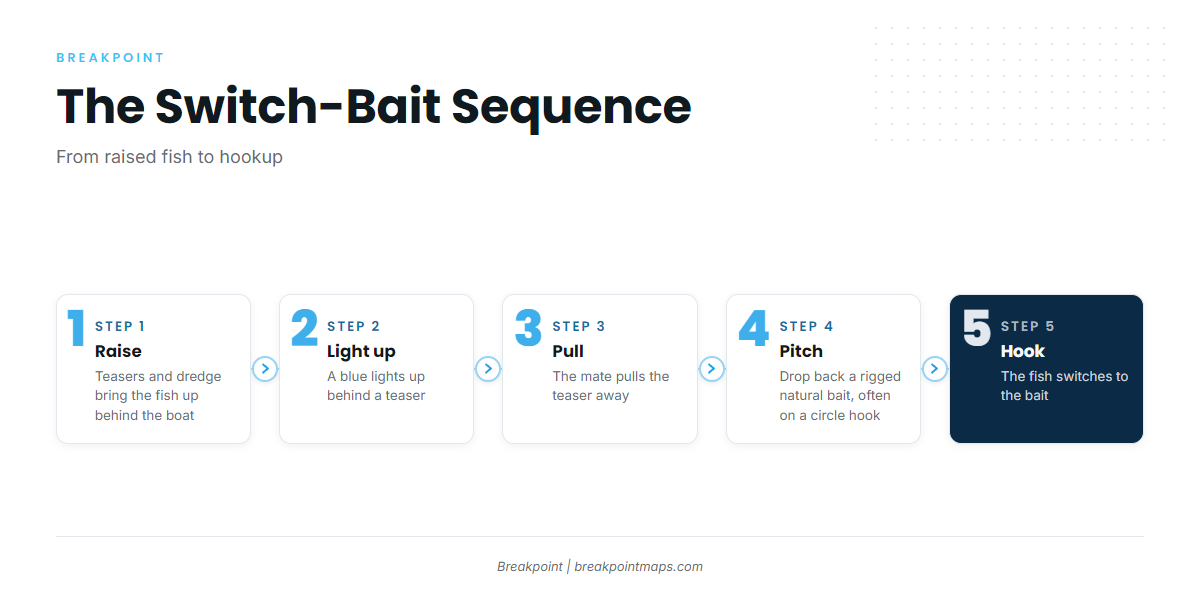
When a blue lights up behind a teaser, the mate pulls the teaser away. The angler drops back a rigged natural bait, the pitch bait, often on a circle hook, and the fish switches to it. The method suits fish that follow but will not commit.
Live and natural bait
Common baits are ballyhoo, mullet, mackerel, bonito, skipjack and blackfin tuna, rigged to swim naturally. Live bait is often slow-trolled on a circle hook.
Tackle
Heavy lever-drag reels are standard. Tackle class is matched to the size of fish in the region, and heavier tackle is common where big fish run, such as Kona. Anglers fight from a stand-up belt and harness, and larger boats add a fighting chair for bigger fish.
The fight and the release
Clear the spread. Back down or chase the fish so the line stays tight, and keep the angler in position.
Circle hooks tend to catch in the corner of the jaw, which supports release. Federal hook rules apply in some situations, covered under Regulations below.
Release practice comes down to a short list:
- Keep the fish in the water.
- Cut the leader close, or remove the hook when practical.
- Keep the boat moving slowly so water passes over the gills before letting go.
- Limit handling time.
Tournaments often require release documentation, so check each tournament’s rules.
Before you set the spread, check where the edges sit in Breakpoint so the first hour is spent on water worth trolling.
FAQ
Can I keep a blue marlin I catch?
Only with an HMS permit, a fish that meets the federal minimum size, and a landing report. State rules add conditions: Maryland requires billfish to stay whole through offloading, and South Carolina bars sale. Most anglers release.
Do I need an HMS permit in state waters?
Federal permit holders follow federal rules in state waters unless the state rule is stricter. South Carolina requires the permit to possess billfish in its waters. Texas requires a fishing license and saltwater endorsement to land fish taken in federal waters.
How do I report a blue marlin landing?
Report within 24 hours of the trip ending. Use the HMS Catch Reporting app, the HMS Permit Shop website or the phone line in Regulations. Captains who file through SAFIS eTrips or Bluefin Data VESL skip the separate report. Released fish outside tournaments are not part of this landing report.
What is the difference between blue and black marlin?
Pectoral fins separate them. A blue’s fold flat against the body, while an adult black’s are rigid. Color is unreliable. Black marlin are Pacific fish, so the question matters mainly off Hawaii.
What is LJFL?
LJFL is lower jaw fork length. Run a flexible tape from the tip of the lower jaw to the fork of the tail, over the curve of the body. The bill is excluded because it breaks and varies from fish to fish.
Are circle hooks required for blue marlin?
Federal rules require non-offset circle hooks in certain situations, notably billfish tournaments that use natural bait. Check NOAA HMS for current specifics before you fish, since requirements depend on the situation and the permit.
What else bites on a blue marlin trip?
Yellowfin tuna, dolphin and wahoo often turn up on the troll. In the Atlantic, white marlin and sailfish share the water. Off Kona, striped marlin and spearfish do. Each species has its own rules, so check before you keep anything.
To see where the edges set up before your next run, download Breakpoint from the App Store or Google Play.