




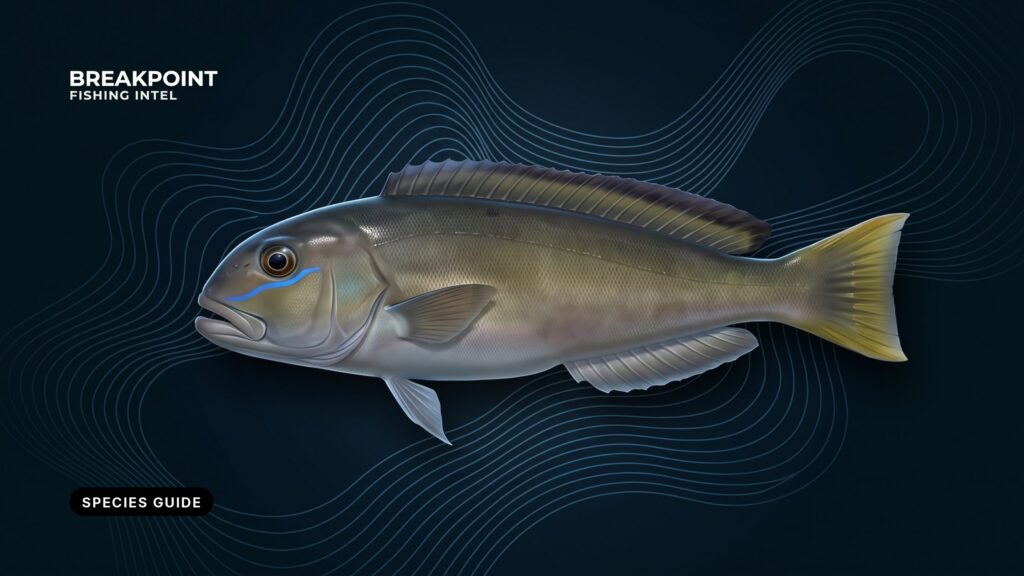
A field guide to Caulolatilus microps from the Mid-Atlantic canyons to the eastern Gulf
Blueline tilefish, Caulolatilus microps, is a small, sedentary tilefish of the outer shelf, shelf break and upper slope. It ranges from the Mid-Atlantic canyons south to Florida and into the eastern Gulf. This guide covers identification, bottom, methods and rules. The rules split at the Virginia/North Carolina line, so where you fish determines your bag, season and permit. Port-level detail is in our regional fishing guides.
Identifying Blueline Tilefish
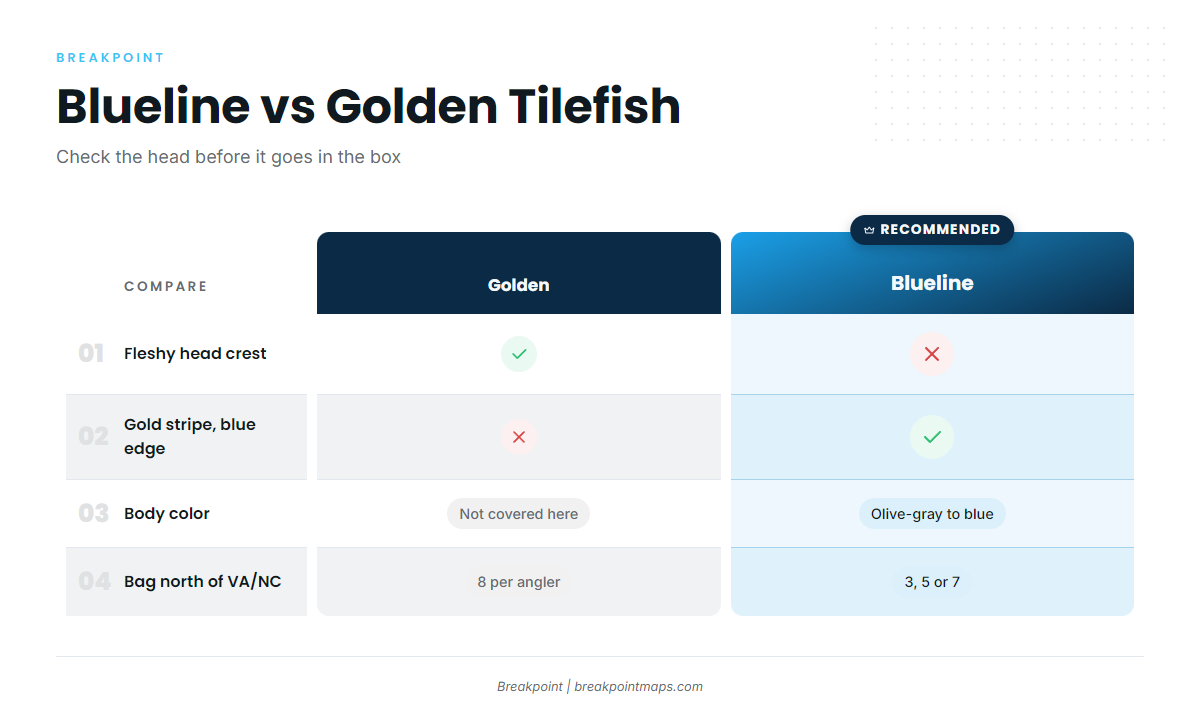
NOAA Fisheries describes blueline tilefish as having "a narrow gold stripe underlined in blue that runs from their snout to the tip of their eye." There is no fleshy crest on the head. The body is commonly described as olive-gray to bluish, fading to a white belly.
Golden tilefish carries a prominent fleshy crest, an adipose flap, in front of the dorsal fin. Blueline does not. Blueline is also called grey tilefish (or gray tilefish). NOAA places the species in Malacanthidae, and FishBase lists it under Latilidae. It grows to about 35 inches.
Mistaking a blueline for a golden tilefish changes your legal bag. North of the Virginia/North Carolina line the limit is 8 golden tilefish per angler, against 3, 5 or 7 bluelines per person depending on boat type. Check the head for the crest before the fish goes in the box.
| Feature | Blueline tilefish | Golden tilefish | Sand tilefish |
|---|---|---|---|
| Head crest | None | Prominent fleshy crest in front of the dorsal fin | Not covered here |
| Line under the eye | Narrow gold stripe underlined in blue, snout to eye | Not a blue-lined fish | Not covered here |
| Alternate names | Grey tilefish, gray tilefish | Not covered here | Not covered here |
| Typical habitat | Outer shelf, shelf break, upper slope | Not covered here | See agency ID guides |
| Rule note | Limits differ by zone; see Regulations | Separate bag; 8 per angler north of VA/NC line | See agency ID guides |
Biology: How Blueline Tilefish Live and Feed
Blueline tilefish live on the outer continental shelf, the shelf break and the upper slope. According to NOAA, they hold on irregular bottom with ledges or crevices, around boulders and rubble piles. SAFMC adds sand, mud and shell hash. A NJ Fish and Wildlife profile describes mud and rubble burrows shared with groupers and snappers.
Bluelines burrow head first into cone-shaped sand piles. SEDAR 32 describes burrows in soft sandy sediment occupied by up to 3 fish.
They feed on the bottom. NOAA lists crabs, shrimp, snails, worms, sea urchins and small fish, so the bait belongs on the bottom.
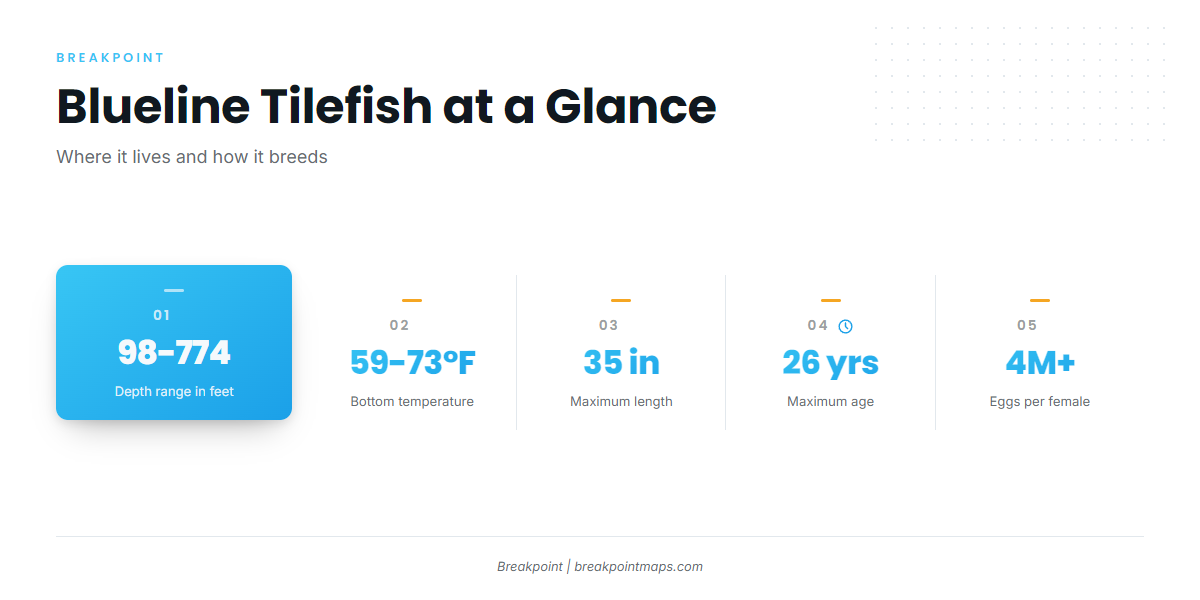
Spawning can occur year-round and peaks in May, mostly at night. Females mature at about 3 years and can release more than 4 million free-floating eggs. According to NOAA, they live up to 26 years.
The fish is relatively sedentary and is not thought to make north-south coastal migrations, per the SEDAR 32 stock assessment report. A productive spot holds resident fish, and heavy repeat harvest from one pile depletes it. Spread your effort rather than emptying a spot.
Depth and habitat at a glance:
- Depth: 98 to 774 feet (NOAA). SAFMC gives 240 to 780 feet.
- Bottom temperature: 59 to 73°F (NOAA, SAFMC).
- Zone: shelf break and upper slope, plus shelf edge and upper slope reefs (SEDAR 92).
- Bottom: ledges, crevices, boulders, rubble piles, sand-pile burrows, mud and shell hash.
- Companions: groupers and snappers (SAFMC).
Where and When: Blueline Tilefish by Region
All of these fish belong to one genetic stock, from the eastern Gulf through the Mid-Atlantic (SEDAR 92). Federal seasons, not fish movement, set the calendar. The windows are in Regulations below.
| Region | Where the fish sit | Rules that apply |
|---|---|---|
| Mid-Atlantic canyons | Hudson to Veatch Canyons; Norfolk Canyon hard bottom | Mid-Atlantic federal rules |
| Outer Banks | Shelf break off Hatteras and Oregon Inlet | South Atlantic federal rules |
| SC and Georgia shelf edge | Rocky shelf edge and slope reefs | South Atlantic federal rules |
| East Florida | North Carolina to southern Florida range | South Atlantic federal rules offshore; FWC in state waters |
| Eastern Gulf | Present in the eastern Gulf | Check NOAA Fisheries and FWC |
Mid-Atlantic canyons
NOAA places most of the northern fishery between Nantucket and Cape May, concentrated between Hudson and Veatch Canyons. Off Virginia, Norfolk Canyon samples came from about 200 to 600 feet, typically on hard bottom (SEDAR 32). The federal season runs May 15 to November 14.
Outer Banks
The shelf break off Hatteras and Oregon Inlet sits south of the Virginia/North Carolina line, so South Atlantic rules apply. The Gulf Stream pushes hard current across the drop-off, which makes boat handling the main factor in your line angle.
South Carolina and Georgia shelf edge
Bluelines turn up on rocky bottom at the shelf edge and on slope reefs (SEDAR 32). Expect grouper and snapper company.
East Florida
The documented range runs from North Carolina to southern Florida (FishBase). South Atlantic federal rules apply offshore, and FWC governs state waters.
Eastern Gulf
The species is present in the eastern Gulf (NOAA; SEDAR 92). Check NOAA Fisheries and FWC for Gulf rules.
Port-level spots and run distances are in our regional fishing guides.
How to Catch Blueline Tilefish
Deep-dropping for bluelines is bottom fishing. The sections below cover tackle, bait, finding bottom and handling the boat.
Rigs, line and reels
Most deep-droppers run top-and-bottom or multi-hook rigs with circle hooks and enough lead to hold bottom in the current. Some drop heavy jigs instead. If golden tilefish are possible north of the Virginia/North Carolina line, rig to the golden rule: rod and reel, no more than 5 hooks per rod.
Braid is standard because it is thin and has little stretch, so bites register at depth. Monofilament stretch hides bites.
Many anglers hand-crank on the shallow end of the range. Electric reels take over as depth and lead weight climb. Manual or electric reels are both legal for golden tilefish north of the line.
For the full deep-drop setup across species, see our bottom-fish and deep-drop guides.
Bait
- Cut squid: durable and hard to strip.
- Cut fish: survives more nibbles than soft baits like clam.
- Why it matters: stolen baits mean wasted drops, a long crank up and a long drop back down.
Finding blueline bottom
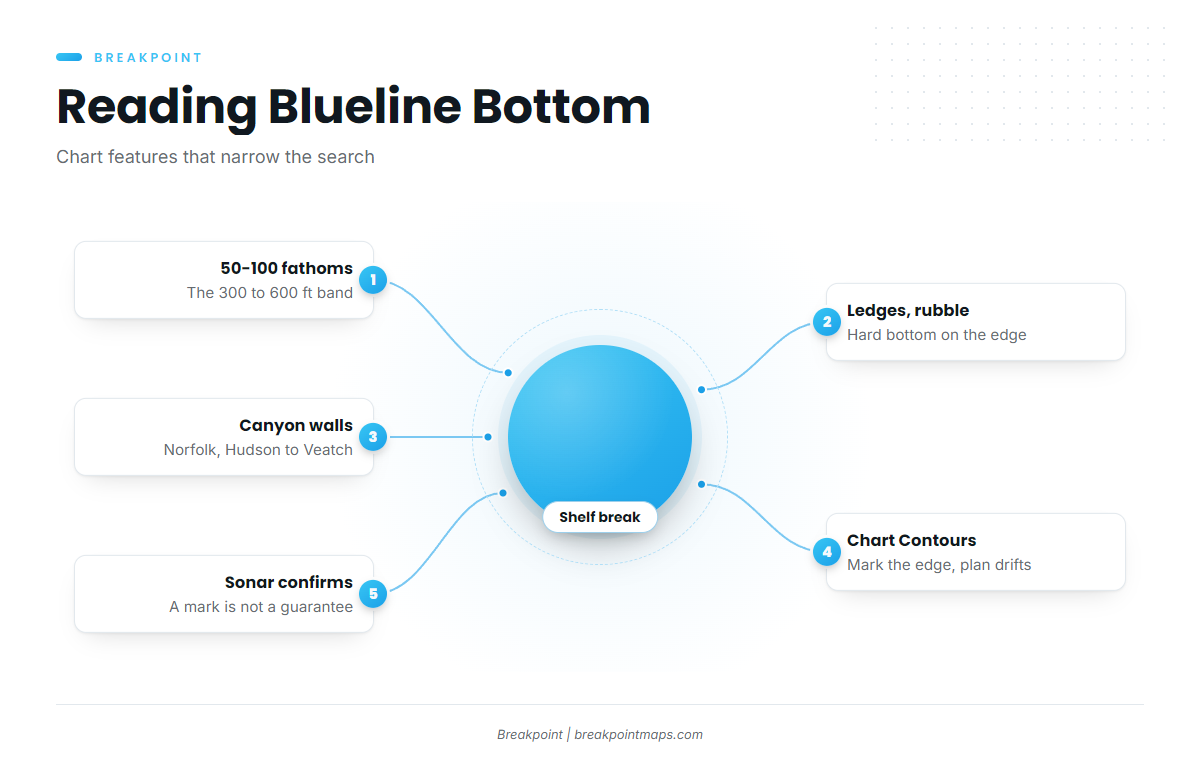
Translate the biology into chart features:
- The shelf break and upper slope in the 50 to 100 fathom band (300 to 600 feet).
- Ledges and rubble on the edge.
- Canyon walls and rims around Norfolk Canyon and from Hudson Canyon to Veatch.
The Chart Contours layer in Breakpoint draws the shelf break and that 50 to 100 fathom band, so you can mark the edge and plan drifts before you leave the dock. Chart layers are not for navigation.
Contours show the shape of the slope, not what the bottom is made of. At 500 feet a sonar cone covers a wide footprint, and small rubble piles and sand-pile burrows can merge with the surrounding bottom. Dual-frequency or CHIRP sonar helps separate hard returns from mud, but a mark is not a guarantee. Contours narrow the search and sonar confirms it, though neither promises fish.
Boat handling in current
When drifting, bump the boat slowly into the current, just enough to keep the lines vertical. Vertical lines mean fewer tangles, less lost gear and better bites.
Barotrauma and descending devices
Fish from depth come up with expanded swim bladders. A descending device returns released fish to depth. NOAA Fisheries requires one on board in South Atlantic federal waters when fishing for or possessing snapper-grouper species. See Regulations.
What else comes up
Black sea bass mix with bluelines. Snowy grouper and golden tilefish share the deeper edge. Each has its own rules, so identify every fish before it goes in the box.
Region guides for blueline tilefish: blueline tilefish fishing in the Atlantic Southeast and blueline tilefish fishing in the Gulf of Mexico.
Blueline Tilefish FAQ
How do you tell a blueline tilefish from a golden tilefish?
Look at the head. According to NOAA, blueline has a narrow gold stripe underlined in blue from snout to eye and no fleshy crest. Golden has a prominent crest in front of the dorsal fin. The bags differ, so identify the fish before you keep it. Source: NOAA Fisheries.
What depth do blueline tilefish live at?
NOAA gives 98 to 774 feet, and SAFMC gives 240 to 780 feet. They sit on the shelf break and upper slope, where bottom temperature runs 59 to 73°F. Source: NOAA Fisheries and SAFMC.
Do you need a permit for blueline tilefish north of North Carolina?
Yes. Private vessels need the free Private Recreational Tilefish Vessel Permit and an electronic trip report within 24 hours of any trip that targets or keeps tilefish. For-hire vessels need the charter/party tilefish permit. Source: NOAA Fisheries GARFO.
What is the blueline tilefish bag limit and season off North Carolina?
In South Atlantic federal waters the bag is 2 per person per day with no minimum size. The season is May 1 to September 1, or earlier on quota. For state waters, check NC DMF. Source: NOAA Fisheries Southeast Regional Office and SAFMC.
Can charter captains and crew keep blueline tilefish?
South of the Virginia/North Carolina line, no. The captain and crew of a charter vessel or headboat may not keep them. North of the line, bags are set per person by vessel type: 5 on an uninspected for-hire vessel and 7 on an inspected one. Source: NOAA Fisheries.
Is a descending device required?
Yes, on board in South Atlantic federal waters when fishing for or possessing snapper-grouper species. It lets you return released fish to depth. Source: NOAA Fisheries.
Is blueline tilefish good to eat?
Anglers widely keep it as table fare, with mild white fillets, which is why many target it. Keep only legal fish, and confirm the rules for your zone first. Source: NOAA Fisheries.
To plan the next deep-drop from the dock, download Breakpoint from the App Store or Google Play and check where the shelf edge sits on Chart Contours before you run.