




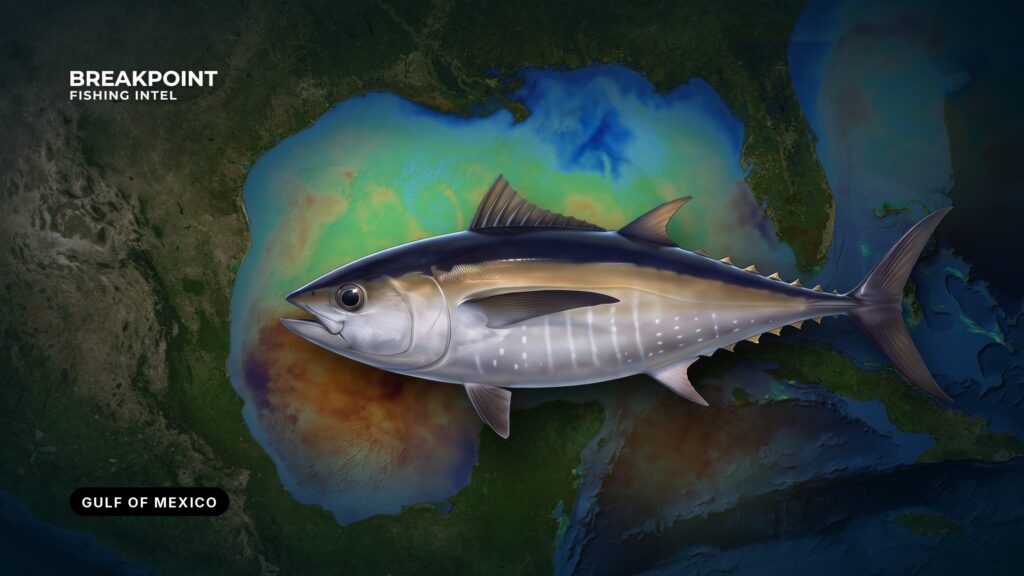
Blackfin are the most abundant tuna in the Gulf, and the one a center console can reach. A peer-reviewed Marine and Coastal Fisheries paper puts them at more than 80% of Thunnus larvae in long-term Gulf sampling. This guide covers where they hold, how to read the water, how to fish it, and which rules apply. Rigs, edges and lumps hold them, because bait gathers there and tuna follow the bait. The rules come from the states rather than from federal tuna rules. No guide can promise fish, but this one should help you decide where to look.
Quick facts
- Northern Gulf: rig fish are present year-round.
- Eastern Gulf and Panhandle: the season runs mid-March to Christmas.
- Peak: the August full moon to just after the November full moon.
- Best bite: dawn and dusk.
- Night rig fish: about 10 to 15 lb on average, per charter reports.
- Structure: oil and gas platforms, the shelf edge, lumps and wrecks.
- Permit: no HMS Angling Permit is needed for blackfin.
- Florida Gulf limit: 2 per person or 10 per vessel per day, whichever is greater. No minimum size. Open year-round.
Gulf blackfin at a glance: identification and biology
Blackfin are the small tuna of the Gulf, and they often turn up with yellowfin at the same rigs. Tell them apart before you keep anything, because a misidentified yellowfin falls under different rules. The blackfin tuna species guide covers identification and biology in full. Gulf blackfin life history is less studied than yellowfin.
Where and when to find blackfin tuna in the Gulf
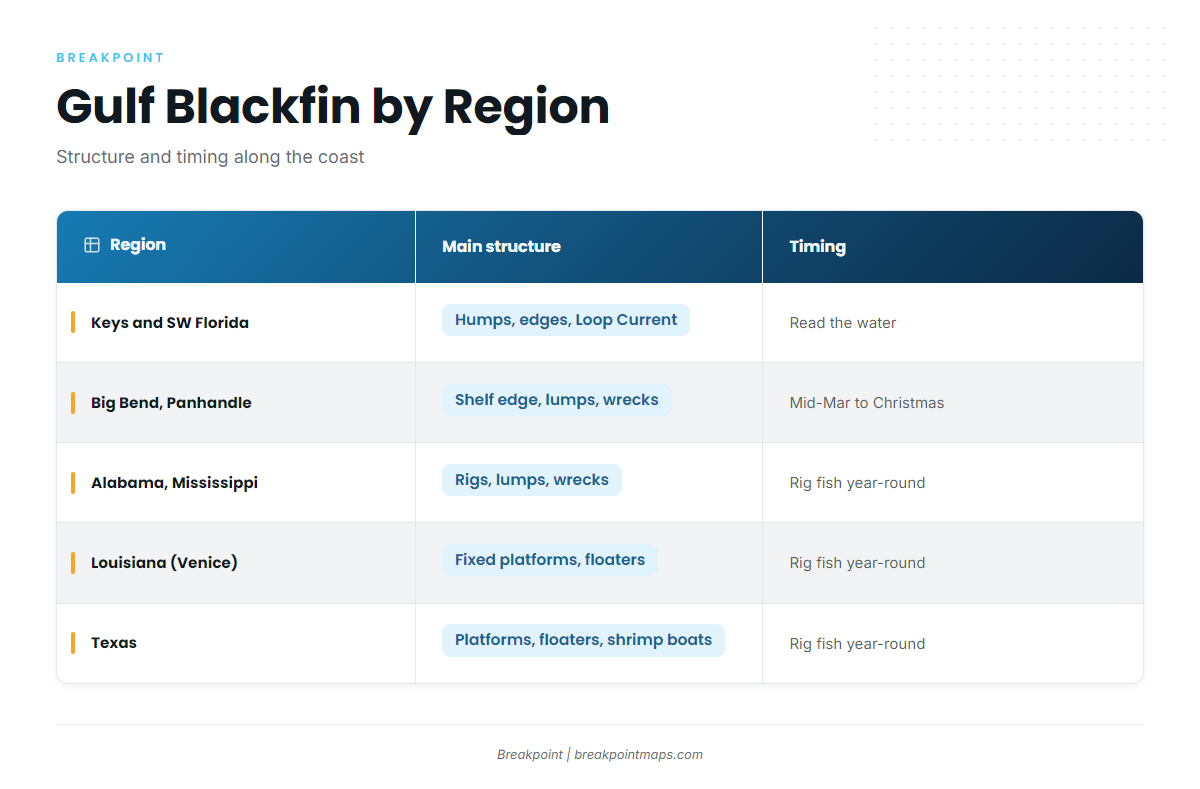
Bait concentrates on structure and edges, and tuna follow it. Where that structure sits changes by coastline. For ports, seasons and other species, start with our Gulf of Mexico fishing guide. The ports below are Venice, Orange Beach, Destin and Port Aransas, each on its own stretch of coast.
Florida Keys and southwest Florida edge
Gulf water and Atlantic water meet here, and Loop Current water moves past toward the Florida Straits. Fish relate to edges and humps in deep water close to the reef line. The water is a better guide than the calendar. For the Atlantic side of the same corner, see blackfin tuna fishing in the Atlantic Southeast.
Big Bend and Panhandle
This is a shelf-edge and lump fishery. The shelf runs wide, so the run to the 100-fathom curve is long. Out of Destin, the season runs mid-March to Christmas and peaks from the August full moon to just after the November full moon.
Madison and Swanson, Steamboat Lumps and The Edges sit on these runs and are federal closed areas. See Regulations for the details.
Alabama and Mississippi
This is the transition coast. Rigs begin to dominate to the west, and lumps and wrecks matter closer in. Out of Orange Beach, rig fish are present year-round.
Louisiana around Venice
This is the heart of the rig fishery. Blue water reaches close to the river mouth, and dense platform fields lie off it. The key distinction is fixed rigs versus deepwater floaters. Fixed platforms stand on the bottom on the shelf. Floaters are deepwater production platforms tethered past the shelf break. Night fish hold tight to the rigs and average 10 to 15 lb, per charter reports.
Texas
Platforms and shrimp boats make up the structure out of Port Aransas. The deepwater floaters lie far offshore. Rig fish are present year-round.
Season summary
| Region | Main structure | Timing |
|---|---|---|
| Keys and SW Florida edge | Humps, edges, Loop Current water | Read the water. Follow local reports. |
| Big Bend and Panhandle | Shelf edge, lumps, wrecks | Mid-March to Christmas. Peak from the August full moon to just after the November full moon. |
| Alabama and Mississippi | Rigs, lumps, wrecks | Rig fish year-round |
| Louisiana (Venice) | Fixed platforms, floaters | Rig fish year-round |
| Texas | Platforms, floaters, shrimp boats | Rig fish year-round |
All regions bite best at dawn and dusk.
The water and structure that hold Gulf blackfin
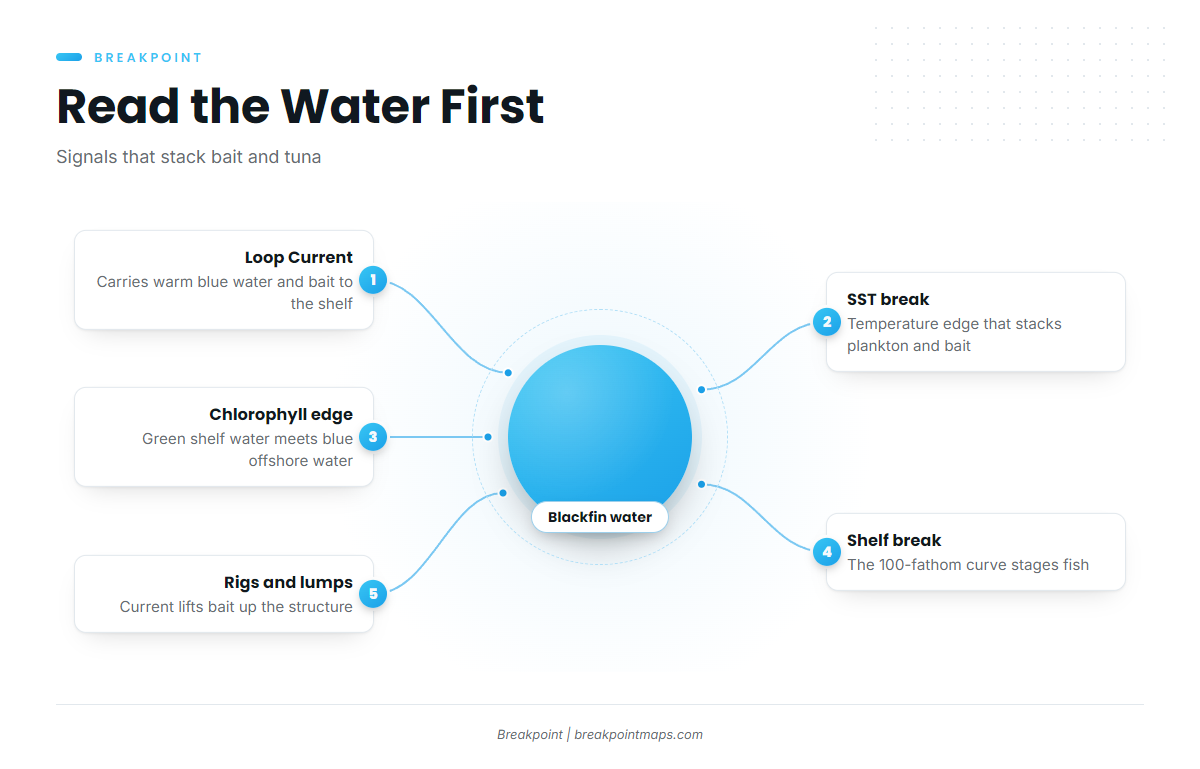
Current hits a rig, lump or ledge and deflects upward, lifting bait toward the surface. Bait holds on the up-current side and in the seam, and tuna work it. A rig is effectively a lump that reaches the surface. Platforms also hold hardtails, so live bait comes before tuna fishing.
Structure and water edges work together. These are the features to read:
- Loop Current and eddies: warm, blue water and bait pushed toward the shelf.
- SST breaks: temperature edges that stack plankton and bait.
- Color and chlorophyll edges: green shelf water against blue offshore water.
- Shelf break and bottom features: the 100-fathom curve, lumps and wrecks.
Loop Current and eddies
The Loop Current carries warm, blue water and bait toward the shelf. The edge moves, and eddies break off and drift, so last week’s edge may not be this week’s.
SST breaks and what the image cannot see
An SST break is a temperature edge that stacks plankton and bait. An SST image reads only the surface skin, so a thermocline edge can sit below a blank image. Cloud also blocks a satellite pass. Use the image to find candidates, then confirm on the water.
Color change and chlorophyll edges
Green, productive shelf water meets blue offshore water. The chlorophyll edge marks where plankton and bait sit. A color change that lines up with a temperature edge is stronger than either signal alone.
Shelf edge, 100-fathom curve, lumps and wrecks
The shelf break, the 100-fathom curve, is where the eastern Gulf stages fish. Lumps and wrecks act like small rigs. Some of the best-known lumps lie inside federal closed areas, so check Regulations before you fish them.
To narrow the search, lay OBS SST over Chart Contours and look for where a temperature edge crosses the shelf break. Then check Chlorophyll for the color change on the same line. Chart layers are not for navigation.
How anglers fish blackfin tuna in the Gulf
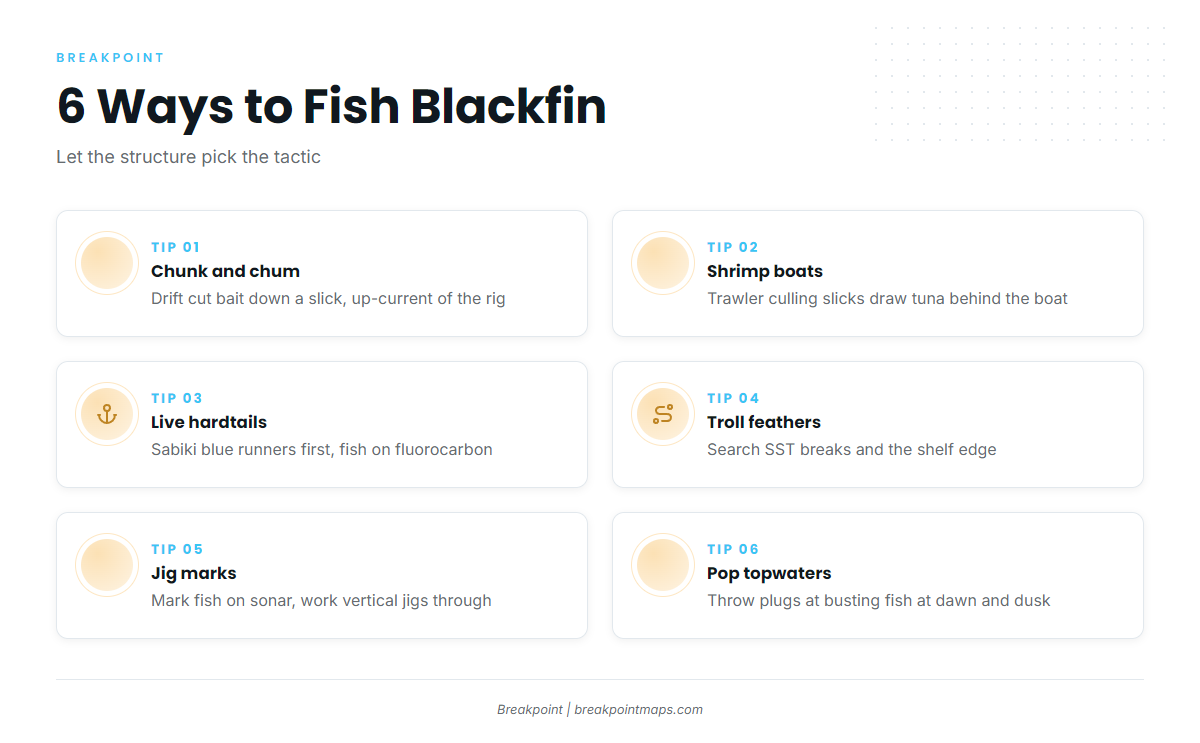
The structure picks the tactic. These six cover most of the Gulf, and our tuna fishing guides cover the yellowfin that share the same rigs and baits.
- Rig chunking and chumming. Drift cut bait down a steady slick on the up-current side of the platform. Keep a pitch bait rigged and ready for fish that rise into the slick.
- Shrimp boats. Trawlers culling bycatch create a natural chum slick, and tuna follow it. This is a classic tactic off Louisiana and Texas.
- Live hardtails. Stop at the platform with a sabiki for blue runners before you start tuna fishing. Saltwater Sportsman’s Gulf offshore primer covers both the shrimp-boat slick and the hardtail bait. Fish them on a fluorocarbon leader.
- Trolling feathers and cedar plugs. Use this to search along SST breaks, color changes and the shelf edge. Run the lures well back from the transom.
- Jigging. Mark fish on sonar around the structure. Work vertical jigs through the marks.
- Popping. Throw small topwater plugs at fish busting bait at dawn and dusk, or into a chunk slick.
Mark rigs, lumps and edges in the app before the run. Check the official National Weather Service marine forecast for wind, wave height and period.
Guides to blackfin tuna fishing from specific ports: Dauphin Island, Apalachicola, Cocodrie, Biloxi, Corpus Christi, Orange Beach, Carrabelle and Grand Isle.
Frequently asked questions about blackfin tuna in the Gulf
Do I need an HMS permit for blackfin tuna?
No. Blackfin need no HMS Angling Permit in state or federal waters. Yellowfin and skipjack do need one, so identify your fish before you keep it.
What is the blackfin limit in Florida’s Gulf waters?
The limit is 2 per person or 10 per vessel per day, whichever is greater. There is no minimum size, and the season is open year-round. FWC sets these rules, so check its page before fishing.
Which state’s rules apply when I land blackfin?
The landing state’s rules and license apply. In Florida, a saltwater license is required to land fish wherever they were caught. For other states, check that state’s agency.
When is the best time to fish for blackfin in the Gulf?
Northern Gulf rig fish are present year-round. The eastern Gulf and Panhandle season runs mid-March to Christmas, peaking from the August full moon to just after the November full moon. Fish bite best at dawn and dusk.
How do I tell blackfin from yellowfin?
They look alike at a glance, and the difference changes which rules apply. Yellowfin need an HMS permit and blackfin do not. See the full identification notes before you keep a fish.
Can I fish for blackfin in Madison and Swanson or Steamboat Lumps?
No. Both are closed to fishing year-round. The closures exempt Atlantic HMS species, and blackfin is not one. Check the federal rule before fishing near them.
Are bonito and little tunny under the same limit as blackfin?
No. In Florida, Atlantic bonito and little tunny are limited to 2 fish or 100 pounds per day, whichever is more.