




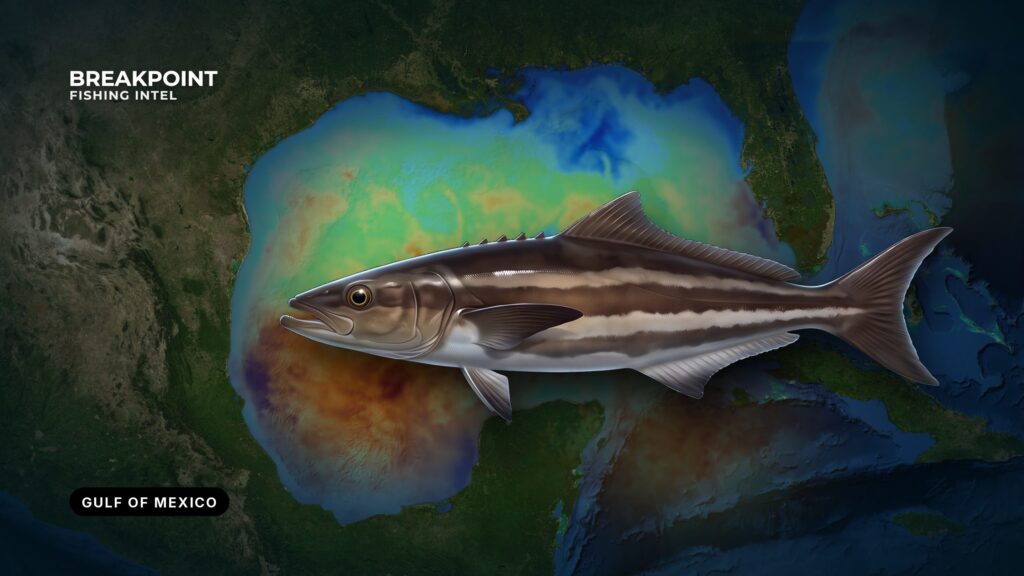
Cobia in the Gulf of Mexico follow a seasonal pattern. Fish run west along the northern beaches in spring, hold on structure through summer, and push back south in fall and winter off southwest Florida and the Keys. This guide covers where and when the fish show up, the water and structure that hold them, how they’re fished, and the state and federal rules, with agency links, so you know which structure to put on your map and which rule applies where the fish comes over the rail.
Know the fish
Cobia are a large coastal pelagic fish, often mistaken near the surface for sharks or remoras. They travel singly or in small groups and shadow larger animals and floating objects.
Identification, biology and general tackle are in our cobia species guide.
Where and when cobia show up in the Gulf of Mexico
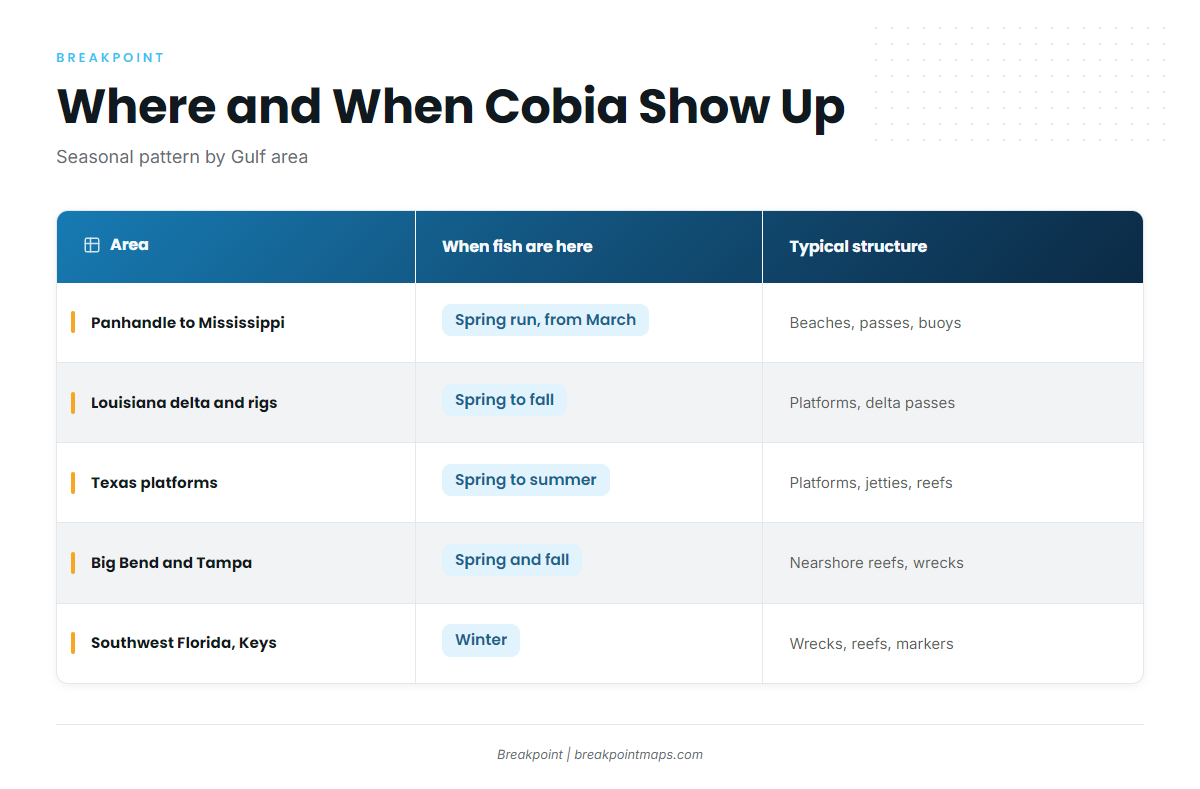
The Gulf breaks into three working regions: the northern Gulf beaches, the central and western Gulf rigs, and southwest Florida with the Keys. Our broader Gulf fishing guide covers the whole basin. For cobia, the run follows warming water along the beaches.
The spring run on the northern Gulf
The run arrives in March and moves west along the beaches past Destin, Pensacola and Orange Beach, continuing to the Mississippi barrier islands and on toward Louisiana. Fish cruise near the surface heading west, and boats run the beach lines looking for them.
Rigs, delta and western Gulf
Fish hold on oil and gas platforms off Louisiana and Texas through summer, and some stay around rigs year-round. Off Venice, the short rigs fill again in late summer and fall as fish push back south. South Pass, Red Pass and the 12-Mile Rigs are the names to know there. In Texas, look at the Port O’Connor platforms and jetties.
Big Bend, Tampa and the winter fish
Nearshore reefs and wrecks hold fish from Bayport to Cedar Key and off Tampa. In winter, fish hold off southwest Florida and the Keys.
When is the cobia run
The spring cobia run starts in March on the northern Gulf. Fish travel west from the Florida Panhandle past Alabama and Mississippi toward Louisiana, then hold on rigs and reefs through summer before pushing back south in fall.
| Area | When fish are present | Typical structure |
|---|---|---|
| Florida Panhandle through Alabama and Mississippi | Spring run, from March | Beaches, passes, buoys, channel markers, nearshore reefs |
| Louisiana delta and rigs | Spring through fall; fall push on the short rigs | Platforms, delta passes |
| Texas platforms and jetties | Spring through summer | Platforms, jetties, artificial reefs |
| Big Bend and Tampa Bay nearshore reefs | Spring and fall | Nearshore reefs, wrecks |
| Southwest Florida and Keys | Winter | Wrecks, reefs, markers |
Water and structure that hold cobia
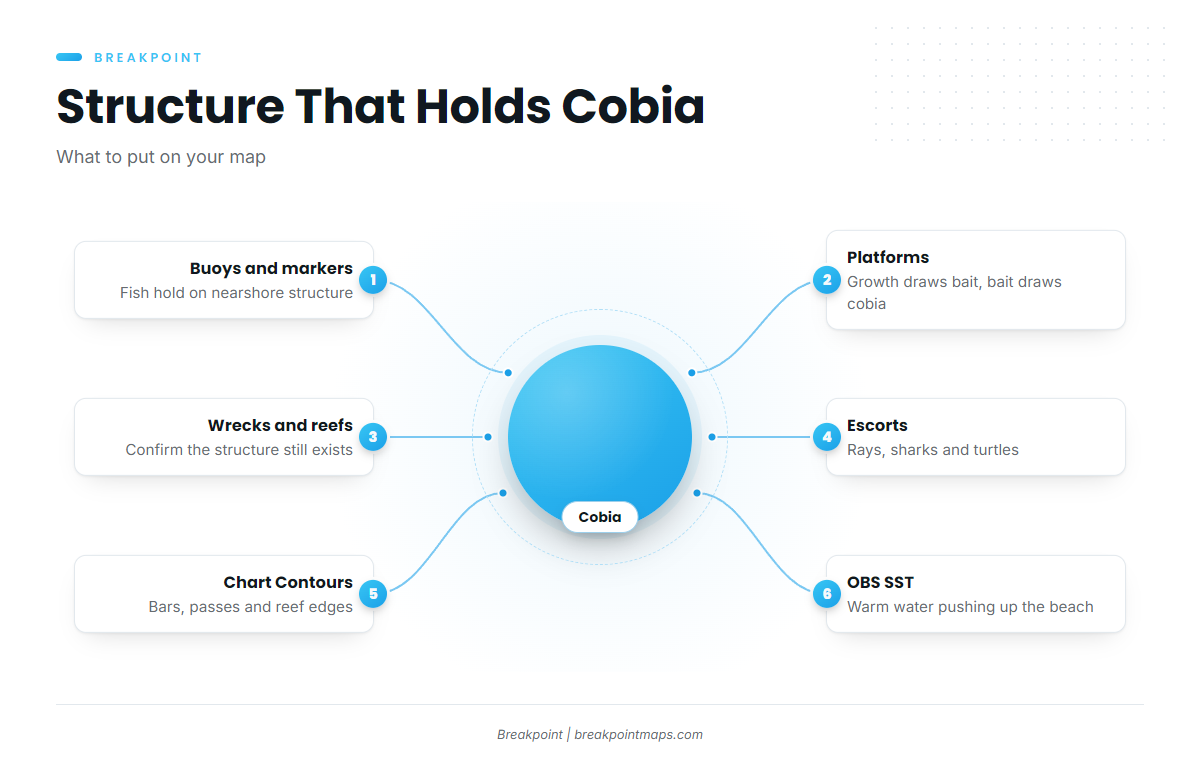
Cobia are almost always on some kind of structure. Temperature and bait move them from one piece to the next.
Nearshore, work the following:
- Buoys and channel markers
- Passes and sandbars
- Floating debris
- Wrecks and artificial reefs
Offshore, platforms work like reefs: growth on the legs draws bait, and bait draws cobia. Platforms get removed over time, so confirm a structure still exists before you run to it.
Cobia also shadow cownose rays, sharks and sea turtles. A cobia under a ray won’t show on any satellite layer, so the person watching from the tower sees what the data can’t.
Each map layer has limits:
- OBS SST shows where warm water is pushing up the beach. Cloud can block a satellite pass, so check how fresh the composite is.
- Chlorophyll shows color edges and bait water.
- Chart Contours shows bars, passes and reef edges. Charted wreck and reef positions vary in survey age.
Sight fishing depends on sun angle, surface conditions and water clarity. For wind, wave height and period, read the NWS marine forecast.
Turn on Chart Contours to trace the nearshore bars, passes and reef edges the fish travel, and check OBS SST before the run to see where warm water is pushing up the beach. Chart layers are not for navigation.
How anglers fish for cobia in the Gulf
Sight casting on the run
Run the beach from a tower and look for shapes, rays and turtles. Cast ahead of the fish rather than on top of it, and let the fish see the bait before it sees the boat. Sight casting from a tower is the main method on the northern Gulf.
Baits and lures
Most setups come down to a short list:
- Bucktail jigs
- Eel imitations
- Live eels
- Pinfish
- Menhaden
- Croakers
Use a stout casting rod with enough line to stop a fish short of the rig legs.
Rigs and reefs: chumming and live bait
Set up uptide and chum to pull fish off the structure, then fish live bait in the slick. Turn the fish’s head early so it stays off the legs.
Cobia often show up during snapper and amberjack drops, so keep a rigged bait ready. They share rigs and reefs with king mackerel, greater amberjack and red snapper, and our other coastal and offshore gamefish guides cover those fish.
At the boat: gaff or net
A green cobia thrashes on deck, and many anglers wait until the fish is tired before landing it. A net makes release easier for a short fish. Measure the fish before deciding to keep it.
Build a route of buoys, wrecks, artificial reefs and platforms in Breakpoint before you leave the dock, and you’ll have a better idea of where to look.
Guides to cobia fishing from specific ports: Orange Beach, Apalachicola, Cocodrie, Biloxi, Corpus Christi, Boca Grande, Grand Isle and Gulfport.
FAQ
What are the best months for cobia by area?
On the northern Gulf, spring is the window, starting in March. Off Louisiana and Texas, fish hold on the rigs through summer, with a fall push on the Venice short rigs. Southwest Florida and the Keys hold fish in winter.
Can you catch cobia in the Florida Keys in winter?
Yes. Fish winter off southwest Florida and the Keys around wrecks, reefs and markers. Florida’s figures apply on both coasts, so the 36-inch minimum and the bag limit are the same there as on the Panhandle.
What is the cobia size limit, and how do I measure it?
The minimum is 36 inches fork length in Florida and in federal Gulf waters. Measure from the fork in the tail to the tip of the mouth, with the fish flat and its mouth closed. Check your state agency for state-water rules.
Where does state water end and federal water begin?
State waters end at 9 nautical miles off Florida and Texas. Off Louisiana, Mississippi and Alabama they generally end at 3 nautical miles. The rule that applies is the one for the waters where the fish was caught.
Does a charter cover my fishing license?
It depends on the state. Rules on licenses vary, so check with the state agency (FWC, ADCNR, MDMR, LDWF or TPWD) before you book, and ask the charter what it covers so you don’t assume.
Why do some documents say Gulf of America?
Federal and agency documents use Gulf of America for the same water this guide calls the Gulf of Mexico. Match the name to the document you are reading. The cobia rules apply to the same fishery either way.
How do I tell a cobia from a remora or a shark?
Look at the body and the habit. A cobia swims near the surface on its own or in a small group, often under a ray or beside a buoy, while a remora rides on a host. The full identification is in our cobia species guide. Cobia are also widely kept for the table.
If you fish the Gulf and want to see where structure, warm water and bait line up before you leave the dock, download Breakpoint from the App Store or Google Play.