



Pacific bluefin fishing in the Pacific Northwest follows two patterns. Juveniles travel with albacore in blue water far offshore, and larger fish turn up in the outer green water closer in. This guide covers where they show up, the water that holds them, how anglers fish for them here, and which rules apply. For the wider offshore and bottomfish picture from Westport to Charleston, see our Pacific Northwest fishing guide.
Know the Fish
Pacific bluefin (Thunnus orientalis) belong to the family Scombridae. NOAA puts a typical adult at about 4 ft 11 in and 130 lb, with a maximum near 9.8 ft and 990 lb. They eat sardines, anchovies, saury, herring, mackerel, hake, other tunas and squid. California Sea Grant describes the juvenile trans-Pacific migration: fish cross more than 5,000 miles from the Sea of Japan, then range up and down the coast between Washington and Mexico until about age 7 before returning to spawn. That coastal movement is why young fish can show up off Washington and Oregon. Identification, size and life history are covered in our Pacific bluefin tuna guide.
Where and When Bluefin Show Up
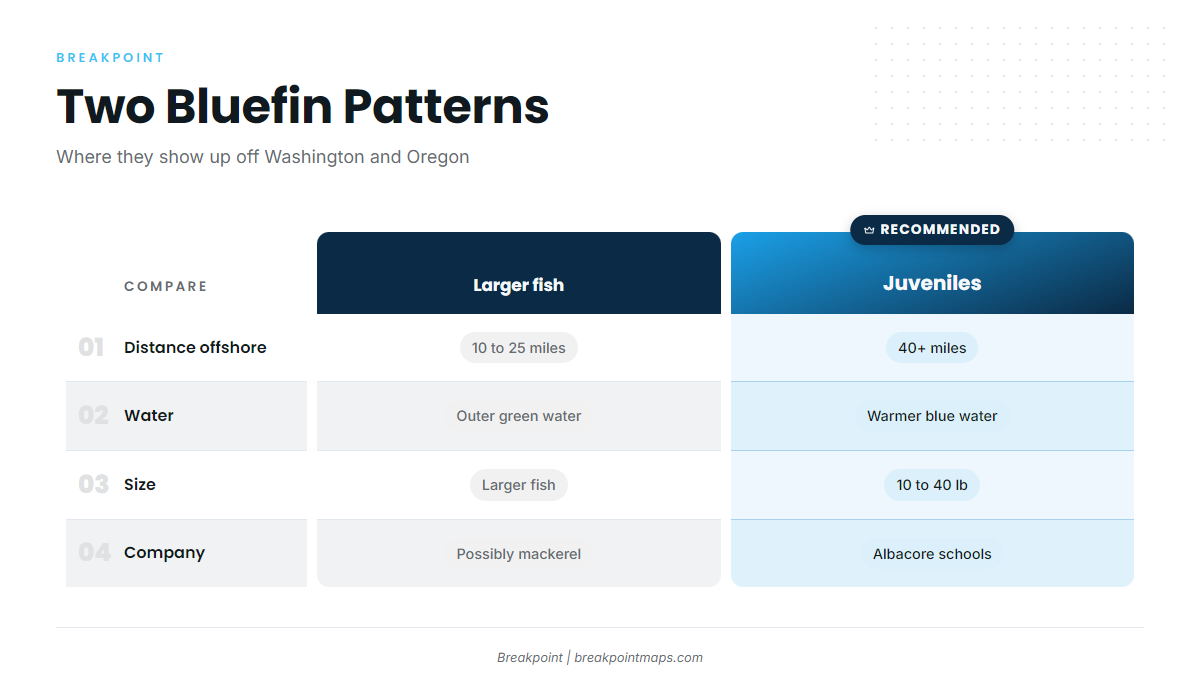
Off Washington and Oregon, bluefin appear mainly in late summer and fall. Juveniles of 10 to 40 lb travel with albacore in blue water 40 or more miles offshore. Larger fish turn up in the outer green water about 10 to 25 miles off southwest Washington.
WDFW’s Pacific bluefin page describes bluefin as sporadically caught by anglers targeting albacore, most often out of Ilwaco and Westport. Reports of larger fish in the outer green water off southwest Washington have increased since about 2016, and WDFW notes those fish are possibly feeding on mackerel.
| Pattern | Distance offshore | Water | Size | Company |
|---|---|---|---|---|
| Juveniles | 40 or more miles | Warmer, clearer blue water | 10 to 40 lb | Schools of albacore |
| Larger fish | About 10 to 25 miles off southwest Washington | Outer edge of the green water | Larger than juveniles; WA record 92.5 lb (WDFW) | Possibly feeding on mackerel |
Swipe the table sideways to see every column.
For bluefin off Washington, Ilwaco and Westport are the ports WDFW names. ODFW lists bluefin among the species Oregon tuna anglers catch, so Newport, Charleston and Coos Bay are the tuna ports to work from on the Oregon side.
Bluefin here are sporadic and vary with warm-water years. WDFW suggests that as the stock recovers in its core range off California and Mexico, more fish may be expanding north. For that southern range, see the California and Baja fishery.
The Water and Structure That Hold Them
Water defines both patterns. Blue water is warmer and clearer, and green water is cooler and more productive. The edge between them is where you start looking.
Green water meets blue on OBS SST
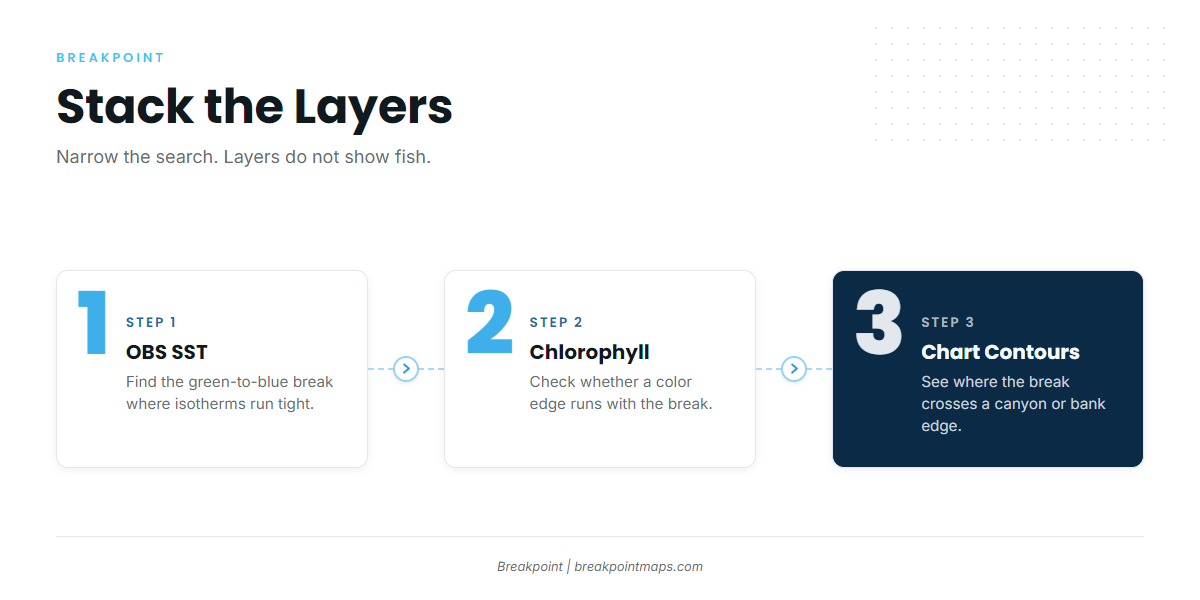
On OBS SST, the break shows up as a tight run of isotherms where the cooler green-water side meets the warmer offshore side. Juveniles sit with albacore on the blue side, and larger fish have been reported on the outer edge of the green.
Cloud blocks satellite SST passes. A gap on the image is a gap in the data, not a gap in the water.
Color edges on Chlorophyll
A Chlorophyll edge marks where productive water meets clear water. Bait concentrates along it, the same anchovy, sardine, saury and mackerel NOAA lists as bluefin prey. Chlorophyll shows color, not fish or bait.
Canyons and banks on Chart Contours
Check these features on Chart Contours:
- Astoria Canyon and Grays Canyon off the Columbia and southwest Washington
- Heceta Bank and Stonewall Bank off the central Oregon coast
- Contour bunching, where an SST or color break crosses steep bottom
No feature reliably holds bluefin, so treat these as places to check rather than places to count on.
The Stonewall Bank Yelloweye Rockfish Conservation Area, about 15 miles west of Newport, is closed to bottomfish, long-leader and Pacific halibut fishing. Crews who combo-fish need to know that. Chart layers are not for navigation.
To stack the layers, find the green-to-blue break on OBS SST, check whether a Chlorophyll edge runs with it, then lay Chart Contours over both to see where the break crosses a canyon or bank edge. The layers narrow the search but do not show fish.
How Anglers Fish for Them Here
Most Pacific Northwest bluefin come on albacore gear, according to WDFW. For more on the carry-over from albacore, see our tuna fishing guides.
- Trolling plastic squid or plugs. This is the albacore spread most crews already run (WDFW).
- Vertical jigging on schools marked under the boat (WDFW). NOAA also lists casting and trolling jigs.
- Live anchovy or sardine (WDFW, NOAA).
- Large plugs trolled hundreds of yards back on stout rods and reels. WDFW describes this as how some anglers target the bigger green-water fish.
Albacore gear loses big fish because tackle sized for 10 to 40 lb juveniles is undersized for a fish several times that weight.
Planning the Run
The juvenile grounds are 40 or more miles out, so plan fuel with a reserve for the return. Check wind, wave height and period on the National Weather Service marine forecast before you commit. Oregon anglers need an Ocean Endorsement to keep tuna (details below).
Before the run, check OBS SST, Chlorophyll and Chart Contours, pick the edge, then go.
Guides to Pacific bluefin tuna fishing from specific ports: Eureka, Charleston, Ilwaco, Fort Bragg, Depoe Bay, Sekiu, Shelter Cove and Garibaldi.
Frequently Asked Questions
Are there bluefin tuna off Washington and Oregon?
Yes, sporadically. WDFW describes them as caught most often by albacore anglers out of Ilwaco and Westport. ODFW lists them among the species Oregon tuna anglers catch. Numbers vary with warm-water years.
What is the best time to target bluefin in the Pacific Northwest?
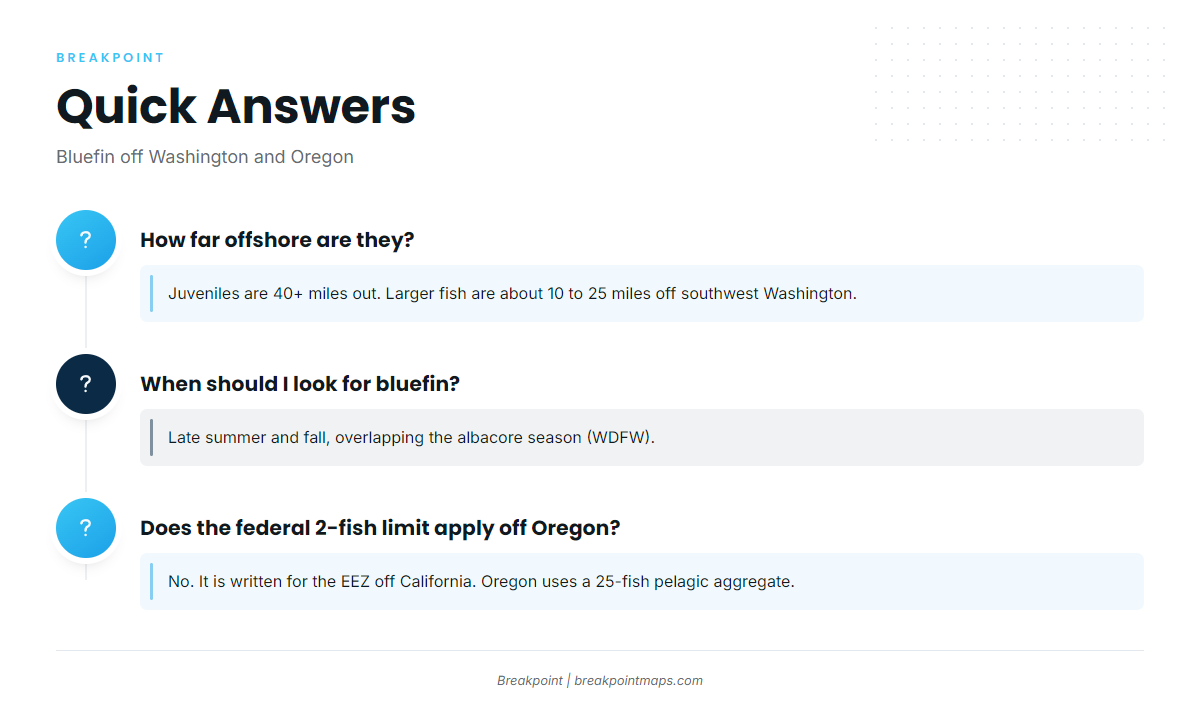
Late summer and fall, overlapping the albacore season, according to WDFW. The agency gives no tighter window, and neither do we.
How far offshore are they?
Juveniles are 40 or more miles out in blue water. Larger fish are about 10 to 25 miles off southwest Washington in the outer green water, according to WDFW.
How do I tell bluefin from albacore?
Check the species guide for identification before you fish, because it matters for the rules. Washington limits bluefin to 2 a day but sets no daily limit on albacore, so a misidentified fish can put you over the limit.
Do I need a federal HMS permit on a private boat?
The 660.707 requirement names commercial and charter vessels. Private anglers still need their state license, and in Oregon the Ocean Endorsement.
Does the federal 2-fish bluefin limit apply off Oregon?
No. It is written for the EEZ off California. Off Oregon, the ODFW 25-fish pelagic aggregate applies.
What changes if I land bluefin in California?
CDFW’s limit of 2 applies to all bluefin possessed wherever taken. Plan the count before you cross a state line.
Can I fish bottomfish and tuna on one trip off Newport?
Partly. The Stonewall Bank Yelloweye Rockfish Conservation Area, about 15 miles west of Newport, is closed to bottomfish, long-leader and halibut fishing. Offshore long-leader rockfish fishing, seaward of the 40-fathom line, can combine with tuna. A traditional bottomfish trip cannot be combined with long-leader fishing. Keep a descending device aboard.
Between OBS SST, Chlorophyll and Chart Contours, you can narrow a 40-mile run to a few likely edges before you leave the dock. Know which state’s rules apply to the fish you bring home before you leave the dock.