



Sailfish in the Atlantic Southeast
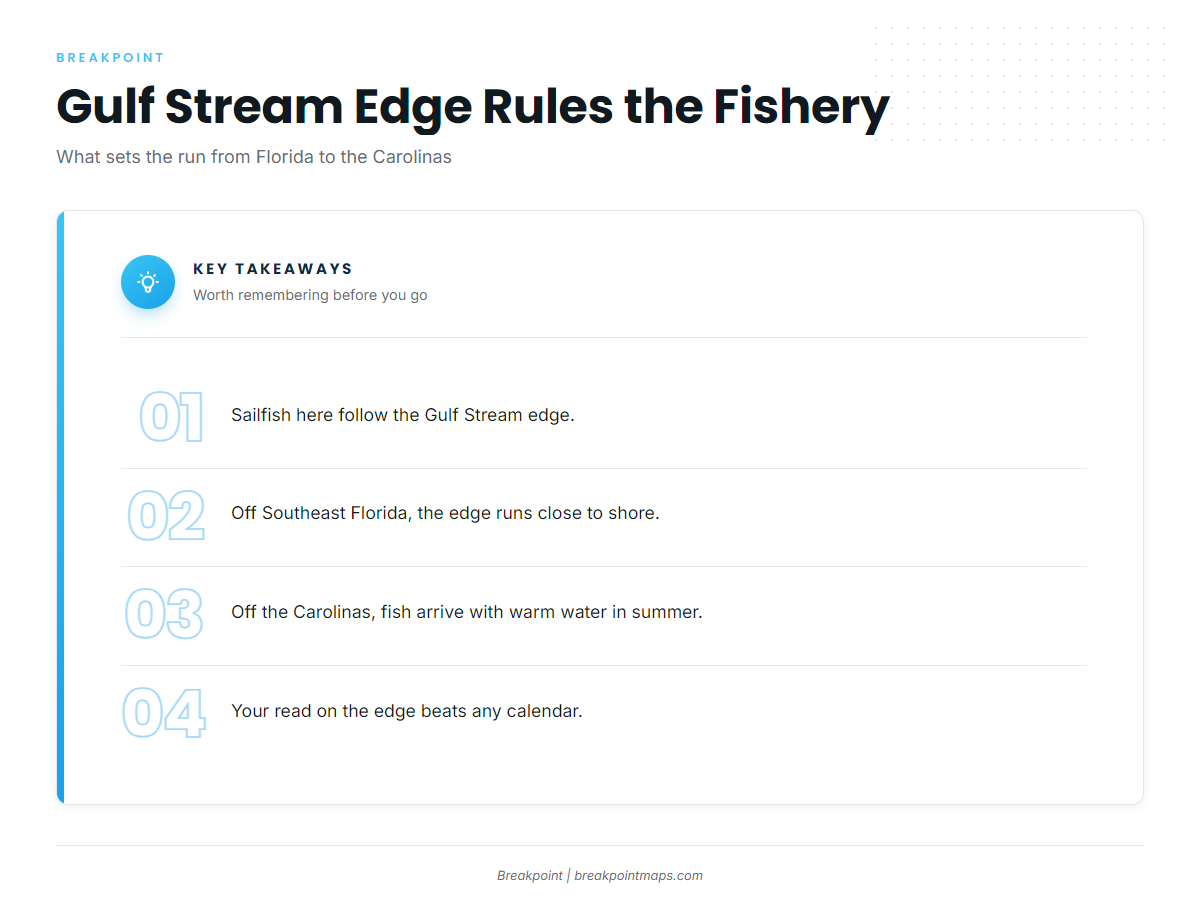
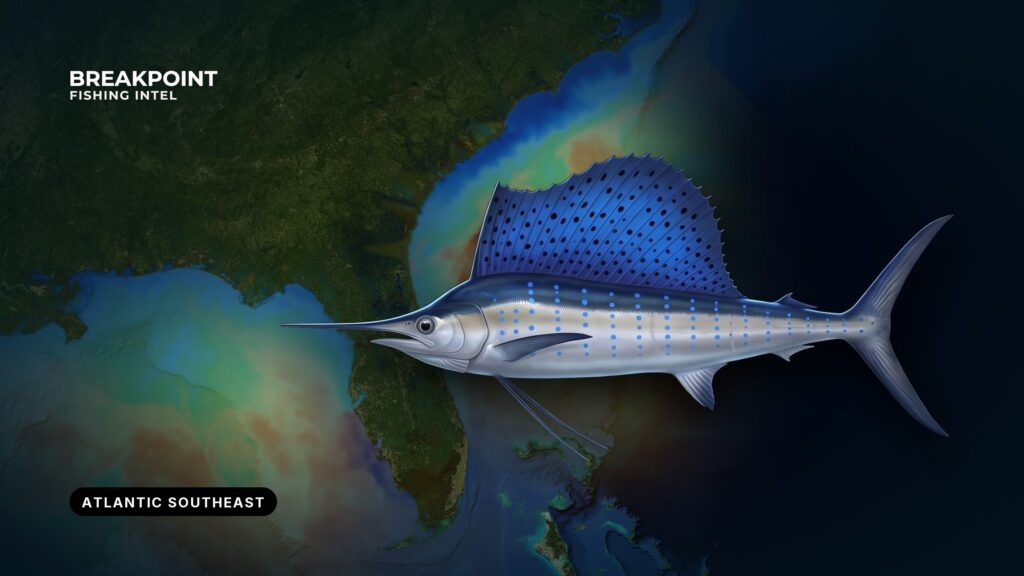
Sailfish fishing in the Atlantic Southeast depends on where the Gulf Stream edge sits relative to the beach. Off Southeast Florida the edge runs close to shore, so the winter fishery is a short run. Off the Carolinas, the fish arrive with warm Gulf Stream water in summer. For this page the region is North Carolina, South Carolina, Georgia, Florida’s Atlantic coast and the Atlantic side of the Keys.
The fish is Istiophorus platypterus. According to the Florida Museum species profile, sailfish feed on halfbeaks, mackerels, jacks and needlefish, and southern Florida fish generally run 68 to 90 inches total length. For identification, size and life history, see the sailfish species guide.
This guide covers where and when the fish show up, the water that holds them, how anglers fish them here, and how the rules divide. It can’t promise fish, but it should help you decide where to look.
Where and When
The Gulf Stream’s distance from shore sets the run. It sits close off Southeast Florida and swings farther out as you go north. Fish follow the warm water up the coast in summer. For other species and region-wide conditions, see the Atlantic Southeast fishing guide.
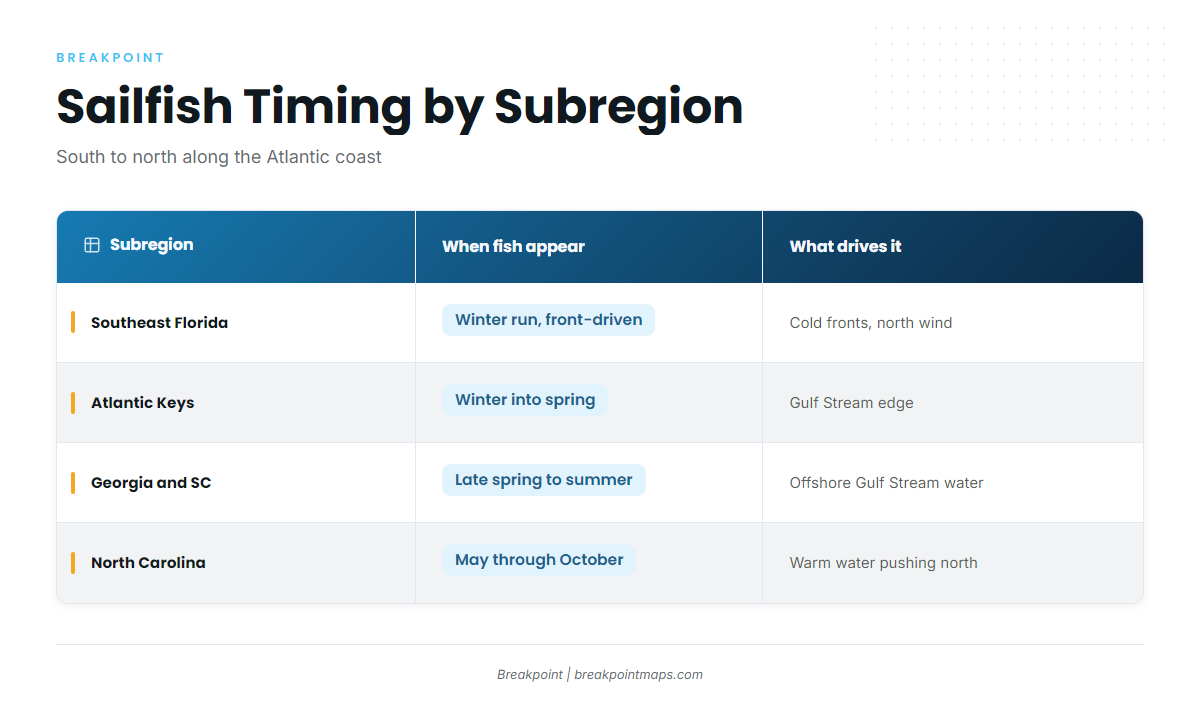
| Subregion | When fish are reported | What drives it | Depth or habitat note |
|---|---|---|---|
| Southeast Florida / Sailfish Alley (Fort Pierce to Miami) | Winter run, front-driven. Summer inshore spawning near the surface (FWC). | Cold fronts, north wind | Gulf Stream edge close to shore |
| Atlantic side of the Keys | Gulf Stream edge | ||
| Georgia and South Carolina | Offshore Gulf Stream water, 70 to 83°F (Florida Museum) | ||
| North Carolina | Sport landings May through October (NC DMF) | 120 to 300 feet (NC DMF) |
Southeast Florida and Sailfish Alley
VISIT FLORIDA calls the stretch Sailfish Alley, with Fort Pierce at the north end and Miami at the south end. Stuart carries the title Sailfish Capital of the World. The main ports are Stuart, Jupiter, Palm Beach, Fort Pierce and Miami.
The winter fishery runs on fronts and north wind, so watch the frontal pattern rather than a calendar. Methods split along the coast: trolling from Stuart north, kites and live bait to the south. More on that below.
In summer the pattern changes. FWC reports that off southeast Florida, sailfish move inshore to shallow water and spawn near the surface.
Atlantic Side of the Keys
The Upper Keys sit at the south end of the same Gulf Stream edge. The Atlantic side is bounded by the South Atlantic Council boundary: 83° W north to 24°35′ N, then east to the mainland. For water west and north of that line, see sailfish in the Gulf of Mexico.
Georgia and South Carolina
The fish here are offshore, in Gulf Stream water. The Florida Museum puts sailfish in water from 70 to 83°F. The Stream runs farther off this coast than it does off Florida, so the run to the fish is longer.
North Carolina
The NC DMF sailfish profile records sport landings from May through October, in 120 to 300 feet of water. NC DMF lists trolling with mullet, Spanish mackerel, bonito and ballyhoo. Wrightsville Beach and the Outer Banks are the main areas. For where the fish go as they push north along the Gulf Stream in summer, see sailfish in the Atlantic Northeast.
The Water and Structure That Hold Them
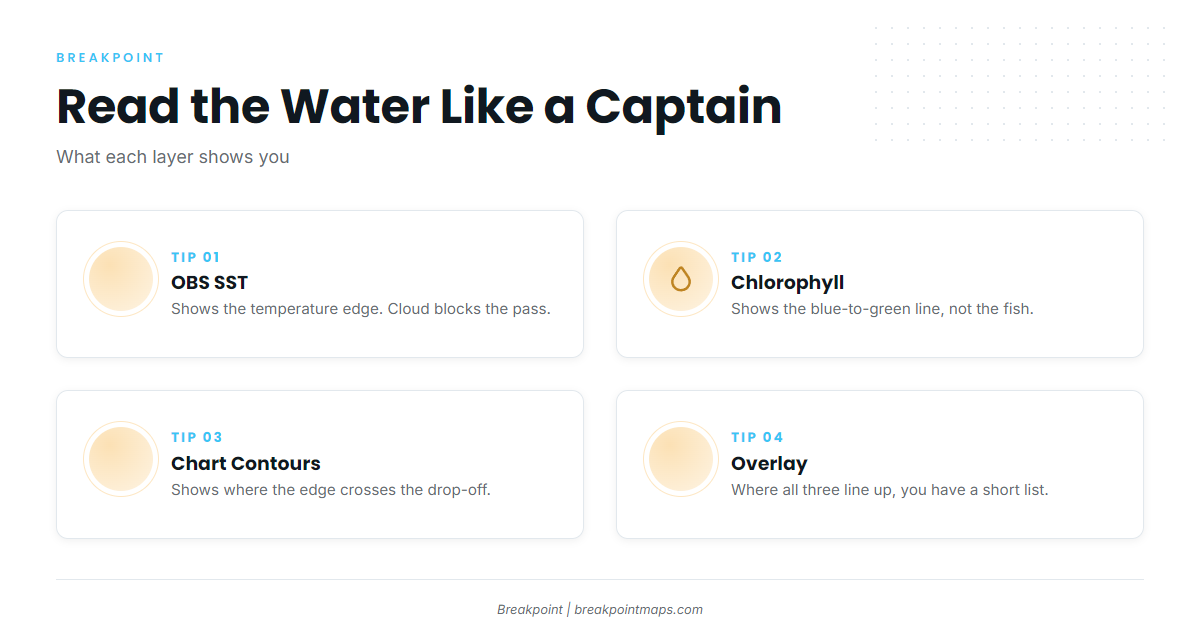
Read the water in this order: temperature, color and current, structure, bait, then the weather that triggers the bite.
Temperature edges
The Florida Museum puts sailfish in 70 to 83°F water. NC DMF narrows it to 77 to 82°F. A temperature break marks where two water masses meet. Bait collects on the seam, and sailfish hunt it. The edge matters more than the absolute number, so look for a change across a short distance.
Color change and current seams
The blue-to-green line is where Gulf Stream water meets shelf water. Current speed and direction change at the seam, and debris and bait line up along it. A sharp line means two water masses pressing hard against each other, and bait stacks tight. A diffuse line spreads the bait out, which leaves less to find.
Reef drop-offs off Southeast Florida
Where the Stream edge rides close to the reef, the drop concentrates current and bait. Sailfish sit on that edge and feed on what the current delivers.
Bait concentrations
Common baits off Southeast Florida include goggle eyes, threadfin herring and pilchards. FWC lists blue runners, pinfish, mullet, scads, ballyhoo and squid as baits that attract cruising sailfish.
Cold fronts and north wind
North wind blows against the north-setting Gulf Stream, and the sea stacks up. Fish travel and tail down-sea on the surface, which makes them easier to see. Wind against current changes the sea state, so read the forecast numbers.
Reading OBS SST, Chlorophyll and Chart Contours
Each layer shows one piece of the picture:
- OBS SST shows the temperature edge. Cloud blocks infrared SST, and a pass blocked by cloud shows nothing.
- Chlorophyll shows the blue-to-green line. It shows water color, not fish.
- Chart Contours show where the edge crosses the drop-off.
Where all three line up, you have a short list of places to look. In Breakpoint, these layers sit on the same chart so you can see where the edge crosses the drop. Chart layers are not for navigation, and no source can tell you where the fish are today.
How Anglers Fish for Sailfish Here
Methods follow the coast, and each fits a different stretch of water.
Kite fishing with live bait
A kite holds live baits at the surface, away from the boat. It is the norm south of Stuart.
Slow-trolled and drifted live bait
Work the edge or the drop with the current, and let the bait ride the seam.
Trolled ballyhoo with dredges
This is the standard from Stuart north and off the Carolinas. NC DMF’s bait list is the guide for the Carolina end.
Sight-casting to tailing fish
On north wind after a front, fish tail down-sea. Anglers run to them and cast.
Releasing the fish
In federal waters, a sailfish you plan to release stays in the water. The same applies in state waters if the vessel holds an HMS permit. Handle the fish in the water and keep it moving. The NOAA HMS compliance guide covers gear rules, so check it before you rig.
Plan the run on OBS SST and Chlorophyll. For wind, wave height and period, use the official National Weather Service marine forecast.
Guides to sailfish fishing from specific ports: Boynton Beach, Golden Isles, Hatteras Village, Charleston, Fernandina Beach, Savannah, Morehead City and Edisto Beach.
FAQ
Do I need an HMS Angling Permit for sailfish?
Yes, in federal waters. Florida does not require one for billfish in state waters. The permit covers the vessel.
Can you keep a sailfish?
Yes. It must measure 63" lower jaw fork length, the limit is 1 billfish per person per day, and you need the right permits. Then report it.
What is the minimum size?
63" lower jaw fork length, per FWC and the federal rules.
Can I take a sailfish out of the water for a photo?
Not if you plan to release it, in federal waters or on an HMS-permitted vessel in state waters.
How do I report a landed sailfish?
Report to NOAA within 24 hours, at 800-894-5528 or hmspermits.noaa.gov.
What water temperature do sailfish like?
70 to 83°F per the Florida Museum, and 77 to 82°F per NC DMF. Look for the edge.
When is the best time for sailfish off Southeast Florida?
Winter, driven by fronts and north wind. Summer spawning brings fish inshore, per FWC.
Do sailfish come off the Carolinas?
Yes. NC DMF records sport landings from May through October, in 120 to 300 feet of water.
Do I need a license on a charter?
Licensing depends on the state and the vessel. Check the state agency and NOAA HMS before you go.
What else bites on a sailfish day?
Live baits worked for sailfish also draw other pelagic fish. FWC’s bait list names blue runners, pinfish, mullet, scads, ballyhoo and squid as sailfish attractors.
If you want to see the temperature edge, the color line and the drop-off on one chart, download Breakpoint from the App Store or Google Play.