




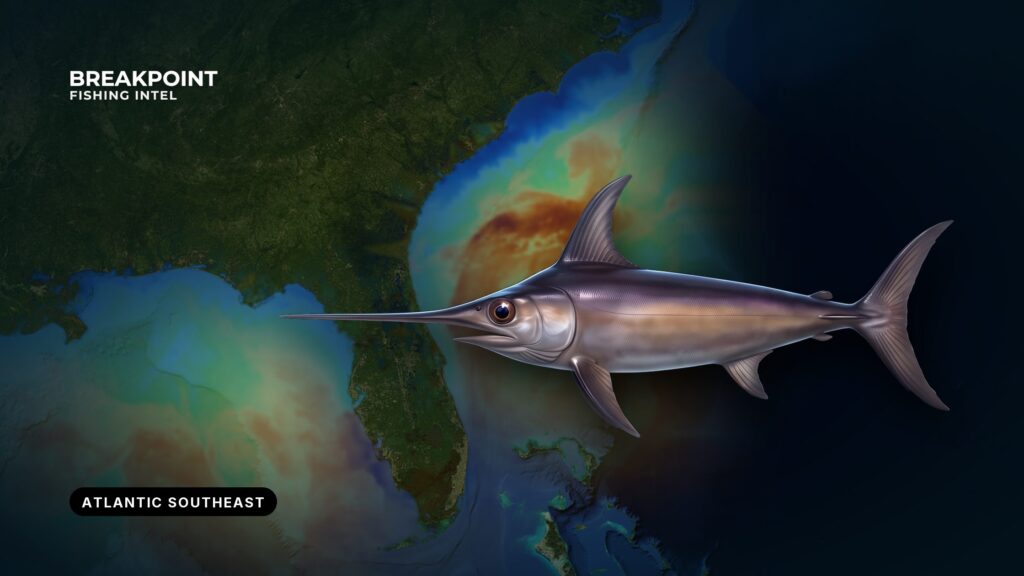
Off the Southeast coast, swordfish sit where the Gulf Stream runs over steep, deep bottom. They hold deep by day and rise at night, and that pattern drives decisions about where to run and how to rig.
This guide covers where and when the fish show up, what water and structure hold them, how the region fishes by day and by night, and how federal and state rules apply from North Carolina to the Florida Keys. It reads the water and the bottom to help you decide where to look. It does not promise fish.
Swordfish at a Glance
Broadbill swordfish (Xiphias gladius) have a flat bill, and adults have no scales. They are a highly migratory species that feeds largely on squid and fish. For identification and biology, see our swordfish species guide.
The Florida Straits are an important nursery area for North Atlantic swordfish. The most recent NOAA assessment finds the stock not overfished and not subject to overfishing, according to NOAA’s North Atlantic swordfish profile.
Where and When to Find Swordfish in the Atlantic Southeast
The region runs from North Carolina to the Florida Straits. The Gulf Stream hugs the coast in South Florida and pulls away farther north, which shapes every port’s fishery. For the wider picture of ports and water, see our Atlantic Southeast fishing guide.
Sub-Regions
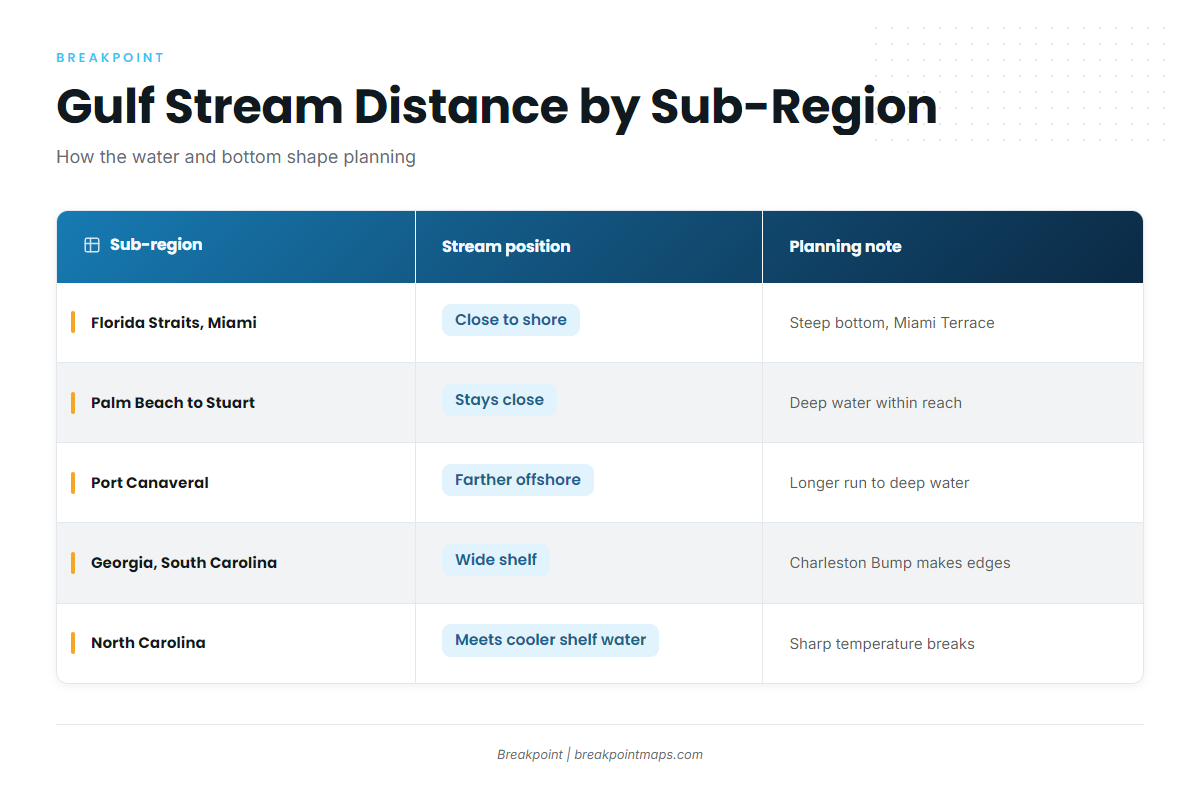
| Sub-region | What the water and bottom do | What that means for planning |
|---|---|---|
| Florida Straits and Miami | The Stream runs close to shore over steep, deep bottom. The Miami Terrace is a deep ledge system off Miami. The area is a known nursery. | Deep water is near the beach, so the run is short and the structure is plentiful. |
| Palm Beach to Stuart | The Stream stays close, and deep water sits within reach of center consoles. | Daytime deep-dropping is a well-established local fishery. |
| Port Canaveral | The shelf widens and the Stream sits farther offshore. | Expect a longer run to deep water than in South Florida. |
| Georgia and South Carolina, with the Charleston Bump | A wide shelf. The Charleston Bump is a rise of deep bottom offshore that deflects the Gulf Stream and creates eddies and edges. | The Bump is a reference point. Plan around where the Stream bends and where edges form. |
| North Carolina’s Gulf Stream edge | The Stream meets cooler shelf water, which produces sharp temperature breaks along the edge. | Fish the edge itself. Where it sits on a given day decides the trip. |
Seasonality and Movement
Swordfish are present in the region year-round. Fish move from warm-water spawning grounds to cooler feeding grounds to the north, and satellite tagging research on swordfish tracks their distribution shifting north along the U.S. East Coast from the Straits of Florida.
Fish that leave the Southeast show up on feeding grounds farther up the coast. For that fishery, see swordfish fishing in the Atlantic Northeast.
The Water and Structure That Hold Swordfish
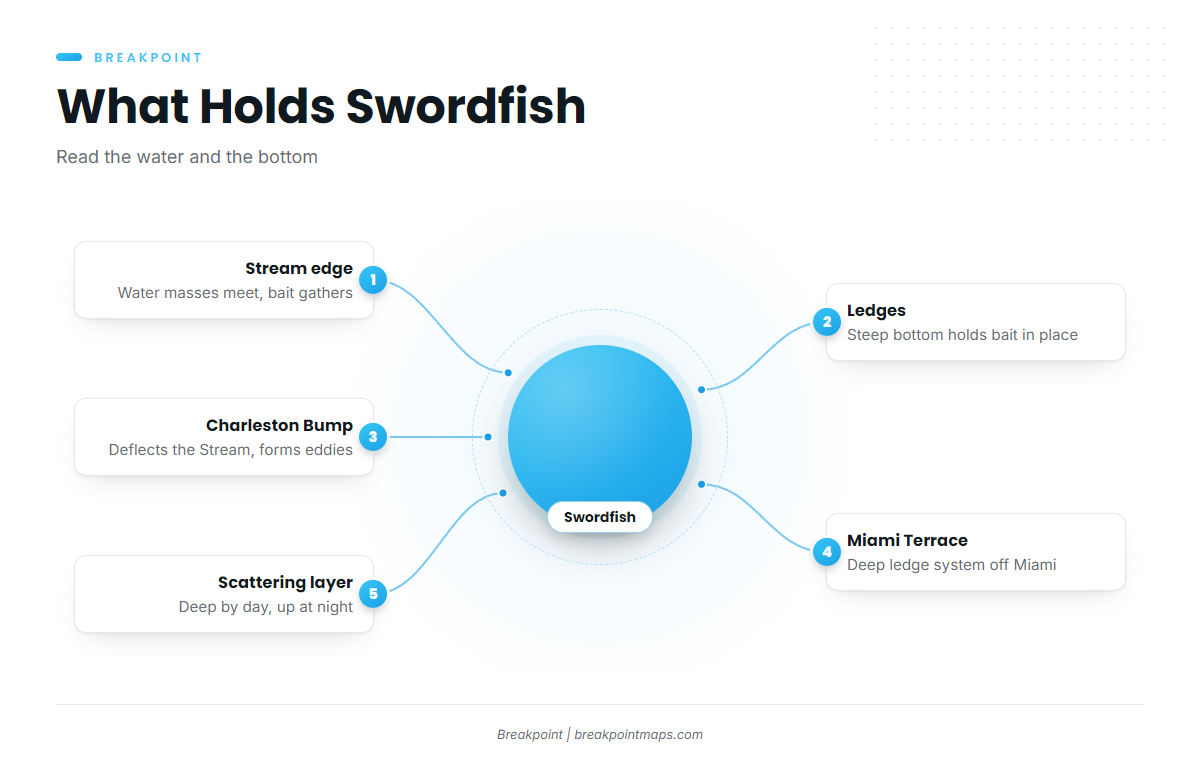
Three things set up a swordfish spot: a water-mass boundary, steep bottom, and the depth where the bait sits. Read them in that order.
The Gulf Stream Edge
Edges and temperature breaks mark where water masses meet. Bait concentrates along that boundary, and predators follow the bait, which makes the edge the main feature of the region. Current speed and direction along it also decide how your boat drifts, which matters again in the methods section.
Ledges, the Miami Terrace and the Charleston Bump
Steep bottom pushes current upward and holds bait in a predictable place. Ledges, drop-offs and rises give daytime fish a reference point.
- Miami Terrace: a deep ledge system off Miami, close to the Stream.
- Charleston Bump: a rise of deep bottom that deflects the Gulf Stream and sets up eddies and edges.
- Ledges and drop-offs: wherever the bottom steps down, current lifts and bait stacks.
- Humps and rises: isolated high spots that break the current and hold bait on their lee side.
Deep by Day, Shallow at Night
The deep scattering layer is a band of small fish, squid and plankton that holds deep in daylight and rises after dark. This daily movement is called diel vertical migration. Swordfish follow it, so they are deep by day and shallower at night.
For that reason the region runs two methods: fishing near the bottom over structure in daylight, and drifting the edge with baits at several depths after dark.
What the Data Shows and What It Cannot
Three layers in Breakpoint read this water:
- Chart Contours shows the ledges and drop-offs where daytime fish hold.
- OBS SST shows surface temperature breaks that mark the Stream edge.
- Chlorophyll shows color changes where water masses meet.
The data has limits. SST reads the surface, not the depth where daytime fish hold. Cloud can block a satellite pass. Deep-water bathymetry varies in resolution, and some shelves have never been surveyed finely. Chart layers are not for navigation.
How the Region Fishes for Swordfish: Day and Night
Daylight puts the fish deep, so anglers go down to them. At night the fish rise, and the approach shifts to drifting the edge.
Daytime Deep-Dropping
Daytime anglers fish a bait near the bottom over a ledge or drop-off. The standard setup has these parts:
- An electric reel to work the line from deep water.
- A breakaway weight that releases when a fish bites.
- A light above the bait.
- Squid or bonito strip baits.
Boat position decides the outcome. Manage drift against current and wind, and keep watching line angle and the rod tip. The bite at depth is subtle and easy to miss.
Nighttime Drifting
At night you drift along the Gulf Stream edge and stagger baits at several depths. Lightsticks or lights sit near the bait, balloons act as floats and strike indicators, and squid and other natural baits do the work.
Day vs. Night at a Glance
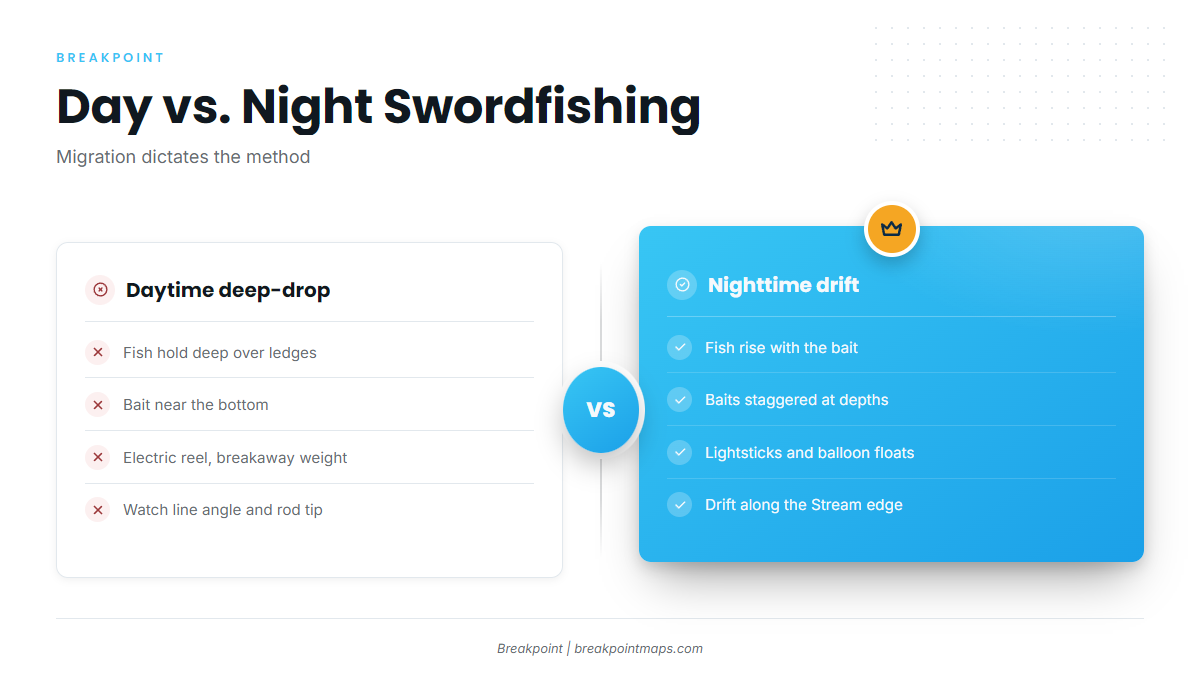
| Factor | Daytime deep-drop | Nighttime drift |
|---|---|---|
| Where the fish are in the water column | Deep, near structure | Shallower, following the rising bait layer |
| Presentation | Bait on or near the bottom with a light above it | Baits staggered at several depths with lights and balloons |
| Main variables | Current, drift and line angle | Current, drift and the position of the edge |
Before the Run
Check the official NOAA marine forecast for wind, wave height and period before you leave the dock, and read the numbers yourself. In Breakpoint, look at where the Stream edge sits in OBS SST the night before, then decide which sub-region and which ledge to fish.
Guides to swordfish fishing from specific ports: Boynton Beach, Hatteras Village, Georgetown, Fernandina Beach, Morehead City, Hilton Head Island, Fort Lauderdale and Sneads Ferry.
Frequently Asked Questions
Do I need an HMS permit to fish for swordfish?
Yes in federal waters. Use an HMS Angling permit on a private boat, or an HMS Charter/Headboat permit on a for-hire trip. The federal permit carries federal rules into state waters.
How many swordfish can I keep?
It depends on the permit. HMS Angling allows 1 per person, up to 4 per vessel per trip. A charter vessel on a for-hire trip allows 1 per paying passenger, up to 6 per vessel per trip. A headboat on a for-hire trip allows 1 per paying passenger, up to 15 per vessel per trip.
How is a swordfish measured?
The minimum is 47" LJFL, measured in a straight line from the tip of the lower jaw to the fork of the tail, with the head naturally attached. If the head is not attached, the minimum is 25" CK, measured along the curve of the body.
How do I report a swordfish?
Report within 24 hours at the NOAA HMS catch reporting page, through the HMS Catch Reporting App or by phone at (888) 872-8862. Tournament operators report tournament fish.
Can I sell a recreationally caught swordfish?
No. An Angling permit allows no sale. Charter/Headboat permits may not sell swordfish on for-hire trips.
Do federal rules apply in state waters?
Yes for federal HMS permit holders. The stricter rule wins, and federal and state limits do not stack.
Why do anglers fish so deep in the daytime?
Swordfish follow the deep scattering layer, which holds deep in daylight and rises after dark. In daylight the fish are deep, so anglers fish deep near structure.
How do Atlantic and Pacific swordfish rules differ?
Pacific swordfish fall under different federal management. See swordfish fishing in the Pacific Southwest for that coast.
To read the Gulf Stream edge, the ledges and the surface water before you pick a spot, download Breakpoint from the App Store or Google Play and open the Atlantic Southeast region. It shows why a spot is ranked and where the data cannot see.