




Swordfish fishing in the Pacific Southwest comes down to where the bait layer is and what edge is holding it. That answer shifts with the water, and this guide covers how to read it.
The area covered is the Southern California Bight from Point Conception south, plus the Channel Islands, Catalina and the outer banks. The ground is the same whether you run your own boat out of San Diego, Dana Point or Newport, or you are booking a first trip. For the wider picture, see our guide to Pacific Southwest offshore fishing.
Anglers here work three approaches: sight-fishing finners with harpoon or bait, daytime deep-drop, and night drifting. This guide explains why broadbill swordfish sit where they do, how to read OBS SST, Chlorophyll and Chart Contours into a drift decision, and how federal and state rules divide. None of it guarantees a bite, but it should help you decide where to look.
Swordfish at a glance
The broadbill swordfish is a deep-feeding billfish with a flat bill and no pelvic fins. It hunts squid and fish, following that prey up and down the water column every day: deep in daylight, higher at night. That habit explains most of the tactics below. For identification and full biology, see our swordfish species guide.
Swordfish share offshore grounds with striped marlin, so a day out here can involve more than one of the billfish species.
- Where: Southern California Bight banks, slopes and canyons
- How: finners, daytime deep-drop, night drift
- What drives it: the deep scattering layer and surface edges
- License: California sport fishing license for anglers 16 and older
- California bag limit: 2 broadbill per person (details in Regulations)
Where and when
The ground is the Southern California Bight, with Point Conception as the northern corner. Inside it are the Channel Islands, Catalina, and the outer banks, including Tanner and Cortes Banks. Productive ground is defined by shape: bank slopes and canyon walls where deep bait collects. San Diego, Dana Point and Newport are the common departure ports.
Timing follows warm water. Fish show up as warm water arrives and the fall pattern sets in, and the timing moves from year to year with ocean conditions. Daytime deep-drop works whenever the bait layer and fish are present, because it does not depend on fish showing at the surface.
The recreational fishery has traditionally been sight-based. According to CDFW’s swordfish species profile, anglers find a finning fish and present live Pacific mackerel, dead squid or live California barracuda. The deep-drop method arrived off California in the late 2010s. Commercial take is by harpoon and deep-set buoy gear.
Water and structure
Read the water in this order: the layer, the fish, the surface signals, the bottom, then the limits of the data.
The deep scattering layer sets the depth
Squid and small fish rise toward the surface at night and sink deep by day. This is the deep scattering layer, and swordfish follow it. Three patterns come from that:
- Deep daytime fish. This is why deep-drop works.
- Fish higher in the column at night. This is why night drifting works.
- Fish that come up to bask. These are the finners.
We print no layer depths here. Find the layer on your sounder, where it shows up with the bottom in the same picture.
Surface signals: temperature breaks and chlorophyll edges
A temperature break and a chlorophyll edge, which shows as a color change, each mark a meeting of water masses. Bait gathers there. The edge matters most over a bank slope, where currents meet rising bottom and the layer stacks against the structure.
Bottom features: bank slope and canyon edge
The bank slope, canyon edge and ridge wall are where the layer holds. A small canyon cutting across a ridge wall often concentrates deep bait, so a drop in that zone is worth the time. The sounder is the most important instrument you own for this work.
Elephant seals hunt squid, so a seal sighting is a reason to stop and drop.
Reading the layers in the app
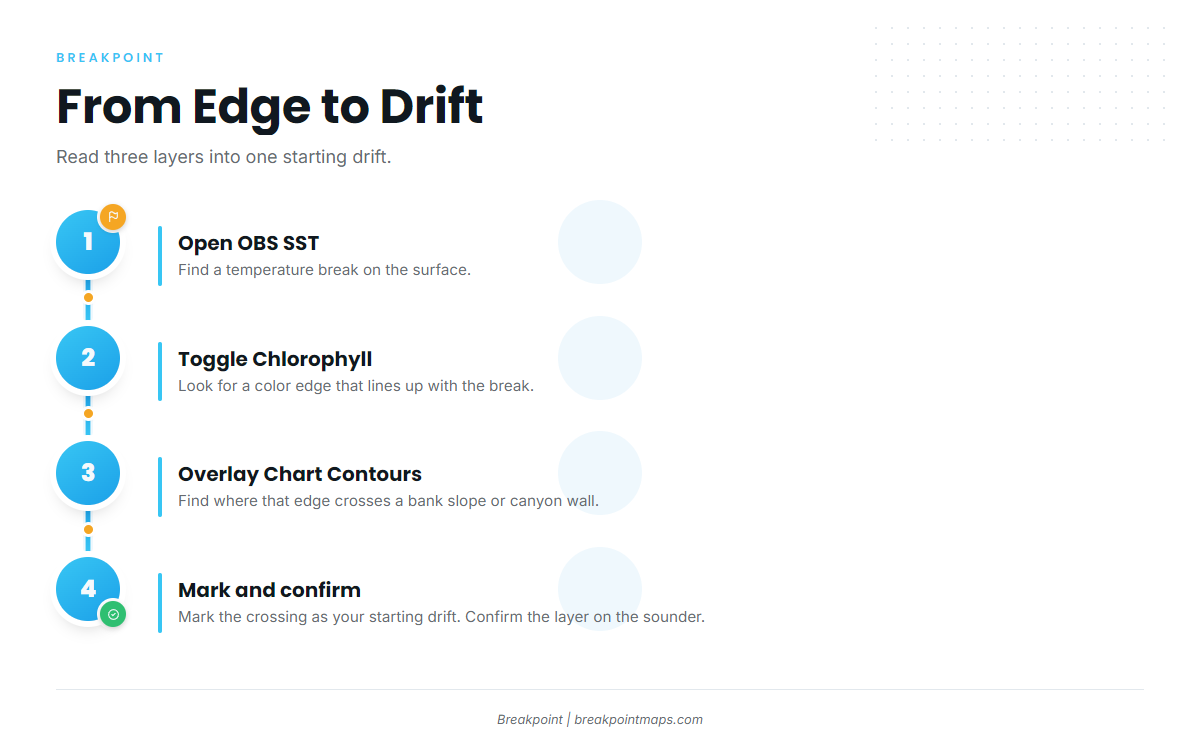
You can build a drift from the night before:
- Open OBS SST and find a temperature break.
- Toggle Chlorophyll and look for a color edge that lines up with it.
- Overlay Chart Contours and look for where that edge crosses a bank slope or canyon wall.
- Mark that crossing as your starting drift, then confirm the layer on the sounder.
Chart layers are not for navigation.
What the data can’t see
Cloud blocks OBS SST passes, so a missing edge may simply be cloud. Chlorophyll shows the surface, not the layer at depth. Forecasts also miss, so check the NWS marine forecast for wind, wave height and period before you go.
How anglers fish for swordfish here
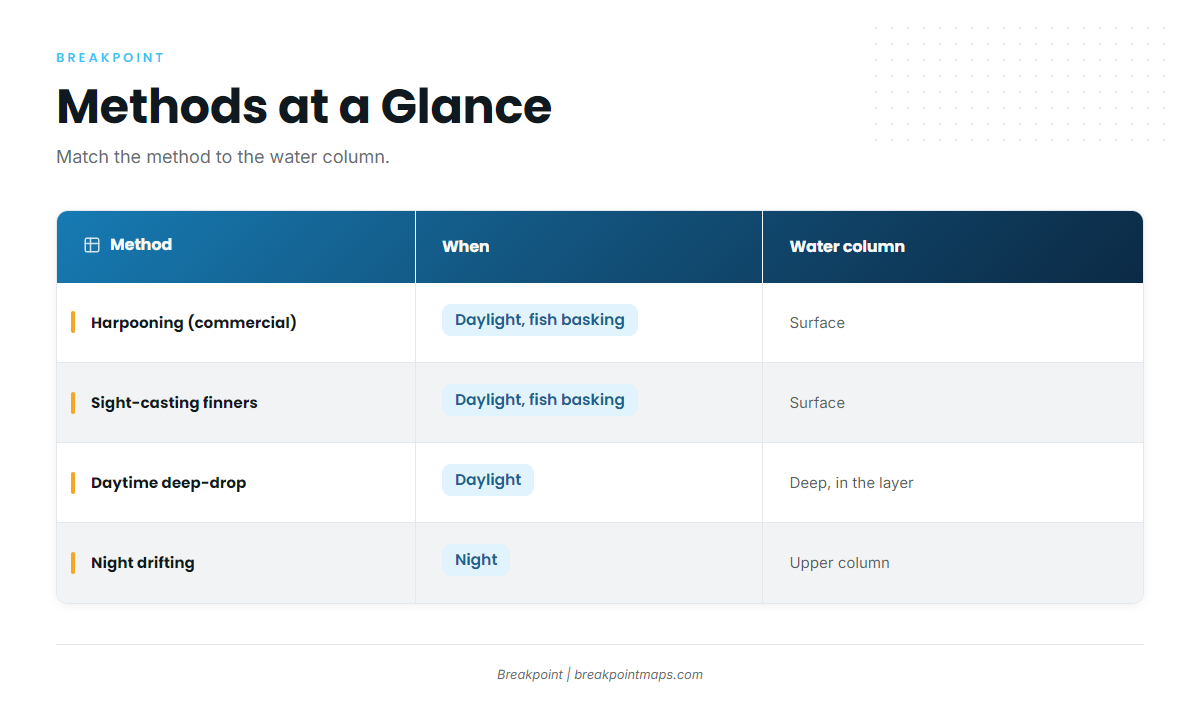
Each method below matches the depth of the bait layer at a different time of day. The comparison table follows the descriptions.
Harpooning finners and sight-casting
Both start the same way: scan for a fin and bill at the surface, then approach and present. Sight-casters offer live mackerel, dead squid or live barracuda. Commercial take is by harpoon and deep-set buoy gear, and the shift away from drift gillnets has raised interest in the buoy gear.
California does not allow harpoons to take broadbill recreationally, and harpoons can’t be aboard on a day swordfish or marlin is taken. See Regulations below.
Daytime deep-drop
The method runs like this:
- Send the bait down. The weight takes it to where the bait layer sits on your sounder.
- Touch bottom, then crank off bottom into the layer.
- Manage the drift along the slope.
- Watch the rod tip for a subtle bite.
The rig is squid bait on a circle or J hook, a mono leader, lights, a breakaway weight, and braid on an electric reel.
The Gulf has its own deep-drop off the Gulf fishery, and Florida’s daytime fishery is long established. The West Coast method is younger.
Night drifting
Run lights on the baits and stagger them higher in the column as the layer rises. Drift over slope edges. The East Coast parallel is canyon night drifting in the Northeast.
Methods compared
| Method | When | Where in the water column | Key gear |
|---|---|---|---|
| Harpooning finners (commercial) | Daylight, fish basking | Surface | Harpoon (commercial only) |
| Sight-casting finners | Daylight, fish basking | Surface | Live mackerel, squid or barracuda |
| Daytime deep-drop | Daylight | Deep, in the layer near the bottom | Electric reel, braid, breakaway weight, lights |
| Night drifting | Night | Upper column, with the risen layer | Lights, staggered baits |
Before you pick a drift, check where the OBS SST and Chlorophyll edges cross the Chart Contours in the app.
Guides to swordfish fishing from specific ports: Avalon, Oceanside and Ventura.
FAQ
Do I need a California fishing license on a charter?
Yes. Anyone 16 or older needs a California sport fishing license. South of Point Arguello you also need an Ocean Enhancement Validation, unless you hold a 1-day or 2-day license. CDFW sets these requirements.
Do private boats need an HMS permit?
The NOAA Fisheries requirement names commercial and charter vessels. Private recreational vessels are not named. Check the NOAA Fisheries page before you fish.
What is the swordfish bag limit in California?
2 broadbill per person. There is no federal recreational limit. CDFW enforces the limit under Title 14.
Can I carry a harpoon while swordfishing?
Not to take broadbill. Harpoons can’t be aboard on a day swordfish or marlin is taken. CDFW’s Title 14 sets the rule.
Is there a minimum size for swordfish?
No. The California rules set no minimum size, and the season is year-round.
Is daytime deep-drop or night fishing better for a first fish?
Daytime deep-drop reaches fish deep along slopes in daylight. It is the newer, common approach. Night drifting meets the risen layer. On a charter, the crew handles the rigging.
How does West Coast swordfishing differ from the East Coast?
Florida’s daytime fishery and the Northeast canyon night fishery are long established. California’s deep-drop method dates from the late 2010s, and its fishery has traditionally been sight-based.
Conclusion
Swordfish follow the deep scattering layer, and the layer gathers along surface edges and structure. The night before a trip, find where a surface edge crosses a bank slope or canyon wall, then confirm it on the sounder.
To see that on one map, download Breakpoint from the App Store or Google Play and check how OBS SST, Chlorophyll and Chart Contours line up for your port.