




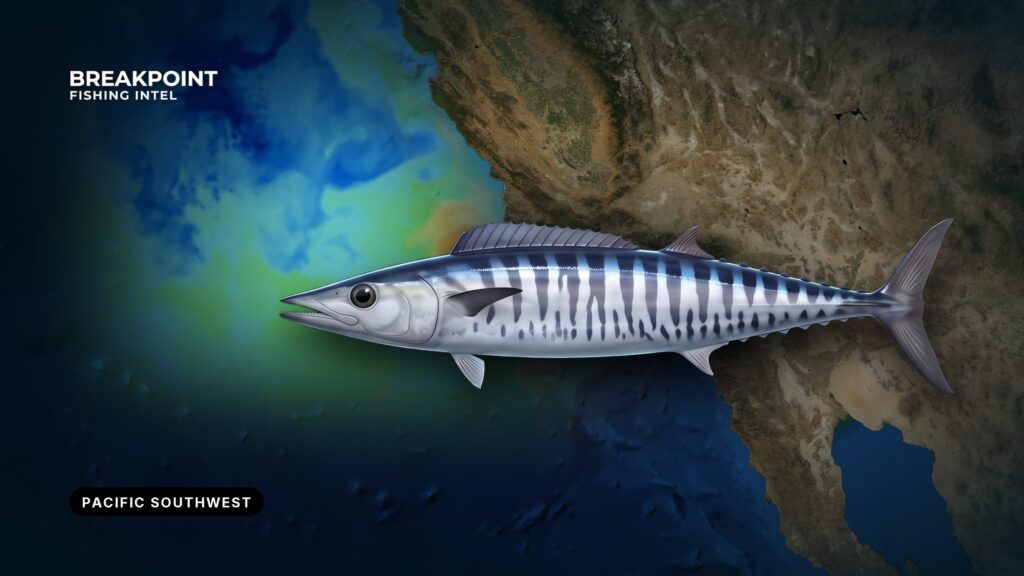
Wahoo fishing in the Pacific Southwest depends on warm water. Off Southern California, wahoo show up only when warm water pushes north. The dependable fishing is south, on the long-range grounds off Baja that San Diego boats run to.
This guide covers where and when wahoo show, the water and banks that hold them, how local boats fish them, and how federal and state rules divide. The odds are modest: a Southern California wahoo is an occasional warm-water bonus, not a fish you plan a day around. They ride the same warm water as the region’s yellowfin tuna and dorado fishing, and you read that water the same way.
Where and When Wahoo Show in the Pacific Southwest
Wahoo are warm-water predators. They reach Southern California in warm-water years, including El Niño years, when warm water pushes north. The timing is late summer into fall, once that water arrives. In some years it never does.
The pattern is straightforward:
- Warm water arrives: wahoo follow it north.
- Warm water stays offshore or south: they stay out of range.
- Timing: late summer into fall, never guaranteed.
Southern California
The grounds anglers associate with warm-water wahoo are 9-Mile Bank, Butterfly Bank, San Clemente Island and Catalina. When the water is right, look there. When it isn’t, no amount of running will produce a bite.
Most Southern California wahoo come as a bonus on yellowfin tuna and dorado trips. If you treat the fish as a possibility inside a tuna day, you’ll make better decisions about where to troll.
Long-range grounds off Baja
Most of the wahoo brought back to San Diego come from the San Diego long-range wahoo grounds: The Ridge and Alijos Rocks. Alijos is an isolated outcropping that concentrates offshore life of all kinds, with open water in every direction.
The long-range season runs later and longer than Southern California’s, from late summer into fall. Operators also run to other southern grounds, including Hurricane Bank and the Revillagigedos.
| Area | How wahoo show | What to expect |
|---|---|---|
| 9-Mile Bank, Butterfly Bank | Only when warm water pushes north | Occasional fish, never guaranteed |
| San Clemente Island, Catalina | Warm-water years | Bonus fish on tuna and dorado trips |
| The Ridge, Alijos Rocks | Most long-range wahoo | Later and longer season |
Water and Structure That Hold Wahoo
Start with the water, then the structure.
A temperature edge, or SST break, is where two water masses meet. Bait stacks along that seam, and wahoo work the bait. A color break marks where productive green water meets clean blue water, and fish hold on the blue side of that line more often than not.
Banks and high spots push water up and hold bait. Where an edge crosses a bank is the best place to start.
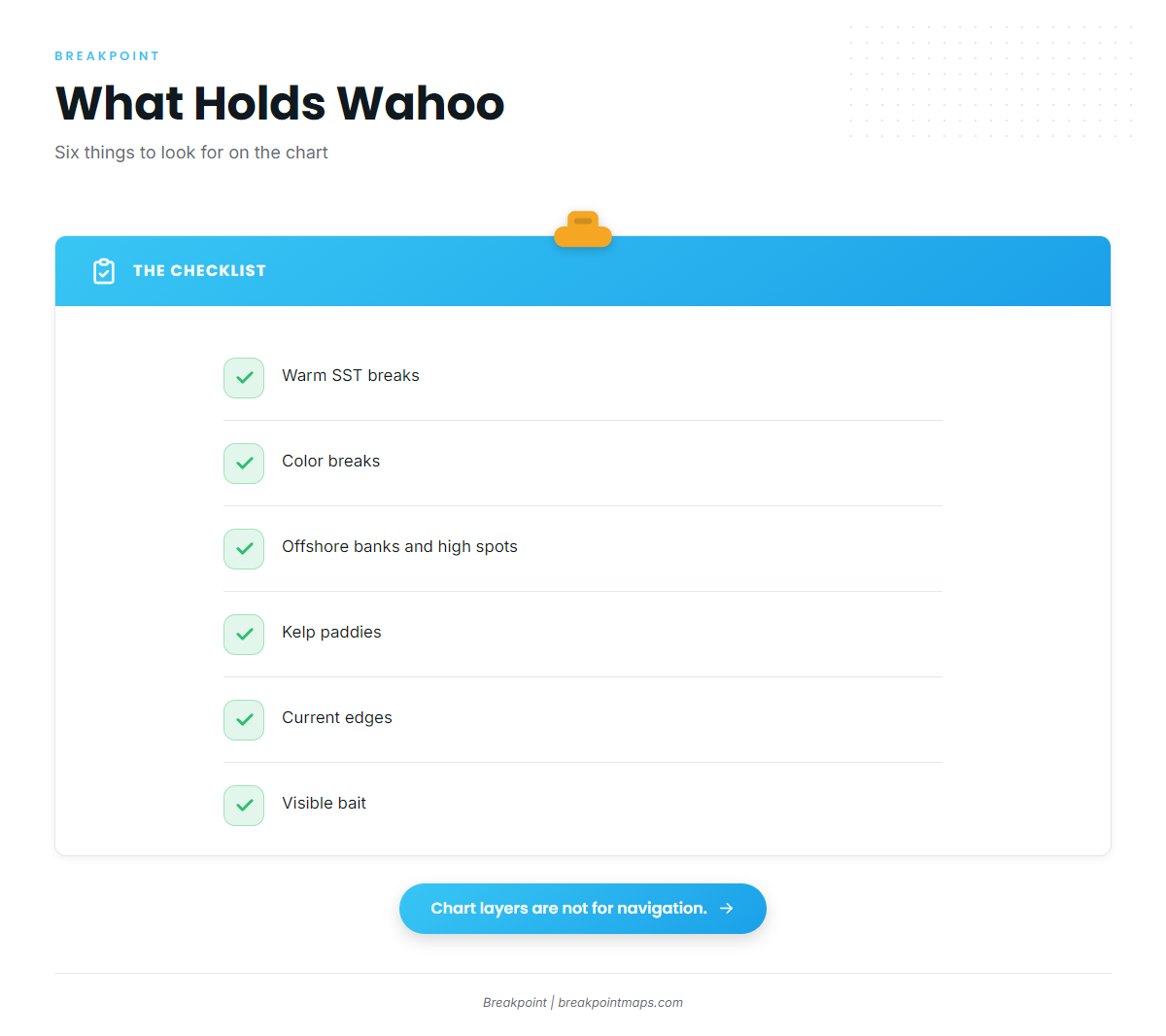
What holds wahoo:
- Warm SST breaks: the seam between warm and cooler water.
- Color breaks: green water meeting clean blue.
- Offshore banks and high spots: structure that lifts water and stacks bait.
- Kelp paddies: floating cover that gathers bait.
- Current edges: lines that concentrate food.
- Visible bait: birds, sonar marks and breaking fish.
Build the plan the night before:
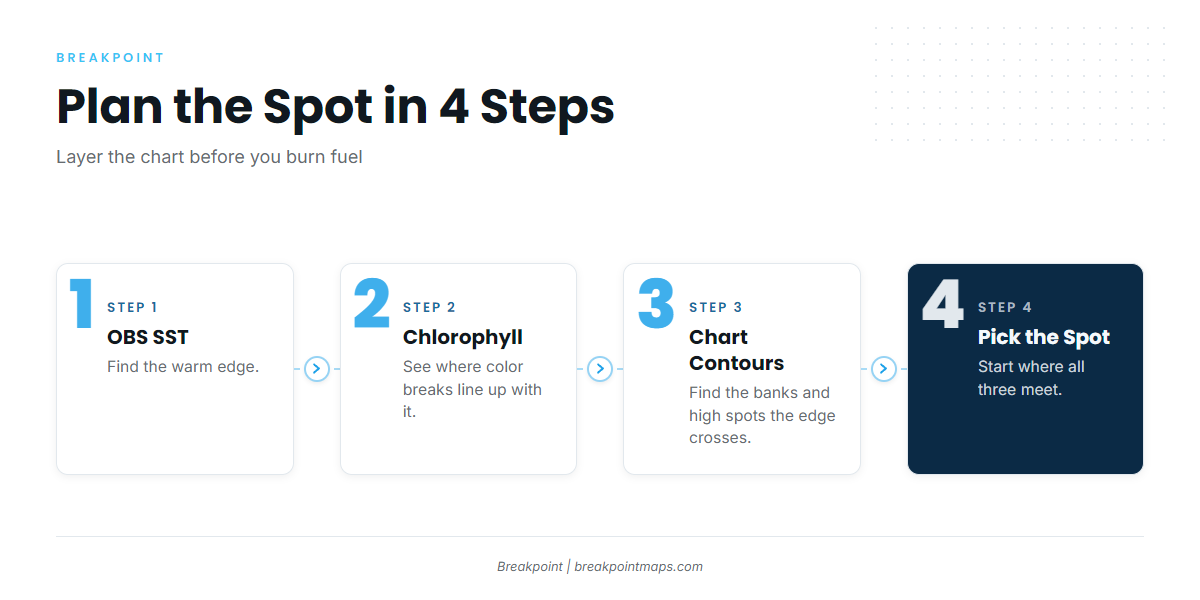
- Check OBS SST for the warm edge.
- Lay Chlorophyll over it to see where the color breaks line up.
- Turn on Chart Contours to find the banks and high spots that edge crosses.
- Pick the spot where all three meet.
The data has limits. Cloud blocks satellite SST passes, and chlorophyll shows color rather than fish. Bathymetry on offshore banks varies in survey age, and where the seabed has never been surveyed, the contours say nothing. Chart layers are not for navigation.
How Anglers Fish for Wahoo Here
West Coast boats lean on West Coast iron and bombs, meaning heavy jigs and purpose-built wahoo bombs. High-speed trolling is more of an East Coast and Caribbean habit. Wahoo here usually turn up as a bonus on other offshore gamefish trips, so the tackle is built around being ready, not around a dedicated wahoo day.
Private boats off Southern California
Trolling for wahoo means running well above a tuna troll speed. Keep a wahoo-ready lure, such as a Marauder-style plug, in the tuna spread so a fish that shows up can be hooked.
A ready kit looks like this:
- High-speed lures and bombs: plugs for the spread, bombs for casting at working fish.
- Single-strand wire, kept short: teeth cut mono.
- A heavy shock leader: it takes the first run and the abrasion.
- Fast-retrieve reels for iron: you need line speed when fish are on top.
There is a trade-off. Wire stops bite-offs. Fluorocarbon may draw more strikes but loses fish to teeth. Most boats choose wire.
Long-range boats
On long-range trips, wahoo come on yo-yo iron, wahoo bombs and live bait while the boat fishes for tuna. Some irons work better in calm water and others when it’s rough, so bring several weights.
Pack for the trip:
- Several iron weights for calm and rough water.
- Spare wire, crimps and extra leaders.
Ask the operator for the boat’s own tackle list before you book. Bleed and ice wahoo promptly to keep the meat firm.
Multi-day trips also bring California’s multi-day declaration into play, which changes how many daily limits you can keep. The details are in the Regulations section below.
Wahoo Identification and Biology
Wahoo are long and narrow, with tiger-stripe barring down the sides and a beak-like jaw full of teeth. They are often confused with king mackerel and barracuda. They are fast, toothy members of the mackerel and tuna family.
For the full breakdown of identification, biology and range, see the full species guide.
When warm water comes north, pull up the edge before you burn the fuel.
Guides to wahoo fishing from specific ports: Channel Islands Harbor, Dana Point, Mission Bay, San Diego and San Francisco Bay.
FAQ
When is wahoo season off Southern California?
Late summer into fall, and only when warm water arrives. Some years it never does. The long-range season off Baja runs later and longer than Southern California’s.
How fast do you troll for wahoo?
Well above a tuna troll speed. Run fast enough to cover water while your lures still swim cleanly. A plug that spins out or skips is running too fast.
Wire or fluorocarbon for wahoo?
Short single-strand wire stops bite-offs. Fluorocarbon may draw more strikes but loses fish to teeth. Most boats choose wire.
Can I keep a wahoo caught in the federal EEZ off California?
No federal rule limits it. Wahoo is not on the Pacific HMS plan’s species list, so no federal recreational bag limit applies in the EEZ off California. California limits govern fish landed in California, so check CDFW’s General Provisions page.
Do I need a Mexican fishing license on a long-range trip?
Mexican rules apply in Mexican waters. Confirm with Mexico’s fisheries authority and your operator before you sail.
How do multi-day limits work on California boats?
With a filed declaration, you can keep up to three daily limits, but only one daily limit per calendar day. The trip must be continuous, with 12 hours or more on the first and last days and no docking within five miles of the mainland. Details are in the Regulations section above.
How do I tell a wahoo from a king mackerel?
Look for tiger-stripe barring and a beak-like jaw full of teeth on a long, narrow body. Barracuda have a different head shape and no barring. For the full set of cues, see the wahoo identification details.