




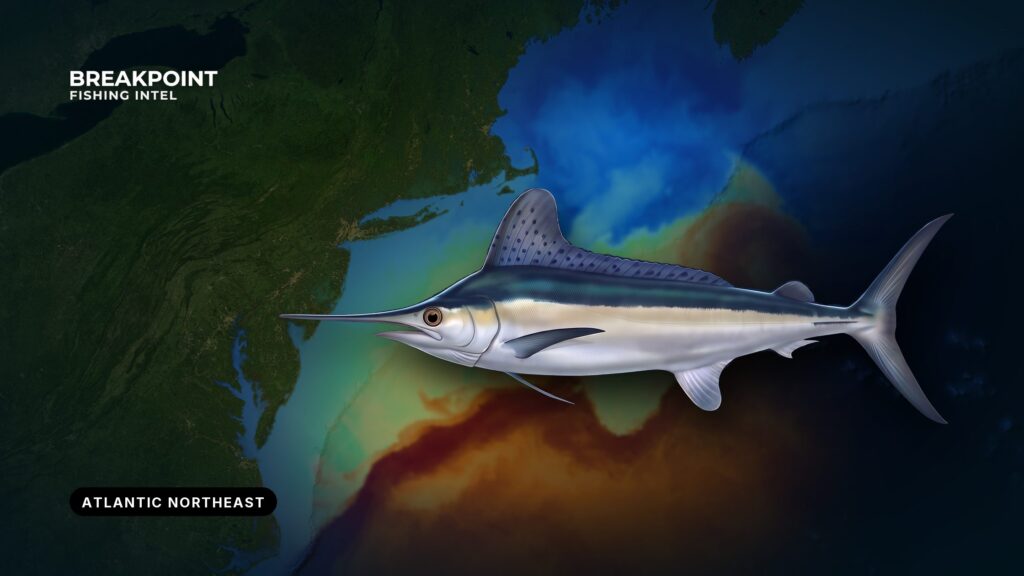
White marlin fishing in the Atlantic Northeast comes down to finding where clean blue water meets canyon structure. The fish arrive with summer Gulf Stream water and work the shelf edge and canyons between Cape Hatteras and Cape Cod. Maryland DNR white marlin facts put the largest fishery in the summer between those two capes. This guide covers where the fish sit, the water that holds them, how crews fish them, and how federal and state rules divide. None of it promises fish, but it narrows where to look.
Identification and Biology in Brief
The white marlin has rounded tips on the first dorsal and first anal fins. A blue marlin’s fin tips are pointed, and the blue is the larger fish. The roundscale spearfish is the lookalike, easily mistaken for a white marlin in the spread and at the boat.
Maryland DNR lists a maximum length of 110 in and a maximum weight of approximately 180 lb. Fish more commonly run 51 to 83 inches. Scale counts, vent position and the rest of the identification, lookalike and biology detail are in our white marlin guide.
Where and When
Timing runs south to north. The southern canyons off Virginia and Maryland see fish first, early in summer. The bite pushes north to the Hudson and the New England canyons as warm water and eddies reach them in late summer. Fish retreat south as the water cools in fall, which is the southern half of the migration. Seasons vary from year to year, so treat the order as a pattern rather than a calendar.
The same canyon trips produce yellowfin tuna, bigeye tuna, mahi and wahoo. That is the wider Atlantic Northeast offshore picture, and it shapes which baits you pull.
White marlin push farther inside onto the shelf than blue marlin do. They are commonly found inside the 30-fathom curve south of Cape Cod and occasionally turn up in state waters off Massachusetts, Rhode Island and New York. The Jack Spot off Ocean City is the best-known inshore lump. Ocean City is also home to the White Marlin Open, a regional reference point for the fishery.
Canyons and Ports
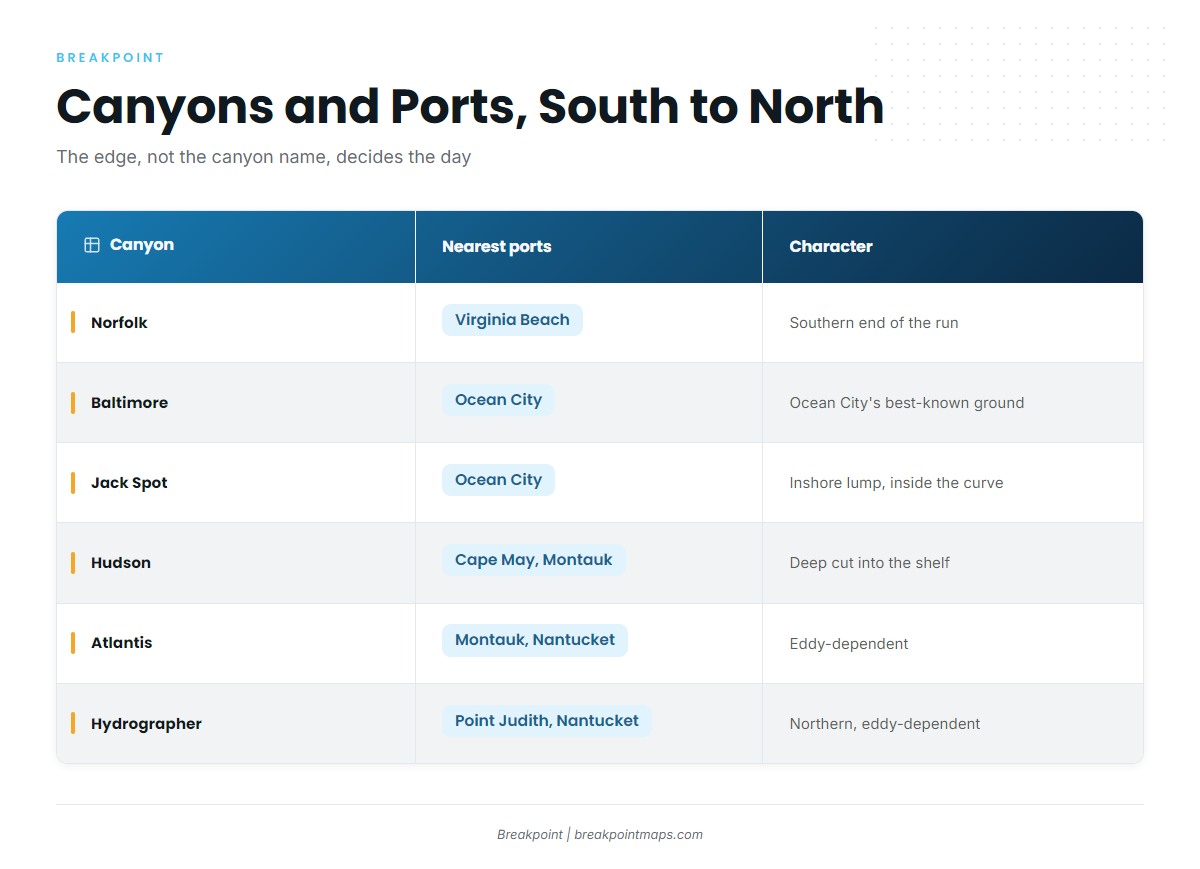
The table runs south to north. The edge, not the canyon name, decides the day.
| Canyon | Nearest ports | Character |
|---|---|---|
| Norfolk | Virginia Beach | Shelf-edge canyon head, southern end of the run |
| Washington | Virginia Beach, Ocean City | Shelf-edge canyon head |
| Poor Man’s | Ocean City | Shelf-edge canyon head |
| Baltimore | Ocean City | Shelf-edge canyon head, Ocean City’s best-known ground |
| Jack Spot | Ocean City | Inshore lump, inside the curve |
| Wilmington | Ocean City, Cape May | Shelf-edge canyon head |
| Hudson | Cape May, Montauk | Large canyon cutting deep into the shelf |
| Block | Montauk, Point Judith | Shelf-edge canyon head |
| Atlantis | Montauk, Point Judith, Nantucket | Shelf-edge canyon head, eddy-dependent |
| Hydrographer | Point Judith, Nantucket | Northern shelf-edge canyon, eddy-dependent |
Chart Contours shows each canyon head against the 100-fathom curve. Chart layers are not for navigation.
Water and Structure
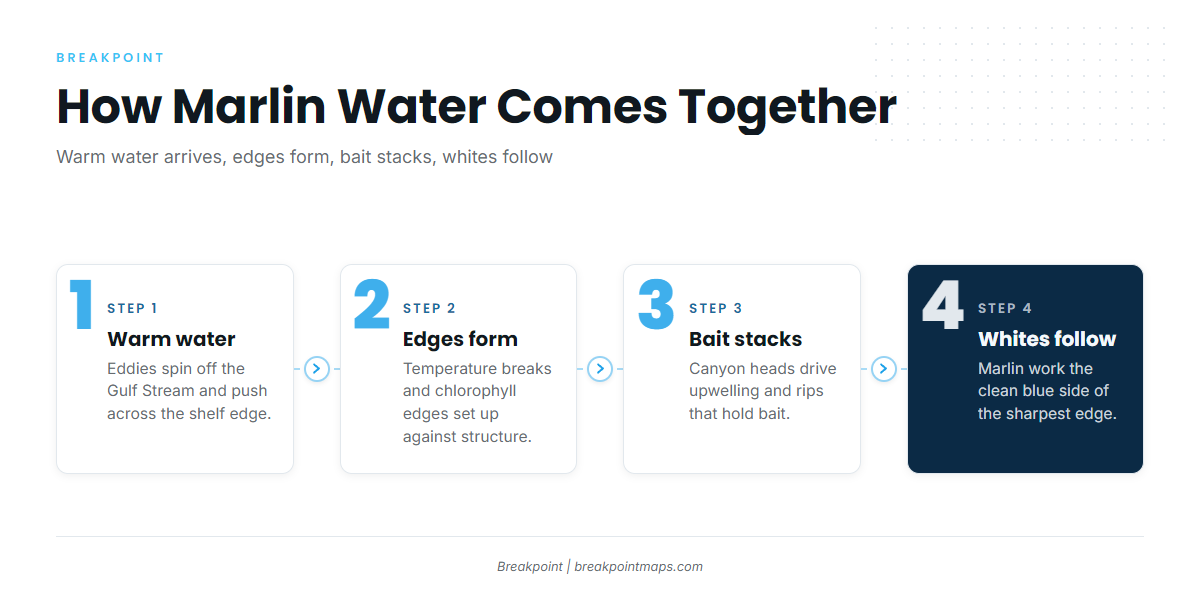
Warm water arrives first. Edges form where it meets cooler water and bottom structure, bait stacks on those edges, and white marlin follow the bait.
Temperature Breaks
A sea surface temperature break is where Gulf Stream or eddy water meets cooler shelf water. Bait and predators work the warm side of a sharp break. A tight gradient is better than a gradual one, so look for the sharpest gradient near structure.
Color and Chlorophyll Edges
A chlorophyll edge separates green shelf water from clean blue water. White marlin favor the clean side of a color change, and the best edges line up with a temperature break.
Warm-Core Eddies
Warm-core eddies spin off the Gulf Stream and rotate clockwise. That rotation pulls warmer, bluer water across the shelf edge and into canyon heads, which is why the northern canyons light up. Watch the water south of Nantucket, over Atlantis and over Hydrographer.
Canyon Heads, the 100-Fathom Curve and Inshore Lumps
A canyon head marks a sharp change in depth. That change drives upwelling and surface rips, and the rips hold bait. The 100-fathom curve is the common reference line for the shelf edge. Lumps such as the Jack Spot hold fish inside the curve when blue water pushes up onto the shelf.
Bait
Birds, slicks, bait on the sounder and flying fish all mark a working edge. They confirm an edge you have already picked rather than tell you where to start.
Reading the Layers Together
Lay OBS SST over Chlorophyll and Chart Contours to see where a clean edge crosses a canyon head. Start with the canyon where both edges converge on the head. Chart layers are not for navigation.
The data has limits:
- Cloud blocks an infrared SST pass, so check the pass time and coverage.
- SST shows the surface skin, not the thermocline.
- Chlorophyll lags and smears near fronts.
- Bottom contours come from surveys, and some are old.
The layers narrow the choice but do not promise fish.
How Anglers Fish for Them
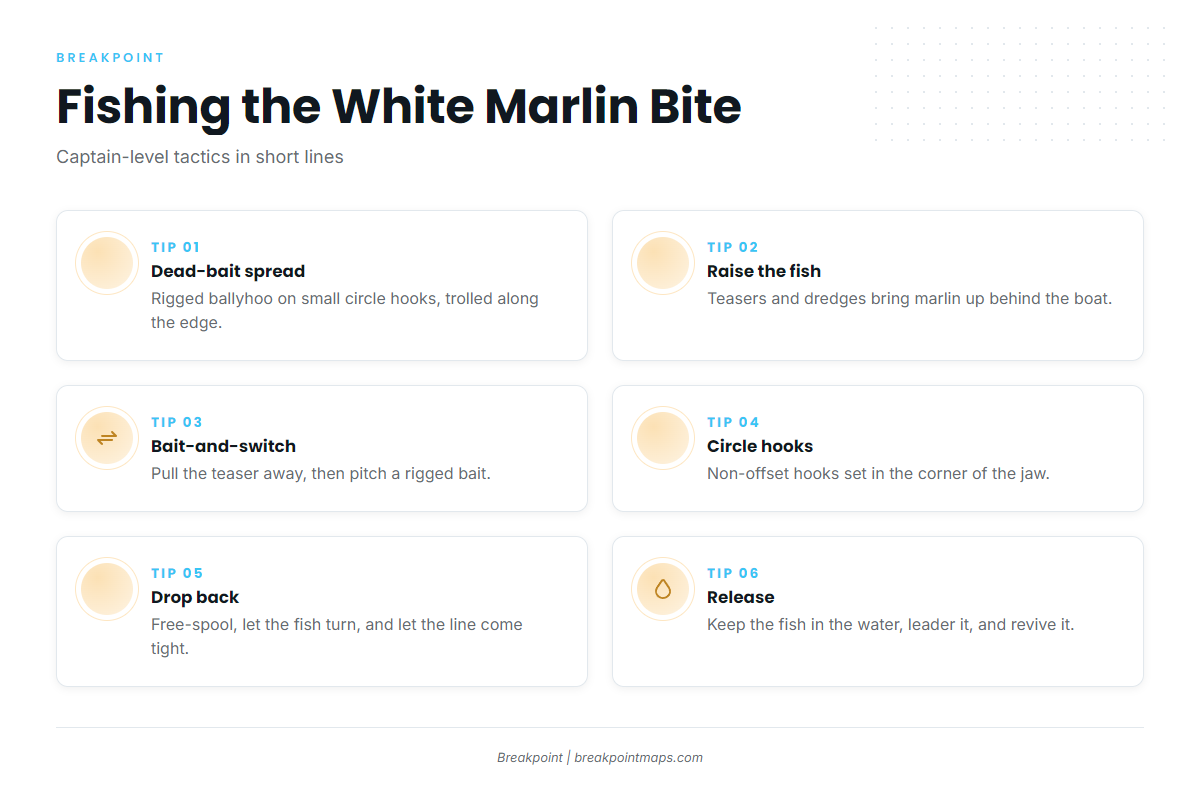
The standard approach is a dedicated dead-bait trolling spread: rigged ballyhoo, small to medium skirted baits, small circle hooks and light tackle. Crews pull it along temperature breaks and canyon drop-offs. Some seasons the fish favor live bait and others dead bait, so stay flexible.
Teasers and dredges raise the fish. Bridge teasers built from squid chains, ballyhoo or chuggers work well, and a staggered spread with flat lines, outriggers and a teaser or dredge gives more shots. Then comes the bait-and-switch: the crew raises the fish on a teaser, pulls the teaser away and pitches a rigged bait on a circle hook.
The hook matters. A non-offset circle hook has its point in the same plane as the shank, so it sets in the corner of the jaw as the line comes tight. That helps hookups in a bony mouth and helps survival after release. J-hooks often fail to hold in that mouth. Spreads and circle-hook rigging across billfish goes deeper on both.
White marlin slap at baits without committing. Give the fish a free-spool drop-back and let it turn. With a circle hook, do not strike hard; let the line come tight. Once hooked, keep the fish in the water, leader it and revive it before release.
Planning the Run
Plan fuel for the run out, a full day of hunting along the edge, the run home and a reserve. Choose north or south by where the edge sits, not by habit. An eddy parked on Atlantis can beat a washed-out Baltimore, and the reverse holds too. Most of white marlin fishing in the Atlantic Northeast is that decision, made the night before.
Before you commit, compare the forecast wind, wave height and period with your boat’s limits. Use the NWS offshore forecast, and remember a forecast is a forecast. Check the edge before you commit the fuel.
Guides to white marlin fishing from specific ports: New London / Waterford, Indian River Inlet, Ocean City, Falmouth / Woods Hole, Atlantic City, Shinnecock, Oregon Inlet and Block Island.
FAQ
When is white marlin season in the Northeast canyons?
Summer into early fall. The southern canyons see fish first, and the bite moves north as eddies arrive. Timing varies from year to year, so use the pattern as a guide rather than a calendar.
Can you keep a white marlin?
Legally, sometimes. In practice, most are released. Retention requires an HMS permit, a fish that meets NOAA’s minimum size and landings within NOAA’s limits. Check NOAA HMS for current figures before you fish.
Do I need an HMS permit on a charter?
The charter boat carries the HMS Charter/Headboat permit. Private boats need an HMS Angling permit. State license exemptions for charter passengers vary. Maine and New Hampshire exempt them, and New Jersey’s registry applies to anglers 16 and older.
How do you tell a white marlin from a roundscale spearfish?
They are hard to separate at the boat. A white marlin has rounded tips on its first dorsal and anal fins. The scale and vent details that settle it are in our white marlin guide.
Why circle hooks?
Non-offset circle hooks set in the corner of the jaw. That improves survival after release and holds in a bony mouth. Federal rules also require them in billfish tournaments when you fish natural bait, so check the NOAA compliance guide.
How far offshore are white marlin from Ocean City or Montauk?
The ground depends on where the edge sits that day, so think in canyons rather than miles. Out of Ocean City, work Poor Man’s, Baltimore, Washington and Wilmington canyons, plus the Jack Spot inside the curve. Out of Montauk, work the Hudson, Block and Atlantis canyons.
What else do you catch on a white marlin trip?
Yellowfin tuna, bigeye tuna, mahi and wahoo, on the same edges.
Planning Your Next Run
The decision behind white marlin fishing in the Atlantic Northeast is which edge, on which canyon, on which day. Breakpoint reads the same public ocean data a captain would and ranks the best places for the species you want. If you fish this coast, download Breakpoint from the App Store or Google Play and see where the edge sits before you commit the fuel.