




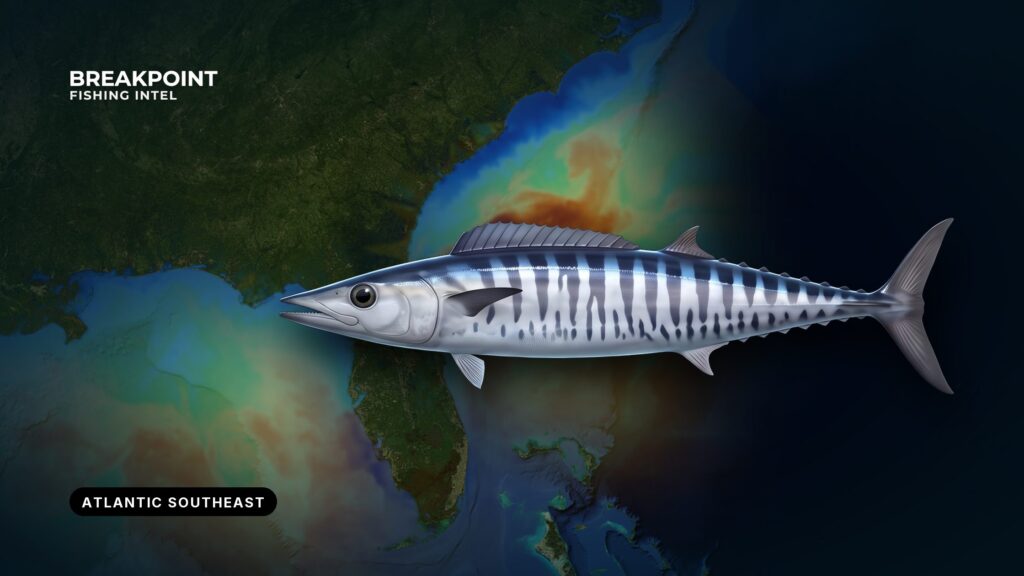
The Gulf Stream runs closer to this coast than anywhere else in the U.S., and wahoo follow its edge from Hatteras to the Keys. Fishing for them here comes down to one current and the places where it meets the bottom. This page is part of our guide to fishing the Atlantic Southeast, covering North Carolina to Florida’s east coast and the Keys. It shows where the edge, the temperature breaks and the shelf-edge structure line up so you can decide where to look, and it covers when to go, the water and structure, the methods and the rules.
Wahoo at a glance
Wahoo (Acanthocybium solandri) are long and narrow, with 25 to 30 blackish-blue vertical bars on the sides. According to the South Atlantic Fishery Management Council (SAFMC) and the North Carolina Division of Marine Fisheries (NCDMF), they are short-lived and fast-growing, and they spawn from June to August in U.S. waters. They share a federal management plan with dolphin (mahi), the Dolphin Wahoo Fishery Management Plan. Identification, growth and biology are covered in our wahoo fishing guide.
Where and when
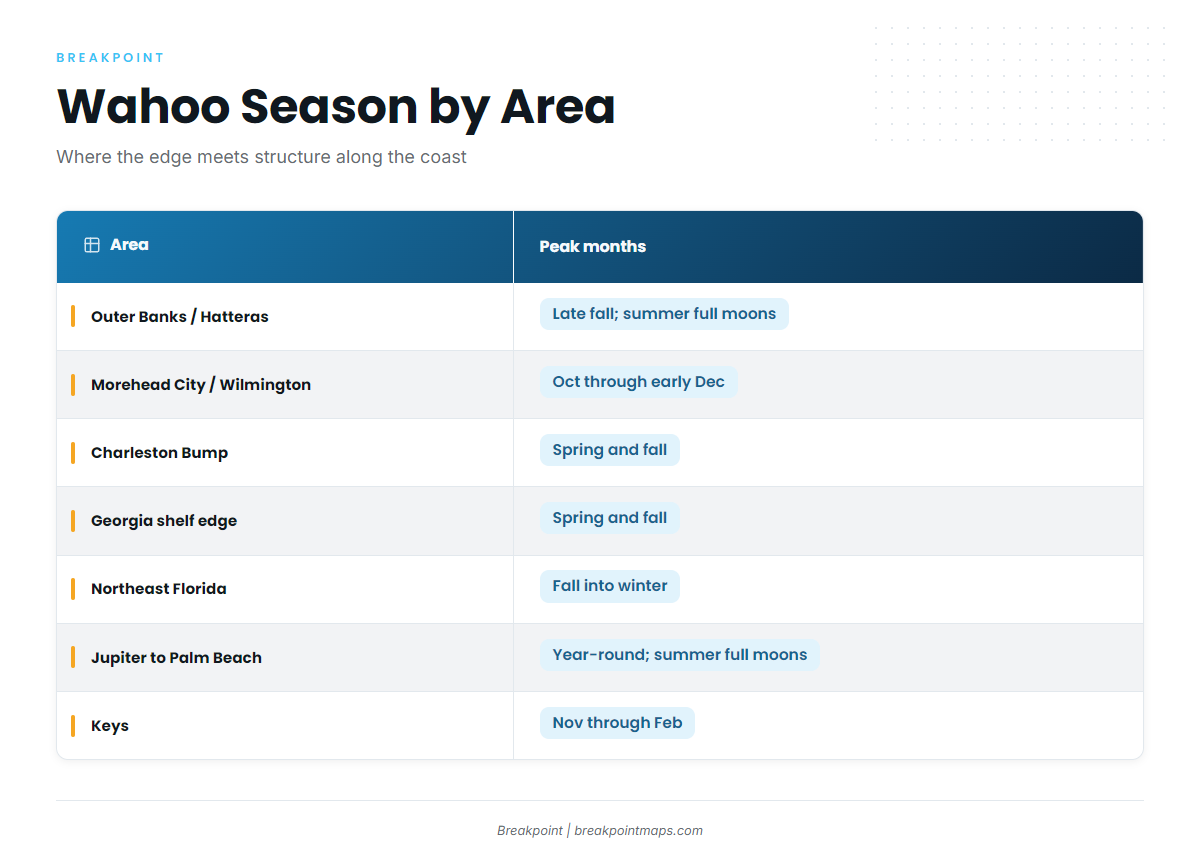
The Gulf Stream carries warm, blue water north along the shelf edge, and wahoo stay with that water. The fishery runs where the Stream comes close to the beach and where bottom structure pushes it around.
Season follows latitude:
- North Carolina and the Carolinas peak in fall, when cooler shelf water sharpens the break against the Stream. Summer full moons also produce off North Carolina.
- Northeast Florida has deep ledges that hold fish into winter.
- South Florida holds fish year-round. Winter is strongest in the Keys and the Florida Straits, and summer full moons produce off southeast Florida.
The places worth knowing, by area:
- Oregon Inlet: the Point and the Tuna Hole.
- Hatteras: the Rockpile and Big Rock.
- Off North Carolina: the Steeples and Black Jack Hole, two of the most consistent fall structures.
- Charleston Bump: deep bottom relief that deflects the Gulf Stream and spins off eddies.
- Georgia: the shelf edge.
- St. Augustine and Jacksonville: the deep ledges.
- Jupiter to Stuart, and Palm Beach to the Keys: the Stream runs close to the beach.
| Area | Key spots | Peak months | Pattern notes |
|---|---|---|---|
| Outer Banks / Hatteras | Oregon Inlet (Point, Tuna Hole), Rockpile, Big Rock | Late fall; summer full moons (July, August) | Shelf water against the Stream |
| Morehead City and Wilmington | The Steeples, Black Jack Hole | October through early December | Fall thermal edges |
| Charleston | Charleston Bump | Spring and fall | Eddies off the Bump |
| Georgia | Shelf edge | Spring and fall | Ledges under the edge |
| Northeast Florida | Deep ledges off St. Augustine and Jacksonville | Fall into winter | Structure holds fish late |
| Jupiter to Palm Beach | Jupiter to Stuart, Palm Beach | Year-round; summer full moons (July to September) | Stream runs close to the beach |
| Keys | Palm Beach to the Keys, Florida Straits | November through February | Winter is strongest |
North of Hatteras the pattern shifts; see wahoo in the Atlantic Northeast. Florida’s other coast is covered in wahoo in the Gulf of Mexico, and the Pacific fishery in wahoo in the Pacific Southwest.
Water and structure
Wahoo hold where bait stacks, and bait stacks on edges. The best water is where an edge crosses structure.
Temperature breaks and the Gulf Stream edge
Cold, green shelf water meets warm, blue Gulf Stream water and forms a sharp temperature break. Bait gathers along the seam, and wahoo patrol it. The western wall of the Stream moves daily and bends around bottom features. Look for the warm side of a sharp break along the shelf edge.
Color change, eddies and filaments
A color change between green and blue water often marks the edge, even where the temperature difference is small. Eddies and warm filaments peel off the Stream, notably near the Charleston Bump, and carry the edge onto new bottom. The Chlorophyll layer shows where that color change sits.
Weed lines and sargassum
Sargassum lines collect along current seams and hold bait. They draw dolphin first. A weed line sitting over a ledge is worth a pass at wahoo speed.
Ledges, humps and drop-offs
Even a few feet of relief can hold wahoo. The Steeples and Black Jack Hole off North Carolina, the St. Augustine and Jacksonville ledges, and the Georgia shelf edge all fit that description.
Reading it on the map
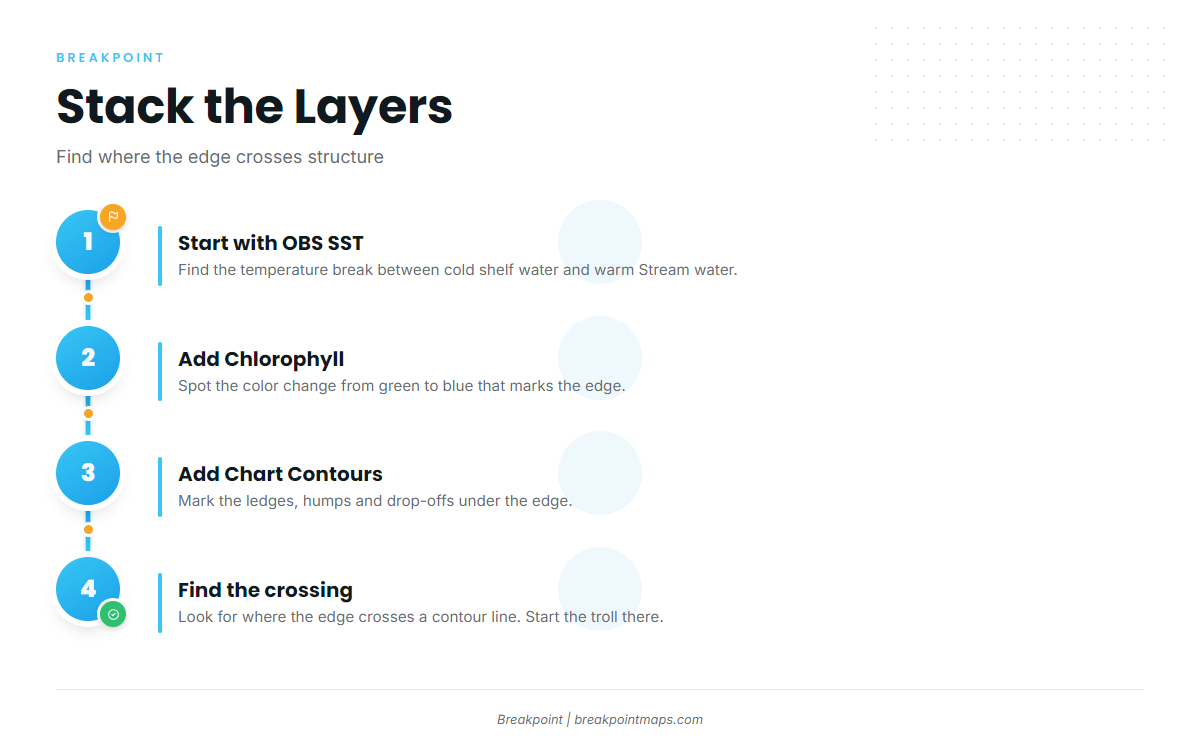
Stack the layers and look for where the edge crosses a contour line:
- OBS SST shows the temperature break.
- Chlorophyll shows the color change.
- Chart Contours shows the ledges and humps.
The layers help you decide where to start the troll. They do not promise fish, and chart layers are not for navigation.
The data has limits. Cloud cover blocks SST passes. Satellite data shows only the surface, and the surface edge is not always where the fish sit. The edge also moves daily.
How anglers fish for them here
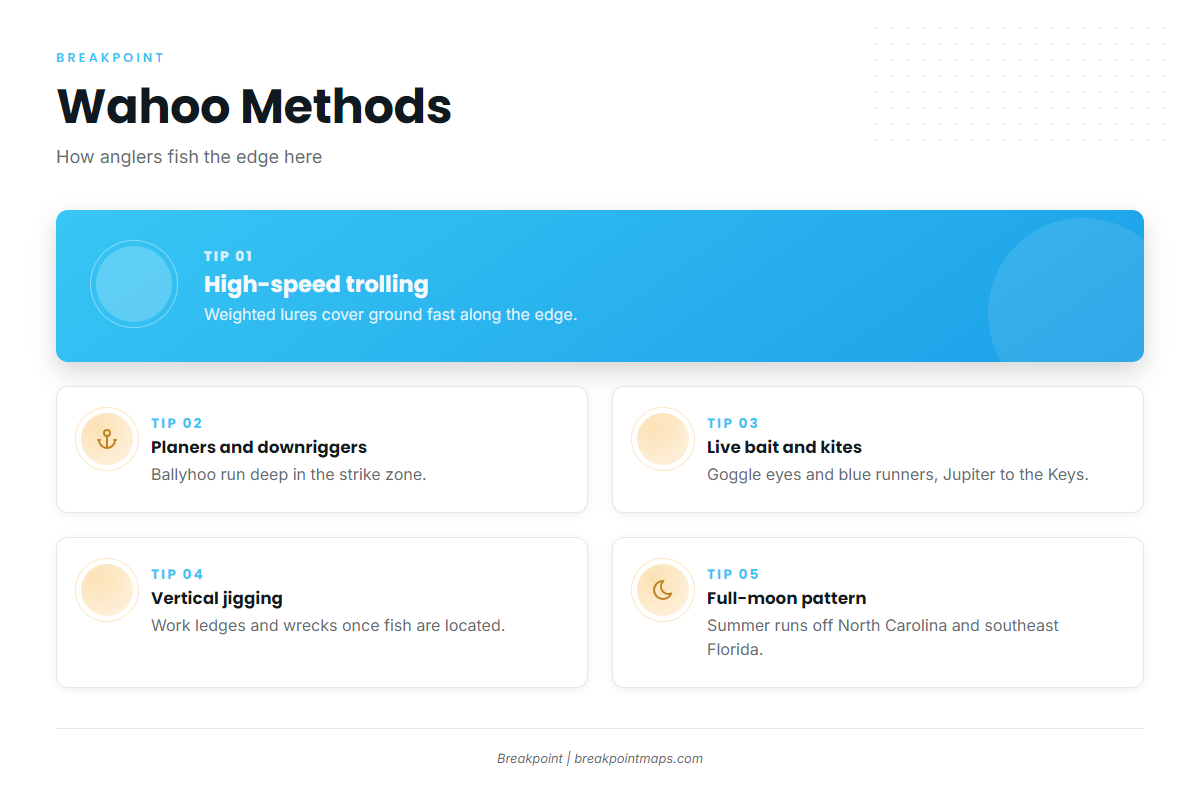
High-speed trolling
High-speed trolling covers ground fast to find fish along the edge. It runs much faster than a dolphin spread, with weighted, skirted lures built to track at speed.
Ballyhoo with planers or downriggers
Ballyhoo rigged with chuggers or skirts run behind a planer or downrigger. That puts the bait down in the strike zone where wahoo prefer to attack.
Live bait and kite fishing
This method dominates South Florida. Goggle eyes and blue runners are flown on a kite or slow-trolled around structure. It works from Jupiter through the Keys.
Vertical jigging
Vertical jigging works over structure when fish are holding on ledges or wrecks. It complements trolling once you have located fish.
Wire leader and terminal tackle
Wahoo teeth cut through most things, so the terminal end matters:
- Wire leader, because wahoo teeth cut mono.
- Strong hooks and crimps matched to the leader.
- Trolling weights or a planer to get lures down.
- A gaff ready, since wahoo are kept with head and fins intact.
Full-moon pattern
Captains fish the summer full moons off southeast Florida and North Carolina. It is a pattern, not a guarantee.
Dolphin and wahoo on one trip
Many trips target dolphin and pick up wahoo. To shift toward wahoo, speed up along the edge and work structure under the break. For other offshore gamefish, the setups change.
Before the run, check where the OBS SST break sits against Chart Contours, and whether cloud left gaps in the pass.
Guides to wahoo fishing from specific ports: Boynton Beach, Golden Isles, Carolina Beach, Charleston, Fernandina Beach, Savannah, Hatteras Village and Edisto Beach.
FAQ
When is wahoo season in the Southeast?
Wahoo are present year-round, and there is no closed federal season. Fall peaks off the Carolinas, winter is strongest in the Keys, and summer full moons produce off southeast Florida.
Where do you find wahoo off the Carolinas?
Work the Gulf Stream edge off Oregon Inlet and Hatteras, the Steeples, Black Jack Hole and the Charleston Bump. Look for temperature breaks that sit over structure, since that is where bait and wahoo stack.
Can you keep wahoo in Florida?
Yes. The limit is 2 per person per day with no minimum size, open year-round in both FWC state waters and federal waters. Check FWC before fishing for any changes.
Do charter boats need a permit?
For-hire vessels need the Atlantic Dolphin and Wahoo charter vessel/headboat permit. Private anglers need no federal permit. A vessel operator or crew member must also hold a valid operator card for the permit to be valid.
What is the difference between federal and state waters?
Federal waters run 3 to 200 nautical miles and fall under SAFMC and NOAA Fisheries. State waters run from shore to 3 nautical miles under each state’s agency. Check the state agency before fishing inside 3 miles.
Is there a size limit?
There is no federal minimum size and no Florida minimum size. Wahoo must be kept with head and fins intact. Gutting, gilling and scaling are allowed.
Do wahoo bite on the full moon?
Captains fish summer full moons off southeast Florida and North Carolina. It is a pattern worth fishing, not a guarantee, so tie it to where the edge sits that day.
How do you tell a wahoo from a king mackerel?
Wahoo have 25 to 30 blackish-blue vertical bars and a long, narrow body with a long snout. The full comparison is in our wahoo fishing guide.
How healthy is the wahoo stock?
According to NOAA Fisheries, the South Atlantic stock has not been assessed, so its status is unknown. Catch is at the recommended level, and catch limits are in place.